
Particle Physics-I
- In modern particle physics, forces are explained as interactions via exchange of particles.
- These particles are called field particles, exchange particles, or gauge bosons.
- Interaction between two particles occurs through continuous emission and absorption of field particles.
- Force is not action at a distance but mediated by particle exchange.
Four Fundamental Forces & Their Field Particles
| Force | Relative Strength | Range | Field Particle |
|---|---|---|---|
| Strong (Nuclear) | 1 | $10^{-15}\,\text{m}$ | Gluons |
| Electromagnetic | $10^{-2}$ | Infinite | Photons |
| Weak | $10^{-5}$ | $10^{-18}\,\text{m}$ | $W^\pm, Z^0$ bosons |
| Gravitational | $10^{-39}$ | Infinite | Graviton (hypothetical) |
-
Electromagnetic Interaction
- Mediated by photons which are massless and travel at the speed of light.
- Responsible for atomic structure and chemical bonding.
- It is a long-range force following the inverse-square law.
-
Strong Nuclear Interaction
- Mediated by gluons and acts between quarks inside nucleons.
- It is the strongest force with a very short range of $10^{-15}\,\text{m}$.
- Gluons bind quarks together to form protons and neutrons.
-
Weak Interaction
- Mediated by $W^+$, $W^-$, and $Z^0$ bosons.
- It has a very short range of $10^{-18}\,\text{m}$.
- Responsible for radioactive decay and particle transformations.
-
Gravitational Interaction
- Hypothetically mediated by gravitons which are predicted to be massless.
- It is a long-range but extremely weak force.
- Graviton has not been experimentally observed.
Properties of Gauge Bosons
- All field particles are bosons with integer spin and obey Bose-Einstein statistics.
- Massless bosons produce long-range forces (photon, graviton).
- Massive bosons produce short-range forces ($W, Z$).
- Photon, gluon, and $W, Z$ bosons have spin 1, while graviton is predicted to have spin 2.
All fundamental forces in nature are mediated by exchange of gauge bosons between interacting particles.
The image below shows Standard Model particles, including leptons, quarks, gauge bosons, and the Higgs boson.
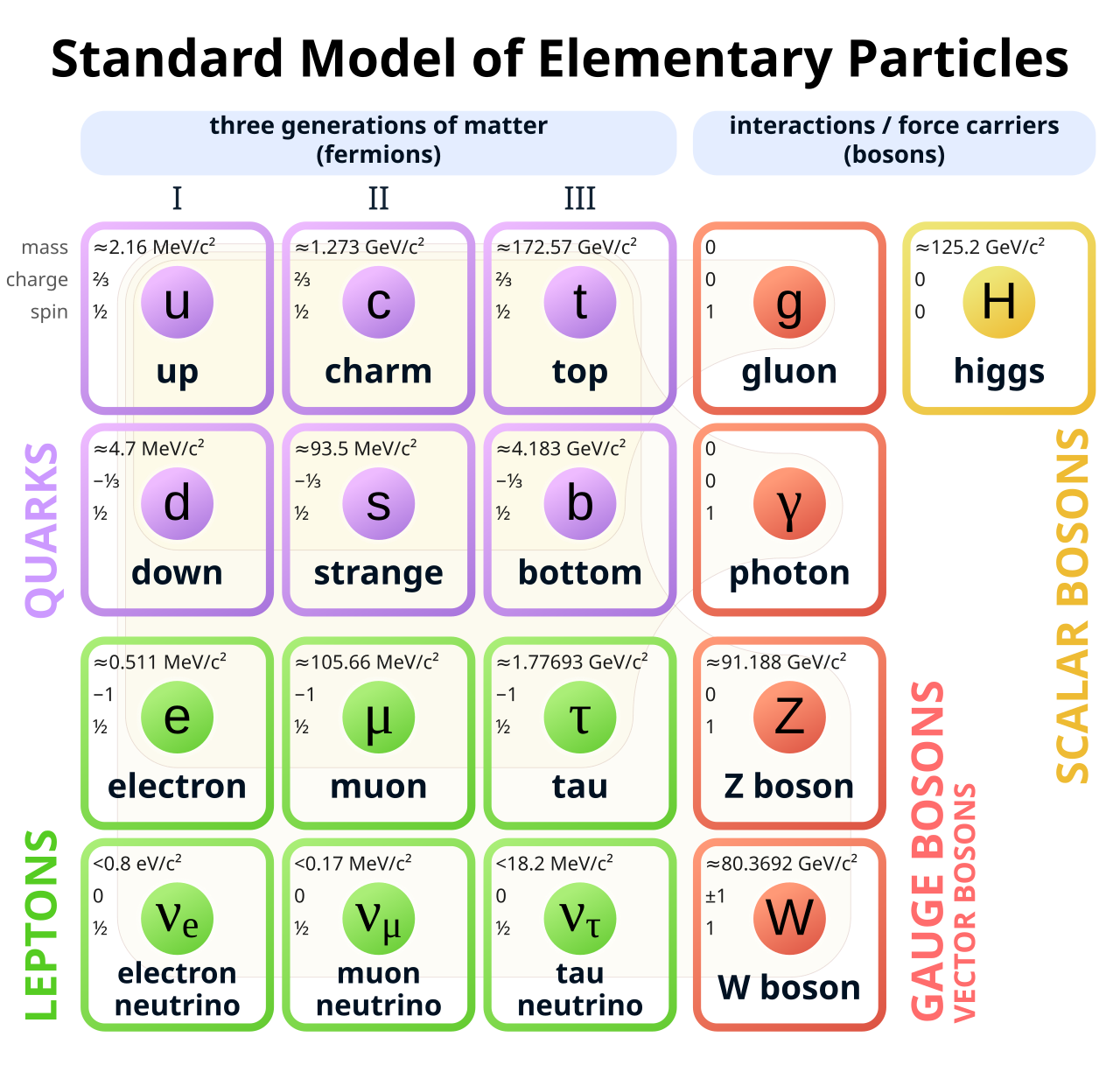
Figure 1: Standard Model of particle physics
Positrons and Antiparticles
- In relativistic quantum theory, $ \text{electron} $ behavior was explained by an equation that predicted negative energy states.
- To resolve this, all negative energy states were assumed to be filled, forming the Dirac sea.
- Due to Pauli exclusion principle, electrons in these states cannot transition further and are not observable.
- If an electron gains sufficient energy, it moves to a positive energy state, leaving behind a hole.
- This hole behaves like a particle with positive charge and same mass as electron, called a positron.
- A positron is the antiparticle of the electron.
Properties of Antiparticles
- Every particle has a corresponding antiparticle.
- Antiparticle has same mass but opposite charge.
-
Applies to both fermions and bosons (with few exceptions like photon).
- Example:
- Electron charge $ = -1.602 \times 10^{-19}\,\text{C} $
- Positron charge $ = +1.602 \times 10^{-19}\,\text{C} $
Discovery of Positron
- Positron was discovered experimentally using a cloud chamber in a magnetic field.
- Charged particles follow curved paths, and direction of curvature indicates charge.
- Positron showed curvature opposite to electron.
Pair Production
- A high-energy photon converts into an electron-positron pair near a nucleus.
- Minimum energy required: \(2 m_e c^2 = 1.02\,\text{MeV}\)
- Nucleus is required to conserve momentum.
- Excess energy appears as kinetic energy of particles.
Annihilation
- When an electron and positron meet, they annihilate each other.
- They produce two gamma photons moving in opposite directions.
- This satisfies conservation of momentum and energy.
Applications (PET Scan)
- Based on electron-positron annihilation.
- A radioactive substance emits positrons inside the body.
- Positrons annihilate with electrons producing gamma rays.
- Detection of gamma rays helps in imaging internal organs.
Every particle has a corresponding antiparticle, and their interaction leads to pair production and annihilation phenomena.
Field Particles/Gauge Bosons/Exchange Particles
-
Photons: The electromagnetic force is mediated by photons, which are particles of light and act as the messenger of this force. This force is responsible for binding electrons to the nucleus and holding matter together. Charged particles interact by exchanging virtual photons, which carry information causing attraction or repulsion depending on the charges. Photons are massless, uncharged bosons with spin $1$, are stable, and are their own antiparticles.
-
Gluons: The strong nuclear force is mediated by gluons, which act between quarks and are responsible for binding them inside protons and neutrons. Quarks carry color charges (red, green, blue), and gluons carry a combination of color and anticolor. Through gluon exchange, quarks continuously change their color while maintaining an overall neutral (white) combination. Gluons are massless, spin $1$ bosons, can interact with each other due to their color charge, and exist in eight possible combinations.
-
W and Z Bosons: The weak nuclear force is mediated by the $W^+$, $W^-$, and $Z^0$ bosons and is responsible for particle transformations such as radioactive decay. These bosons are massive, spin $1$ particles, which limits the range of the weak force. The $W^\pm$ bosons carry charge and can change the type and charge of particles, while the $Z^0$ boson is neutral and involved in processes where charge does not change. The $W^+$ and $W^-$ are antiparticles of each other, while $Z^0$ is its own antiparticle.
-
Graviton: Gravity is believed to be mediated by a hypothetical graviton, a massless spin $2$ particle not yet observed. Other predicted but unconfirmed particles include glueballs, tachyons, and supersymmetric partners, which extend beyond the current Standard Model.
Note: Higgs boson is a unique scalar particle responsible for giving mass to other particles through the Higgs mechanism, and it does not mediate a fundamental force.
Leptons
Fundamental Nature and Types of Leptons:
Leptons are fundamental particles, meaning they are not made up of smaller components. The electron is one such particle and belongs to the lepton family, which consists of six types (flavors). The term lepton refers to their relatively small mass compared to protons and neutrons. These six leptons are divided into two groups: three charged leptons (electron $e^-$, muon $\mu^-$, tau $\tau^-$) and three neutral leptons called neutrinos ($\nu_e, \nu_\mu, \nu_\tau$).
Mass and Stability of Charged Leptons:
The electron is the lightest charged lepton with mass $9.109 \times 10^{-31}\,\text{kg}$ and is stable. The muon is about $207$ times heavier than the electron and is unstable, decaying in about $2.2 \,\mu s$. The tau particle is the heaviest lepton, about $3477$ times more massive than the electron, and is highly unstable with a lifetime of $2.9 \times 10^{-13}\,s$. This shows a general trend that heavier leptons are more unstable than lighter ones.
Neutrinos and Their Weak Interaction:
Neutrinos are neutral counterparts of these charged leptons and are extremely light and stable. They interact very weakly with matter because they have no electric charge and atoms are mostly empty space. Hence, neutrinos can pass through matter almost undisturbed, with very low probability of interaction. Their masses are extremely small and not precisely known.
Spin, Fermions and Conservation Laws:
All leptons have spin $1/2$ and are therefore fermions, obeying the Pauli Exclusion Principle, which states that no two identical fermions can occupy the same quantum state simultaneously. Leptons also possess a conserved quantity called lepton number, equal to $+1$ for leptons and $0$ for non-leptons, along with separate family numbers (electron, muon, tau), which play an important role in particle interactions and decay processes.
Baryons
Quarks and Their Fundamental Properties:
Quarks are elementary particles that form the building blocks of baryons such as protons and neutrons. Like leptons, quarks are fermions with spin $1/2$ and obey the Pauli Exclusion Principle. There are six flavors of quarks: up ($u$), down ($d$), strange ($s$), charm ($c$), bottom ($b$), and top ($t$), arranged in order of increasing mass. Quarks differ from leptons in that they participate in the strong nuclear force and possess fractional electric charges of either $+2/3$ (for $u, c, t$) or $-1/3$ (for $d, s, b$). Each quark has a corresponding antiquark with the same mass but opposite charge. Quarks are never found in isolation due to their strong interaction and always exist in bound states.
Hadrons and Structure of Baryons:
Hadrons are particles composed of quarks and are divided into two categories: mesons (one quark and one antiquark) and baryons (three quarks). Baryons are specifically made of three quarks bound together by the strong force. The most common baryons are the proton and neutron. A proton ($p^+$) consists of two up quarks and one down quark ($uud$), giving a net charge of $+1$, while a neutron ($n^0$) consists of one up quark and two down quarks ($udd$), resulting in zero charge. The neutron is slightly more massive than the proton because the down quark is more massive than the up quark. Since each quark has spin $1/2$, the total spin of baryons is always a half-integer, typically $1/2$ or $3/2$, depending on how the quark spins are aligned.
Variety, Spin Configuration, and Mass of Baryons:
Different combinations of quark flavors produce a wide variety of baryons. For example, the lambda particle ($\Lambda^0$) is composed of an up, down, and strange quark, making it heavier than the neutron due to the presence of the heavier strange quark. Similarly, baryons containing charm, bottom, or top quarks are even more massive and highly unstable. The mass of a baryon cannot be determined simply by adding the masses of its constituent quarks because the binding energy between quarks also contributes significantly to the total mass. Additionally, baryons with identical quark composition can have different masses due to spin configurations. For instance, the neutron and the delta particle both contain $udd$, but the delta has all spins aligned, giving it a higher energy state and spin $3/2$, making it more massive than the neutron with spin $1/2$.
Baryon Number, Conservation Laws, and Stability:
Baryons possess a conserved quantum number called baryon number, which is $+1$ for baryons and $+1/3$ for each quark, while antibaryons and antiquarks have negative values. This conservation law ensures that the total baryon number remains constant in all particle interactions and decays. The proton is the lightest baryon and is stable, while all other baryons are unstable when isolated. A free neutron, for example, undergoes beta decay with a half-life of about $10.3$ minutes, transforming into a proton, an electron, and an antineutrino. This decay occurs because the neutron has greater mass (energy) than the resulting particles, and all conservation laws (energy, charge, baryon number, and lepton number) are satisfied. Protons cannot decay into lighter particles because no lighter baryon exists and decay into non-baryons would violate baryon number conservation.
Baryon Stability in Nuclei and General Trends:
Although free neutrons are unstable, neutrons within atomic nuclei can be stable due to binding energy, which lowers the overall energy of the system and prevents decay. The stability of nuclei depends on achieving the lowest possible energy configuration without violating conservation laws. While many baryons exist theoretically due to different quark combinations and spin arrangements, most are short-lived. The observable universe is composed primarily of protons and neutrons, as they are the most stable baryons. In general, baryons containing heavier quarks are more massive and less stable, and their study provides important insights into the strong nuclear force and fundamental structure of matter.
Mesons
Mesons and Their Intermediate Nature:
Mesons are subatomic particles with masses between leptons (like electrons) and baryons (like protons and neutrons). Unlike leptons, which are elementary, and baryons, which are made of three quarks, mesons are composed of one quark and one antiquark. They have very short lifetimes, typically lasting only a fraction of a microsecond, but they play an important role in understanding fundamental physical laws and particle interactions.
Strong Force and Color Charge in Mesons:
The strong nuclear force binds quarks together and is much stronger than the electromagnetic force at very short distances, but it has a limited range. Quarks possess a special type of charge called color charge (red, green, blue), while antiquarks have corresponding anticolors. Particles formed by quarks must be colorless. In mesons, this is achieved when a quark combines with an antiquark of the corresponding anticolor, such as red with antired, forming a neutral (colorless) particle.
Structure, Mass, and Types of Mesons:
Mesons are lighter than baryons because they contain only two constituents (one quark and one antiquark). However, their mass is not simply the sum of quark masses, as binding energy and internal motion contribute significantly. For example, the pion ($\pi^+$), made of an up quark and a down antiquark, has much less mass than expected. Mesons are named using Greek or Latin symbols such as $\pi, \rho, \eta, K, D,$ and $B$. Their properties depend on quark composition and internal energy dynamics.
Spin, Bosonic Nature, and Stability:
Mesons have integer spin (either $0$ or $1$) because they are made of two quarks whose spins combine, making them bosons. Unlike fermions, bosons do not obey the Pauli Exclusion Principle, so multiple mesons can occupy the same quantum state. All mesons are unstable and decay rapidly into lighter particles such as photons, muons, or neutrinos. Their lifetimes range from about $10^{-9}$ to $10^{-8}$ seconds, with heavier mesons decaying faster.
Antimesons and Quantum Behavior:
Since mesons are made of one quark and one antiquark, their antiparticles are also mesons with reversed quark content. For example, $\pi^+$ and $\pi^-$ are particle-antiparticle pairs. Some neutral mesons are their own antiparticles, such as those made from a quark and its own antiquark. Certain mesons, like the neutral pion ($\pi^0$), exhibit quantum behavior where their composition is indeterminate, existing as a probability mixture of different quark-antiquark pairs. This reflects the probabilistic nature of quantum mechanics.
Importance of Mesons in Physics:
Although mesons exist only briefly, they provide crucial insights into the strong force and the internal structure of baryons. Their study has helped physicists understand quark interactions, particle decay processes, and conservation laws. Mesons also demonstrate complex quantum phenomena, making them essential for advancing knowledge in particle physics.