

02 Jun 2025
Central-Force Motion and Angular Momentum
Planar motion under a central force, angular-momentum conservation, areal velocity, and centrifugal force.
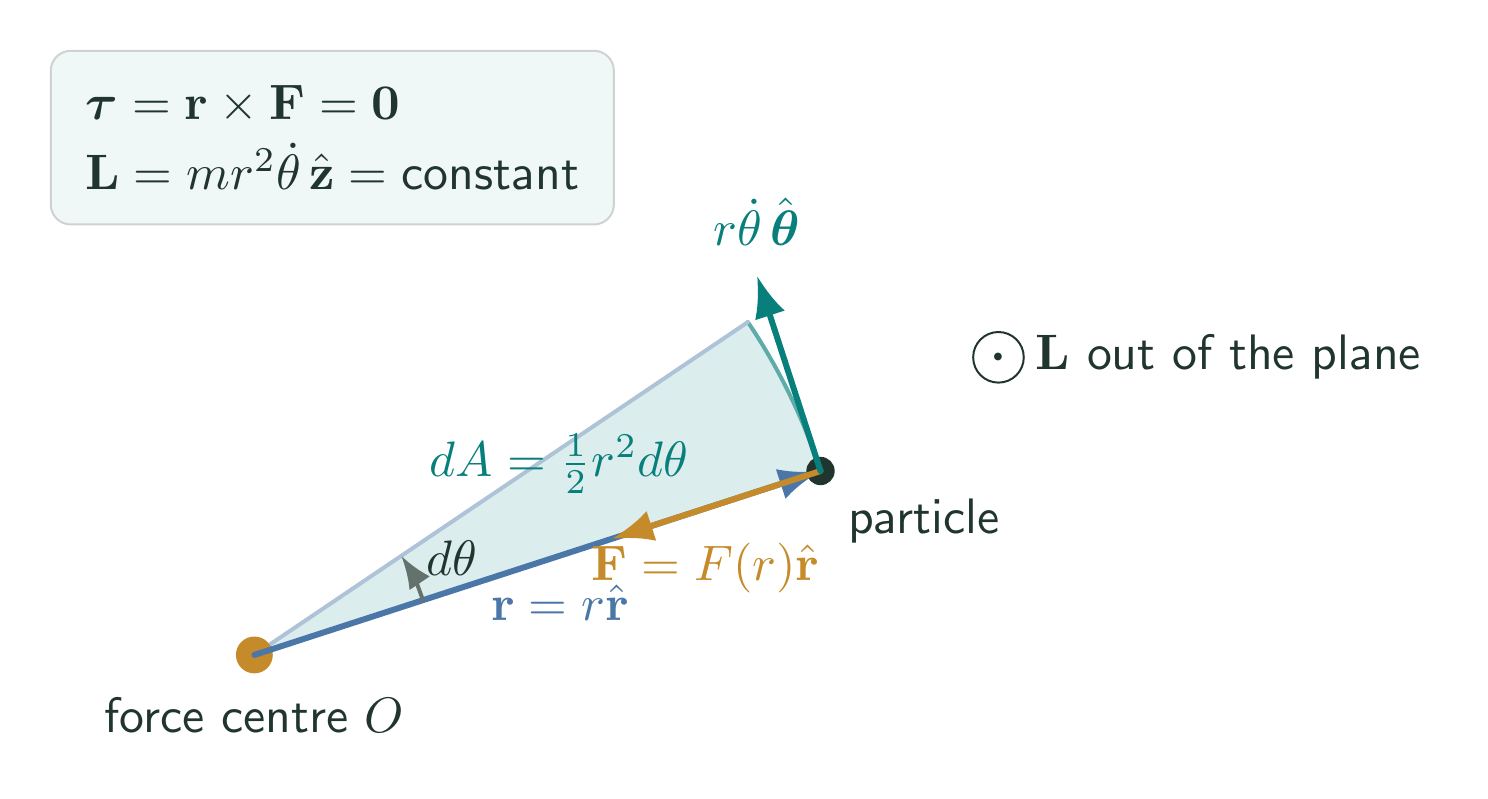
Let the fixed force centre be the origin and let $r>0$. A central force has the form
\[\mathbf F(\mathbf r)=F(r)\,\hat{\mathbf r},\]where the signed scalar $F(r)$ is positive for an outward force and negative for an inward force. Its torque about the centre is
\[\boldsymbol\tau =\mathbf r\times\mathbf F =r\hat{\mathbf r}\times F(r)\hat{\mathbf r} =\mathbf 0.\]Therefore
\[\frac{d\mathbf L}{dt}=\boldsymbol\tau=\mathbf 0, \qquad \boxed{\mathbf L=\text{constant}}.\]If $\mathbf L\ne\mathbf 0$, both $\mathbf r$ and the velocity remain in the fixed plane perpendicular to $\mathbf L$. If $\mathbf L=\mathbf 0$, the motion is purely radial along a fixed line. Thus a central-force orbit can always be treated as a plane problem.
Polar equations of motion
In the orbital plane,
\[\frac{d\hat{\mathbf r}}{dt}=\dot\theta\,\hat{\boldsymbol\theta}, \qquad \frac{d\hat{\boldsymbol\theta}}{dt}=-\dot\theta\,\hat{\mathbf r}.\]Differentiating $\mathbf r=r\hat{\mathbf r}$ once gives
\[\dot{\mathbf r}=\dot r\,\hat{\mathbf r} +r\dot\theta\,\hat{\boldsymbol\theta}.\]Differentiating again and collecting radial and transverse components gives
\[\ddot{\mathbf r} =(\ddot r-r\dot\theta^2)\hat{\mathbf r} +(r\ddot\theta+2\dot r\dot\theta)\hat{\boldsymbol\theta}.\]Since a central force has no transverse component, Newton’s law yields
\[m(\ddot r-r\dot\theta^2)=F(r),\] \[m(r\ddot\theta+2\dot r\dot\theta)=0.\]Multiplication of the transverse equation by $r$ gives
\[m\left(r^2\ddot\theta+2r\dot r\dot\theta\right) =\frac{d}{dt}\left(mr^2\dot\theta\right)=0.\]Hence the constant angular-momentum magnitude is
\[\boxed{L=mr^2\dot\theta}.\]Areal velocity
During an infinitesimal angular displacement $d\theta$, the radius vector sweeps the sector area
\[dA=\frac12r(r\,d\theta)=\frac12r^2d\theta.\]Consequently,
\[\boxed{\frac{dA}{dt}=\frac12r^2\dot\theta =\frac{L}{2m}=\text{constant}}.\]This result follows from centrality alone; it does not require an inverse-square force.
Radial energy and the centrifugal term
For a conservative central force, define the potential by
\[F(r)=-\frac{dV}{dr}.\]The mechanical energy is
\[E=\frac12m\dot r^2+\frac12mr^2\dot\theta^2+V(r).\]Using $\dot\theta=L/(mr^2)$ in the angular kinetic energy,
\[\frac12mr^2\dot\theta^2 =\frac12mr^2\left(\frac{L}{mr^2}\right)^2 =\frac{L^2}{2mr^2}.\]Thus
\[\boxed{E=\frac12m\dot r^2+V_{\rm eff}(r)}, \qquad \boxed{V_{\rm eff}(r)=V(r)+\frac{L^2}{2mr^2}}.\]The radial equation may also be rearranged as
\[m\ddot r=F(r)+mr\dot\theta^2 =F(r)+\frac{L^2}{mr^3}.\]In a frame rotating with angular velocity $\boldsymbol\Omega$, the centrifugal pseudo-force is
\[\mathbf F_{\rm cf} =-m\boldsymbol\Omega\times(\boldsymbol\Omega\times\mathbf r).\]When $\boldsymbol\Omega$ is perpendicular to the orbital plane, this becomes
\[\boxed{\mathbf F_{\rm cf}=m\Omega^2r\,\hat{\mathbf r}},\]directed outward. For a circular orbit, $\Omega=\dot\theta$ and $\ddot r=0$, so the inward central force and the outward centrifugal pseudo-force balance in the rotating description:
\[F(r)+m\Omega^2r=0.\]The centrifugal force is not a new physical interaction; it appears because the chosen frame rotates. In the inertial description, the same term is part of the radial acceleration.
Solved Problems
1. Separate radial and transverse motion at one instant
Problem. A particle of mass $2.0\ \mathrm{kg}$ is at $r=0.50\ \mathrm{m}$ with radial velocity $\dot r=-1.0\ \mathrm{m\,s^{-1}}$ and transverse velocity $v_\theta=3.0\ \mathrm{m\,s^{-1}}$. At that instant take $V(r)=0$. Find its angular momentum, areal velocity, and energy, and verify the radial-energy form.
Solution. Since $v_\theta=r\dot\theta$,
\[L=mrv_\theta =(2.0)(0.50)(3.0) =3.0\ \mathrm{kg\,m^2\,s^{-1}}.\]The areal velocity is
\[\frac{dA}{dt}=\frac{L}{2m} =\frac{3.0}{2(2.0)} =0.75\ \mathrm{m^2\,s^{-1}}.\]Directly from the two perpendicular velocity components,
\[E=\frac12m(\dot r^2+v_\theta^2) =\frac12(2.0)(1.0^2+3.0^2) =10\ \mathrm{J}.\]The effective-potential form gives the same value:
\[\frac12m\dot r^2=1\ \mathrm{J}, \qquad \frac{L^2}{2mr^2} =\frac{3.0^2}{2(2.0)(0.50)^2} =9\ \mathrm{J},\]so $E=1+9=10\ \mathrm{J}$.
Checks. $L$ has units $\mathrm{kg\,m^2\,s^{-1}}$ and $L/(2m)$ has units $\mathrm{m^2\,s^{-1}}$. The negative $\dot r$ correctly denotes inward motion but does not reverse the positive angular momentum. The energy is positive because $V=0$ at the stated point. In the limit $v_\theta\to0$, both $L$ and the swept-area rate vanish, leaving only radial kinetic energy.
2. Circular orbit in an attractive linear central force
Problem. A particle with $m=0.50\ \mathrm{kg}$ and $L=1.0\ \mathrm{kg\,m^2\,s^{-1}}$ moves under $F(r)=-kr$ with $k=8.0\ \mathrm{N\,m^{-1}}$. Find the circular-orbit radius, angular speed, energy, and radial stability.
Solution. Here $V(r)=kr^2/2$. A circular orbit requires $dV_{\rm eff}/dr=0$, or
\[kr-\frac{L^2}{mr^3}=0.\]Therefore
\[r_c=\left(\frac{L^2}{mk}\right)^{1/4} =\left(\frac{1.0^2}{(0.50)(8.0)}\right)^{1/4} =0.707\ \mathrm{m}.\]Since $r_c^2=0.50\ \mathrm{m^2}$,
\[\omega_c=\frac{L}{mr_c^2} =\frac{1.0}{(0.50)(0.50)} =4.0\ \mathrm{rad\,s^{-1}}.\]At this radius,
\[V(r_c)=\frac12kr_c^2=2.0\ \mathrm{J}, \qquad \frac{L^2}{2mr_c^2}=2.0\ \mathrm{J},\]so $E=V_{\rm eff}(r_c)=4.0\ \mathrm{J}$. Finally,
\[\left.\frac{d^2V_{\rm eff}}{dr^2}\right|_{r_c} =k+\frac{3L^2}{mr_c^4} =8.0+24.0 =32\ \mathrm{N\,m^{-1}}>0,\]which makes the circular orbit radially stable.
Checks. $L^2/(mk)$ has units $\mathrm{m^4}$, and the fourth root is a length. The inward force $-kr\hat{\mathbf r}$ is balanced by the positive centrifugal term. Also $\omega_c=\sqrt{k/m}=4.0\ \mathrm{rad\,s^{-1}}$, an independent check. As $L\to0$, $r_c\to0$ and the finite-radius circular orbit collapses.
Descriptive Questions
- Starting from $\boldsymbol\tau=\mathbf r\times\mathbf F$, prove that a central-force orbit is planar and state separately what happens when $\mathbf L=\mathbf0$.
- Derive the radial and transverse equations of motion in plane polar coordinates and hence obtain constant areal velocity.
- Derive the one-dimensional radial energy equation and explain the origin of the term $L^2/(2mr^2)$ in the effective potential.
- Distinguish the inertial-frame radial equation from the rotating-frame centrifugal pseudo-force, including the direction and sign convention of each term.
Numerical Problems
-
At $\mathbf r=(3\hat{\mathbf i}+4\hat{\mathbf j})\ \mathrm{m}$, a central force is $\mathbf F=(-6\hat{\mathbf i}-8\hat{\mathbf j})\ \mathrm{N}$. Calculate its torque about the origin.
Final answer: $\boldsymbol\tau=\mathbf0\ \mathrm{N\,m}$.
-
A $0.50\ \mathrm{kg}$ particle has $\mathbf r=(0.60\hat{\mathbf i}+0.80\hat{\mathbf j})\ \mathrm{m}$ and $\mathbf v=(-2.0\hat{\mathbf i}+1.5\hat{\mathbf j})\ \mathrm{m\,s^{-1}}$. Find $\mathbf L$.
Final answer: $\mathbf L=1.25\hat{\mathbf k}\ \mathrm{kg\,m^2\,s^{-1}}$.
-
A particle of mass $1.2\ \mathrm{kg}$ has constant angular momentum $2.4\ \mathrm{kg\,m^2\,s^{-1}}$. How long does its radius vector take to sweep $3.0\ \mathrm{m^2}$?
Final answer: $3.0\ \mathrm{s}$.
-
For $V(r)=-(18\ \mathrm{J\,m})/r$, $m=2.0\ \mathrm{kg}$, and $L=4.0\ \mathrm{kg\,m^2\,s^{-1}}$, evaluate $V_{\rm eff}$ at $r=2.0\ \mathrm{m}$.
Final answer: $V_{\rm eff}=-8.0\ \mathrm{J}$.
-
A $0.30\ \mathrm{kg}$ body is observed in a frame rotating at $4.0\ \mathrm{rad\,s^{-1}}$. At perpendicular distance $0.50\ \mathrm{m}$ from the axis, find the centrifugal force.
Final answer: $2.4\ \mathrm{N}$, radially outward.
-
At $r=3.0\ \mathrm{m}$, a $2.0\ \mathrm{kg}$ particle has $L=6.0\ \mathrm{kg\,m^2\,s^{-1}}$ and experiences $F(r)=-30\ \mathrm{N}$. Find $\ddot r$.
Final answer: $\ddot r=-44/3\ \mathrm{m\,s^{-2}}\simeq-14.7\ \mathrm{m\,s^{-2}}$, inward.
The identities and all eight worked answers are independently checked in the Maxima worksheet; every printed residual or check is zero.
References
- Central force — Wikipedia.
- John R. Taylor, Classical Mechanics, University Science Books (2005), Chapters 8–9.
- Herbert Goldstein, Charles Poole, and John Safko, Classical Mechanics, 3rd ed., Addison-Wesley (2002), Chapter 3.


Discussion