

10 Jun 2025
Circular Satellites and Applications
Orbital speed, period, energy, altitude, geostationary condition, and weightlessness for circular satellites.
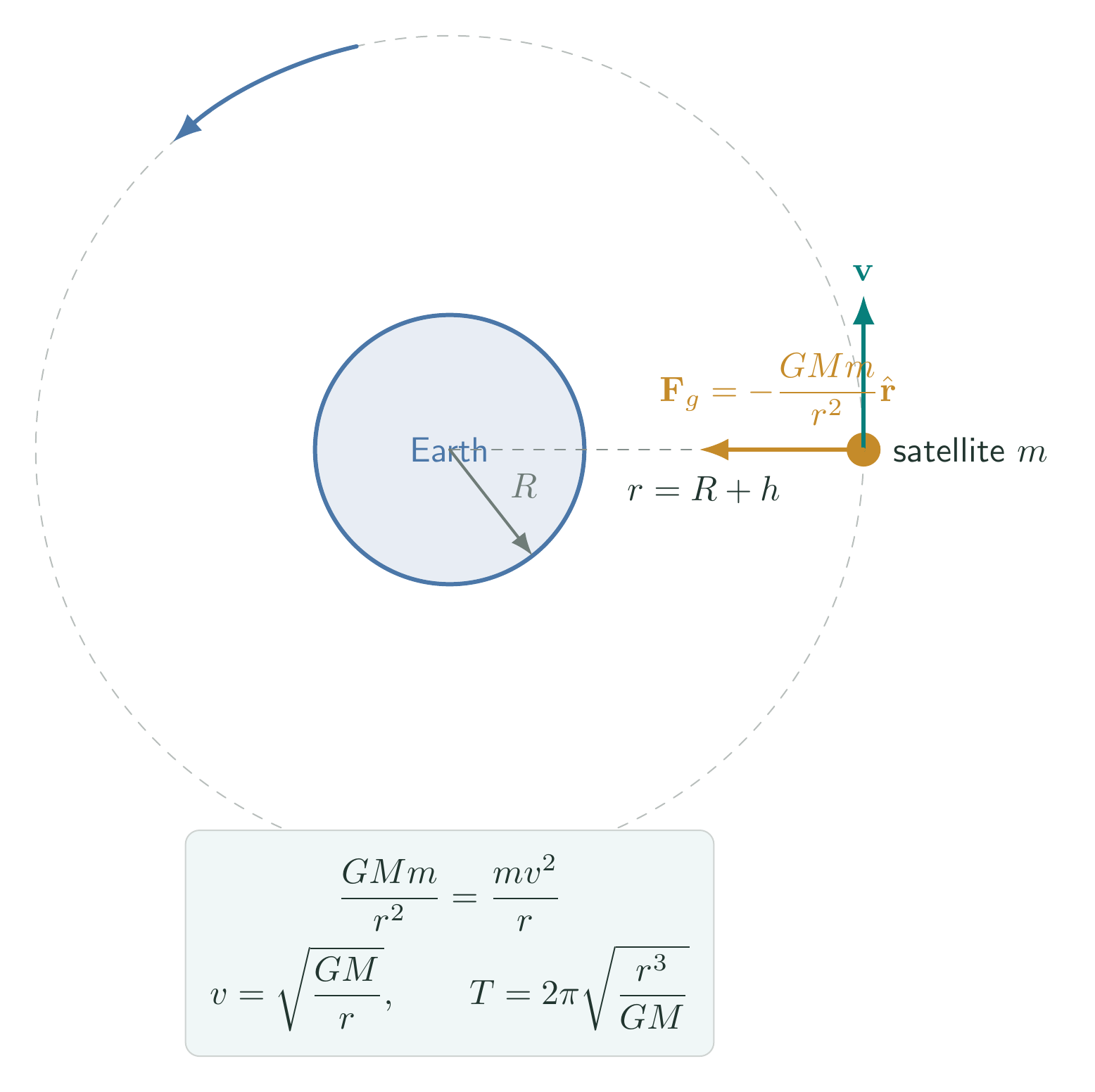
Consider a satellite of mass $m$ in a circular orbit outside a spherical Earth of mass $M$ and radius $R$. If its altitude is $h$, the distance from the Earth’s centre is
\[r=R+h.\]Neglecting atmospheric drag and other perturbations, gravity is the only force. Both the gravitational force and the centripetal acceleration point inward, so their magnitudes obey
\[\frac{GMm}{r^2}=m\frac{v^2}{r}.\]Cancelling $m/r$ gives the orbital speed
\[\boxed{v=\sqrt{\frac{GM}{r}}}.\]Thus the speed is independent of satellite mass. Since $v=r\omega$,
\[\omega=\frac vr=\sqrt{\frac{GM}{r^3}}.\]Using $T=2\pi/\omega$,
\[\boxed{T=2\pi\sqrt{\frac{r^3}{GM}}}, \qquad \boxed{T^2=\frac{4\pi^2}{GM}r^3}.\]This is Kepler’s third law for a circular orbit.
Energy of a circular satellite
From $v^2=GM/r$, the kinetic energy is
\[K=\frac12mv^2=\frac{GMm}{2r}.\]Taking gravitational potential energy to be zero at infinity,
\[U=-\frac{GMm}{r}.\]Therefore
\[\boxed{E=K+U=-\frac{GMm}{2r}}.\]The negative total energy shows that the circular orbit is bound.
Period, radius, and altitude
Solving the period equation for the orbit radius gives
\[T^2=\frac{4\pi^2r^3}{GM} \quad\Longrightarrow\quad \boxed{r=\left(\frac{GMT^2}{4\pi^2}\right)^{1/3}}.\]Hence the required altitude is
\[\boxed{h=\left(\frac{GMT^2}{4\pi^2}\right)^{1/3}-R}.\]Applications
A geostationary satellite must
- have the Earth’s sidereal rotation period $T_{\rm E}$,
- move in a circular orbit in the equatorial plane, and
- revolve in the same sense as the Earth’s rotation.
Its angular speed then equals $\Omega_{\rm E}=2\pi/T_{\rm E}$, so
\[\boxed{r_{\rm geo}=\left(\frac{GM}{\Omega_{\rm E}^2}\right)^{1/3}}, \qquad \boxed{h_{\rm geo}=r_{\rm geo}-R}.\]It remains above the same longitude and is therefore useful for continuous communication and weather observation over a fixed region.
A polar satellite has an orbital plane passing nearly through the Earth’s poles. As the Earth rotates beneath that plane, successive passes cover different surface strips; this is useful for mapping and remote sensing. Circular-orbit speed and period relations also determine the operating orbits of navigation satellites.
An astronaut in an orbiting spacecraft appears weightless because astronaut and spacecraft have the same inward acceleration $GM/r^2$. They are in continuous free fall together, so the cabin supplies essentially no normal reaction. Gravity is not zero at the orbit.
Solved Problems
In the following problems use Earth’s gravitational parameter
\[\mu=GM=3.986004418\times10^{14}\ \mathrm{m^3\,s^{-2}}\]and mean radius $R=6.371\times10^6\ \mathrm{m}$.
1. A low-Earth circular orbit
Problem. Find the speed, period, and specific orbital energy of a satellite at altitude $400\ \mathrm{km}$.
Solution. The distance from Earth’s centre is
\[r=R+h=6.371\times10^6+0.400\times10^6 =6.771\times10^6\ \mathrm{m}.\]The circular speed is
\[v=\sqrt{\frac{\mu}{r}} =\sqrt{\frac{3.986004418\times10^{14}}{6.771\times10^6}} =7.673\times10^3\ \mathrm{m\,s^{-1}}.\]The period is
\[T=2\pi\sqrt{\frac{r^3}{\mu}} =5.545\times10^3\ \mathrm{s} =92.4\ \mathrm{min}.\]The total energy per unit satellite mass is
\[\varepsilon=\frac{E}{m}=-\frac{\mu}{2r} =-2.943\times10^7\ \mathrm{J\,kg^{-1}}.\]Checks. $\mu/r$ has units $\mathrm{m^2\,s^{-2}}$, $r^3/\mu$ has units $\mathrm{s^2}$, and $\varepsilon$ has units $\mathrm{J\,kg^{-1}}$. The negative energy correctly identifies a bound orbit. The speed is tangential while gravity is inward, so their directions are perpendicular. As $r\to\infty$, both $v$ and $\varepsilon$ tend to zero.
2. The geostationary radius
Problem. Using the sidereal day $T_{\rm E}=86164\ \mathrm{s}$, find the geostationary radius, altitude, and speed.
Solution. Kepler’s circular period relation gives
\[r_{\rm geo} =\left(\frac{\mu T_{\rm E}^2}{4\pi^2}\right)^{1/3} =4.2164\times10^7\ \mathrm{m}.\]Thus
\[h_{\rm geo}=r_{\rm geo}-R =3.5793\times10^7\ \mathrm{m} =35793\ \mathrm{km}.\]The orbital speed is
\[v_{\rm geo}=\sqrt{\frac{\mu}{r_{\rm geo}}} =3.075\times10^3\ \mathrm{m\,s^{-1}}.\]Checks. The cube-root argument has units $\mathrm{m^3}$, and subtracting $R$ from $r_{\rm geo}$ leaves a positive altitude. Substitution into $2\pi r/v$ returns $86164\ \mathrm{s}$. The numerical radius alone is not sufficient for geostationarity: the orbit must also be circular, equatorial, and prograde. In the limit of a longer rotation period, $r_{\rm geo}\propto T_{\rm E}^{2/3}$ increases.
Descriptive Questions
- Derive the speed, angular speed, and period of a circular satellite directly from Newton’s law of gravitation.
- Derive the kinetic, potential, and total energies of a circular satellite and explain the sign of the total energy.
- State and justify every condition required for a satellite to be geostationary.
- Explain the coverage advantage of a polar satellite and why an astronaut in orbit is weightless even though gravity is not zero.
Numerical Problems
Use the same values of $\mu$ and $R$ as above.
-
A circular satellite moves at $7.50\ \mathrm{km\,s^{-1}}$. Find its orbital radius and altitude.
Final answer: $r=7.086\times10^6\ \mathrm{m}$ and $h=7.152\times10^5\ \mathrm{m}\simeq715\ \mathrm{km}$.
-
Find the specific angular momentum $h_s=rv$ of a circular orbit of radius $9.00\times10^6\ \mathrm{m}$.
Final answer: $h_s=\sqrt{\mu r}=5.989\times10^{10}\ \mathrm{m^2\,s^{-1}}$.
-
Circular satellite B orbits at radius $1.80\times10^7\ \mathrm{m}$, while satellite A orbits at radius $8.00\times10^6\ \mathrm{m}$. Find $T_B/T_A$ and $v_B/v_A$ without first evaluating either period or speed.
Final answer: $T_B/T_A=(r_B/r_A)^{3/2}=27/8=3.375$ and $v_B/v_A=(r_A/r_B)^{1/2}=2/3\simeq0.6667$; both ratios are dimensionless.
-
A $500\ \mathrm{kg}$ satellite is moved from one circular orbit of radius $7.00\times10^6\ \mathrm{m}$ to another of radius $1.40\times10^7\ \mathrm{m}$. Find the increase in orbital energy, ignoring transfer-path details.
Final answer: $\Delta E=7.118\times10^9\ \mathrm{J}$.
-
At $r=8.00\times10^6\ \mathrm{m}$, find Earth’s gravitational acceleration and the cabin’s normal force on an $80\ \mathrm{kg}$ freely orbiting astronaut.
Final answer: $g(r)=6.228\ \mathrm{m\,s^{-2}}$ inward, gravitational force $498.3\ \mathrm{N}$ inward, and normal force $0\ \mathrm{N}$.
-
During a $6000\ \mathrm{s}$ polar orbit, through what angle does Earth rotate beneath the approximately fixed orbital plane? Use a sidereal day of $86164\ \mathrm{s}$.
Final answer: $360^\circ(6000/86164)=25.07^\circ$.
The orbital identities and all eight worked answers are independently checked in the Maxima worksheet; every printed residual or check is zero.
References
- Circular orbit — Wikipedia.
- OpenStax, University Physics Volume 1, Section 13.4: Satellite Orbits and Energy.
- John R. Taylor, Classical Mechanics, University Science Books (2005), Chapter 8.


Discussion