

08 May 2025
Compressible Capillary Flow and Rankine's Method
For an incompressible liquid, the volume rate is the same at every cross-section. A gas expands as its pressure falls, so its local volume rate changes even though the mass rate remains constant.
Isothermal flow of a gas through a capillary
Consider steady, laminar flow through a capillary of radius $a$ and length $l$. Let the absolute pressures at the inlet and outlet be $p_1$ and $p_2$, with $p_1>p_2$. At position $x$, write the pressure as $p(x)$ and the local volume rate as $Q(x)$.
Mass conservation requires
\[\dot m=\rho Q=\text{constant}.\]For an ideal gas flowing isothermally, $\rho/p$ is constant. Consequently,
\[pQ=C,\]where $C$ is constant along the tube.
Apply the local Poiseuille relation to an element $dx$:
\[Q=-\frac{\pi a^4}{8\eta}\frac{dp}{dx}.\]Substituting $Q=C/p$ gives
\[\frac{C}{p}=-\frac{\pi a^4}{8\eta}\frac{dp}{dx},\]or
\[C\,dx=-\frac{\pi a^4}{8\eta}p\,dp.\]Integrating from $(0,p_1)$ to $(l,p_2)$,
\[\begin{aligned} Cl &=-\frac{\pi a^4}{8\eta}\int_{p_1}^{p_2}p\,dp\\ &=\frac{\pi a^4}{16\eta}(p_1^2-p_2^2). \end{aligned}\]Therefore
\[\boxed{ C=pQ =\frac{\pi a^4(p_1^2-p_2^2)}{16\eta l} }.\]If $Q_2$ is measured at the outlet pressure $p_2$, then $C=p_2Q_2$ and
\[\boxed{ Q_2=\frac{\pi a^4(p_1^2-p_2^2)}{16\eta lp_2} }, \qquad \boxed{ \eta=\frac{\pi a^4(p_1^2-p_2^2)}{16lp_2Q_2} }.\]Both $p_1$ and $p_2$ must be absolute pressures. A manometer reading supplies only their difference, so atmospheric pressure must be included before using this equation.
Let
\[p_m=\frac{p_1+p_2}{2}, \qquad \Delta p=p_1-p_2.\]The volume rate referred to the mean pressure is $Q_m=C/p_m$. Since $p_1^2-p_2^2=2p_m\Delta p$,
\[\boxed{Q_m=\frac{\pi a^4\Delta p}{8\eta l}}.\]Thus the familiar incompressible form is recovered when the gas rate is stated at the mean pressure. If the outlet rate $Q_2$ is used and $\Delta p\ll p_2$, then
\[Q_2=\frac{\pi a^4\Delta p}{8\eta l} \left(1+\frac{\Delta p}{2p_2}\right) \simeq\frac{\pi a^4\Delta p}{8\eta l}.\]Rankine’s gas viscometer
Rankine’s apparatus is a closed glass loop. One limb is a fine capillary and the other is a wider, nearly uniform fall tube. A mercury pellet seals the wide limb and acts as a moving piston.
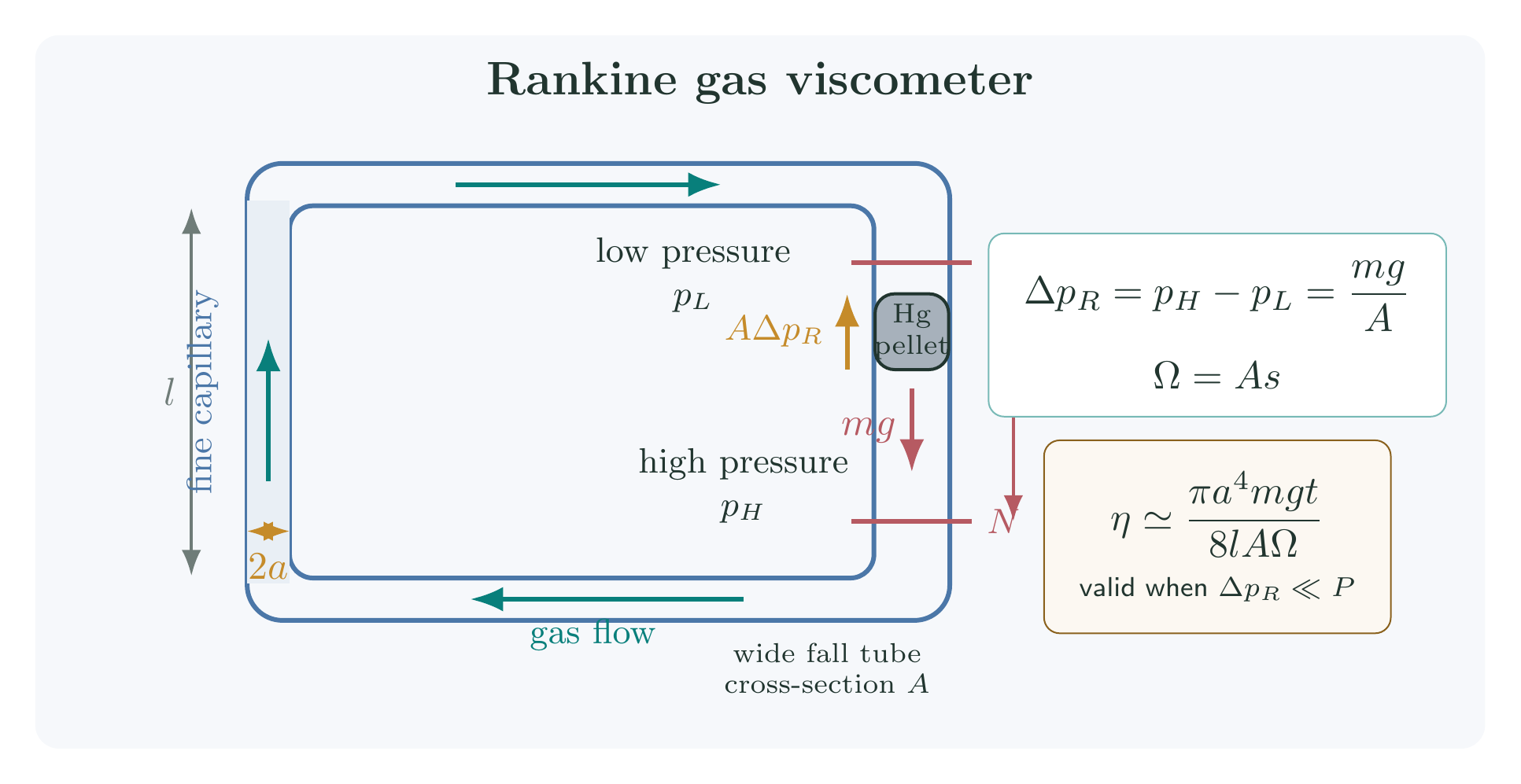
Let the capillary have radius $a$ and length $l$, the fall tube have cross-sectional area $A$, and the pellet have mass $m$. When the instrument is vertical, the pellet descends and forces gas from its lower side through the capillary to its upper side. Neglecting pellet-wall resistance and the weight of the gas, force balance on the pellet gives the nearly constant pressure difference
\[mg=A\Delta p_R, \qquad \boxed{\Delta p_R=p_H-p_L=\frac{mg}{A}}.\]The closed-loop gas is compressible, so the swept volume divided by time is not, in general, the gas volume rate at one fixed pressure. Let $V$ be the total gas volume, neglecting the small capillary volume, and let $P$ be the uniform pressure when the apparatus is horizontal. At an instant during the fall, let $V_L$ be the volume above the pellet and $V_H=V-V_L$ the volume below it. Isothermal conservation of the enclosed gas gives
\[p_LV_L+p_HV_H=PV, \qquad p_H-p_L=\Delta p_R.\]Solving these equations,
\[p_L=P-\Delta p_R+\frac{\Delta p_R}{V}V_L, \qquad p_H=P+\frac{\Delta p_R}{V}V_L.\]Thus both chamber pressures change as the pellet moves, although their difference stays constant. The pressure-volume throughput through the capillary is
\[\mathcal C=p_LQ_L=p_HQ_H =\frac{\pi a^4(p_H^2-p_L^2)}{16\eta l}.\]Meanwhile, the pressure-volume content above the pellet increases at the rate
\[\mathcal C=\frac{d(p_LV_L)}{dt} =\left(P-\Delta p_R+\frac{2\Delta p_RV_L}{V}\right) \frac{dV_L}{dt}.\]Using $p_H^2-p_L^2=\Delta p_R(p_H+p_L)$ therefore gives
\[dt=\frac{16\eta l}{\pi a^4\Delta p_R} \frac{P-\Delta p_R+2\Delta p_RV_L/V} {2P-\Delta p_R+2\Delta p_RV_L/V}\,dV_L.\]If the timed fall changes $V_L$ from $V_a$ to $V_b$, define
\[\mathcal I=(V_b-V_a) -\frac{PV}{2\Delta p_R} \ln\!\left[ \frac{2P-\Delta p_R+2\Delta p_RV_b/V} {2P-\Delta p_R+2\Delta p_RV_a/V} \right].\]The exact ideal-gas result is then
\[\boxed{ \eta=\frac{\pi a^4\Delta p_R\,t}{16l\mathcal I} }.\]For $\Delta p_R\ll P$, $\mathcal I\simeq(V_b-V_a)/2$. If the calibrated swept volume is $\Omega=V_b-V_a=As$, this reduces to the commonly quoted approximation
\[\boxed{ \eta\simeq\frac{\pi a^4mgt}{8lA\Omega} \qquad(\Delta p_R\ll P) }.\]In practice, mercury surface tension and contact with the fall tube alter the effective driving pressure. The same instrument is therefore often calibrated with a reference gas of known viscosity $\eta_0$. With the same pellet, geometry, marks, equilibrium pressure and temperature, all factors except $\eta$ and $t$ are unchanged, so
\[\boxed{\frac{\eta}{\eta_0}=\frac{t}{t_0}}.\]The instrument is inverted to return the pellet above the first mark and repeat the timing. The editable apparatus diagram is available as a TikZ file.
Mass rate and limits of the capillary model
For an ideal gas,
\[\rho=\frac{p}{R_sT},\]where $R_s$ is the specific gas constant. Since $C=pQ$, the invariant mass rate is
\[\boxed{ \dot m=\rho Q=\frac{C}{R_sT} =\frac{\pi a^4(p_1^2-p_2^2)}{16\eta lR_sT} }.\]This expression makes the distinction between a conserved mass rate and a pressure-dependent volume rate explicit. The model assumes steady continuum flow, a constant viscosity, an ideal gas at uniform temperature, no slip, and a long tube with fully developed laminar motion. At very low pressures, molecular slip invalidates the no-slip assumption; large pressure drops can also introduce appreciable temperature change, density-dependent viscosity and entrance corrections.
Solved Problems
1. Outlet rate, inlet rate and mass rate of air
Air at $T=300\ \mathrm{K}$ flows isothermally through a capillary with $a=0.150\ \mathrm{mm}$, $l=0.500\ \mathrm{m}$ and $\eta=1.80\times10^{-5}\ \mathrm{Pa\,s}$. The absolute pressures are $p_1=150\ \mathrm{kPa}$ and $p_2=100\ \mathrm{kPa}$. Take $R_s=287\ \mathrm{J\,kg^{-1}K^{-1}}$. Find $C$, the inlet and outlet volume rates, and the mass rate.
The pressure-volume throughput is
\[\begin{aligned} C &=\frac{\pi(0.150\times10^{-3})^4 [(150\times10^3)^2-(100\times10^3)^2]} {16(1.80\times10^{-5})(0.500)}\\ &=0.1381\ \mathrm{Pa\,m^3\,s^{-1}}. \end{aligned}\]Therefore
\[Q_1=\frac{C}{p_1} =9.204\times10^{-7}\ \mathrm{m^3\,s^{-1}},\] \[Q_2=\frac{C}{p_2} =1.381\times10^{-6}\ \mathrm{m^3\,s^{-1}}.\]The conserved mass rate is
\[\dot m=\frac{C}{R_sT} =\frac{0.1381}{(287)(300)} =1.603\times10^{-6}\ \mathrm{kg\,s^{-1}}.\]Thus
\[\boxed{ Q_1=9.204\times10^{-7}\ \mathrm{m^3\,s^{-1}},\quad Q_2=1.381\times10^{-6}\ \mathrm{m^3\,s^{-1}},\quad \dot m=1.603\times10^{-6}\ \mathrm{kg\,s^{-1}}}.\]The outlet volume rate is larger because the gas is less dense there. The checks $p_1Q_1=p_2Q_2=C$ and $Q_2/Q_1=p_1/p_2=1.50$ confirm both sign and pressure referencing.
2. Exact Rankine reduction and its small-pressure approximation
In a Rankine viscometer, let $P=100\ \mathrm{kPa}$, $\Delta p_R=10.0\ \mathrm{kPa}$ and $V=100\ \mathrm{cm^3}$. During a $50.0\ \mathrm{s}$ timing, $V_L$ changes from $V_a=20.0\ \mathrm{cm^3}$ to $V_b=60.0\ \mathrm{cm^3}$. The capillary has $a=0.200\ \mathrm{mm}$ and $l=0.400\ \mathrm{m}$. Find $\eta$ from the exact ideal-gas expression and compare it with the small-$\Delta p_R/P$ result.
Using SI volumes in the exact integral,
\[\begin{aligned} \mathcal I &=(V_b-V_a)-\frac{PV}{2\Delta p_R} \ln\!\left[ \frac{2P-\Delta p_R+2\Delta p_RV_b/V} {2P-\Delta p_R+2\Delta p_RV_a/V} \right]\\ &=1.9795\times10^{-5}\ \mathrm{m^3}. \end{aligned}\]Consequently,
\[\begin{aligned} \eta &=\frac{\pi a^4\Delta p_Rt}{16l\mathcal I}\\ &=1.9838\times10^{-5}\ \mathrm{Pa\,s}. \end{aligned}\]The approximation $\mathcal I\simeq(V_b-V_a)/2$ instead gives
\[\eta_{\rm small} =\frac{\pi a^4\Delta p_Rt}{8l(V_b-V_a)} =1.9635\times10^{-5}\ \mathrm{Pa\,s}.\]Thus
\[\boxed{\eta=1.9838\times10^{-5}\ \mathrm{Pa\,s}},\]while the approximation is $1.02\%$ low. Here $\Delta p_R/P=0.100$, so a detectable correction is reasonable. The chamber pressures remain positive throughout the timed interval, as required for the ideal-gas calculation.
Descriptive Questions
- Derive the isothermal capillary-flow relation $pQ=\pi a^4(p_1^2-p_2^2)/(16\eta l)$ from mass conservation and the local Poiseuille law.
- Explain why both end pressures must be absolute and why the reported volume rate must include its reference pressure.
- Describe the construction and operation of Rankine’s gas viscometer, including the function of the mercury pellet.
- Derive the exact Rankine timing integral and identify the assumptions required for the time-ratio calibration method.
Numerical Problems
-
A gas with $\eta=1.80\times10^{-5}\ \mathrm{Pa\,s}$ leaves a capillary of radius $0.100\ \mathrm{mm}$ and length $0.400\ \mathrm{m}$ at $p_2=100\ \mathrm{kPa}$ with $Q_2=1.200\times10^{-7}\ \mathrm{m^3\,s^{-1}}$. Find $p_1$.
Final answer: $p_1=120.0\ \mathrm{kPa}$ absolute.
-
A capillary has $a=0.120\ \mathrm{mm}$ and $l=0.500\ \mathrm{m}$. Between $p_1=130\ \mathrm{kPa}$ and $p_2=100\ \mathrm{kPa}$, it delivers $80.0\ \mathrm{cm^3}$ at the outlet in $120\ \mathrm{s}$. Find the gas viscosity.
Final answer: $\eta=8.43\times10^{-6}\ \mathrm{Pa\,s}$.
-
The absolute end pressures are $160\ \mathrm{kPa}$ and $80.0\ \mathrm{kPa}$. Find the ratio of inlet to outlet volume rates.
Final answer: $Q_1/Q_2=p_2/p_1=0.500$.
-
A closed Rankine viscometer contains a total gas volume $V=120\ \mathrm{cm^3}$ at equilibrium pressure $P=100\ \mathrm{kPa}$. When upright, the mercury pellet maintains $\Delta p_R=8.00\ \mathrm{kPa}$ and the low-pressure chamber has volume $V_L=45.0\ \mathrm{cm^3}$. Find the two chamber pressures.
Final answer: $p_L=95.0\ \mathrm{kPa}$ and $p_H=103.0\ \mathrm{kPa}$, both absolute.
-
A reference gas of viscosity $1.80\times10^{-5}\ \mathrm{Pa\,s}$ takes $40.0\ \mathrm{s}$ between the marks of a Rankine viscometer. An unknown gas takes $55.0\ \mathrm{s}$ under identical conditions. Find its viscosity.
Final answer: $\eta=2.475\times10^{-5}\ \mathrm{Pa\,s}$.
-
For $p_2=100\ \mathrm{kPa}$ and $p_1-p_2=20.0\ \mathrm{kPa}$, by what percentage does the exact outlet rate exceed the incompressible-rate estimate?
Final answer: $10.0\%$ of the incompressible estimate.
The pressure integration, exact timing integral, limiting form and all numerical answers are checked in the Unit I Maxima worksheet.


Discussion