

02 May 2025
Elasticity and Elastic Constants
An external force changes the relative positions of the particles of a solid. When the force is removed, interatomic forces tend to restore the original configuration. A deformation is elastic if the body recovers its original dimensions after the load is removed.
Stress, strain and Hooke’s law
For a rod of original length $L$ and cross-sectional area $A$, an axial tensile force $F$ produces an extension $\Delta L$. The normal stress and longitudinal strain are
\[\sigma=\frac{F}{A}, \qquad \epsilon_l=\frac{\Delta L}{L}.\]Within the proportional range, Hooke’s law states that stress is proportional to strain:
\[\boxed{\sigma=Y\epsilon_l},\]where $Y$ is Young’s modulus. Stress has dimension $[ML^{-1}T^{-2}]$ and strain is dimensionless, so every elastic modulus has the dimension of pressure.
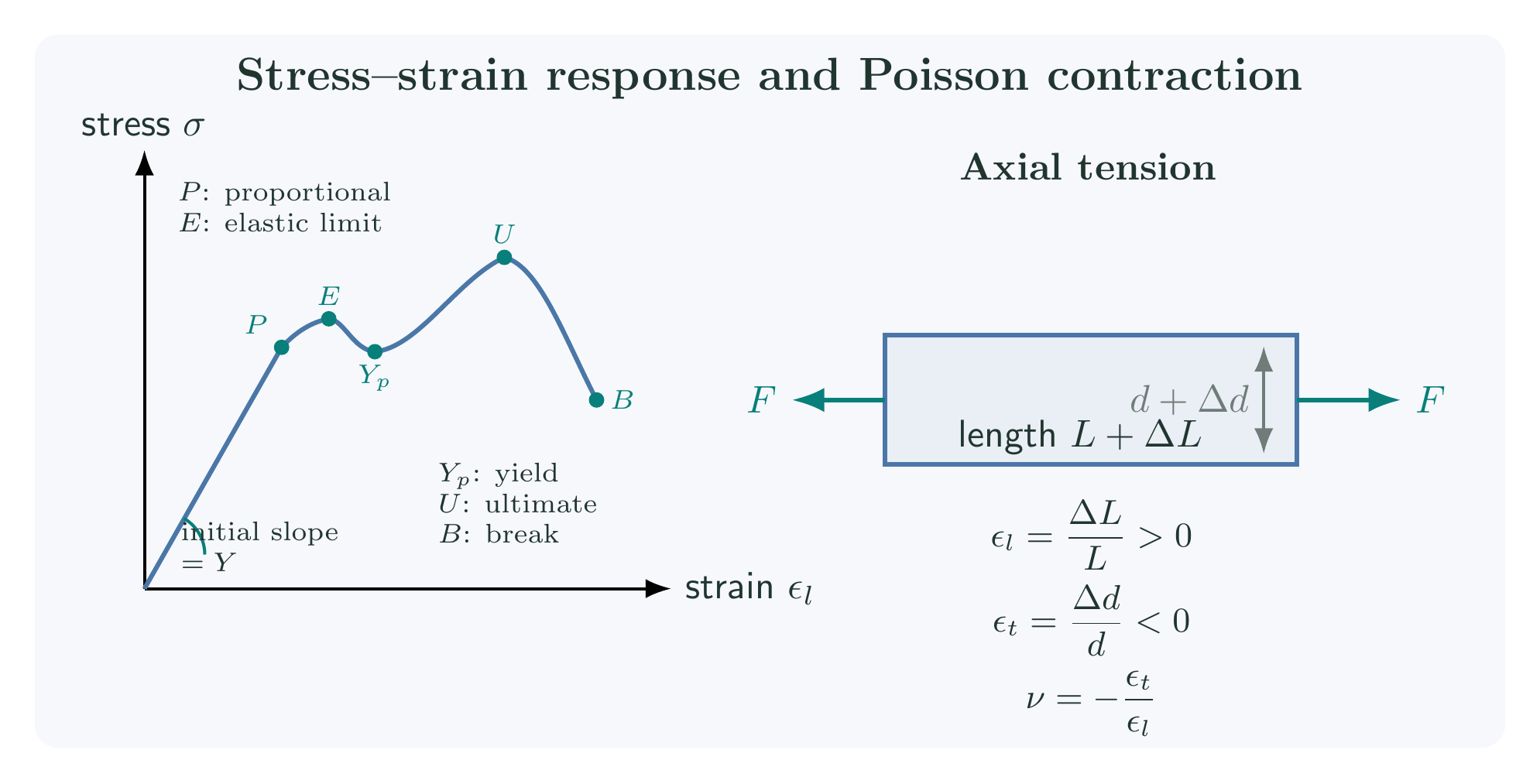
On the stress-strain diagram, $O$ to $P$ is the straight-line or proportional region, with slope
\[Y=\frac{d\sigma}{d\epsilon_l}.\]Up to the elastic limit $E$, unloading restores the original dimensions. Beyond $E$, permanent strain remains. Plastic flow begins near the yield point $Y_p$; the engineering stress reaches its greatest value at the ultimate point $U$ and the specimen finally breaks at $B$. Only the initial straight segment obeys the simple equation $\sigma=Y\epsilon_l$.
The editable source of the diagram is available as a TikZ file.
Elastic moduli
Three elementary deformations define the usual elastic moduli.
Young’s modulus. Under axial loading,
\[Y=\frac{\text{normal stress}}{\text{longitudinal strain}} =\frac{F/A}{\Delta L/L}.\]Bulk modulus. If a uniform external pressure $p$ changes the volume from $V$ to $V+\Delta V$,
\[K=-\frac{p}{\Delta V/V}.\]The minus sign makes $K$ positive because compression gives $\Delta V<0$.
Shear modulus or modulus of rigidity. If tangential stress $\tau$ produces engineering shear strain $\gamma_s$, then
\[G=\frac{\tau}{\gamma_s}.\]For a small shear angle $\phi$, $\gamma_s=\tan\phi\simeq\phi$.
Poisson’s ratio
When a rod is stretched, it normally contracts in a transverse direction. If a transverse dimension changes from $d$ to $d+\Delta d$, then
\[\epsilon_t=\frac{\Delta d}{d}, \qquad \boxed{\nu=-\frac{\epsilon_t}{\epsilon_l}}.\]Under tension, $\epsilon_l>0$ and $\epsilon_t<0$, so $\nu$ is positive for ordinary materials.
Relations among the elastic constants
For a homogeneous isotropic solid in the linear range, only two elastic constants are independent. For a mechanically stable ordinary isotropic solid, $K>0$ and $G>0$, which imply
\[\boxed{-1<\nu<\frac12}.\]The upper limit corresponds to the incompressible limit $K\to\infty$; it is not reached by a material with finite bulk modulus.
Relation between $Y$, $K$ and $\nu$
Apply equal compressive stresses $-p$ along the three mutually perpendicular axes. Along $x$, the direct strain is $-p/Y$. Each of the stresses along $y$ and $z$ produces a lateral strain $+\nu p/Y$ along $x$. By superposition,
\[\epsilon_x=-\frac{p}{Y}+\frac{\nu p}{Y}+\frac{\nu p}{Y} =-\frac{p}{Y}(1-2\nu).\]The three normal strains are equal. To first order,
\[\frac{\Delta V}{V}=\epsilon_x+\epsilon_y+\epsilon_z =-\frac{3p}{Y}(1-2\nu).\]Using $K=-p/(\Delta V/V)$ gives
\[\boxed{Y=3K(1-2\nu)}.\]Relation between $Y$, $G$ and $\nu$
A state of pure shear stress $\tau$ has principal stresses $+\tau$ and $-\tau$ along directions at $45^\circ$ to the sheared faces. The corresponding principal strains are
\[\epsilon_+=\frac{\tau-\nu(-\tau)}{Y} =\frac{(1+\nu)\tau}{Y},\] \[\epsilon_-= \frac{-\tau-\nu\tau}{Y} =-\frac{(1+\nu)\tau}{Y}.\]For this small deformation the engineering shear strain is their difference:
\[\gamma_s=\epsilon_+-\epsilon_- =\frac{2(1+\nu)\tau}{Y}.\]Since $G=\tau/\gamma_s$,
\[\boxed{Y=2G(1+\nu)}.\]Equivalent forms
Eliminating $\nu$ between the two relations gives
\[\boxed{Y=\frac{9KG}{3K+G}}, \qquad \boxed{\nu=\frac{3K-2G}{2(3K+G)}}.\]The requested expressions for Poisson’s ratio in terms of other elastic constants may also be written as
\[\boxed{ \nu=\frac{Y}{2G}-1 =\frac{3K-Y}{6K} =\frac{3K-2G}{2(3K+G)} }.\]Elastic strain energy
Loading a linearly elastic specimen quasistatically from zero stress to $\sigma$ stores work per unit volume equal to the area under the stress–strain line:
\[u=\int_0^{\epsilon_l}\sigma\,d\epsilon_l =\int_0^{\epsilon_l}Y\epsilon_l\,d\epsilon_l.\]Hence
\[\boxed{ u=\frac12\sigma\epsilon_l =\frac{\sigma^2}{2Y} =\frac12Y\epsilon_l^2 }.\]For a uniform rod of volume $AL$, this gives
\[U=uAL=\frac12F\Delta L.\]The factor $1/2$ is essential: during gradual loading the force rises from zero to $F$, so its average value is $F/2$. This expression applies only while unloading retraces the linear elastic path.
Solved Problems
1. Extension, lateral contraction and stored energy of a wire
A wire has length $L=2.00\ \mathrm{m}$, diameter $d=1.00\ \mathrm{mm}$, Young’s modulus $Y=2.00\times10^{11}\ \mathrm{Pa}$ and Poisson’s ratio $\nu=0.300$. It is pulled by $F=100\ \mathrm{N}$ within its elastic range. Find its longitudinal extension, change in diameter and stored elastic energy.
The original cross-sectional area is
\[A=\frac{\pi d^2}{4} =\frac{\pi(1.00\times10^{-3})^2}{4} =7.854\times10^{-7}\ \mathrm{m^2}.\]Therefore
\[\sigma=\frac{F}{A}=1.273\times10^8\ \mathrm{Pa}, \qquad \epsilon_l=\frac{\sigma}{Y}=6.366\times10^{-4}.\]The extension is
\[\boxed{\Delta L=\epsilon_lL =1.273\times10^{-3}\ \mathrm{m} =1.273\ \mathrm{mm}}.\]The transverse strain carries the contraction sign:
\[\epsilon_t=-\nu\epsilon_l =-1.910\times10^{-4},\]so
\[\boxed{\Delta d=\epsilon_td =-1.910\times10^{-7}\ \mathrm{m} =-0.191\ \mathrm{\mu m}}.\]Finally,
\[\boxed{U=\frac12F\Delta L=6.366\times10^{-2}\ \mathrm{J}}.\]The negative $\Delta d$ denotes contraction, not a negative diameter. As checks, $\sigma/Y$ is dimensionless and $2U=F\Delta L$.
2. Recovering $Y$ and $\nu$ from $K$ and $G$
An isotropic solid has bulk modulus $K=75.0\ \mathrm{GPa}$ and shear modulus $G=30.0\ \mathrm{GPa}$. Determine Young’s modulus and Poisson’s ratio, and test whether the constants describe a stable isotropic solid.
Using the equivalent forms,
\[\begin{aligned} Y &=\frac{9KG}{3K+G}\\ &=\frac{9(75.0)(30.0)}{3(75.0)+30.0}\ \mathrm{GPa}\\ &=79.41\ \mathrm{GPa}, \end{aligned}\]and
\[\begin{aligned} \nu &=\frac{3K-2G}{2(3K+G)}\\ &=\frac{3(75.0)-2(30.0)}{2[3(75.0)+30.0]}\\ &=0.3235. \end{aligned}\]Thus
\[\boxed{Y=79.41\ \mathrm{GPa},\qquad \nu=0.3235}.\]Both $K$ and $G$ are positive, and $-1<0.3235<1/2$, so the stability conditions are satisfied. Substitution into $Y=2G(1+\nu)$ returns $79.41\ \mathrm{GPa}$, providing an independent consistency check.
Descriptive Questions
- Distinguish the proportional limit, elastic limit, yield point and ultimate tensile point on an engineering stress–strain curve.
- Derive $Y=3K(1-2\nu)$ by superposing three mutually perpendicular normal stresses.
- Explain why only two elastic constants are independent for a homogeneous isotropic solid.
- Show from positivity of $K$ and $G$ why the admissible range of Poisson’s ratio is $-1<\nu<1/2$.
Numerical Problems
-
An isotropic block of initial volume $250\ \mathrm{cm^3}$ is subjected to a uniaxial tensile stress of $30.0\ \mathrm{MPa}$. If $Y=3.00\ \mathrm{GPa}$ and $\nu=0.400$, find its first-order change in volume.
Final answer:
\[\begin{aligned} \frac{\Delta V}{V} &=\epsilon_l+2\epsilon_t =(1-2\nu)\frac{\sigma}{Y} =2.00\times10^{-3},\\ \Delta V&=+0.500\ \mathrm{cm^3}. \end{aligned}\] -
A liquid of volume $0.0200\ \mathrm{m^3}$ has bulk modulus $2.20\ \mathrm{GPa}$. Find its volume change when the external pressure increases by $5.00\ \mathrm{MPa}$.
Final answer: $\Delta V=-4.55\times10^{-5}\ \mathrm{m^3}=-45.5\ \mathrm{cm^3}$.
-
A cube of side $0.100\ \mathrm{m}$ is sheared by a tangential force of $12.0\ \mathrm{kN}$ on its top face. If $G=30.0\ \mathrm{GPa}$, find the top-face displacement.
Final answer: $x=4.00\ \mathrm{\mu m}$.
-
An isotropic material has $Y=70.0\ \mathrm{GPa}$ and $\nu=0.350$. Calculate $G$ and $K$.
Final answer: $G=25.93\ \mathrm{GPa}$, $K=77.78\ \mathrm{GPa}$.
-
Find the elastic energy density in a specimen stressed uniaxially to $120\ \mathrm{MPa}$ if $Y=200\ \mathrm{GPa}$.
Final answer: $u=3.60\times10^4\ \mathrm{J\,m^{-3}}$.
-
A cube is subjected to mutually perpendicular normal stresses $\sigma_x=+100\ \mathrm{MPa}$, $\sigma_y=+40.0\ \mathrm{MPa}$ and $\sigma_z=-20.0\ \mathrm{MPa}$, where positive stress denotes tension. If $Y=200\ \mathrm{GPa}$ and $\nu=0.300$, find the normal strain along $x$.
Final answer:
\[\begin{aligned} \epsilon_x &=\frac{\sigma_x-\nu(\sigma_y+\sigma_z)}{Y}\\ &=+4.70\times10^{-4} \quad\text{(elongation)}. \end{aligned}\]
All symbolic identities and numerical answers above are checked in the Unit I Maxima worksheet.


Discussion