

26 Jun 2025
Forced Oscillations, Resonance, and Quality Factor
Steady forced response, displacement and power resonance, bandwidth, power dissipation, and quality factor.
A damped oscillator driven by the harmonic force $F_0\cos\omega t$ obeys
\[m\ddot x+b\dot x+kx=F_0\cos\omega t, \qquad m>0,\ b>0,\ k>0.\]The complete motion is the sum of a decaying transient and a steady forced oscillation. After the transient has died away, write
\[x=A\cos(\omega t-\delta), \qquad A>0.\]Then
\[\dot x=-\omega A\sin(\omega t-\delta), \qquad \ddot x=-\omega^2A\cos(\omega t-\delta).\]Substitution in the equation of motion gives
\[A(k-m\omega^2)\cos(\omega t-\delta) -Ab\omega\sin(\omega t-\delta) =F_0\cos\omega t.\]Using
\[\cos(\omega t-\delta) =\cos\omega t\cos\delta+\sin\omega t\sin\delta,\] \[\sin(\omega t-\delta) =\sin\omega t\cos\delta-\cos\omega t\sin\delta,\]the cosine and sine coefficients give
\[A\left[(k-m\omega^2)\cos\delta+b\omega\sin\delta\right]=F_0,\] \[A\left[(k-m\omega^2)\sin\delta-b\omega\cos\delta\right]=0.\]The second equation yields
\[\tan\delta=\frac{b\omega}{k-m\omega^2}.\]The tangent alone does not fix the quadrant. For $\omega>0$, choose
\[\boxed{\delta=\operatorname{atan2}(b\omega,k-m\omega^2)}, \qquad 0<\delta<\pi.\]Squaring and adding the two coefficient equations gives
\[A^2\left[(k-m\omega^2)^2+b^2\omega^2\right]=F_0^2.\]Therefore the steady displacement amplitude is
\[\boxed{A(\omega)= \frac{F_0}{\sqrt{(k-m\omega^2)^2+b^2\omega^2}}}.\]Three limiting values provide useful checks. In the quasistatic limit,
\[\lim_{\omega\to0}A=\frac{F_0}{k}, \qquad \lim_{\omega\to0}\delta=0.\]At the natural frequency,
\[A(\omega_0)=\frac{F_0}{b\omega_0}, \qquad \delta(\omega_0)=\frac\pi2.\]At very high frequency, inertia dominates:
\[A(\omega)\sim\frac{F_0}{m\omega^2}, \qquad \delta\to\pi \quad(\omega\to\infty).\]Displacement resonance
The amplitude is largest when its squared denominator
\[D(\omega)=(k-m\omega^2)^2+b^2\omega^2\]is smallest. Differentiation gives
\[\frac{dD}{d\omega} =2(k-m\omega^2)(-2m\omega)+2b^2\omega.\]For a nonzero stationary frequency,
\[-2m(k-m\omega_r^2)+b^2=0.\]Using $\omega_0^2=k/m$ and $\beta=b/(2m)$,
\[\boxed{\omega_r=\sqrt{\omega_0^2-2\beta^2}}.\]A nonzero displacement-resonance peak exists only when
\[\boxed{\beta<\frac{\omega_0}{\sqrt2}}.\]As the damping becomes smaller, the amplitude peak becomes higher and narrower, and $\omega_r\to\omega_0$. If $b=0$ exactly at $\omega=\omega_0$, there is no finite steady-state amplitude; the resonant response grows with time.
Average power dissipation
The positive instantaneous rate at which the damper removes mechanical energy is
\[P_{\rm diss}=b\dot x^2.\]Since $\langle\sin^2(\omega t-\delta)\rangle=1/2$ over a cycle,
\[\langle P\rangle =b\omega^2A^2\left\langle\sin^2(\omega t-\delta)\right\rangle =\frac12b\omega^2A^2.\]Thus
\[\boxed{\langle P\rangle= \frac{F_0^2b\omega^2} {2\left[(k-m\omega^2)^2+b^2\omega^2\right]}}.\]In steady motion, this equals the average input power. Indeed,
\[\langle F\dot x\rangle =\frac12F_0A\omega\sin\delta =\frac12b\omega^2A^2.\]To locate the power maximum, put $y=\omega^2$. Apart from a positive constant,
\[\langle P\rangle\propto \frac{y}{m^2(\omega_0^2-y)^2+b^2y}.\]Differentiating with respect to $y$, the numerator of the derivative reduces to
\[m^2(\omega_0^4-y^2).\]Hence the power is maximum at
\[\boxed{\omega=\omega_0}, \qquad \boxed{\langle P\rangle_{\max}=\frac{F_0^2}{2b}}.\]At this frequency $k-m\omega_0^2=0$, so $\delta=\pi/2$: the velocity is in phase with the driving force.
Sharpness, bandwidth, and quality factor
Let $\omega_1<\omega_0<\omega_2$ be the two frequencies at which the average power is half its maximum. The half-power condition is
\[\frac{F_0^2b\omega^2}{2D(\omega)} =\frac12\frac{F_0^2}{2b}.\]After cancellation,
\[(k-m\omega^2)^2=b^2\omega^2.\]The positive roots on the two sides of $\omega_0$ are
\[\boxed{\omega_1=\sqrt{\omega_0^2+\beta^2}-\beta},\] \[\boxed{\omega_2=\sqrt{\omega_0^2+\beta^2}+\beta}.\]Therefore the full width at half maximum of the power curve is exactly
\[\boxed{\Delta\omega=\omega_2-\omega_1=2\beta=\frac bm}.\]The quality factor is
\[\boxed{Q=\frac{\omega_0}{\Delta\omega} =\frac{m\omega_0}{b} =\frac{\omega_0}{2\beta}}.\]A sharp resonance has $\Delta\omega\ll\omega_0$, equivalently $Q\gg1$.
At $\omega=\omega_0$, the stored mechanical energy is $E=\tfrac12m\omega_0^2A^2$, while the energy dissipated in one period is $\langle P\rangle(2\pi/\omega_0)=\pi b\omega_0A^2$. Hence
\[\boxed{Q=2\pi\frac{\text{energy stored}} {\text{energy dissipated per cycle}}}.\]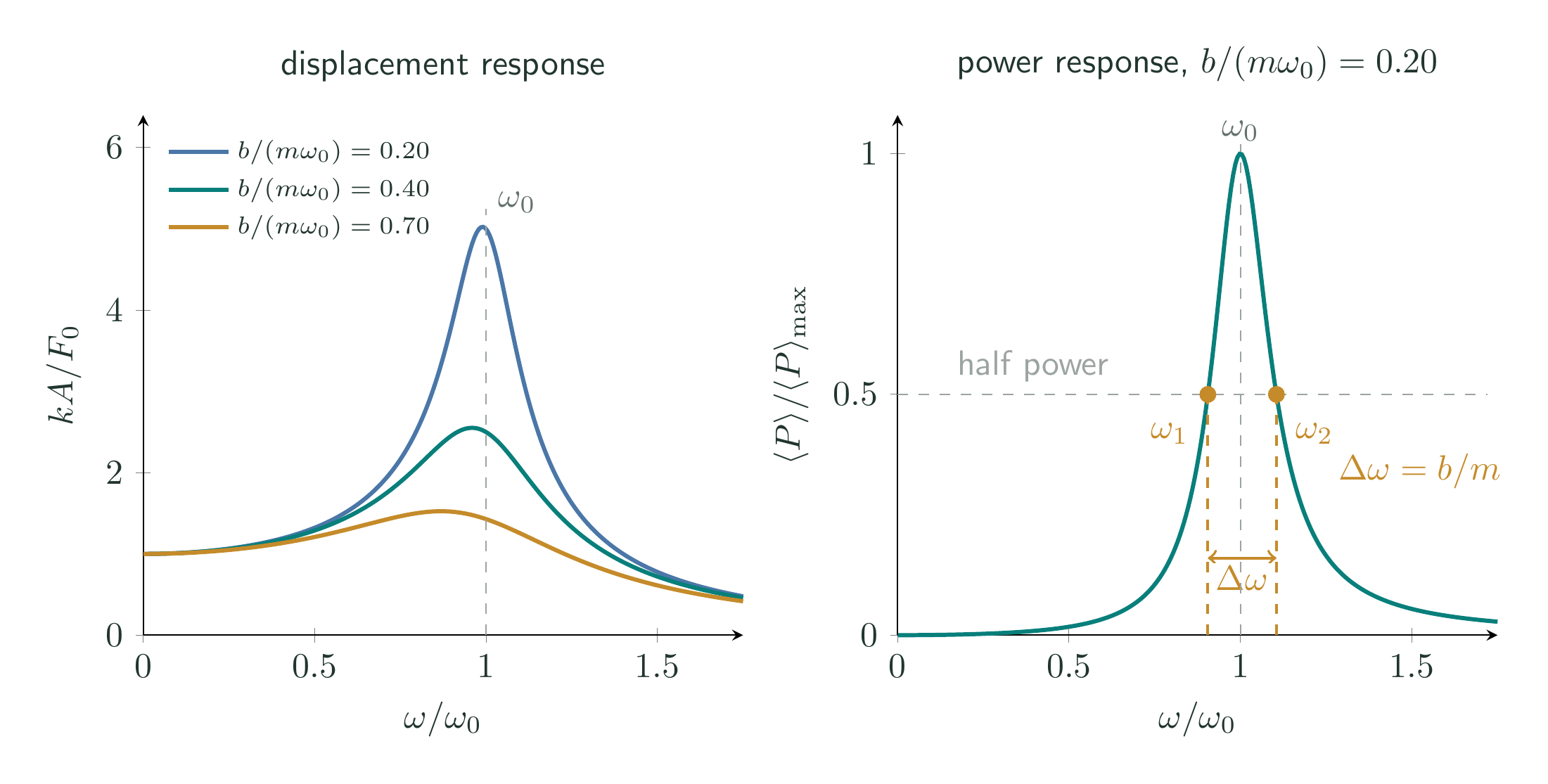
Solved Problems
1. Off-resonance amplitude, phase, and power
Problem. A driven oscillator has $m=1.0\ \mathrm{kg}$, $k=25\ \mathrm{N\,m^{-1}}$, $b=2.0\ \mathrm{kg\,s^{-1}}$, and $F_0=3.0\ \mathrm{N}$. Find the steady amplitude, phase lag, and average dissipated power at $\omega=4.0\ \mathrm{rad\,s^{-1}}$.
Solution. The stiffness and damping terms are
\[k-m\omega^2=25-1(4^2)=9\ \mathrm{N\,m^{-1}},\] \[b\omega=(2)(4)=8\ \mathrm{N\,m^{-1}}.\]Thus
\[A=\frac{3}{\sqrt{9^2+8^2}} =\frac3{\sqrt{145}} =0.2491\ \mathrm{m}.\]The phase lag is
\[\delta=\operatorname{atan2}(8,9) =0.7266\ \mathrm{rad} =41.63^\circ.\]The average power is
\[\langle P\rangle =\frac12b\omega^2A^2 =\frac12(2)(4^2)\frac9{145} =\frac{144}{145} =0.9931\ \mathrm{W}.\]Checks. Both terms under the amplitude square root have units $(\mathrm{N\,m^{-1}})^2$, so the result has units of length. Since $\omega<\omega_0=5\ \mathrm{rad\,s^{-1}}$, both arguments of $\operatorname{atan2}$ are positive and $0<\delta<\pi/2$, as found. The dissipated power is positive. If $b\to0$ at this nonresonant frequency, $A\to F_0/(k-m\omega^2)=1/3\ \mathrm{m}$ and $\delta\to0$.
2. Exact natural-frequency response and energy definition of $Q$
Problem. For $m=0.50\ \mathrm{kg}$, $k=72\ \mathrm{N\,m^{-1}}$, $b=3.0\ \mathrm{kg\,s^{-1}}$, and $F_0=6.0\ \mathrm{N}$, evaluate the amplitude, phase, maximum average power, bandwidth, quality factor, stored energy, and energy lost per cycle at $\omega=\omega_0$.
Solution. The natural angular frequency is
\[\omega_0=\sqrt{\frac{k}{m}} =\sqrt{\frac{72}{0.50}} =12\ \mathrm{rad\,s^{-1}}.\]At this frequency $k-m\omega_0^2=0$, so
\[A(\omega_0)=\frac{F_0}{b\omega_0} =\frac6{(3)(12)} =\frac16\ \mathrm{m}, \qquad \delta=\frac\pi2.\]The maximum average power is
\[\langle P\rangle_{\max}=\frac{F_0^2}{2b} =\frac{36}{6} =6.0\ \mathrm{W}.\]Also,
\[\Delta\omega=\frac bm=6.0\ \mathrm{rad\,s^{-1}}, \qquad Q=\frac{m\omega_0}{b}=2.0.\]At $\omega_0$, the stored mechanical energy is
\[E=\frac12m\omega_0^2A^2 =\frac12(0.50)(12^2)\left(\frac16\right)^2 =1.00\ \mathrm{J}.\]The energy dissipated in one period is
\[\Delta E_{\rm cycle} =\langle P\rangle_{\max}\frac{2\pi}{\omega_0} =6\frac{2\pi}{12} =\pi\ \mathrm{J}.\]Consequently $2\pi E/\Delta E_{\rm cycle}=2=Q$.
Checks. $b/m$ has units $\mathrm{s^{-1}}$ and $Q$ is dimensionless. The phase is exactly $\pi/2$, so the velocity is in phase with the force and the input power is positive. The energy lost per cycle equals average power times period. As $b\to0^+$, the steady resonant amplitude and power diverge, signalling the failure of a finite steady-state solution for the undamped resonant system.
Descriptive Questions
- Derive the steady-state amplitude and phase lag of a harmonically driven damped oscillator by matching sine and cosine coefficients.
- Distinguish displacement resonance from power resonance and derive the frequency and existence condition for the displacement peak.
- Derive the average input and dissipated powers and prove that the power maximum occurs at $\omega_0$.
- Derive the exact half-power frequencies, bandwidth, and both standard forms of the quality factor.
Numerical Problems
-
A force of amplitude $4.0\ \mathrm{N}$ acts quasistatically on an oscillator of stiffness $80\ \mathrm{N\,m^{-1}}$. Find the steady displacement amplitude and phase lag.
Final answer: $A(0)=0.050\ \mathrm{m}$ and $\delta(0)=0$.
-
Find the displacement-resonance frequency for $\omega_0=20\ \mathrm{rad\,s^{-1}}$ and $\beta=3.0\ \mathrm{s^{-1}}$.
Final answer: $\omega_r=\sqrt{382}=19.545\ \mathrm{rad\,s^{-1}}$.
-
For $m=0.50\ \mathrm{kg}$ and $k=50\ \mathrm{N\,m^{-1}}$, find the largest $b$ that permits a nonzero displacement-resonance peak. Does $b=8.0\ \mathrm{kg\,s^{-1}}$ permit one?
Final answer: $b<\sqrt{2mk}=7.071\ \mathrm{kg\,s^{-1}}$; therefore $b=8.0\ \mathrm{kg\,s^{-1}}$ does not.
-
An oscillator has $\omega_0=12\ \mathrm{rad\,s^{-1}}$ and $b/m=3.0\ \mathrm{s^{-1}}$. Find its exact half-power frequencies and bandwidth.
Final answer: $\omega_1=10.593\ \mathrm{rad\,s^{-1}}$, $\omega_2=13.593\ \mathrm{rad\,s^{-1}}$, and $\Delta\omega=3.000\ \mathrm{rad\,s^{-1}}$.
-
A $0.500\ \mathrm{kg}$ oscillator driven at $10.0\ \mathrm{rad\,s^{-1}}$ has steady amplitude $4.00\ \mathrm{cm}$ and lags the force by $45.0^\circ$. If $b=3.00\ \mathrm{kg\,s^{-1}}$, determine the stiffness $k$ and force amplitude $F_0$.
Final answer:
\[\begin{aligned} k-m\omega^2 &=\frac{b\omega}{\tan\delta} =30.0\ \mathrm{N\,m^{-1}},\\ k&=80.0\ \mathrm{N\,m^{-1}},\\ F_0 &=A\sqrt{(k-m\omega^2)^2+b^2\omega^2}\\ &=1.20\sqrt2\ \mathrm{N} =1.697\ \mathrm{N}. \end{aligned}\] -
A resonance has $f_0=100\ \mathrm{Hz}$ and half-power bandwidth $\Delta f=5.0\ \mathrm{Hz}$. Find its quality factor.
Final answer: $Q=f_0/\Delta f=20$.
The response identities and all eight worked answers are independently checked in the Maxima worksheet; every printed residual or check is zero.
References
- Resonance — Wikipedia.
- OpenStax, University Physics Volume 1, Section 15.6: Forced Oscillations.
- John R. Taylor, Classical Mechanics, University Science Books (2005), Chapter 5.


Discussion