

01 Jul 2025
Frames, the Michelson–Morley Experiment, and Einstein's Postulates
Inertial and non-inertial frames, the ether-drift test, its null result, and the two postulates of special relativity.
A reference frame is a coordinate system together with synchronized clocks. If two frames $S$ and $S^{\prime}$ have parallel axes and $S^{\prime}$ moves at constant velocity $v\hat{\mathbf x}$ relative to $S$, Newtonian kinematics gives the Galilean transformation
\[x^{\prime}=x-vt,\qquad y^{\prime}=y,\qquad z^{\prime}=z,\qquad t^{\prime}=t.\]Differentiating twice,
\[u_x^{\prime}=u_x-v,\qquad a_x^{\prime}=a_x,\]so Newton’s equation has the same form in every frame moving uniformly relative to another. Such a frame is inertial: a free particle has constant velocity, or equivalently $\mathbf a=0$.
If the frame origin has acceleration $\mathbf A(t)$, then $\mathbf r^{\prime}=\mathbf r-\mathbf R(t)$ gives
\[\mathbf a^{\prime}=\mathbf a-\mathbf A, \qquad m\mathbf a^{\prime}=\mathbf F-m\mathbf A.\]The extra term $-m\mathbf A$ is an inertial (fictitious) force. A frame whose origin accelerates, or whose axes rotate, is therefore non-inertial; rotating frames similarly require centrifugal and Coriolis terms. Special relativity relates inertial frames.
The ether-drift prediction
Nineteenth-century wave theory suggested that light propagated through a stationary ether. Consider equal interferometer arms of length $L$ in the pre-relativistic ether model, with the apparatus moving at speed $v$ through the ether. Light of ether-frame speed $c$ would then have different round-trip times along arms parallel and perpendicular to $\mathbf v$.
For a parallel arm of length $L$, the outward and return times would be
\[t_+=\frac{L}{c-v},\qquad t_-=\frac{L}{c+v},\]hence
\[t_{\parallel} =\frac{L}{c-v}+\frac{L}{c+v} =\frac{2Lc}{c^2-v^2} =\frac{2L}{c}\frac{1}{1-\beta^2}, \qquad \beta=\frac vc.\]For one transverse crossing of duration $t_\perp/2$, the mirror advances by $vt_\perp/2$ while the light covers $ct_\perp/2$. The right triangle therefore gives
\[\left(\frac{ct_\perp}{2}\right)^2 =L^2+\left(\frac{vt_\perp}{2}\right)^2,\]and hence
\[t_\perp=\frac{2L}{\sqrt{c^2-v^2}} =\frac{2L}{c}\frac{1}{\sqrt{1-\beta^2}}.\]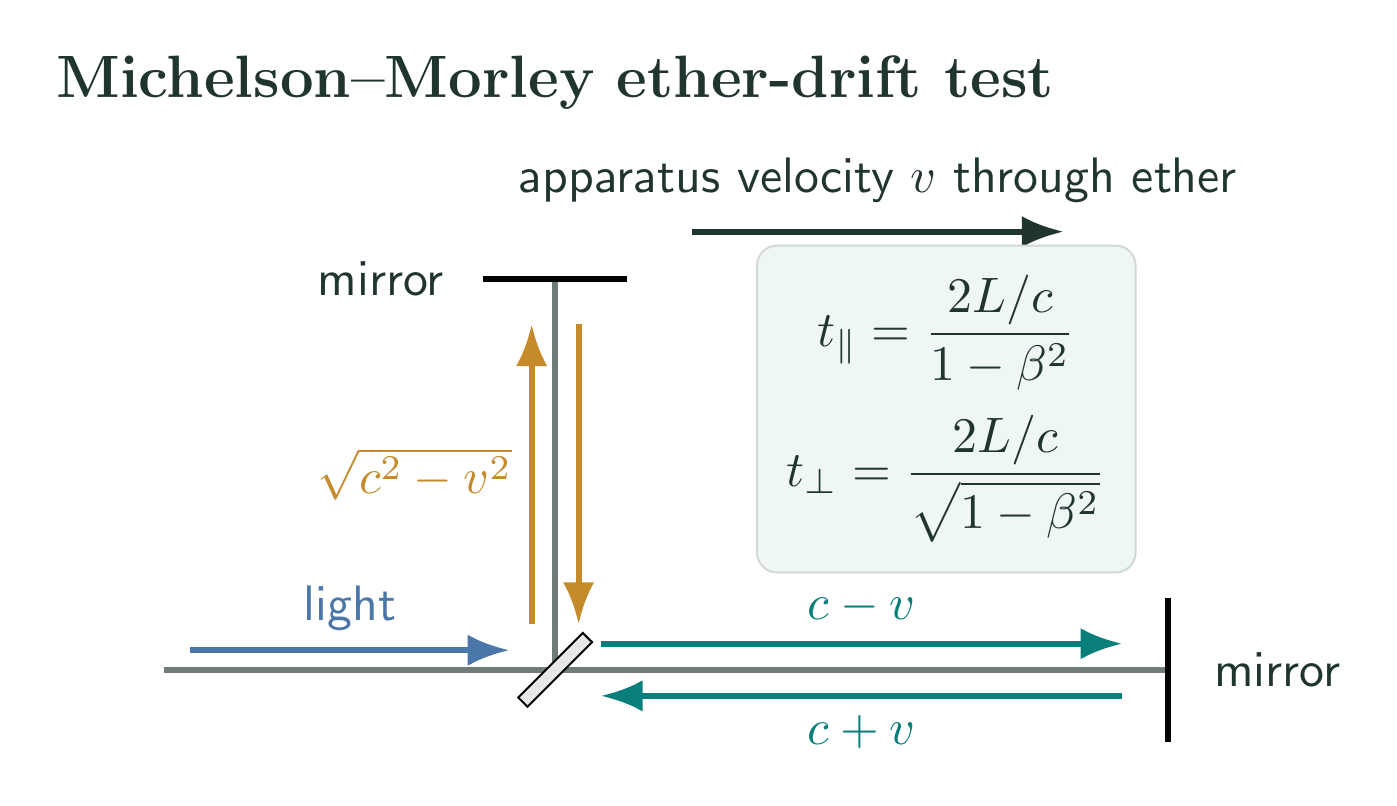
Their predicted difference is
\[\Delta t=t_\parallel-t_\perp =\frac{2L}{c} \left[ \frac{1}{1-\beta^2}-\frac{1}{\sqrt{1-\beta^2}} \right].\]For $v\ll c$, $(1-\beta^2)^{-1}\simeq1+\beta^2$ and $(1-\beta^2)^{-1/2}\simeq1+\beta^2/2$, so
\[\boxed{\Delta t\simeq\frac{Lv^2}{c^3}}.\]Rotating the apparatus through $90^\circ$ exchanges the arms, changing the difference by $2\Delta t$. The corresponding predicted fringe displacement is
\[N=\frac{c(2\Delta t)}{\lambda} \simeq\boxed{\frac{2Lv^2}{\lambda c^2}}.\]Michelson and Morley observed no displacement of the predicted size within experimental sensitivity: the outcome was null. No preferred ether rest frame was detected.
The two postulates
Einstein replaced the ether hypothesis by two statements:
- Relativity principle: the laws of physics have the same form in every inertial frame.
- Light-speed invariance: light in vacuum has the same speed $c$ in every inertial frame, independent of the motion of its source or observer.
The Galilean rule would give $u_x^{\prime}=c-v$ for a light pulse and therefore contradict the second postulate. Space and time must transform together. The next lecture derives that transformation.
Solved Problems
1. Apparent weight in an accelerating frame
A lift accelerates upward at $A=2.00\ \mathrm{m\,s^{-2}}$. Find the apparent weight of a $70.0\ \mathrm{kg}$ passenger, using both the ground frame $S$ and the lift frame $S^{\prime}$. Take upward as positive and $g=9.81\ \mathrm{m\,s^{-2}}$.
In the approximately inertial ground frame, the passenger has acceleration $+A$. If $N$ is the normal reaction,
\[N-mg=mA,\]so
\[N=m(g+A) =(70.0\ \mathrm{kg})(11.81\ \mathrm{m\,s^{-2}}) =\boxed{826.7\ \mathrm N}.\]In $S^{\prime}$ the passenger is at rest, so $a^{\prime}=0$. The frame acceleration is $+A$, hence the inertial force is $-mA$:
\[N-mg-mA=0,\]which gives the same $N=826.7\ \mathrm N$. The upward-support force exceeds $mg$, so the passenger feels heavier. For $A\to0$, $N\to mg$; for free fall, $A\to-g$ and $N\to0$.
2. Predicted Michelson–Morley fringe shift
An ether model assigns an interferometer equal effective arm length $L=11.0\ \mathrm m$, wavelength $\lambda=500\ \mathrm{nm}$, and drift speed $v=30.0\ \mathrm{km\,s^{-1}}$. Take $c=3.00\times10^8\ \mathrm{m\,s^{-1}}$ and calculate the shift after a $90^\circ$ rotation.
All speeds are measured in the assumed ether frame. Here
\[\beta=\frac vc=1.00\times10^{-4}.\]The exact pre-relativistic round-trip times are
\[t_{\parallel}=\frac{2L/c}{1-\beta^2}, \qquad t_{\perp}=\frac{2L/c}{\sqrt{1-\beta^2}}.\]Numerically,
\[t_{\parallel}=7.333333407\times10^{-8}\ \mathrm s, \qquad t_{\perp}=7.333333370\times10^{-8}\ \mathrm s,\]so one orientation has $\Delta t=3.667\times10^{-16}\ \mathrm s$. Rotation reverses this delay, giving an optical-path change $2c\Delta t$. Therefore
\[N=\frac{2c\Delta t}{\lambda} \simeq\frac{2Lv^2}{\lambda c^2} =\boxed{0.440\ \text{fringe}}.\]The positive sign denotes the predicted displacement from exchanging the parallel and transverse arms; the opposite rotation gives the opposite displacement. The effect is second order in $v/c$, so $N\to0$ as $v\to0$. The observed null result was therefore physically significant at the instrument’s quoted sensitivity.
Descriptive Questions
- Distinguish inertial and non-inertial frames by applying Newton’s first law, and explain why inertial forces are required in an accelerating frame.
- Derive the longitudinal and transverse round-trip light times predicted by the stationary-ether model.
- Explain why rotating a Michelson interferometer through $90^\circ$ doubles the change in relative travel time.
- State Einstein’s two postulates and identify the conflict between light-speed invariance and Galilean velocity transformation.
Numerical Problems
- A $3.00\ \mathrm{kg}$ body experiences a net force of $12.0\ \mathrm N$ in an inertial frame. A second frame translates at constant velocity relative to it. Find the acceleration measured in each frame. Answer: $4.00\ \mathrm{m\,s^{-2}}$ in both frames.
- A $2.00\ \mathrm{kg}$ body is at rest at radius $0.500\ \mathrm m$ on a platform rotating uniformly at $4.00\ \mathrm{rad\,s^{-1}}$. Find the centrifugal force in the platform frame. Answer: $F_{\rm cf}=m\omega^2r=16.0\ \mathrm N$ radially outward.
- In the ether calculation take $v=0.600c$. Express $t_{\parallel}$ and $t_{\perp}$ as multiples of $2L/c$. Answer: $t_{\parallel}=1.5625(2L/c)$ and $t_{\perp}=1.2500(2L/c)$.
- A railway carriage starts accelerating along $+x$ at $2.50\ \mathrm{m\,s^{-2}}$. A puck, initially at rest relative to the carriage, is released on a frictionless floor. Find its carriage-frame displacement from the release point after $4.00\ \mathrm s$. Answer: $x^{\prime}=-\tfrac12At^2=-20.0\ \mathrm m$; the puck falls behind the accelerating carriage.
- An interferometer with $L=10.0\ \mathrm m$ and $\lambda=500\ \mathrm{nm}$ has a predicted shift $N=0.100$. Infer the ether-drift speed from the small-$\beta$ formula. Answer: $v=1.50\times10^4\ \mathrm{m\,s^{-1}}=15.0\ \mathrm{km\,s^{-1}}$.
- A light ray moves along $+x$ while a rocket moves in the same direction at $0.400c$. Find the ray speed in the rocket according to Galilean kinematics and according to Einstein’s second postulate. Answer: $0.600c$ (Galilean); $c$ (special relativity).
The derivations and all problem values are checked in the Maxima worksheet; every printed residual is zero.
References
- “Michelson–Morley experiment,” Wikipedia.
- A. P. French, Special Relativity, 1st ed., MIT Introductory Physics Series, W. W. Norton, 1968, Chapter 2, “Perplexities in the Propagation of Light.”
- David J. Griffiths, Introduction to Electrodynamics, 4th ed., Cambridge University Press, 2017, Chapter 12, §12.1, “The Special Theory of Relativity.”


Discussion