

06 Jun 2025
Kepler's Laws and Their Derivation
Derivation of elliptical planetary orbits, equal areas, and the period law from inverse-square gravity.
For a planet of mass $m$ orbiting a much heavier Sun of mass $M$, Newtonian gravity is
\[\mathbf F=-\frac{GMm}{r^2}\hat{\mathbf r}.\]Let
\[h=\frac{L}{m}=r^2\dot\theta\]be the constant angular momentum per unit mass, and put $u=1/r$. A prime will denote differentiation with respect to $\theta$. Since $r=u^{-1}$ and $\dot\theta=hu^2$,
\[\dot r=\frac{dr}{d\theta}\dot\theta =\left(-\frac{u^{\prime}}{u^2}\right)(hu^2) =-hu^{\prime}.\]Differentiating with respect to time,
\[\ddot r=-h\frac{du^{\prime}}{dt} =-hu^{\prime\prime}\dot\theta =-h^2u^2u^{\prime\prime}.\]Also,
\[r\dot\theta^2 =\frac1u(hu^2)^2 =h^2u^3.\]Substitution in the radial equation gives
\[m(\ddot r-r\dot\theta^2) =-mh^2u^2(u^{\prime\prime}+u) =-GMmu^2.\]Cancelling the nonzero factor $-mu^2$ leaves Binet’s equation for gravity:
\[u^{\prime\prime}+u=\frac{GM}{h^2}.\]Its general solution is
\[u=\frac{GM}{h^2}+C\cos(\theta-\theta_0).\]Choose the direction of closest approach as $\theta=0$ and write $C=eGM/h^2$, where $e\ge0$. Then
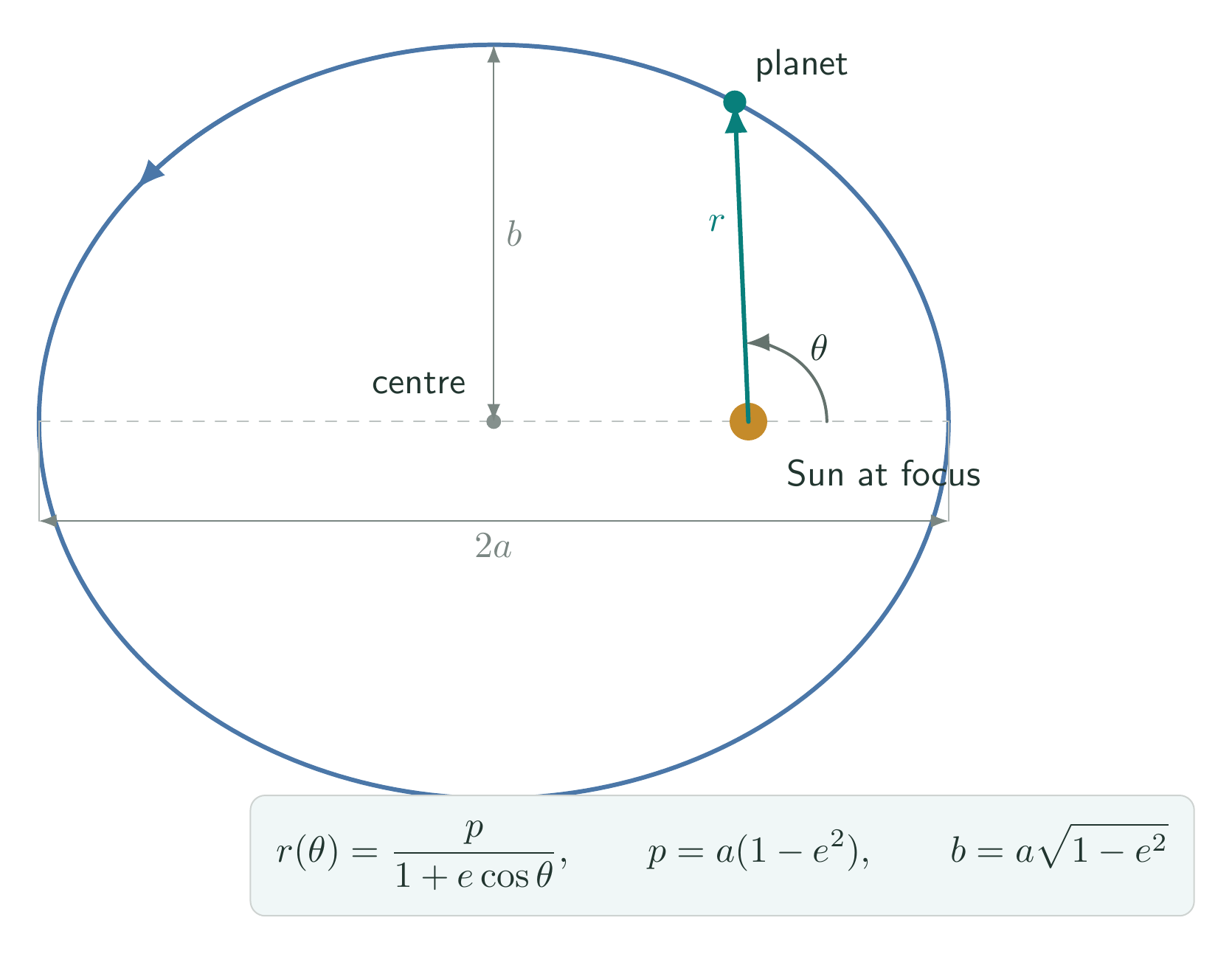
\[\boxed{r(\theta)=\frac{p}{1+e\cos\theta}}, \qquad \boxed{p=\frac{h^2}{GM}}.\]First law: the orbit is an ellipse
For a bound planetary orbit, $0\le e<1$. With $x=r\cos\theta$ and $r^2=x^2+y^2$, the polar orbit equation gives
\[r+ex=p, \qquad r=p-ex.\]Squaring the second equation,
\[x^2+y^2=(p-ex)^2,\]and hence
\[(1-e^2)x^2+2pex+y^2=p^2.\]Completing the square in $x$ gives
\[(1-e^2)\left(x+\frac{pe}{1-e^2}\right)^2+y^2 =\frac{p^2}{1-e^2}.\]Define
\[a=\frac{p}{1-e^2}, \qquad b=\frac{p}{\sqrt{1-e^2}}=a\sqrt{1-e^2}.\]Then
\[\boxed{\frac{(x+ae)^2}{a^2}+\frac{y^2}{b^2}=1}.\]This is an ellipse of semi-major axis $a$, semi-minor axis $b$, and focal distance $ae$. One focus is the origin, where the Sun lies. Therefore Kepler’s first law states: each planet moves in an ellipse with the Sun at one focus.
Second law: equal areas in equal times
Gravity is central, so $L$ and $h=L/m$ are constant. The areal velocity is
\[\boxed{\frac{dA}{dt}=\frac{L}{2m}=\frac h2=\text{constant}}.\]Thus the Sun-planet radius vector sweeps equal areas in equal times. This is Kepler’s second law.
Third law: the period relation
In one period $T$, the radius vector sweeps the whole area $\pi ab$ of the ellipse. Since $dA/dt=h/2$,
\[\pi ab=\frac h2T,\]so
\[T=\frac{2\pi ab}{h}.\]From $p=h^2/(GM)$ and $p=a(1-e^2)$,
\[h^2=GMa(1-e^2).\]Using $b^2=a^2(1-e^2)$ and squaring the period,
\[T^2=\frac{4\pi^2a^2b^2}{h^2} =\frac{4\pi^2a^4(1-e^2)}{GMa(1-e^2)}.\]Therefore
\[\boxed{T^2=\frac{4\pi^2}{GM}a^3}, \qquad \boxed{T^2\propto a^3}.\]This is Kepler’s third law: for bodies orbiting the same central mass, the square of the orbital period is proportional to the cube of the semi-major axis.
Solved Problems
1. Reconstruct an elliptical orbit from $p$ and $e$
Problem. A planet has orbit equation $r=p/(1+e\cos\theta)$ with $p=1.20\times10^{11}\ \mathrm{m}$ and $e=0.250$. Find $a$, $b$, the perihelion distance $r_p$, and the aphelion distance $r_a$.
Solution. From $p=a(1-e^2)$,
\[a=\frac{p}{1-e^2} =\frac{1.20\times10^{11}}{1-0.250^2} =1.28\times10^{11}\ \mathrm{m}.\]The semi-minor axis is
\[b=a\sqrt{1-e^2} =(1.28\times10^{11})\sqrt{0.9375} =1.239\times10^{11}\ \mathrm{m}.\]Perihelion occurs at $\theta=0$ and aphelion at $\theta=\pi$:
\[r_p=\frac{p}{1+e} =9.60\times10^{10}\ \mathrm{m},\] \[r_a=\frac{p}{1-e} =1.60\times10^{11}\ \mathrm{m}.\]The independent ellipse identity
\[\frac{r_p+r_a}{2}=1.28\times10^{11}\ \mathrm{m}=a\]confirms the semi-major axis.
Checks. $p$, $a$, $b$, $r_p$, and $r_a$ all have units of length. Both radii are positive because $0<e<1$, and $r_p<r_a$ as required physically. In the circular limit $e\to0$, all four lengths tend to $p$.
2. Determine the solar mass from Earth’s orbit
Problem. Treat Earth’s orbit as Keplerian with $a=1.496\times10^{11}\ \mathrm{m}$ and $T=365.25\ \mathrm{d}$. Using $G=6.67430\times10^{-11}\ \mathrm{m^3\,kg^{-1}\,s^{-2}}$, determine the central mass.
Solution. Convert the period to SI units:
\[T=(365.25)(86400) =3.15576\times10^7\ \mathrm{s}.\]Kepler’s third law gives
\[M=\frac{4\pi^2a^3}{GT^2}.\]Therefore
\[M= \frac{4\pi^2(1.496\times10^{11})^3} {(6.67430\times10^{-11})(3.15576\times10^7)^2} =1.989\times10^{30}\ \mathrm{kg}.\]Checks. The dimensions are $[a^3/(GT^2)]=\mathrm{kg}$. Every factor in the expression is positive, so the inferred mass is positive. The value agrees with the expected solar mass scale. At fixed $a$, a longer period would imply a smaller central mass, consistently with $M\propto T^{-2}$.
Descriptive Questions
- Derive Binet’s equation for inverse-square gravity from the polar radial equation and the conservation of specific angular momentum.
- Starting with $r=p/(1+e\cos\theta)$, reduce the bound orbit to the Cartesian equation of an ellipse with the force centre at one focus.
- Explain why Kepler’s second law follows from centrality alone, whereas the first and third laws require the inverse-square force.
- Derive Kepler’s third law by combining constant areal velocity with the area and geometry of an ellipse.
Numerical Problems
-
For $h=7.50\times10^{10}\ \mathrm{m^2\,s^{-1}}$ and $GM=3.986\times10^{14}\ \mathrm{m^3\,s^{-2}}$, calculate the semi-latus rectum.
Final answer: $p=h^2/(GM)=1.411\times10^7\ \mathrm{m}$.
-
An orbit has $p=1.20\times10^7\ \mathrm{m}$ and $e=0.20$. Find $r$ at $\theta=60^\circ$.
Final answer: $r=1.091\times10^7\ \mathrm{m}$.
-
A planet’s perihelion and aphelion distances are $8.0\times10^{10}\ \mathrm{m}$ and $1.2\times10^{11}\ \mathrm{m}$. Find $a$, $e$, and $p$.
Final answer: $a=1.00\times10^{11}\ \mathrm{m}$, $e=0.20$, $p=9.60\times10^{10}\ \mathrm{m}$.
-
A planet has $h=5.0\times10^{10}\ \mathrm{m^2\,s^{-1}}$. Find the area swept in $4.0\ \mathrm{d}$.
Final answer: $\Delta A=(h/2)\Delta t=8.64\times10^{15}\ \mathrm{m^2}$.
-
Two planets orbit the same star with $a_2=4a_1$. Find $T_2/T_1$.
Final answer: $T_2/T_1=(a_2/a_1)^{3/2}=8$.
-
An ellipse has $a=2.0\times10^{11}\ \mathrm{m}$ and $e=0.60$. Find $b$ and its area.
Final answer:
\[\begin{aligned} b&=1.60\times10^{11}\ \mathrm{m},\\ \pi ab&=3.20\pi\times10^{22}\ \mathrm{m^2}\\ &\simeq1.005\times10^{23}\ \mathrm{m^2}. \end{aligned}\]
The derivations and all eight worked answers are independently checked in the Maxima worksheet; every printed residual or check is zero.
References
- Kepler’s laws of planetary motion — Wikipedia.
- OpenStax, University Physics Volume 1, Section 13.5: Kepler’s Laws of Planetary Motion.
- John R. Taylor, Classical Mechanics, University Science Books (2005), Chapter 8.


Discussion