

22 Jun 2025
LC Circuit and Damped Oscillations
Electrical SHM in an ideal LC circuit and the underdamped, critically damped, and overdamped solutions.
Ideal LC circuit
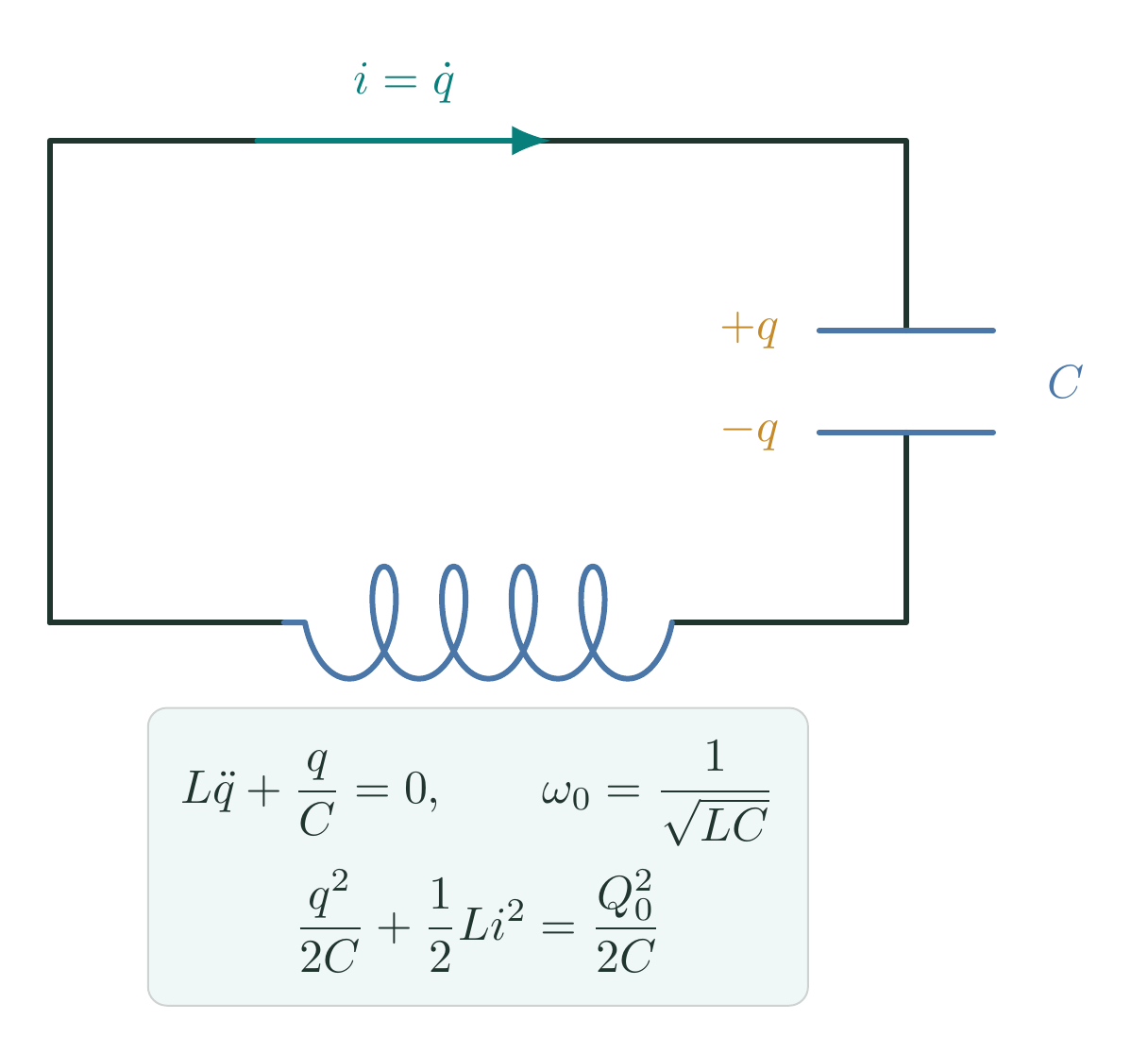
Let $q(t)$ be the signed charge coordinate of a capacitor $C$ connected to an ideal inductor $L$, and choose the loop orientation so that the current is
\[i=\frac{dq}{dt}.\]With no resistance or source, Kirchhoff’s loop rule is
\[L\frac{di}{dt}+\frac qC=0.\]Since $di/dt=d^2q/dt^2$,
\[L\ddot q+\frac qC=0.\]Division by $L$ gives
\[\boxed{\ddot q+\omega_0^2q=0}, \qquad \boxed{\omega_0=\frac1{\sqrt{LC}}}.\]Therefore the oscillation period and frequency are
\[\boxed{T=2\pi\sqrt{LC}}, \qquad \boxed{f=\frac{1}{2\pi\sqrt{LC}}}.\]Thus charge executes SHM:
\[q=Q_0\cos(\omega_0t+\phi).\]The current is
\[i=\dot q=-\omega_0Q_0\sin(\omega_0t+\phi).\]The capacitor’s electric energy and the inductor’s magnetic energy are
\[U_E=\frac{q^2}{2C}, \qquad U_B=\frac12Li^2.\]Substitution of $q$ and $i$, together with $L\omega_0^2=1/C$, gives
\[U_E=\frac{Q_0^2}{2C}\cos^2(\omega_0t+\phi),\] \[U_B=\frac{Q_0^2}{2C}\sin^2(\omega_0t+\phi).\]Therefore
\[\boxed{U_E+U_B=\frac{Q_0^2}{2C}=\text{constant}}.\]The conservation can also be checked directly:
\[\frac{d}{dt}(U_E+U_B) =\frac qC\dot q+Li\dot i =i\left(\frac qC+L\dot i\right)=0\]by Kirchhoff’s equation. The mechanical correspondences are $q\leftrightarrow x$, $i\leftrightarrow\dot x$, $L\leftrightarrow m$, and $1/C\leftrightarrow k$.
Free damped oscillator
For a mechanical oscillator with viscous resistance $-b\dot x$, where $b>0$, Newton’s equation is
\[m\ddot x=-kx-b\dot x.\]Hence
\[m\ddot x+b\dot x+kx=0.\]Define
\[2\beta=\frac bm, \qquad \omega_0^2=\frac km.\]The equation becomes
\[\boxed{\ddot x+2\beta\dot x+\omega_0^2x=0}.\]With $x=e^{\lambda t}$,
\[(\lambda^2+2\beta\lambda+\omega_0^2)e^{\lambda t}=0,\]so the characteristic roots are
\[\boxed{\lambda=-\beta\pm\sqrt{\beta^2-\omega_0^2}}.\]Underdamping: $0<\beta<\omega_0$
Now $\beta^2-\omega_0^2<0$. Define
\[\omega_d=\sqrt{\omega_0^2-\beta^2}.\]Then $\lambda=-\beta\pm i\omega_d$, and the real solution is
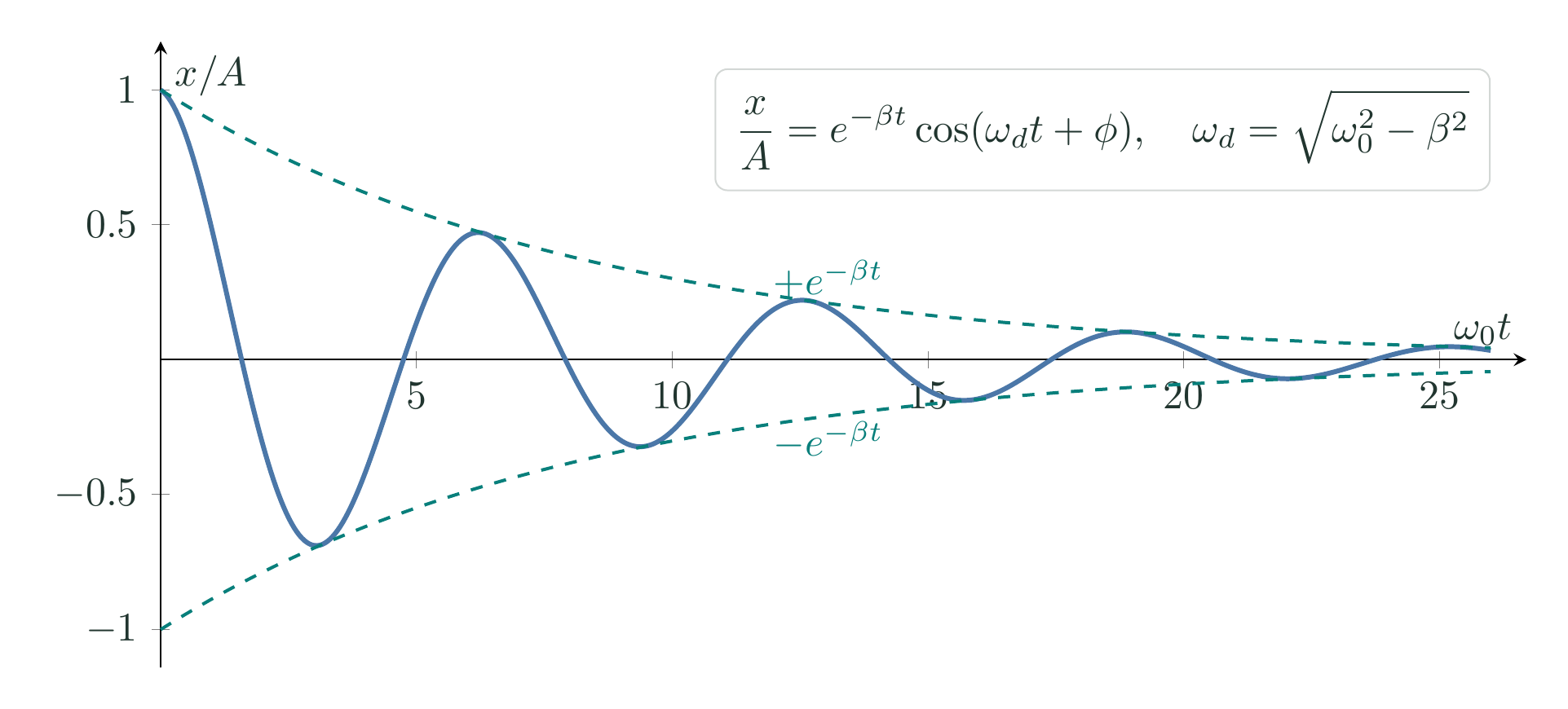
\[\boxed{x=Ae^{-\beta t}\cos(\omega_dt+\phi)}.\]The system oscillates at the damped angular frequency $\omega_d<\omega_0$ inside the exact amplitude envelopes $\pm Ae^{-\beta t}$.
Successive maxima of the same sign are separated by the damped period
\[T_d=\frac{2\pi}{\omega_d}.\]If their magnitudes are $x_n$ and $x_{n+1}$, the exponential envelope gives
\[\frac{|x_n|}{|x_{n+1}|}=e^{\beta T_d}.\]The logarithmic decrement is therefore
\[\boxed{\Lambda=\ln\frac{|x_n|}{|x_{n+1}|} =\beta T_d=\frac{2\pi\beta}{\omega_d}}.\]The amplitude relaxation time is $\tau_A=1/\beta$, the time in which the envelope falls by a factor $e$.
Critical damping: $\beta=\omega_0$
The characteristic equation has the repeated root $\lambda=-\beta$. Two independent solutions are $e^{-\beta t}$ and $te^{-\beta t}$, so
\[\boxed{x=(C_1+C_2t)e^{-\beta t}}.\]The displacement returns to equilibrium without oscillating.
Overdamping: $\beta>\omega_0$
Both characteristic roots are real and negative. Therefore
\[\boxed{x=C_1e^{(-\beta+\sqrt{\beta^2-\omega_0^2})t} +C_2e^{(-\beta-\sqrt{\beta^2-\omega_0^2})t}}.\]This motion also returns to equilibrium without oscillating.
For the mechanical energy
\[E=\frac12m\dot x^2+\frac12kx^2,\]the exact rate of change is
\[\frac{dE}{dt} =\dot x(m\ddot x+kx) =-b\dot x^2\le0.\]Thus damping removes energy monotonically. The displacement envelope decays exactly as $e^{-\beta t}$ in the underdamped case. Only in the weak-damping limit, $\beta\ll\omega_0$, may the energy averaged over a cycle be written as $\langle E\rangle\propto e^{-2\beta t}$.
Solved Problems
1. Charge, current, and energy in an LC oscillator
Problem. An ideal circuit has $L=0.250\ \mathrm{H}$ and $C=10.0\ \mu\mathrm{F}$. Initially the capacitor carries charge $Q_0=40.0\ \mu\mathrm{C}$ and the current is zero. Find $\omega_0$, $T$, the maximum current, and the total energy.
Solution. The angular frequency is
\[\omega_0=\frac1{\sqrt{LC}} =\frac1{\sqrt{(0.250)(10.0\times10^{-6})}} =632.46\ \mathrm{rad\,s^{-1}}.\]Hence
\[T=\frac{2\pi}{\omega_0} =9.935\times10^{-3}\ \mathrm{s}.\]With $q=Q_0\cos\omega_0t$, the current amplitude is
\[I_{\max}=\omega_0Q_0 =(632.46)(40.0\times10^{-6}) =2.530\times10^{-2}\ \mathrm{A}.\]The conserved energy is initially electric:
\[E=\frac{Q_0^2}{2C} =\frac{(40.0\times10^{-6})^2}{2(10.0\times10^{-6})} =8.00\times10^{-5}\ \mathrm{J}.\]Checks. $LC$ has units $\mathrm{s^2}$, $\omega_0Q_0$ has units of amperes, and $Q_0^2/C$ has units of joules. The current initially vanishes and then has the sign $i=-\omega_0Q_0\sin\omega_0t$ for the stated loop convention. At $q=0$, $LI_{\max}^2/2=8.00\times10^{-5}\ \mathrm{J}$, independently checking the energy. As $C\to\infty$, $\omega_0\to0$.
2. An underdamped initial-value problem
Problem. A damped oscillator has $m=1.0\ \mathrm{kg}$, $k=25\ \mathrm{N\,m^{-1}}$, and $b=6.0\ \mathrm{kg\,s^{-1}}$. It is released from rest at $x(0)=0.100\ \mathrm{m}$. Find $x(t)$, the logarithmic decrement, and the same-sign peak-amplitude ratio after one cycle.
Solution. The parameters are
\[\beta=\frac{b}{2m}=3.0\ \mathrm{s^{-1}}, \qquad \omega_0=\sqrt{\frac{k}{m}}=5.0\ \mathrm{rad\,s^{-1}}.\]Since $\beta<\omega_0$, the motion is underdamped, with
\[\omega_d=\sqrt{\omega_0^2-\beta^2} =\sqrt{25-9} =4.0\ \mathrm{rad\,s^{-1}}.\]Write
\[x=e^{-3t}(C\cos4t+D\sin4t).\]The initial displacement gives $C=0.100\ \mathrm{m}$. Differentiating and setting $t=0$ gives
\[v(0)=-3C+4D=0,\]so $D=0.075\ \mathrm{m}$. Therefore
\[\boxed{x(t)=e^{-3t}(0.100\cos4t+0.075\sin4t)\ \mathrm{m}}.\]The logarithmic decrement is
\[\Lambda=\frac{2\pi\beta}{\omega_d} =\frac{2\pi(3)}4 =\frac{3\pi}{2} =4.712.\]Thus
\[\frac{|x_{n+1}|}{|x_n|}=e^{-\Lambda} =e^{-3\pi/2} =8.98\times10^{-3}.\]Checks. $\beta$ and $\omega_d$ both have units $\mathrm{s^{-1}}$, so $\Lambda$ is dimensionless. Direct substitution gives $x(0)=0.100\ \mathrm{m}$ and $v(0)=0$. Both characteristic roots have negative real part, so the envelope decays rather than grows. The critical value is $b_c=2\sqrt{mk}=10\ \mathrm{kg\,s^{-1}}$; as $b\to b_c^-$, $\omega_d\to0$ and the oscillatory description reaches its boundary.
Descriptive Questions
- Derive the differential equation, frequency, charge, current, and energy conservation law of an ideal LC oscillator.
- Starting from the characteristic equation, derive the underdamped, critically damped, and overdamped solutions and state the condition for each.
- Derive the logarithmic decrement and explain how it measures the decay of successive same-sign maxima.
- Prove that $dE/dt=-b\dot x^2$ for viscous damping and distinguish exact amplitude decay from weak-damping cycle-averaged energy decay.
Numerical Problems
-
An ideal LC oscillator has $L=0.200\ \mathrm{H}$, $C=8.00\ \mu\mathrm{F}$, and charge amplitude $Q_0=40.0\ \mu\mathrm{C}$. At an instant when $q=20.0\ \mu\mathrm{C}$ and decreasing, find the current and the fractions of the total energy stored electrically and magnetically.
Final answer:
\[\begin{aligned} i&=-\sqrt{\frac{Q_0^2-q^2}{LC}} =-2.739\times10^{-2}\ \mathrm{A},\\ \frac{U_E}{E}&=\frac14, \qquad \frac{U_B}{E}=\frac34,\\ U_E+U_B&=E. \end{aligned}\] -
A $3.0\ \mu\mathrm{F}$ capacitor has maximum charge $12\ \mu\mathrm{C}$. Find its maximum voltage.
Final answer: $V_{\max}=Q_0/C=4.0\ \mathrm{V}$.
-
The amplitude envelope of an underdamped oscillator of mass $0.500\ \mathrm{kg}$ falls from $12.0\ \mathrm{mm}$ to $9.00\ \mathrm{mm}$ in $0.800\ \mathrm{s}$. Find the amplitude relaxation time $\tau_A$ and viscous damping coefficient $b$.
Final answer: $\tau_A=0.800/\ln(12/9)=2.781\ \mathrm{s}$ and $b=2m/\tau_A=0.3596\ \mathrm{kg\,s^{-1}}$.
-
Classify the damping for $m=2.0\ \mathrm{kg}$, $k=18\ \mathrm{N\,m^{-1}}$, and $b=12\ \mathrm{kg\,s^{-1}}$.
Final answer: $\beta=3.0\ \mathrm{s^{-1}}=\omega_0$; the motion is critically damped.
-
For $m=1.0\ \mathrm{kg}$, $k=100\ \mathrm{N\,m^{-1}}$, and $b=8.0\ \mathrm{kg\,s^{-1}}$, find $\omega_d$ and $T_d$.
Final answer: $\omega_d=\sqrt{84}=9.165\ \mathrm{rad\,s^{-1}}$ and $T_d=0.6856\ \mathrm{s}$.
-
Find the two decay constants for $m=1.0\ \mathrm{kg}$, $k=8.0\ \mathrm{N\,m^{-1}}$, and $b=6.0\ \mathrm{kg\,s^{-1}}$.
Final answer: $\lambda_1=-2.0\ \mathrm{s^{-1}}$ and $\lambda_2=-4.0\ \mathrm{s^{-1}}$; the motion is overdamped.
The LC and damping identities and all eight worked answers are independently checked in the Maxima worksheet; every printed residual or check is zero.
References
- RLC circuit — Wikipedia.
- OpenStax, University Physics Volume 2, Section 14.5: Oscillations in an LC Circuit.
- OpenStax, University Physics Volume 2, Section 14.6: RLC Series Circuits.
- OpenStax, University Physics Volume 1, Section 15.5: Damped Oscillations.
- John R. Taylor, Classical Mechanics, University Science Books (2005), Chapter 5.


Discussion