

07 Jul 2025
Length Contraction and Time Dilation
Operational definitions of proper time and proper length, followed by complete Lorentz-transformation derivations.
Relativistic measurements compare events. An event has coordinates $(t,x,y,z)$; a time interval needs two clock readings, while a length needs the two endpoint positions measured at the same time in the measuring frame. Throughout, $S^{\prime}$ moves at speed $v$ along $+x$ relative to $S$, with $\lvert v\rvert<c$.
Time dilation
Let a clock be at rest in $S^{\prime}$. Two ticks occur at the same position, so $\Delta x^{\prime}=0$. Its reading
\[\Delta\tau\equiv\Delta t^{\prime}\]is the proper time. From the inverse Lorentz transformation,
\[\Delta t =\gamma\left(\Delta t^{\prime}+\frac{v\Delta x^{\prime}}{c^2}\right) =\gamma\Delta t^{\prime}.\]Hence
\[\boxed{\Delta t=\gamma\Delta\tau}.\]Because $\gamma\ge1$, the coordinate-time interval in $S$ is at least as large as the proper time recorded by the single clock: a moving clock accumulates less elapsed time between the same two events.
The same result follows from a light clock. If the mirrors have rest separation $D$, one transverse half-tick lasts $\Delta\tau/2=D/c$. In $S$, the light crosses a diagonal while the clock moves $v\Delta t/2$:
\[\left(\frac{c\Delta t}{2}\right)^2 =D^2+\left(\frac{v\Delta t}{2}\right)^2.\]Using $D=c\Delta\tau/2$,
\[c^2\Delta t^2=c^2\Delta\tau^2+v^2\Delta t^2,\] \[\Delta t^2(1-\beta^2)=\Delta\tau^2, \qquad \Delta t=\gamma\Delta\tau.\]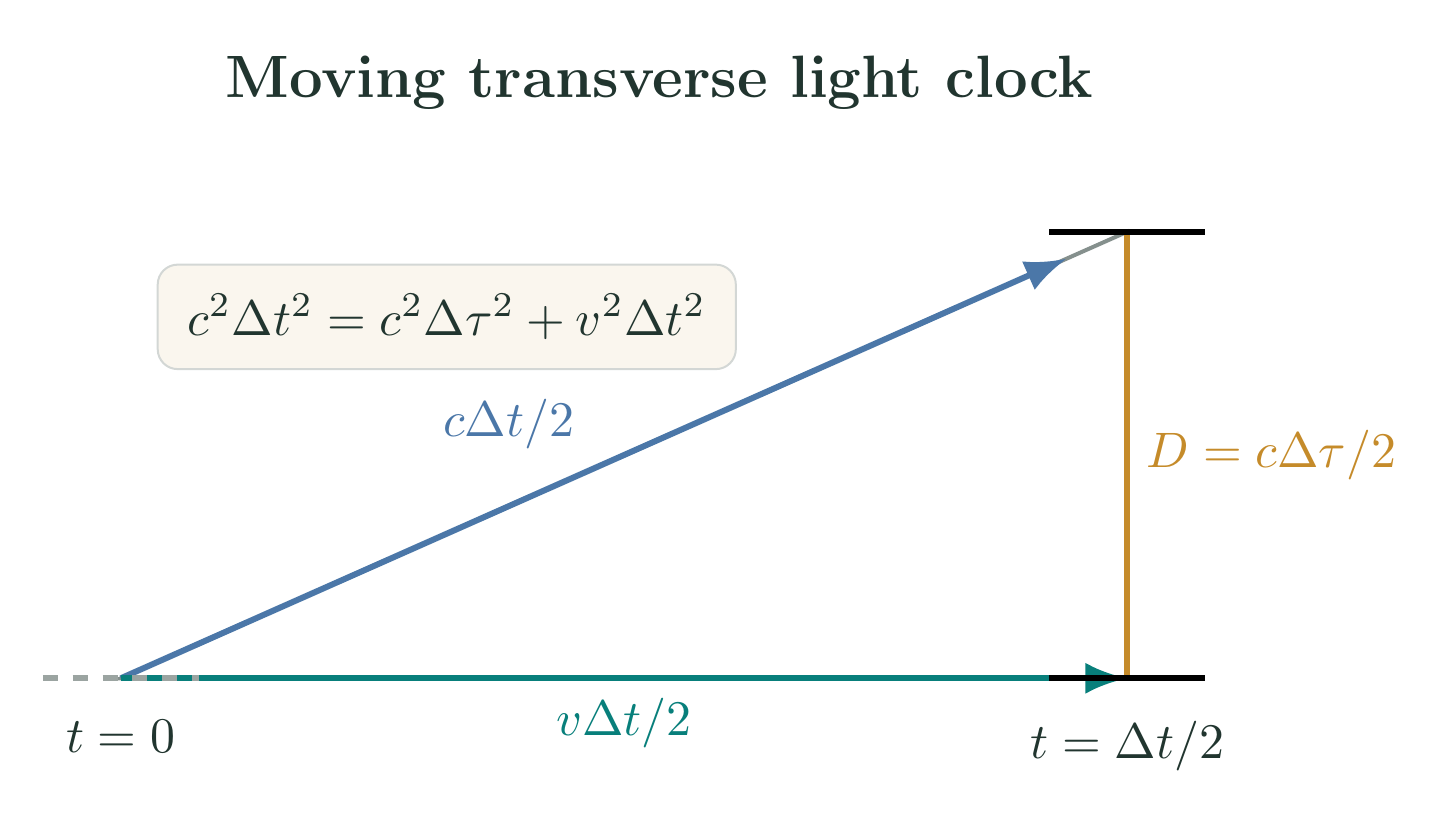
Lorentz contraction
Let a rod be at rest in $S^{\prime}$ with endpoints $x_1^{\prime}$ and $x_2^{\prime}$. Its proper length is
\[L_0=x_2^{\prime}-x_1^{\prime}.\]To measure its length in $S$, record both endpoint positions simultaneously: $\Delta t=t_2-t_1=0$. Applying the direct position transformation to the two endpoint events,
\[\begin{aligned} L_0=\Delta x^{\prime} &=\gamma(\Delta x-v\Delta t)\\ &=\gamma\Delta x. \end{aligned}\]Therefore
\[\boxed{L=\Delta x=\frac{L_0}{\gamma} =L_0\sqrt{1-\frac{v^2}{c^2}}}.\]Only the dimension parallel to the relative motion contracts; $y^{\prime}=y$ and $z^{\prime}=z$ leave transverse lengths unchanged. The simultaneity condition $\Delta t=0$ is essential: endpoint positions recorded at different times do not define the rod’s length in $S$. At $v=0$, $\gamma=1$ and $L=L_0$; as $\lvert v\rvert$ increases, $L<L_0$.
Solved Problems
1. Atmospheric muons in two frames
A muon has proper mean lifetime $\tau_0=2.197\ \mu\mathrm s$ and moves downward at $v=0.980c$ relative to Earth. Find its mean lifetime and travel distance in the Earth frame, then reproduce the encounter distance in the muon frame. Take downward as positive and $c=3.00\times10^8\ \mathrm{m\,s^{-1}}$.
The muon is at rest in its own frame, so its decay events occur at the same place there and $\tau_0$ is the proper time. Since
\[\gamma=\frac{1}{\sqrt{1-0.980^2}}=5.0252,\]the Earth-frame lifetime is
\[\Delta t=\gamma\tau_0 =(5.0252)(2.197\ \mu\mathrm s) =\boxed{11.04\ \mu\mathrm s}.\]The mean downward distance in Earth coordinates is
\[d=v\Delta t =(0.980)(3.00\times10^8)(11.04\times10^{-6}) =\boxed{3.246\times10^3\ \mathrm m}.\]In the muon frame, Earth and the atmosphere move upward. The Earth-frame distance $d$ is a proper length for two points fixed to Earth, so the muon measures
\[d^{\prime}=\frac d\gamma=645.9\ \mathrm m.\]It also obtains $\lvert d^{\prime}\rvert=(0.980c)\tau_0=645.9\ \mathrm m$; the negative velocity only indicates upward motion. The two frames therefore predict the same encounter event. For $v\to0$, $\gamma\to1$, time dilation and length contraction both disappear.
2. Simultaneous endpoint measurement of a moving rod
A rod has proper length $L_0=10.0\ \mathrm m$ in $S^{\prime}$ and moves along $+x$ at $v=0.800c$ relative to $S$. Find its length in $S$ and the time separation in $S^{\prime}$ between the two endpoint events used by $S$.
The measuring frame $S$ must record the rear and front endpoints simultaneously, so
\[\Delta t=0.\]With $\gamma=5/3$, the position transformation gives
\[L_0=\Delta x^{\prime}=\gamma(\Delta x-v\Delta t)=\gamma L.\]Thus
\[L=\frac{L_0}{\gamma} =\frac{10.0}{5/3} =\boxed{6.00\ \mathrm m}.\]The same pair of events is not simultaneous in $S^{\prime}$:
\[\begin{aligned} \Delta t^{\prime} &=\gamma\left(\Delta t-\frac{v\Delta x}{c^2}\right)\\ &=-\frac53\frac{(0.800c)(6.00\ \mathrm m)}{c^2}\\ &=\boxed{-2.667\times10^{-8}\ \mathrm s}. \end{aligned}\]The negative sign means that, in the rod frame, the event at the front endpoint occurred first. It is therefore invalid to call the $6.00\ \mathrm m$ separation a rest-frame length. At $v=0$, both frames measure $10.0\ \mathrm m$ and the endpoint events become simultaneous.
Descriptive Questions
- Define proper time operationally and derive time dilation using the inverse Lorentz transformation.
- Derive time dilation from the geometry of a transverse light clock and identify the frame of each measured interval.
- Define proper length and derive longitudinal length contraction using simultaneous endpoint events.
- Explain why transverse dimensions do not contract and why simultaneity is essential in any length measurement.
Numerical Problems
- During a $10.0\ \mu\mathrm s$ laboratory interval, a clock moves at $0.800c$. Find the moving clock’s reading and how far it falls behind the laboratory clocks. Answer: $\Delta\tau=6.00\ \mu\mathrm s$; lag $=4.00\ \mu\mathrm s$.
- A spacecraft moving at $0.600c$ takes $0.400\ \mu\mathrm s$ to pass a fixed detector, from nose arrival to tail arrival. Find its length in the laboratory and its proper length. Answer: $L=v\Delta t=72.0\ \mathrm m$ and $L_0=\gamma L=90.0\ \mathrm m$.
- At what speed is a moving clock dilated by a factor of two? Answer: $v=(\sqrt3/2)c\simeq0.866c$.
- A rod is observed to have $80.0\%$ of its proper length. Find its speed. Answer: $v=0.600c$.
- Two events have $\Delta t=5.00\ \mu\mathrm s$ and $\Delta x=900\ \mathrm m$ in the laboratory. Find the proper time between them. Answer: $\Delta\tau=4.00\ \mu\mathrm s$.
- A cube has rest dimensions $1.00\ \mathrm m\times1.00\ \mathrm m\times1.00\ \mathrm m$ and moves along one edge at $0.600c$. Find its laboratory dimensions and volume. Answer: $0.800\ \mathrm m\times1.00\ \mathrm m\times1.00\ \mathrm m$; $V=0.800\ \mathrm{m^3}$.
The derivations and all problem values are checked in the Maxima worksheet; every printed residual is zero.
References
- “Time dilation,” Wikipedia.
- A. P. French, Special Relativity, 1st ed., MIT Introductory Physics Series, W. W. Norton, 1968, Chapter 4, “Relativity and the Measurement of Lengths and Time Intervals.”
- David J. Griffiths, Introduction to Electrodynamics, 4th ed., Cambridge University Press, 2017, Chapter 12, §12.1, “The Special Theory of Relativity.”


Discussion