

04 Jul 2025
Lorentz Transformations from the Light Postulate
A first-principles derivation of the direct and inverse Lorentz transformations and the invariant spacetime interval.
Use the standard configuration: $S^{\prime}$ moves with constant velocity $v\hat{\mathbf x}$ relative to $S$, the axes are parallel, and the origins coincide at $t=t^{\prime}=0$. We require $\lvert v\rvert<c$. Homogeneity of space and time requires a linear transformation. Since the origin $x^{\prime}=0$ follows $x=vt$,
\[x^{\prime}=A(x-vt).\]Write the most general linear time relation as $t^{\prime}=B(t-Dx)$. A light pulse emitted at the common origin satisfies $x=ct$ and $x^{\prime}=ct^{\prime}$. Substitution gives
\[A(c-v)t=cB(1-Dc)t. \tag{1}\]For the pulse moving toward $-x$, $x=-ct$ and $x^{\prime}=-ct^{\prime}$, so
\[A(-c-v)t=-cB(1+Dc)t,\]or
\[A(c+v)=cB(1+Dc). \tag{2}\]Adding and subtracting (1) and (2),
\[2Ac=2cB\quad\Rightarrow\quad A=B,\] \[2Av=2c^2BD\quad\Rightarrow\quad D=\frac{v}{c^2}.\]Thus
\[x^{\prime}=A(x-vt), \qquad t^{\prime}=A\left(t-\frac{vx}{c^2}\right).\]The relativity principle and reciprocity make the inverse transformation identical in form after $v\to-v$ and interchange of primed and unprimed coordinates:
\[x=A(x^{\prime}+vt^{\prime}), \qquad t=A\left(t^{\prime}+\frac{vx^{\prime}}{c^2}\right).\]Insert the direct expressions into the first inverse equation:
\[\begin{aligned} x &=A\left[A(x-vt)+vA\left(t-\frac{vx}{c^2}\right)\right]\\ &=A^2x\left(1-\frac{v^2}{c^2}\right). \end{aligned}\]Therefore
\[A^2(1-\beta^2)=1, \qquad A=\gamma\equiv\frac{1}{\sqrt{1-\beta^2}},\]where the positive root is selected by continuity with $A=1$ at $v=0$. The Lorentz transformations are
\[\boxed{x^{\prime}=\gamma(x-vt)},\qquad \boxed{t^{\prime}=\gamma\left(t-\frac{vx}{c^2}\right)},\] \[\boxed{y^{\prime}=y},\qquad \boxed{z^{\prime}=z}.\]Their inverse is obtained by changing the sign of $v$:
\[\boxed{x=\gamma(x^{\prime}+vt^{\prime})},\qquad \boxed{t=\gamma\left(t^{\prime}+\frac{vx^{\prime}}{c^2}\right)}, \qquad y=y^{\prime},\quad z=z^{\prime}.\]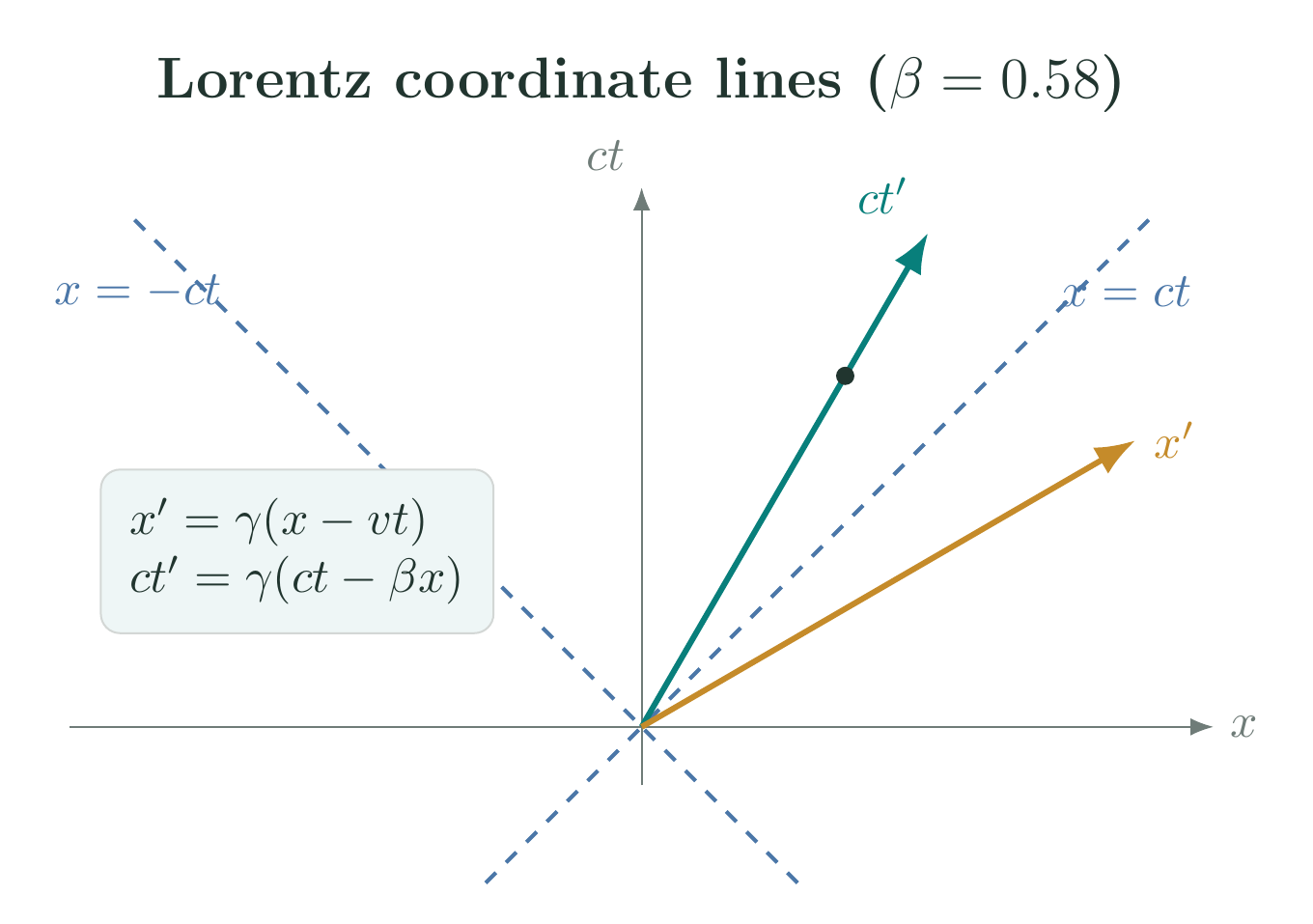
Interval check
Direct substitution gives
\[\begin{aligned} c^2(t^{\prime})^2-(x^{\prime})^2 &=\gamma^2\left[ c^2\left(t-\frac{vx}{c^2}\right)^2-(x-vt)^2 \right]\\ &=\gamma^2\left[ c^2t^2-2vtx+\frac{v^2x^2}{c^2} -x^2+2vtx-v^2t^2 \right]\\ &=\gamma^2(1-\beta^2)(c^2t^2-x^2)\\ &=c^2t^2-x^2. \end{aligned}\]Including the unchanged transverse coordinates,
\[\boxed{c^2(t^{\prime})^2-(x^{\prime})^2-(y^{\prime})^2-(z^{\prime})^2 =c^2t^2-x^2-y^2-z^2}.\]This invariant will be used to classify event order. For fixed event coordinates in the non-relativistic limit $\lvert v\rvert/c\to0$, $\gamma\to1$ and $vx/c^2\to0$, recovering $x^{\prime}\simeq x-vt$ and $t^{\prime}\simeq t$.
Solved Problems
1. Transforming an event and checking its interval
Frame $S^{\prime}$ moves along $+x$ at $v=0.600c$ relative to $S$. An event has $x=600\ \mathrm m$ and $t=3.00\ \mu\mathrm s$ in $S$. Find $(x^{\prime},t^{\prime})$ and verify the spacetime interval. Use $c=3.00\times10^8\ \mathrm{m\,s^{-1}}$.
For $\beta=0.600$,
\[\gamma=\frac{1}{\sqrt{1-0.600^2}}=1.25.\]The direct transformation gives
\[\begin{aligned} x^{\prime} &=\gamma(x-vt)\\ &=1.25\left[600-(0.600)(3.00\times10^8)(3.00\times10^{-6})\right]\mathrm m\\ &=\boxed{75.0\ \mathrm m}, \end{aligned}\]and
\[\begin{aligned} t^{\prime} &=\gamma\left(t-\frac{vx}{c^2}\right)\\ &=1.25\left[3.00-\frac{(0.600)(600)}{300}\right]\mu\mathrm s\\ &=\boxed{2.25\ \mu\mathrm s}. \end{aligned}\]In $S$, $ct=900\ \mathrm m$, so
\[c^2t^2-x^2=(900)^2-(600)^2=4.50\times10^5\ \mathrm{m^2}.\]In $S^{\prime}$, $ct^{\prime}=675\ \mathrm m$, and
\[c^2(t^{\prime})^2-(x^{\prime})^2=(675)^2-(75)^2 =4.50\times10^5\ \mathrm{m^2}.\]The positive interval is unchanged, so the event lies inside the future light cone of the common origin. As $v\to0$, $x^{\prime}\to x$ and $t^{\prime}\to t$.
2. Two collinear Lorentz boosts
Frame $S^{\prime}$ moves at $v_1=0.600c$ relative to $S$, and $S^{\prime\prime}$ moves at $v_2=0.800c$ relative to $S^{\prime}$, both along $+x$. Find the velocity and Lorentz factor of $S^{\prime\prime}$ relative to $S$ by composing the transformations.
Write $\beta_i=v_i/c$. Applying the two position transformations gives
\[\begin{aligned} x^{\prime\prime} &=\gamma_2(x^{\prime}-v_2t^{\prime})\\ &=\gamma_1\gamma_2 \left[(1+\beta_1\beta_2)x-(v_1+v_2)t\right]. \end{aligned}\]Factor the coefficient of $x$:
\[x^{\prime\prime}=\gamma_1\gamma_2(1+\beta_1\beta_2) \left[x-\frac{v_1+v_2}{1+v_1v_2/c^2}t\right].\]It has the standard Lorentz form, hence
\[\beta=\frac{\beta_1+\beta_2}{1+\beta_1\beta_2} =\frac{0.600+0.800}{1+(0.600)(0.800)} =\boxed{\frac{35}{37}\simeq0.94595}.\]Also,
\[\gamma =\gamma_1\gamma_2(1+\beta_1\beta_2) =\left(\frac54\right)\left(\frac53\right)\left(\frac{37}{25}\right) =\boxed{\frac{37}{12}\simeq3.0833}.\]Both velocities were defined positive, so the resultant is along $+x$ and remains below $c$. If $v_2\to0$, the result becomes $v_1$; when both speeds are small compared with $c$, the denominator tends to one and the Galilean sum is recovered.
Descriptive Questions
- Derive the Lorentz transformation from linearity, the two light rays $x=\pm ct$, and reciprocity between inertial frames.
- Explain why the positive root of the normalization factor is selected when deriving $\gamma$.
- Obtain the inverse Lorentz transformation and show explicitly that it recovers the original event coordinates.
- Prove that the spacetime interval is invariant under a standard Lorentz boost and state its physical significance.
Numerical Problems
- An event has $ct=500\ \mathrm m$ and $x=500/3\ \mathrm m$ in $S$. Apart from $v=0$, find the boost along $+x$ for which its transformed coordinate time is unchanged, $t^{\prime}=t$, and then find $x^{\prime}$. Answer: $v=+0.600c$ and $x^{\prime}=-500/3\ \mathrm m\simeq-166.7\ \mathrm m$.
- For $v=0.600c$, an event has $x^{\prime}=120\ \mathrm m$, $t^{\prime}=1.00\ \mu\mathrm s$. Use the inverse transformation. Answer: $x=375\ \mathrm m$, $t=1.55\ \mu\mathrm s$.
- Calculate the Lorentz factor at $v=0.960c$. Answer: $\gamma=25/7\simeq3.571$.
- A light event has $x=900\ \mathrm m$, $t=3.00\ \mu\mathrm s$. Transform it to a frame moving at $0.800c$ along $+x$. Answer: $x^{\prime}=300\ \mathrm m$, $t^{\prime}=1.00\ \mu\mathrm s$, so $x^{\prime}=ct^{\prime}$.
- Two events satisfy $c\Delta t=500\ \mathrm m$ and $\Delta x=300\ \mathrm m$. Find $\Delta s^2$ and the proper time. Answer: $\Delta s^2=1.60\times10^5\ \mathrm{m^2}$, $\Delta\tau=1.333\ \mu\mathrm s$.
- An event on the moving origin has $x=480\ \mathrm m$ at $t=2.00\ \mu\mathrm s$ in $S$. Find the velocity of $S^{\prime}$ relative to $S$. Answer: $v=x/t=+0.800c$.
The derivations and all problem values are checked in the Maxima worksheet; every printed residual is zero.
References
- “Lorentz transformation,” Wikipedia.
- A. P. French, Special Relativity, 1st ed., MIT Introductory Physics Series, W. W. Norton, 1968, Chapter 3, “Einstein and the Lorentz–Einstein Transformations.”
- David J. Griffiths, Introduction to Electrodynamics, 4th ed., Cambridge University Press, 2017, Chapter 12, §12.1, “The Special Theory of Relativity.”


Discussion