

18 Jun 2025
Simple, Compound, and Torsional Pendulums
Small-oscillation equations and periods of three mechanical systems executing SHM.
The following systems execute simple harmonic motion only when their restoring force or torque is linear in the displacement.
Simple pendulum
Consider a point mass $m$ suspended from a fixed support by a light, inextensible string of length $l$. Let $\theta$ be the angular displacement from the downward vertical. The tangential component of gravity is opposite to increasing $\theta$:
\[F_\theta=-mg\sin\theta.\]The tangential acceleration is $a_\theta=l\ddot\theta$, so
\[ml\ddot\theta=-mg\sin\theta.\]After cancellation of $m$ and division by $l$, the exact equation is
\[\ddot\theta+\frac gl\sin\theta=0.\]For a small angular amplitude measured in radians, $\lvert\theta\rvert\ll1$ and $\sin\theta\simeq\theta$. The equation then becomes
\[\ddot\theta+\frac gl\theta=0.\]Comparison with $\ddot\theta+\omega_0^2\theta=0$ gives
\[\omega_0=\sqrt{\frac gl}, \qquad \boxed{T=2\pi\sqrt{\frac lg}}.\]The finite-amplitude pendulum is periodic but is not exactly simple harmonic; the boxed period is the small-angle result.
Compound pendulum
A compound pendulum is a rigid body of mass $m$ oscillating about a fixed horizontal axis. Let its centre of mass be a distance $d>0$ from the axis, and let $I$ be its moment of inertia about that axis. Gravity produces the restoring torque
\[\tau=-mgd\sin\theta.\]Using $I\ddot\theta=\tau$,
\[I\ddot\theta=-mgd\sin\theta.\]For $\lvert\theta\rvert\ll1$,
\[\ddot\theta+\frac{mgd}{I}\theta=0.\]Therefore
\[\omega_0=\sqrt{\frac{mgd}{I}}, \qquad \boxed{T=2\pi\sqrt{\frac{I}{mgd}}}.\]If $I_{\rm cm}=mk_g^2$, where $k_g$ is the radius of gyration about the centre-of-mass axis parallel to the pivot axis, the parallel-axis theorem gives
\[I=I_{\rm cm}+md^2=m(k_g^2+d^2).\]Substitution into the period yields
\[T=2\pi\sqrt{\frac{k_g^2+d^2}{gd}}.\]Define the equivalent simple-pendulum length $l_{\rm eq}$ by $T=2\pi\sqrt{l_{\rm eq}/g}$. Equating the two expressions for $T^2$ gives
\[\frac{l_{\rm eq}}g=\frac{I}{mgd},\]and hence
\[\boxed{l_{\rm eq}=\frac{I}{md}=d+\frac{k_g^2}{d}}.\]For a body with fixed $k_g$, the equivalent length is least when
\[\frac{d l_{\rm eq}}{d\,d} =1-\frac{k_g^2}{d^2}=0.\]Since $d>0$, this gives $d=k_g$. Moreover,
\[\frac{d^2 l_{\rm eq}}{d\,d^2}=\frac{2k_g^2}{d^3}>0,\]so the stationary value is a minimum. Therefore
\[\boxed{l_{\rm eq,min}=2k_g}, \qquad \boxed{T_{\min}=2\pi\sqrt{\frac{2k_g}{g}}}.\]Torsional pendulum
Let a body of moment of inertia $I$ be suspended by a wire. Within the wire’s linear elastic range, a small rotation $\theta$ produces the restoring torque
\[\tau=-\kappa\theta,\]where $\kappa>0$ is the torsional constant. The rotational equation of motion is
\[I\ddot\theta=-\kappa\theta,\]or
\[\ddot\theta+\frac\kappa I\theta=0.\]Thus
\[\omega_0=\sqrt{\frac\kappa I}, \qquad \boxed{T=2\pi\sqrt{\frac I\kappa}}.\]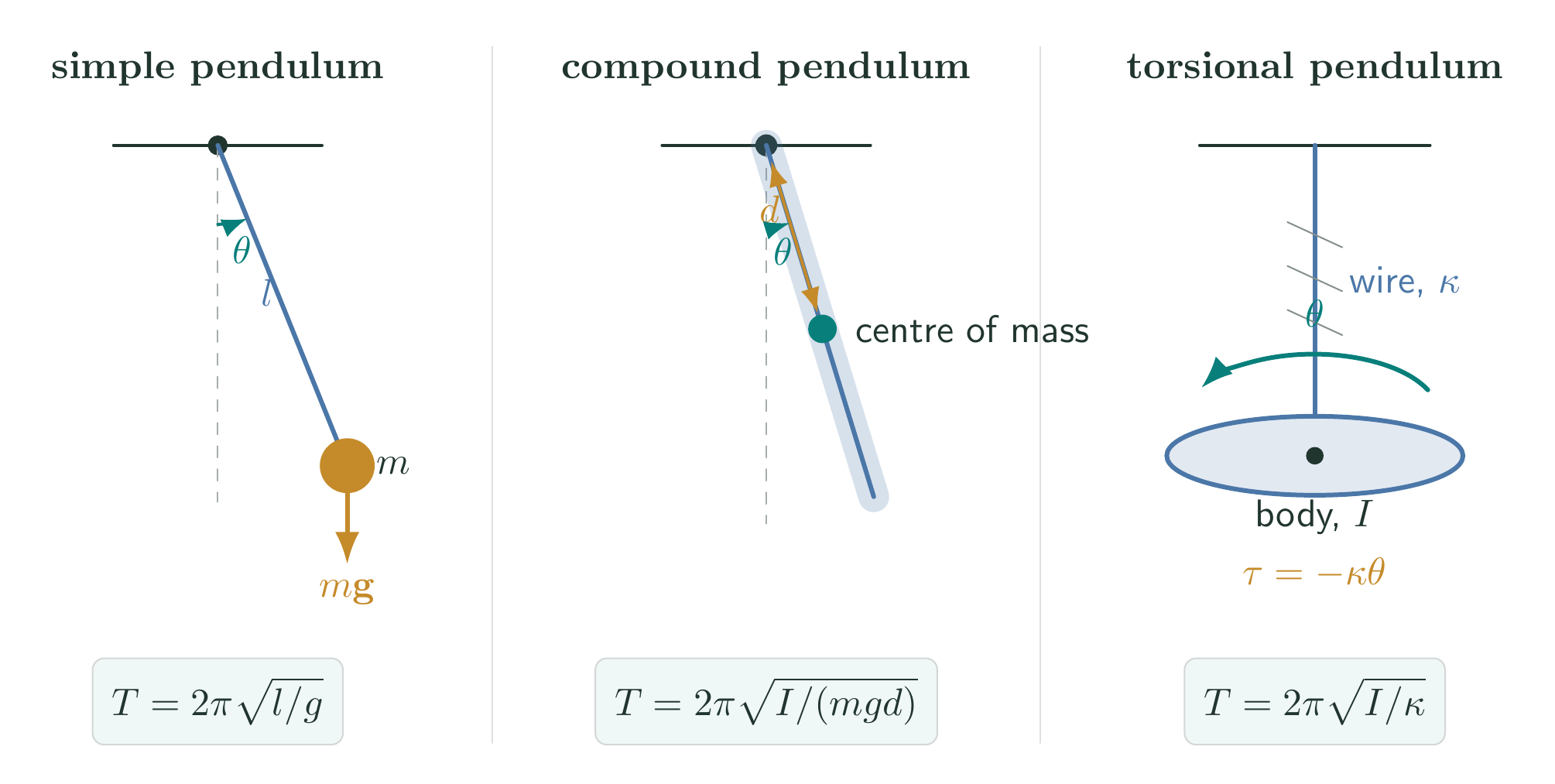
Solved Problems
1. Uniform rod as a compound pendulum
Problem. A uniform rod of length $1.20\ \mathrm{m}$ is pivoted about a horizontal axis through a point $0.20\ \mathrm{m}$ from one end. Find its equivalent length and small-oscillation period using $g=9.80\ \mathrm{m\,s^{-2}}$.
Solution. The centre of mass is $0.60\ \mathrm{m}$ from the same end, so
\[d=0.60-0.20=0.40\ \mathrm{m}.\]For a uniform rod,
\[I_{\rm cm}=\frac{mL^2}{12}.\]The parallel-axis theorem gives
\[I=m\left(\frac{L^2}{12}+d^2\right) =m(0.120+0.160) =0.280m.\]Hence
\[l_{\rm eq}=\frac{I}{md} =\frac{0.280}{0.40} =0.700\ \mathrm{m},\]and
\[T=2\pi\sqrt{\frac{l_{\rm eq}}{g}} =2\pi\sqrt{\frac{0.700}{9.80}} =1.679\ \mathrm{s}.\]Checks. The mass cancels, and $I/(md)$ has units of length. Here $d>0$, so the gravitational torque is restoring for small positive $\theta$. The equivalent length lies within the rod but need not equal the pivot-to-centre-of-mass distance. As $d\to0^+$, the restoring torque vanishes and the period tends to infinity.
2. Added ring on a torsional platform
Problem. A torsional platform has moment of inertia $I_0=0.020\ \mathrm{kg\,m^2}$ and period $T_0=1.00\ \mathrm{s}$. A thin ring of mass $1.00\ \mathrm{kg}$ and radius $0.200\ \mathrm{m}$ is placed concentrically on it. Find the torsional constant and the new period.
Solution. From $T_0=2\pi\sqrt{I_0/\kappa}$,
\[\kappa=\frac{4\pi^2I_0}{T_0^2} =4\pi^2(0.020) =0.7896\ \mathrm{N\,m\,rad^{-1}}.\]The ring’s moment of inertia about its symmetry axis is
\[I_{\rm ring}=MR^2 =(1.00)(0.200)^2 =0.040\ \mathrm{kg\,m^2}.\]Thus $I=I_0+I_{\rm ring}=0.060\ \mathrm{kg\,m^2}$, and
\[T=2\pi\sqrt{\frac{I}{\kappa}} =T_0\sqrt{\frac{I}{I_0}} =\sqrt3\ \mathrm{s} =1.732\ \mathrm{s}.\]Checks. $\kappa$ has units $\mathrm{N\,m\,rad^{-1}}$, so $I/\kappa$ has units $\mathrm{s^2}$. The torque $-\kappa\theta$ opposes the angular displacement. Adding positive moment of inertia must lengthen the period, as the result does. If the ring mass tends to zero, $I\to I_0$ and $T\to T_0$.
Descriptive Questions
- Derive the exact equation of a simple pendulum and obtain its small-angle period, stating precisely where the SHM approximation enters.
- Derive the period and equivalent length of a compound pendulum using the parallel-axis theorem.
- Show that the compound-pendulum period is minimum when the pivot-to-centre-of-mass distance equals the radius of gyration.
- Derive the equation and period of a torsional pendulum and explain the physical meaning and SI units of the torsional constant.
Numerical Problems
-
Find the small-angle period of a simple pendulum of length $0.810\ \mathrm{m}$ at $g=9.80\ \mathrm{m\,s^{-2}}$.
Final answer: $T=1.806\ \mathrm{s}$.
-
A simple pendulum has period $1.50\ \mathrm{s}$ where $g=9.80\ \mathrm{m\,s^{-2}}$. Find its length.
Final answer: $l=g(T/2\pi)^2=0.5585\ \mathrm{m}$.
-
A compound pendulum has $k_g=0.300\ \mathrm{m}$ and period $T$ when its pivot is $d_1=0.200\ \mathrm{m}$ from the centre of mass. Find the other positive pivot distance $d_2\ne d_1$ that gives the same small-oscillation period, and find that period at $g=9.80\ \mathrm{m\,s^{-2}}$.
Final answer: Equal equivalent lengths give $d_1d_2=k_g^2$, so $d_2=0.450\ \mathrm{m}$; $l_{\rm eq}=0.650\ \mathrm{m}$ and $T=\pi\sqrt{13}/7=1.618\ \mathrm{s}$.
-
A rigid body has $k_g=0.300\ \mathrm{m}$. Find the pivot distance for minimum period and the minimum period at $g=9.81\ \mathrm{m\,s^{-2}}$.
Final answer: $d=0.300\ \mathrm{m}$ and $T_{\min}=1.554\ \mathrm{s}$.
-
Find the period of a torsional pendulum with $I=0.012\ \mathrm{kg\,m^2}$ and $\kappa=0.300\ \mathrm{N\,m\,rad^{-1}}$.
Final answer: $T=1.257\ \mathrm{s}$.
-
A torsional pendulum has $I=0.010\ \mathrm{kg\,m^2}$, $\kappa=0.400\ \mathrm{N\,m\,rad^{-1}}$, and angular amplitude $0.100\ \mathrm{rad}$. Find its maximum angular speed.
Final answer: $\dot\theta_{\max}=\theta_0\sqrt{\kappa/I}=0.6325\ \mathrm{rad\,s^{-1}}$.
The small-oscillation identities and all eight worked answers are independently checked in the Maxima worksheet; every printed residual or check is zero.
References
- Pendulum — Wikipedia.
- OpenStax, University Physics Volume 1, Section 15.4: Pendulums.
- John R. Taylor, Classical Mechanics, University Science Books (2005), Chapter 5.


Discussion