

16 Jul 2025
Relativistic Doppler Effect
Longitudinal, angular, and transverse relativistic Doppler shifts with explicit sign and angle conventions.
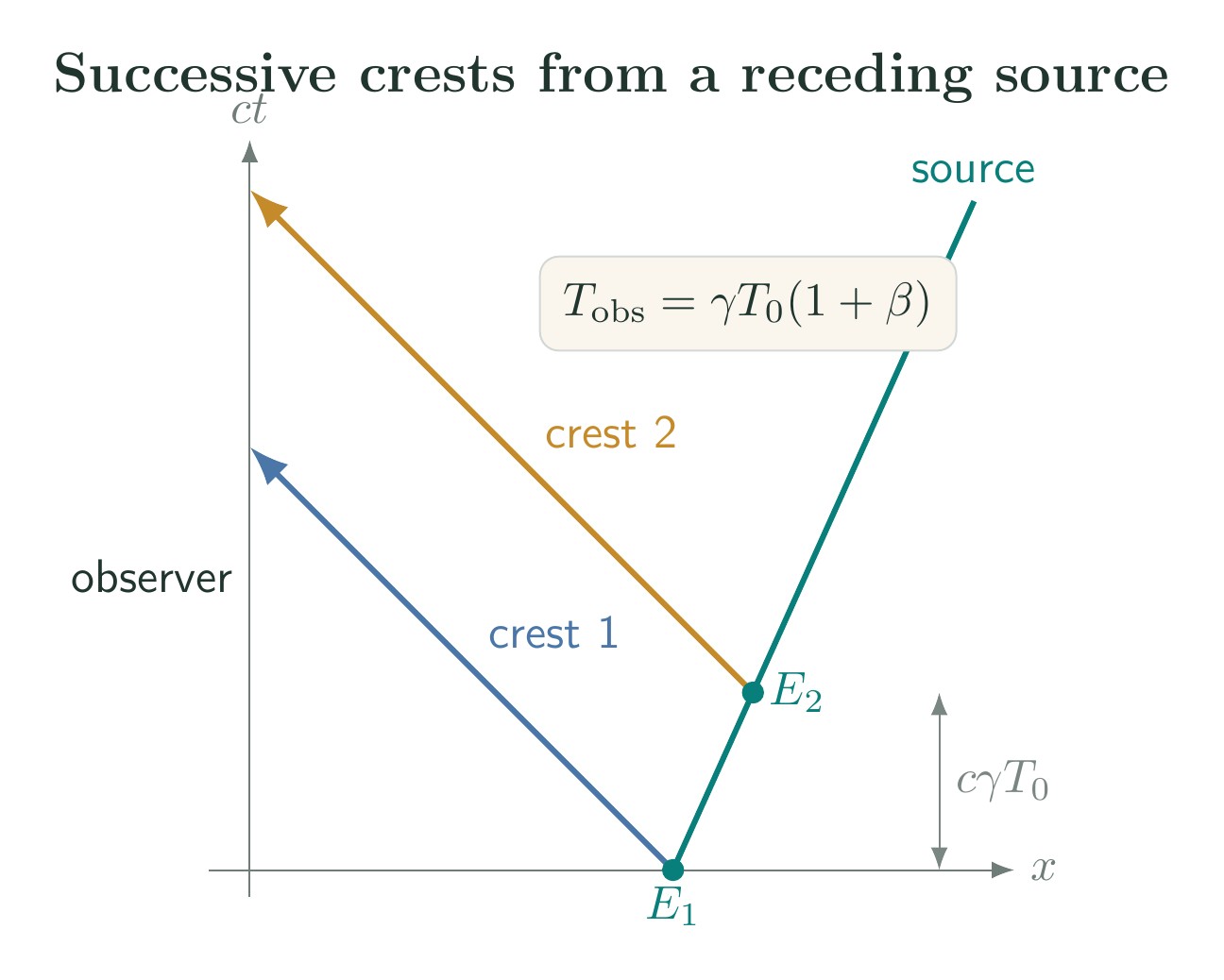
Let a source emit successive wave crests with proper period $T_0=1/\nu_0$. The two emissions occur at the same source position in its rest frame, so an observer who sees the source move at speed $v$ measures the emission interval
\[\Delta t_{\rm e}=\gamma T_0.\]Receding source
During this interval the source moves away by
\[\Delta x_{\rm e}=v\Delta t_{\rm e}=v\gamma T_0.\]The second crest must traverse this additional distance, taking $\Delta x_{\rm e}/c$. The reception period is therefore
\[\begin{aligned} T_{\rm obs} &=\Delta t_{\rm e}+\frac{\Delta x_{\rm e}}{c}\\ &=\gamma T_0(1+\beta). \end{aligned}\]Consequently,
\[\begin{aligned} \nu_{\rm obs} &=\frac{\nu_0}{\gamma(1+\beta)}\\ &=\nu_0\frac{\sqrt{1-\beta^2}}{1+\beta}\\ &=\boxed{\nu_0\sqrt{\frac{1-\beta}{1+\beta}}}. \end{aligned}\]The frequency decreases: this is a redshift.
Approaching source
If the source approaches, its second emission is closer by $v\gamma T_0$. The reception interval becomes
\[T_{\rm obs}=\gamma T_0(1-\beta),\]and
\[\boxed{\nu_{\rm obs} =\nu_0\sqrt{\frac{1+\beta}{1-\beta}}}.\]The frequency increases: this is a blueshift. For purely longitudinal motion, both cases can be written with signed radial velocity $\beta_r=v_r/c$, positive for recession:
\[\boxed{\frac{\nu_{\rm obs}}{\nu_0} =\sqrt{\frac{1-\beta_r}{1+\beta_r}}}.\]For $\lvert\beta_r\rvert\ll1$, use $(1+x)^a\simeq1+ax$:
\[\frac{\nu_{\rm obs}}{\nu_0} =(1-\beta_r)^{1/2}(1+\beta_r)^{-1/2} \simeq\left(1-\frac{\beta_r}{2}\right) \left(1-\frac{\beta_r}{2}\right) \simeq1-\beta_r.\]Thus the classical first-order Doppler shift is recovered, while the exact square-root factor contains the relativistic correction.
Arbitrary viewing angle
Let $\theta$ be the angle, measured in the observer’s frame, between the source velocity $+\hat{\mathbf x}$ and the light propagation direction. A light wave has $k_x=(\omega/c)\cos\theta$. Transforming its frequency to the source rest frame gives
\[\omega_0 =\gamma(\omega-vk_x) =\gamma\omega(1-\beta\cos\theta).\]Therefore the observed frequency is
\[\boxed{ \nu_{\rm obs} =\frac{\nu_0}{\gamma(1-\beta\cos\theta)} }.\]Here $0\le\beta<1$ and $-1\le\cos\theta\le1$, so $1-\beta\cos\theta\ge1-\beta>0$; the frequency is finite and positive throughout its physical domain.
This convention reproduces the longitudinal results: $\theta=\pi$ for a receding source and $\theta=0$ for an approaching source. When the light is transverse in the observer’s frame, $\theta=\pi/2$, so
\[\boxed{\nu_\perp=\frac{\nu_0}{\gamma}}.\]This purely relativistic transverse Doppler shift is a redshift. The angle must always be stated because the emission angle in the source frame is not the same as $\theta$.
Solved Problems
1. Recession speed from a spectral-line redshift
A source emits the hydrogen line at rest wavelength $\lambda_0=656.28\ \mathrm{nm}$. A stationary observer in frame $S$ measures $\lambda_{\rm obs}=820.35\ \mathrm{nm}$ while the source recedes along the line of sight. Find its speed. Take positive radial velocity to mean recession.
For longitudinal recession,
\[R\equiv\frac{\lambda_{\rm obs}}{\lambda_0} =\sqrt{\frac{1+\beta}{1-\beta}}.\]Here $R=820.35/656.28=1.2500$. Squaring and solving,
\[R^2(1-\beta)=1+\beta,\] \[\beta=\frac{R^2-1}{R^2+1} =\frac{1.25^2-1}{1.25^2+1} =\boxed{0.21951}.\]Therefore
\[v=+0.21951c =\boxed{6.58\times10^7\ \mathrm{m\,s^{-1}}}.\]The sign is positive because the observed wavelength is longer than the rest wavelength. For $R\to1$, $v\to0$; at small redshift, $\beta\simeq R-1$, whereas the exact expression remains subluminal for every finite $R$.
2. Viewing angle for zero net Doppler shift
A source moves at $v=+0.600c$ along $+x$. At what observer-frame angle $\theta$ between $+x$ and the light propagation direction is the observed frequency equal to the source rest frequency?
The angular formula is
\[\frac{\nu_{\rm obs}}{\nu_0} =\frac{1}{\gamma(1-\beta\cos\theta)}.\]For $\beta=0.600$, $\gamma=1.25$. Setting the ratio to one gives
\[\gamma(1-\beta\cos\theta)=1,\] \[\cos\theta =\frac{1-1/\gamma}{\beta} =\frac{1-0.800}{0.600} =\frac13.\]Hence
\[\boxed{\theta=\cos^{-1}\!\left(\frac13\right) \simeq70.53^\circ}.\]The photon has a positive $x$ component because $\cos\theta>0$. At smaller angles the longitudinal approach contribution dominates and produces a blueshift; at larger angles time dilation dominates and produces a redshift. This zero-shift angle tends to $90^\circ$ as $\beta\to0$, although the shift itself then vanishes for every angle.
Descriptive Questions
- Derive the longitudinal relativistic Doppler factor for a receding source from successive emission and reception events.
- Obtain the approaching-source result and show that the classical first-order shift is recovered for small radial speed.
- Derive the observer-angle formula by Lorentz transforming the wave frequency and wave-vector component.
- Explain the transverse Doppler redshift and why the reference frame used to define the angle must be stated.
Numerical Problems
- A receding source moves at $0.800c$ and emits at $600\ \mathrm{THz}$. Find the observed frequency. Answer: $\nu_{\rm obs}=200\ \mathrm{THz}$.
- A source approaches at $0.600c$ and emits wavelength $500\ \mathrm{nm}$. Find the observed wavelength. Answer: $\lambda_{\rm obs}=250\ \mathrm{nm}$.
- A source moves transversely in the observer frame at $0.800c$ and emits at $500\ \mathrm{THz}$. Find the observed frequency. Answer: $\nu_\perp=300\ \mathrm{THz}$.
- A source with $\beta=0.600$ is seen at $\theta=60^\circ$ and has $\nu_0=400\ \mathrm{THz}$. Find the observed frequency. Answer: $\nu_{\rm obs}=(8/7)\nu_0=457.14\ \mathrm{THz}$.
- Two identical beacons move along the line of sight at equal unknown speeds, one approaching and one receding. Their observed frequencies are $800\ \mathrm{THz}$ and $200\ \mathrm{THz}$, respectively. Find their common speed and rest frequency. Answer: $v=0.600c$ and $\nu_0=\sqrt{\nu_{\rm app}\nu_{\rm rec}}=400\ \mathrm{THz}$.
- A star recedes at $30.0\ \mathrm{km\,s^{-1}}$ and emits a $600\ \mathrm{nm}$ line. Compare the first-order and exact wavelength shifts using $c=3.00\times10^8\ \mathrm{m\,s^{-1}}$. Answer: $\Delta\lambda_{\rm first}=0.0600\ \mathrm{nm}$; $\Delta\lambda_{\rm exact}=0.060003\ \mathrm{nm}$.
The derivations and all problem values are checked in the Maxima worksheet; every printed residual is zero.
References
- “Relativistic Doppler effect,” Wikipedia.
- A. P. French, Special Relativity, 1st ed., MIT Introductory Physics Series, W. W. Norton, 1968, Chapter 5, “Relativistic Kinematics.”
- David J. Griffiths, Introduction to Electrodynamics, 4th ed., Cambridge University Press, 2017, Chapter 12, §12.1, “The Special Theory of Relativity.”


Discussion