

13 Jul 2025
Relativistic Mass, Mass–Energy Equivalence, and Massless Particles
Momentum-based derivation of velocity-dependent relativistic mass, total energy, rest energy, and the massless energy-momentum relation.
Let $m_0$ denote invariant rest mass. For a massive particle with $\lvert v\rvert<c$, relativistic momentum is
\[\boxed{\mathbf p=\gamma m_0\mathbf v}, \qquad \gamma=\frac{1}{\sqrt{1-v^2/c^2}}.\]In the older velocity-dependent terminology, the relativistic mass is
\[\boxed{m(v)=\gamma m_0 =\frac{m_0}{\sqrt{1-v^2/c^2}}},\]so $\mathbf p=m(v)\mathbf v$. It equals $m_0$ at rest and increases without bound as $v\to c$. Modern usage normally reserves “mass” for the invariant $m_0$ and puts the velocity dependence in energy and momentum.
Work and total energy
For one-dimensional motion, $dW=F\,dx$ and $F=dp/dt$, hence
\[dW=\frac{dp}{dt}\,dx=v\,dp.\]Now $p=\gamma m_0v$. Differentiate $\gamma$:
\[\frac{d\gamma}{dv} =\frac{d}{dv}(1-v^2/c^2)^{-1/2} =\frac{v}{c^2}(1-v^2/c^2)^{-3/2} =\frac{\gamma^3v}{c^2}.\]Therefore
\[\begin{aligned} \frac{dp}{dv} &=m_0\left(\gamma+v\frac{d\gamma}{dv}\right)\\ &=m_0\left(\gamma+\frac{\gamma^3v^2}{c^2}\right)\\ &=m_0\gamma^3, \end{aligned}\]because $\gamma+\gamma^3\beta^2=\gamma^3[\gamma^{-2}+\beta^2]=\gamma^3$. Thus
\[dW=m_0\gamma^3v\,dv.\]Since $d\gamma=\gamma^3v\,dv/c^2$,
\[K=\int_0^v dW =m_0c^2\int_1^\gamma d\gamma =\boxed{(\gamma-1)m_0c^2}.\]Adding the rest energy $E_0=m_0c^2$ gives
\[\boxed{E=\gamma m_0c^2=m(v)c^2}, \qquad \boxed{E_0=m_0c^2}.\]This is mass–energy equivalence: rest mass is a form of energy, and a change $\Delta m_0$ of a system’s rest mass corresponds to
\[\boxed{\Delta E_0=\Delta m_0c^2}.\]Energy–momentum relation
Using $E=\gamma m_0c^2$ and $p=\gamma m_0v$, where $p=\lvert\mathbf p\rvert$,
\[\begin{aligned} E^2-p^2c^2 &=\gamma^2m_0^2c^4-\gamma^2m_0^2v^2c^2\\ &=\gamma^2m_0^2c^4(1-v^2/c^2)\\ &=m_0^2c^4. \end{aligned}\]Hence
\[\boxed{E^2=p^2c^2+m_0^2c^4}.\]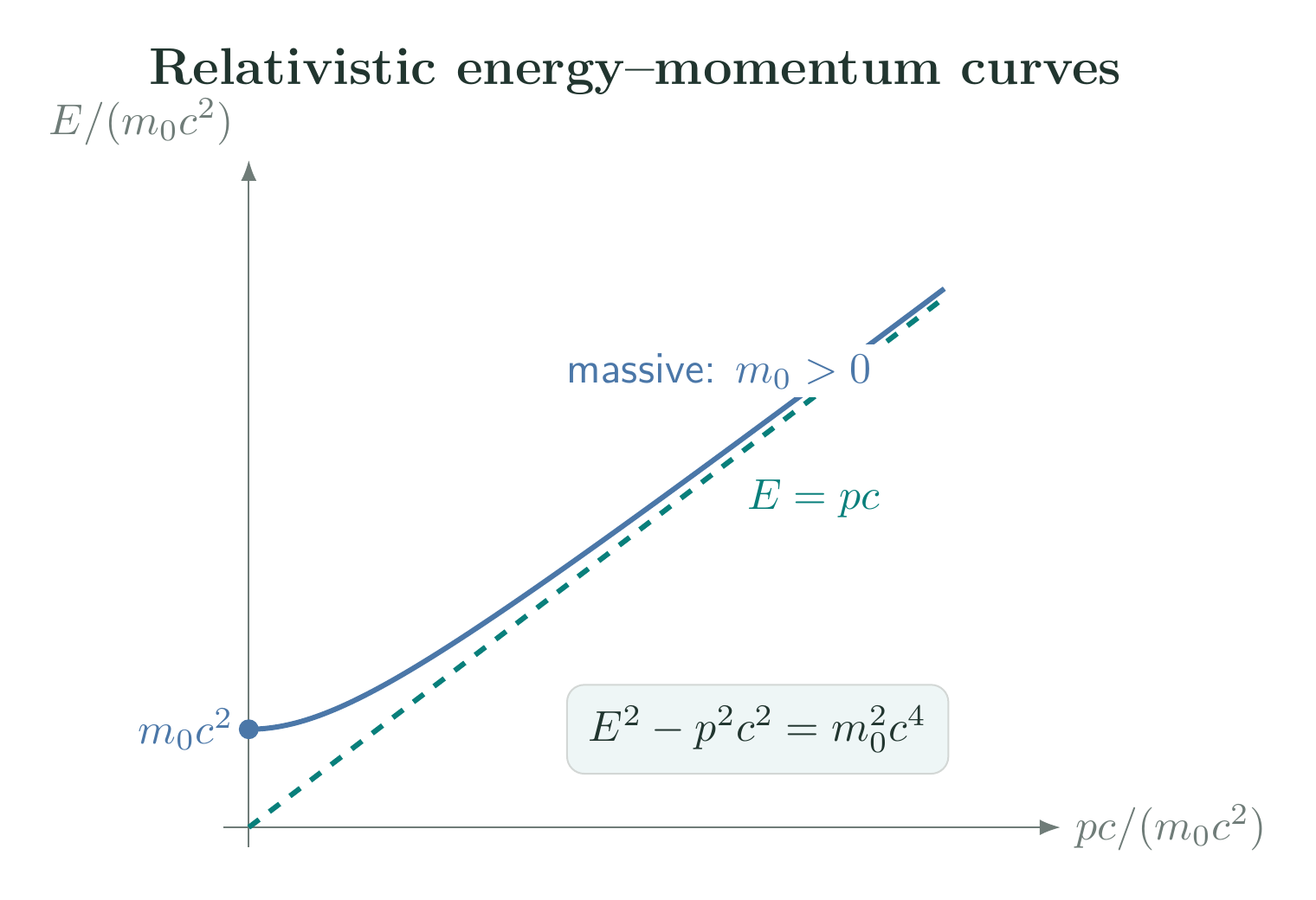
For a massless particle, $m_0=0$. For positive energy, the energy-momentum relation becomes
\[\boxed{E=pc}.\]It cannot have a rest frame: putting $p=0$ would also give $E=0$, not a nonzero-energy particle. Its dispersion relation $E(p)=pc$ gives the propagation speed in vacuum,
\[\boxed{v=\frac{dE}{dp}=c}.\]In the older mass convention, a massless particle can still have the nonzero relativistic mass $m_{\rm rel}=E/c^2=p/c$; it is its rest mass that is zero. Conversely, a massive particle cannot reach $c$ because $\gamma$, $E$, and $p$ diverge as $v\to c$.
Solved Problems
1. Energy and momentum of a relativistic proton
A proton moves at $v=+0.800c$ in the laboratory. Given $m_pc^2=938.272\ \mathrm{MeV}$, calculate its relativistic mass ratio, total energy, kinetic energy, and momentum, then verify the energy–momentum relation.
At $\beta=0.800$,
\[\gamma=\frac{1}{\sqrt{1-0.800^2}}=\frac53.\]The older velocity-dependent mass ratio is therefore
\[\frac{m(v)}{m_p}=\gamma=\boxed{1.6667}.\]The total and kinetic energies are
\[E=\gamma m_pc^2 =\frac53(938.272) =\boxed{1563.79\ \mathrm{MeV}},\] \[K=(\gamma-1)m_pc^2 =\frac23(938.272) =\boxed{625.515\ \mathrm{MeV}}.\]Because the motion is along $+x$, the momentum is positive:
\[p_xc=\gamma\beta m_pc^2 =\frac53(0.800)(938.272) =1251.03\ \mathrm{MeV},\]or
\[\boxed{p_x=1251.03\ \mathrm{MeV}/c}.\]Finally,
\[E^2-(p_xc)^2 =(1563.79)^2-(1251.03)^2 \simeq(938.272)^2\ \mathrm{MeV^2},\]which recovers the invariant rest energy within rounding. As $v\to0$, $E\to m_pc^2$, $K\to0$, and $p_x\to0$; as $v\to c$, all three velocity-dependent quantities diverge.
2. Energy, momentum, and mass convention for a photon
A photon propagates along $-x$ with wavelength $\lambda=500\ \mathrm{nm}$ in vacuum. Find its energy, signed momentum, and velocity-dependent mass $E/c^2$. Use $h=6.62607015\times10^{-34}\ \mathrm{J\,s}$ and $c=2.99792458\times10^8\ \mathrm{m\,s^{-1}}$.
For a massless particle, $E=pc$ in magnitude and $E=h\nu=hc/\lambda$. Thus
\[E=\frac{hc}{\lambda} =\boxed{3.97289\times10^{-19}\ \mathrm J} =\boxed{2.47968\ \mathrm{eV}}.\]The propagation direction fixes the momentum sign:
\[p_x=-\frac Ec=-\frac h\lambda =\boxed{-1.32521\times10^{-27}\ \mathrm{kg\,m\,s^{-1}}}.\]In the older convention,
\[m_{\rm rel}=\frac{E}{c^2} =\boxed{4.42044\times10^{-36}\ \mathrm{kg}},\]but the invariant rest mass remains exactly zero. Indeed,
\[E^2-p_x^2c^2=0.\]The negative momentum records direction; energy and $m_{\rm rel}$ are positive. No rest-frame limit exists for the photon, while increasing $\lambda$ makes $E$, $\lvert p_x\rvert$, and $m_{\rm rel}$ tend to zero.
Descriptive Questions
- Starting from relativistic momentum and the work integral, derive $K=(\gamma-1)m_0c^2$.
- Explain the distinction between invariant rest mass and the older velocity-dependent relativistic mass.
- Derive $E^2=p^2c^2+m_0^2c^4$ from the definitions of relativistic energy and momentum.
- Use the energy–momentum relation to explain why a massless particle has no rest frame and propagates at $c$.
Numerical Problems
- Find the ratio $m(v)/m_0$ for a particle moving at $0.600c$. Answer: $m(v)/m_0=\gamma=1.25$.
- A massive particle has momentum $p=(3/4)m_0c$. Use the energy–momentum relation to find its total energy, kinetic energy, and speed. Answer: $E=(5/4)m_0c^2$, $K=(1/4)m_0c^2$, and $v=(3/5)c=0.600c$.
- A particle has total energy $E=2m_0c^2$. Find its speed. Answer: $v=(\sqrt3/2)c\simeq0.866c$.
- A particle has total energy $5.00\ \mathrm{GeV}$ and rest energy $3.00\ \mathrm{GeV}$. Find its momentum. Answer: $p=4.00\ \mathrm{GeV}/c$.
- A system loses $1.00\ \mathrm{mg}$ of rest mass. Find the released energy using $c=3.00\times10^8\ \mathrm{m\,s^{-1}}$. Answer: $\Delta E=9.00\times10^{10}\ \mathrm J$.
- A massless particle has momentum components $p_x=3.00\ \mathrm{MeV}/c$ and $p_y=4.00\ \mathrm{MeV}/c$. Find its momentum magnitude, energy, and velocity components. Answer: $p=5.00\ \mathrm{MeV}/c$, $E=5.00\ \mathrm{MeV}$, $v_x=0.600c$, and $v_y=0.800c$.
The derivations and all problem values are checked in the Maxima worksheet; every printed residual is zero.
References
- “Mass–energy equivalence,” Wikipedia.
- A. P. French, Special Relativity, 1st ed., MIT Introductory Physics Series, W. W. Norton, 1968, Chapter 7, “More about Relativistic Dynamics.”
- David J. Griffiths, Introduction to Electrodynamics, 4th ed., Cambridge University Press, 2017, Chapter 12, §12.2, “Relativistic Mechanics.”


Discussion