

14 May 2025
Ripples and Gravity Waves
Consider a small wave on the free surface of an incompressible, inviscid liquid of density $\rho$. Take the undisturbed surface as $z=0$, with the liquid in $z<0$. If the depth is $h$, the deep-water condition is $kh\gg1$.
Write the surface displacement as the real part of
\[\zeta(x,t)=\zeta_0e^{i(kx-\omega t)},\]where $k=2\pi/\lambda$.
Velocity potential
For irrotational flow, the fluid velocity is
\[\mathbf v=\boldsymbol\nabla\phi.\]Incompressibility requires
\[\boldsymbol\nabla\cdot\mathbf v=\nabla^2\phi=0.\]The solution with the same $x,t$ dependence as the surface wave and which vanishes as $z\to-\infty$ is
\[\phi(x,z,t)=\phi_0e^{kz}e^{i(kx-\omega t)}.\]Because $k>0$ and $z<0$, the factor $e^{kz}$ shows that the fluid motion decreases exponentially with depth.
Boundary conditions at the surface
The surface moves with the liquid. To first order, the vertical velocity of the surface equals that of the fluid at $z=0$:
\[\frac{\partial\zeta}{\partial t} =\left.\frac{\partial\phi}{\partial z}\right|_{z=0}.\]Substitution gives
\[-i\omega\zeta_0=k\phi_0, \qquad \boxed{\phi_0=-\frac{i\omega}{k}\zeta_0}.\]The linearized unsteady Bernoulli equation gives the liquid pressure at the displaced surface:
\[p-p_0=-\rho\left( \frac{\partial\phi}{\partial t}+g\zeta \right).\]For the weakly curved graph $z=\zeta(x,t)$, the surface-tension pressure is
\[p-p_0=-\gamma\frac{\partial^2\zeta}{\partial x^2} =\gamma k^2\zeta.\]This sign is physically consistent: at a crest, $\partial^2\zeta/\partial x^2<0$, so the liquid pressure exceeds the air pressure.
Equating the two pressure expressions at $z=0$ gives
\[-\rho(-i\omega\phi_0+g\zeta_0) =\gamma k^2\zeta_0.\]Since
\[-i\omega\phi_0 =-\frac{\omega^2}{k}\zeta_0,\]the nonzero amplitude cancels and
\[\frac{\rho\omega^2}{k}-\rho g=\gamma k^2.\]Thus the deep-water gravity-capillary dispersion relation is
\[\boxed{\omega^2=gk+\frac{\gamma}{\rho}k^3}.\]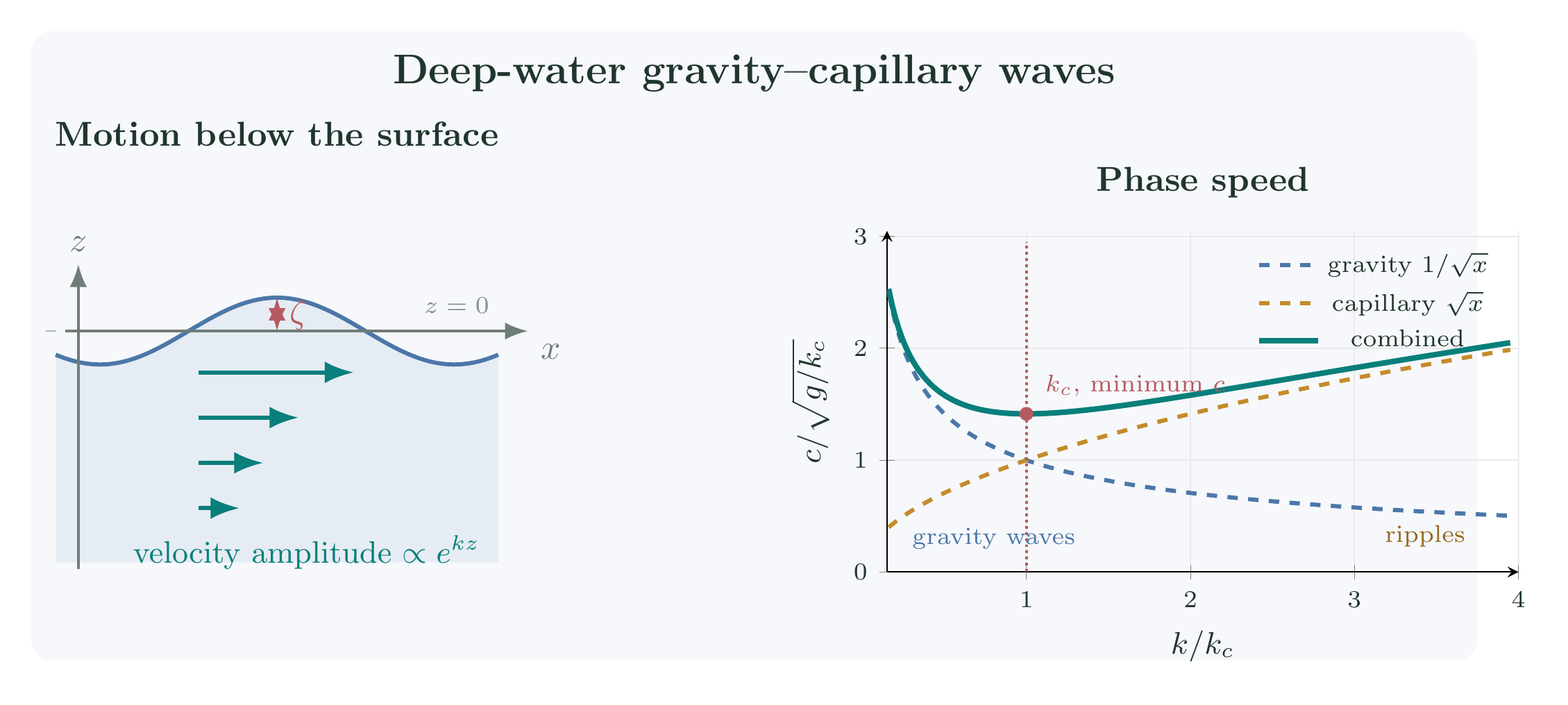
Gravity waves and ripples
The phase speed $c=\omega/k$ satisfies
\[\boxed{ c^2=\frac{g}{k}+\frac{\gamma k}{\rho} =\frac{g\lambda}{2\pi} +\frac{2\pi\gamma}{\rho\lambda} }.\]For $k\ll k_c$ while still satisfying $kh\gg1$, the gravity term dominates:
\[\omega^2\simeq gk, \qquad \boxed{c_{\rm grav}\simeq\sqrt{\frac{g}{k}} =\sqrt{\frac{g\lambda}{2\pi}}}.\]These are gravity waves; gravity is the principal restoring agency.
For $k\gg k_c$, the surface-tension term dominates:
\[\omega^2\simeq\frac{\gamma}{\rho}k^3, \qquad \boxed{c_{\rm cap}\simeq\sqrt{\frac{\gamma k}{\rho}} =\sqrt{\frac{2\pi\gamma}{\rho\lambda}}}.\]These capillary waves are ripples; surface tension is the principal restoring agency.
The two contributions to $c^2$ are equal at
\[\frac{g}{k_c}=\frac{\gamma k_c}{\rho}.\]Therefore
\[\boxed{k_c=\sqrt{\frac{\rho g}{\gamma}}}, \qquad \boxed{\lambda_c=2\pi\sqrt{\frac{\gamma}{\rho g}}}.\]This is also the minimum of the phase-speed curve. Differentiating $c^2$ with respect to $k$ gives
\[\frac{d(c^2)}{dk} =-\frac{g}{k^2}+\frac{\gamma}{\rho}=0 \quad\text{at}\quad k=k_c.\]At the minimum,
\[\boxed{c_{\min}=\left(\frac{4g\gamma}{\rho}\right)^{1/4}}.\]The editable wave and phase-speed diagram is available as a TikZ file.
Finite depth and group velocity
When the liquid has finite depth $h$, the bottom condition is no normal flow at $z=-h$:
\[\left.\frac{\partial\phi}{\partial z}\right|_{z=-h}=0.\]A potential satisfying this condition is
\[\phi=\Phi_0 \frac{\cosh[k(z+h)]}{\cosh(kh)} e^{i(kx-\omega t)}.\]At the surface, $\partial\phi/\partial z=k\tanh(kh)\phi$. Repeating the kinematic and dynamic boundary-condition calculation gives
\[\boxed{ \omega^2=\left(gk+\frac{\gamma}{\rho}k^3\right)\tanh(kh) }.\]For $kh\gg1$, $\tanh(kh)\to1$ and the deep-water result is recovered. For $kh\ll1$,
\[\omega^2\simeq ghk^2+\frac{\gamma h}{\rho}k^4.\]If gravity dominates in shallow water, $\omega\simeq k\sqrt{gh}$ and
\[\boxed{c\simeq\sqrt{gh}},\]which is independent of wavelength to this order.
The group velocity is $c_g=d\omega/dk$. In deep water,
\[\boxed{ c_g=\frac{g+3\gamma k^2/\rho}{2\omega} },\]or
\[\frac{c_g}{c} =\frac{g+3\gamma k^2/\rho} {2(g+\gamma k^2/\rho)}.\]Consequently $c_g=c/2$ for gravity-dominated deep-water waves, $c_g=3c/2$ for capillary waves, and $c_g=c$ at $k=k_c$.
Solved Problems
1. Gravity–capillary crossover for water
For water, take $\rho=1000\ \mathrm{kg\,m^{-3}}$, $\gamma=0.0720\ \mathrm{N\,m^{-1}}$ and $g=9.81\ \mathrm{m\,s^{-2}}$. Find the crossover wave number and wavelength, the minimum phase speed and the crossover frequency.
The equality of the two contributions gives
\[k_c=\sqrt{\frac{\rho g}{\gamma}} =\sqrt{\frac{(1000)(9.81)}{0.0720}} =3.691\times10^2\ \mathrm{m^{-1}}.\]Hence
\[\lambda_c=\frac{2\pi}{k_c} =1.702\times10^{-2}\ \mathrm{m} =1.702\ \mathrm{cm}.\]The minimum speed is
\[c_{\min}=\left(\frac{4g\gamma}{\rho}\right)^{1/4} =0.2306\ \mathrm{m\,s^{-1}}.\]At crossover the gravity and capillary terms are equal, so
\[\omega_c^2=2gk_c, \qquad \omega_c=85.10\ \mathrm{rad\,s^{-1}},\]and
\[f_c=\frac{\omega_c}{2\pi}=13.54\ \mathrm{Hz}.\]Thus
\[\boxed{ k_c=369.1\ \mathrm{m^{-1}},\quad \lambda_c=1.702\ \mathrm{cm},\quad c_{\min}=0.2306\ \mathrm{m\,s^{-1}},\quad f_c=13.54\ \mathrm{Hz}}.\]The dimensional check $\rho g/\gamma\sim\mathrm{m^{-2}}$ confirms that $k_c$ has units $\mathrm{m^{-1}}$, and $c_g=c$ at this minimum.
2. A finite-depth gravity wave
A small-amplitude gravity wave has wavelength $\lambda=20.0\ \mathrm{m}$ in water of depth $h=1.00\ \mathrm{m}$. Surface tension is negligible. Find $\omega$, the phase speed and the group speed, and compare the phase speed with the shallow-water value.
First,
\[k=\frac{2\pi}{\lambda}=0.3142\ \mathrm{m^{-1}}, \qquad kh=0.3142.\]The finite-depth dispersion relation gives
\[\omega=\sqrt{gk\tanh(kh)} =0.9683\ \mathrm{rad\,s^{-1}}.\]Therefore
\[c=\frac{\omega}{k}=3.082\ \mathrm{m\,s^{-1}}.\]For a finite-depth pure gravity wave,
\[c_g=\frac{c}{2} \left[1+\frac{2kh}{\sinh(2kh)}\right] =2.985\ \mathrm{m\,s^{-1}}.\]The shallow-water estimate is
\[\sqrt{gh}=3.132\ \mathrm{m\,s^{-1}}.\]Thus
\[\boxed{ \omega=0.9683\ \mathrm{rad\,s^{-1}},\quad c=3.082\ \mathrm{m\,s^{-1}},\quad c_g=2.985\ \mathrm{m\,s^{-1}}}.\]Because $kh$ is small but not zero, $c$ lies close to, but below, $\sqrt{gh}$; the inequality $c_g<c$ shows the remaining weak dispersion.
Descriptive Questions
- Starting from a velocity potential, derive the deep-water gravity–capillary dispersion relation and state the linearizing assumptions.
- Explain physically why fluid motion associated with a deep-water surface wave decays exponentially with depth.
- Derive the finite-depth factor $\tanh(kh)$ from the no-penetration condition at the bottom.
- Compare phase and group velocities in the gravity-dominated, crossover and capillary-dominated regimes.
Numerical Problems
-
Find the phase speed of a deep-water gravity wave of wavelength $4.00\ \mathrm{m}$.
Final answer: $c=2.499\ \mathrm{m\,s^{-1}}$.
-
A pure capillary ripple on water has $\lambda=4.00\ \mathrm{mm}$, $\gamma=0.0730\ \mathrm{N\,m^{-1}}$ and $\rho=1000\ \mathrm{kg\,m^{-3}}$. Find its phase speed.
Final answer: $c=0.3386\ \mathrm{m\,s^{-1}}$.
-
Using both gravity and surface tension, find the deep-water phase speed for $\lambda=2.00\ \mathrm{cm}$ when $\gamma=0.0720\ \mathrm{N\,m^{-1}}$ and $\rho=1000\ \mathrm{kg\,m^{-3}}$.
Final answer: $c=0.2320\ \mathrm{m\,s^{-1}}$.
-
A deep-water wave is in the pure capillary regime and has phase speed $0.400\ \mathrm{m\,s^{-1}}$. Find its group speed.
Final answer: $c_g=0.600\ \mathrm{m\,s^{-1}}$.
-
For a deep-water surface wave of wavelength $0.120\ \mathrm{m}$, find the depth at which the velocity amplitude has fallen to $1/e$ of its surface value.
Final answer: $z=-1/k=-1.910\times10^{-2}\ \mathrm{m}$, a depth of $19.1\ \mathrm{mm}$.
-
Neglecting surface tension, find the speed of a long shallow-water wave where $h=2.00\ \mathrm{m}$.
Final answer: $c=4.429\ \mathrm{m\,s^{-1}}$.
The boundary-condition algebra, finite-depth and group-speed formulas, and all numerical answers are checked in the Unit I Maxima worksheet.


Discussion