

14 Jun 2025
Simple Harmonic Motion and Energy
The SHM equation and solution, phase, energy exchange, and time-averaged energies.
Simple harmonic motion occurs when the restoring force is directly proportional to the displacement from stable equilibrium and points toward that equilibrium. For a displacement $x$,
\[F=-kx, \qquad k>0.\]Newton’s second law gives
\[m\ddot x=-kx.\]After division by $m$,
\[\boxed{\ddot x+\omega_0^2x=0}, \qquad \boxed{\omega_0=\sqrt{\frac{k}{m}}}.\]Solution of the SHM equation
Try a solution $x=e^{\lambda t}$. Substitution gives
\[(\lambda^2+\omega_0^2)e^{\lambda t}=0.\]Since $e^{\lambda t}\ne0$,
\[\lambda^2+\omega_0^2=0, \qquad \lambda=\pm i\omega_0.\]The real general solution is therefore
\[x=C\cos\omega_0t+D\sin\omega_0t.\]Writing $C=A\cos\phi$ and $D=-A\sin\phi$ gives
\[\boxed{x=A\cos(\omega_0t+\phi)}.\]Here $A\ge0$ is the amplitude and $\phi$ is the initial phase. One complete cycle corresponds to an increase of $2\pi$ in phase, so
\[\omega_0T=2\pi,\]and hence
\[\boxed{T=\frac{2\pi}{\omega_0}=2\pi\sqrt{\frac{m}{k}}}.\]Differentiation gives
\[v=\dot x=-A\omega_0\sin(\omega_0t+\phi),\] \[a=\ddot x=-A\omega_0^2\cos(\omega_0t+\phi) =-\omega_0^2x.\]Thus the speed is greatest at equilibrium and zero at either turning point, whereas the acceleration magnitude is greatest at a turning point and zero at equilibrium.
Kinetic, potential, and total energies
Since $F=-dU/dx$,
\[-\frac{dU}{dx}=-kx \quad\Longrightarrow\quad \frac{dU}{dx}=kx.\]Choosing $U=0$ at $x=0$ and integrating,
\[U=\int_0^x kx^{\prime}\,dx^{\prime}=\frac12kx^2.\]Substitution of the SHM displacement gives
\[\boxed{U(t)=\frac12kA^2\cos^2(\omega_0t+\phi)}.\]The kinetic energy is
\[K=\frac12mv^2 =\frac12mA^2\omega_0^2\sin^2(\omega_0t+\phi).\]Because $m\omega_0^2=k$,
\[\boxed{K(t)=\frac12kA^2\sin^2(\omega_0t+\phi)}.\]Adding the two energies and using $\sin^2\alpha+\cos^2\alpha=1$,
\[E=K+U =\frac12kA^2\left(\sin^2(\omega_0t+\phi)+\cos^2(\omega_0t+\phi)\right),\]so
\[\boxed{E=\frac12kA^2=\text{constant}}.\]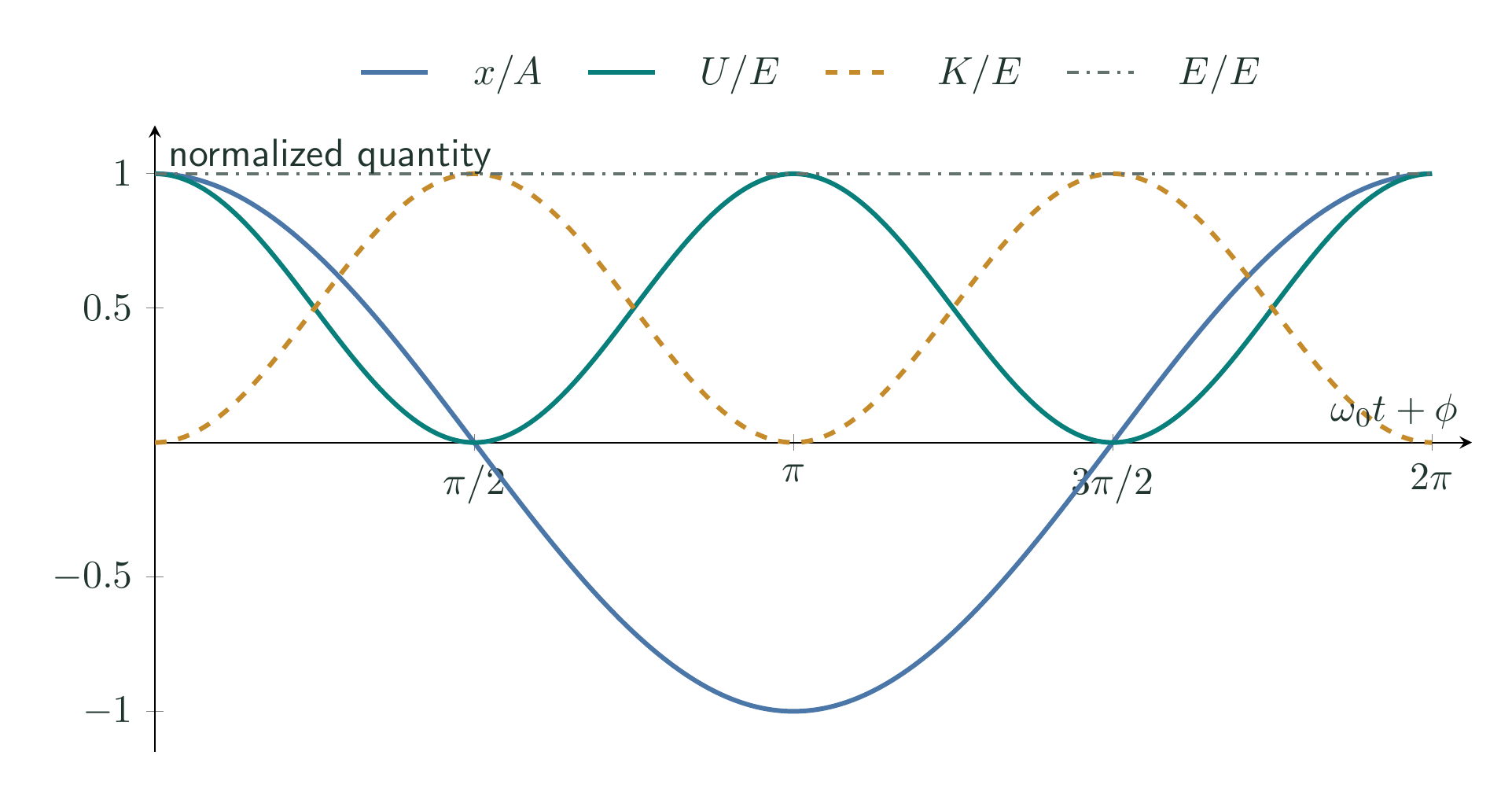
Time-average energies
For any starting time $t_0$, the average over one full period is
\[\left\langle\cos^2(\omega_0t+\phi)\right\rangle =\frac1T\int_{t_0}^{t_0+T}\cos^2(\omega_0t+\phi)\,dt.\]Using $\cos^2\alpha=(1+\cos2\alpha)/2$,
\[\left\langle\cos^2(\omega_0t+\phi)\right\rangle =\frac12+\frac{1}{2T} \left[\frac{\sin(2\omega_0t+2\phi)}{2\omega_0}\right]_{t_0}^{t_0+T}.\]Since $2\omega_0T=4\pi$, the sine has the same value at both limits. Therefore
\[\left\langle\cos^2(\omega_0t+\phi)\right\rangle=\frac12.\]The same calculation gives $\langle\sin^2(\omega_0t+\phi)\rangle=1/2$. Hence
\[\boxed{\langle K\rangle=\frac14kA^2}, \qquad \boxed{\langle U\rangle=\frac14kA^2},\]and, because the total energy is constant,
\[\boxed{\langle E\rangle=\frac12kA^2}.\]Initial-value form
If $x(0)=x_0$ and $v(0)=v_0$, the constants in
\[x=C\cos\omega_0t+D\sin\omega_0t\]are fixed directly. Setting $t=0$ gives $C=x_0$, while differentiating and then setting $t=0$ gives $v_0=\omega_0D$. Hence
\[\boxed{x(t)=x_0\cos\omega_0t +\frac{v_0}{\omega_0}\sin\omega_0t}.\]Comparison with $A\cos(\omega_0t+\phi)$ gives
\[\boxed{A=\sqrt{x_0^2+\left(\frac{v_0}{\omega_0}\right)^2}},\] \[\boxed{\phi=\operatorname{atan2}\!\left(-\frac{v_0}{\omega_0},x_0\right)}.\]The two-argument arctangent fixes the quadrant and therefore preserves the signs of both initial data.
Solved Problems
1. Construct the motion from initial data
Problem. A $0.50\ \mathrm{kg}$ mass is attached to a spring of constant $8.0\ \mathrm{N\,m^{-1}}$. At $t=0$, $x_0=0.030\ \mathrm{m}$ and $v_0=+0.160\ \mathrm{m\,s^{-1}}$. Find $x(t)$, $A$, $\phi$, and the total energy.
Solution. The angular frequency is
\[\omega_0=\sqrt{\frac{k}{m}} =\sqrt{\frac{8.0}{0.50}} =4.0\ \mathrm{rad\,s^{-1}}.\]Therefore
\[x(t)=0.030\cos4t+\frac{0.160}{4.0}\sin4t,\]or
\[\boxed{x(t)=0.030\cos4t+0.040\sin4t\ \mathrm{m}}.\]The amplitude is
\[A=\sqrt{0.030^2+0.040^2} =0.050\ \mathrm{m}.\]For the cosine convention,
\[\phi=\operatorname{atan2}(-0.040,0.030) =-0.927\ \mathrm{rad}.\]Finally,
\[E=\frac12kA^2 =\frac12(8.0)(0.050)^2 =1.00\times10^{-2}\ \mathrm{J}.\]Checks. Both coefficients in $x(t)$ have units of metres. At $t=0$, the formula gives $x=0.030\ \mathrm{m}$ and $\dot x=4(0.040)=+0.160\ \mathrm{m\,s^{-1}}$, so the signs are correct. The positive initial velocity explains the negative phase in this cosine convention. If $v_0\to0$ with $x_0>0$, then $A\to x_0$ and $\phi\to0$.
2. Speed and energy at a specified displacement
Problem. An oscillator has $m=0.20\ \mathrm{kg}$, $k=5.0\ \mathrm{N\,m^{-1}}$, and amplitude $A=0.080\ \mathrm{m}$. Find its speed and the kinetic and potential energies when $x=0.040\ \mathrm{m}$.
Solution. Energy conservation gives
\[\frac12mv^2+\frac12kx^2=\frac12kA^2.\]Thus
\[|v|=\sqrt{\frac{k}{m}(A^2-x^2)} =\sqrt{\frac{5.0}{0.20}(0.080^2-0.040^2)} =0.346\ \mathrm{m\,s^{-1}}.\]The sign of $v$ may be positive or negative because the oscillator passes the same position in both directions. The energies are
\[U=\frac12kx^2 =\frac12(5.0)(0.040)^2 =4.00\times10^{-3}\ \mathrm{J},\] \[K=\frac12mv^2 =1.20\times10^{-2}\ \mathrm{J}.\]Their sum is $1.60\times10^{-2}\ \mathrm{J}$, equal to $kA^2/2$.
Checks. The square-root argument has units $\mathrm{m^2\,s^{-2}}$. Since $\lvert x\rvert<A$, it is positive and the position is physically accessible. The two velocity signs represent the outward and return passages. As $\lvert x\rvert\to A$, $v\to0$ and all the energy becomes potential; as $x\to0$, the speed and kinetic energy are maximum.
Descriptive Questions
- Starting from a linear restoring force, derive the differential equation, angular frequency, and general solution of simple harmonic motion.
- Derive the initial-value form of the SHM solution and explain why a two-argument arctangent is needed to determine the phase.
- Derive the kinetic, potential, and total energies of an oscillator and describe their exchange during one cycle.
- Evaluate the average kinetic and potential energies over an arbitrary complete period and explain why the starting time does not affect the result.
Numerical Problems
-
A $0.80\ \mathrm{kg}$ mass is attached to a $20\ \mathrm{N\,m^{-1}}$ spring. Find $\omega_0$, $T$, and $f$.
Final answer: $\omega_0=5.00\ \mathrm{rad\,s^{-1}}$, $T=1.257\ \mathrm{s}$, and $f=0.7958\ \mathrm{Hz}$.
-
An oscillator has $\omega_0=6.0\ \mathrm{rad\,s^{-1}}$. Find its acceleration at $x=-0.030\ \mathrm{m}$.
Final answer: $a=+1.08\ \mathrm{m\,s^{-2}}$, toward equilibrium.
-
Find the maximum speed for $A=0.050\ \mathrm{m}$ and $f=2.0\ \mathrm{Hz}$.
Final answer: $v_{\max}=2\pi fA=0.628\ \mathrm{m\,s^{-1}}$.
-
An oscillator starts from $x=A$ at rest and has period $0.80\ \mathrm{s}$. When does it first cross equilibrium?
Final answer: $t=T/4=0.20\ \mathrm{s}$.
-
For $k=40\ \mathrm{N\,m^{-1}}$ and $A=0.020\ \mathrm{m}$, find $\langle K\rangle$, $\langle U\rangle$, and $E$.
Final answer: $\langle K\rangle=\langle U\rangle=4.00\times10^{-3}\ \mathrm{J}$ and $E=8.00\times10^{-3}\ \mathrm{J}$.
-
An oscillator of spring constant $100\ \mathrm{N\,m^{-1}}$ has total energy $0.125\ \mathrm{J}$. Find its amplitude.
Final answer: $A=\sqrt{2E/k}=0.050\ \mathrm{m}$.
The analytic identities and all eight worked answers are independently checked in the Maxima worksheet; every printed residual or check is zero.
References
- Simple harmonic motion — Wikipedia.
- OpenStax, University Physics Volume 1, Section 15.1: Simple Harmonic Motion.
- OpenStax, University Physics Volume 1, Section 15.2: Energy in Simple Harmonic Motion.
- John R. Taylor, Classical Mechanics, University Science Books (2005), Chapter 5.


Discussion