

10 Jul 2025
Simultaneity, Event Order, and Relativistic Velocity Addition
Relativity of simultaneity, invariant causal order, and velocity transformation derived by differentiating the Lorentz equations.
For two events separated by $(\Delta t,\Delta x)$, the Lorentz time transformation is
\[\boxed{\Delta t^{\prime}=\gamma\left(\Delta t-\frac{v\Delta x}{c^2}\right)}.\]If the events are simultaneous in $S$, then $\Delta t=0$ and
\[\Delta t^{\prime}=-\gamma\frac{v\Delta x}{c^2}.\]Thus spatially separated events simultaneous in $S$ are not simultaneous in $S^{\prime}$. For $v>0$ and $\Delta x=x_2-x_1>0$, event 2 occurs earlier in $S^{\prime}$ because $\Delta t^{\prime}<0$.
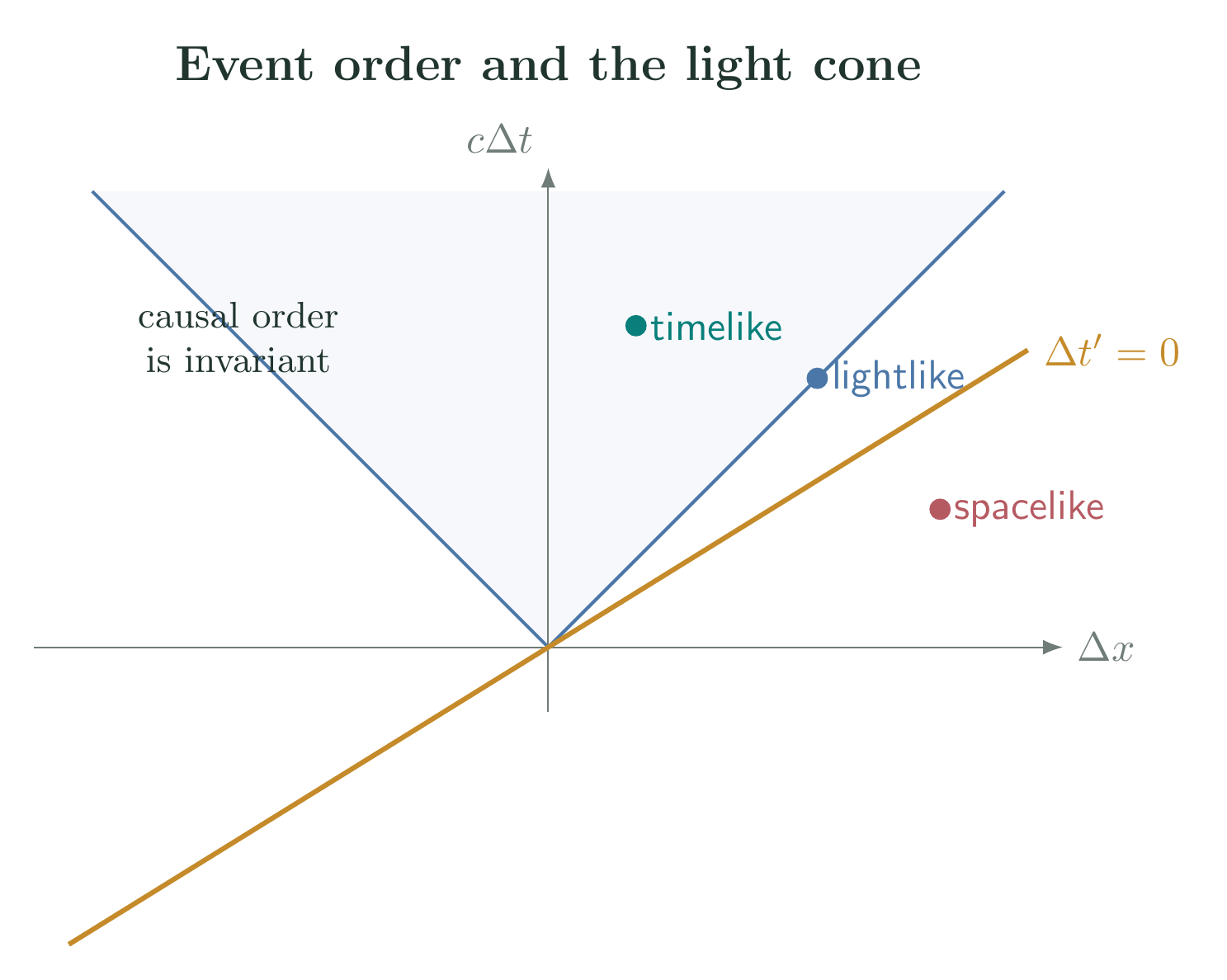
Can event order reverse?
Define the invariant separation
\[\Delta s^2=c^2\Delta t^2-\Delta x^2.\]For a timelike separation, $c^2\Delta t^2>\Delta x^2$. If $\Delta t>0$, then
\[\left\lvert\frac{v\Delta x}{c^2}\right\rvert <\frac{\lvert\Delta x\rvert}{c} <\Delta t,\]because $\lvert v\rvert<c$. Therefore $\Delta t^{\prime}=\gamma(\Delta t-v\Delta x/c^2)>0$: all inertial observers agree on the order.
For a lightlike separation, $\Delta x=\pm c\Delta t$. Therefore
\[\Delta t^{\prime}=\gamma\Delta t(1\mp v/c),\]and both factors $1\mp v/c$ are positive for $\lvert v\rvert<c$. The order is unchanged.
For a spacelike separation, $\lvert\Delta x\rvert>c\lvert\Delta t\rvert$. Choosing
\[v=\frac{c^2\Delta t}{\Delta x}\]is allowed because spacelike separation guarantees $\lvert c^2\Delta t/\Delta x\rvert<c$, and it makes $\Delta t^{\prime}=0$. Nearby allowed velocities on opposite sides of this value give opposite signs of $\Delta t^{\prime}$, so the order can reverse. Such events cannot be causally connected because a signal between them would require speed $\lvert\Delta x/\Delta t\rvert>c$.
Velocity addition
Differentiate the Lorentz equations:
\[dx^{\prime}=\gamma(dx-v\,dt), \qquad dt^{\prime}=\gamma\left(dt-\frac{v\,dx}{c^2}\right).\]Dividing and writing $u_x=dx/dt$,
\[u_x^{\prime}=\frac{dx^{\prime}}{dt^{\prime}} =\frac{dx-v\,dt}{dt-v\,dx/c^2} =\boxed{\frac{u_x-v}{1-u_xv/c^2}}.\]Since $dy^{\prime}=dy$ and $dz^{\prime}=dz$,
\[u_y^{\prime}=\frac{dy}{\gamma(dt-v\,dx/c^2)} =\boxed{\frac{u_y}{\gamma(1-u_xv/c^2)}},\] \[u_z^{\prime}=\boxed{\frac{u_z}{\gamma(1-u_xv/c^2)}}.\]These component transformations require $1-u_xv/c^2\ne0$. For a massive particle or a light ray, $\lvert u_x\rvert\le c$ and $\lvert v\rvert<c$, so $\lvert u_xv\rvert<c^2$ and the denominator is strictly positive.
Solving the longitudinal relation for $u_x$ gives the inverse addition law:
\[u_x^{\prime}(1-u_xv/c^2)=u_x-v,\] \[u_x\left(1+\frac{u_x^{\prime}v}{c^2}\right)=u_x^{\prime}+v,\] \[\boxed{u_x=\frac{u_x^{\prime}+v}{1+u_x^{\prime}v/c^2}}.\]For light in either direction, $u_x=\pm c$ gives
\[u_x^{\prime}=\frac{\pm c-v}{1\mp v/c}=\pm c.\]For the inverse sum, put $w=u_x^{\prime}$, so
\[u_x=\frac{w+v}{1+wv/c^2}.\]If $\lvert w\rvert<c$ and $\lvert v\rvert<c$, then $1+wv/c^2>0$ and
\[\boxed{ 1-\frac{u_x^2}{c^2} =\frac{(1-w^2/c^2)(1-v^2/c^2)}{(1+wv/c^2)^2}>0 }.\]Hence $\lvert u_x\rvert<c$: adding two subluminal velocities cannot produce a superluminal result.
Solved Problems
1. Reversal of order for spacelike events
In $S$, event 2 is separated from event 1 by $\Delta x=+900\ \mathrm m$ and $\Delta t=+1.00\ \mu\mathrm s$. Frame $S^{\prime}$ moves along $+x$ at $v=0.800c$. Determine the event order in $S^{\prime}$, verify the interval, and find the frame in which the events are simultaneous. Use $c=3.00\times10^8\ \mathrm{m\,s^{-1}}$.
First classify the separation:
\[\Delta s^2=(c\Delta t)^2-\Delta x^2 =(300\ \mathrm m)^2-(900\ \mathrm m)^2 =-7.20\times10^5\ \mathrm{m^2}.\]It is spacelike. With $\gamma=5/3$,
\[\begin{aligned} \Delta t^{\prime} &=\gamma\left(\Delta t-\frac{v\Delta x}{c^2}\right)\\ &=\frac53(1.00-2.40)\ \mu\mathrm s\\ &=\boxed{-2.333\ \mu\mathrm s}, \end{aligned}\]and
\[\begin{aligned} \Delta x^{\prime} &=\gamma(\Delta x-v\Delta t)\\ &=\frac53(900-240)\ \mathrm m\\ &=\boxed{1100\ \mathrm m}. \end{aligned}\]Thus event 2 occurs earlier in $S^{\prime}$. Since $c\Delta t^{\prime}=-700\ \mathrm m$,
\[(c\Delta t^{\prime})^2-(\Delta x^{\prime})^2 =(-700)^2-(1100)^2 =-7.20\times10^5\ \mathrm{m^2},\]as required. Setting $\Delta t^{\prime}=0$ gives
\[v_{\rm sim}=\frac{c^2\Delta t}{\Delta x} =\frac{c(300\ \mathrm m)}{900\ \mathrm m} =\boxed{\frac c3}.\]This speed is allowed precisely because the separation is spacelike. The sign reversal has no causal paradox: neither event can signal the other. For $v\to0$, $\Delta t^{\prime}\to\Delta t>0$.
2. Oblique velocity transformation
A spacecraft $S^{\prime}$ moves at $+0.600c$ relative to $S$. In $S^{\prime}$, a probe has components $u_x^{\prime}=+0.300c$ and $u_y^{\prime}=+0.400c$. Find its velocity in $S$ and show that it remains subluminal.
Use the inverse component transformations. With $\gamma_v=1.25$,
\[\frac{u_x}{c} =\frac{u_x^{\prime}/c+v/c}{1+u_x^{\prime}v/c^2} =\frac{0.300+0.600}{1+(0.300)(0.600)} =\boxed{\frac{45}{59}\simeq0.7627}.\]For the transverse component,
\[\frac{u_y}{c} =\frac{u_y^{\prime}/c}{\gamma_v(1+u_x^{\prime}v/c^2)} =\frac{0.400}{(1.25)(1.18)} =\boxed{\frac{16}{59}\simeq0.2712}.\]Therefore
\[\frac{u}{c} =\sqrt{\left(\frac{45}{59}\right)^2+ \left(\frac{16}{59}\right)^2} =\boxed{\frac{\sqrt{2281}}{59}\simeq0.8095<1}.\]Both stated components were positive, so the probe moves forward and toward $+y$ in $S$. The speed remains below $c$, and when the frame speed tends to zero the transformed components tend to $0.300c$ and $0.400c$.
Descriptive Questions
- Derive the relativity-of-simultaneity formula and explain the sign of the time offset for separated simultaneous events.
- Use the invariant interval to prove that timelike and lightlike event order cannot reverse between inertial frames.
- Show why spacelike-separated events can be simultaneous in one inertial frame and occur in either order in others.
- Derive the longitudinal and transverse velocity transformations directly from the Lorentz differentials.
Numerical Problems
- Events separated by $\Delta x=600\ \mathrm m$ are simultaneous in $S$. Find $\Delta t^{\prime}$ for a frame moving at $+0.600c$. Answer: $\Delta t^{\prime}=-1.50\ \mu\mathrm s$.
- Event B occurs $3.00\ \mu\mathrm s$ after event A and $600\ \mathrm m$ away in $S$. Find the speed of a signal joining the events and their invariant separation; can any inertial frame reverse their order? Answer: $u=2.00\times10^8\ \mathrm{m\,s^{-1}}=(2/3)c$, $\Delta s^2=4.50\times10^5\ \mathrm{m^2}$; the separation is timelike, so the order cannot reverse.
- A projectile moves at $0.700c$ in a spacecraft that moves at $0.600c$ in the same direction. Find its Earth-frame speed. Answer: $u=(65/71)c\simeq0.9155c$.
- A particle moves at $+0.500c$ in $S$, while $S^{\prime}$ moves at $+0.800c$. Find $u_x^{\prime}$. Answer: $u_x^{\prime}=-0.500c$.
- In $S$, a light ray has $u_x=0.600c$ and $u_y=0.800c$. Transform it to a frame moving at $+0.600c$. Answer: $u_x^{\prime}=0$, $u_y^{\prime}=c$, hence $u^{\prime}=c$.
- A craft moves at $0.800c$ along $+x$. It launches a probe at $u_x^{\prime}=0$, $u_y^{\prime}=0.600c$. Find the laboratory components and speed. Answer: $u_x=0.800c$, $u_y=0.360c$, $u\simeq0.8773c$.
The derivations and all problem values are checked in the Maxima worksheet; every printed residual is zero.
References
- “Relativity of simultaneity,” Wikipedia.
- A. P. French, Special Relativity, 1st ed., MIT Introductory Physics Series, W. W. Norton, 1968, Chapter 5, “Relativistic Kinematics.”
- David J. Griffiths, Introduction to Electrodynamics, 4th ed., Cambridge University Press, 2017, Chapter 12, §12.1, “The Special Theory of Relativity.”


Discussion