

11 May 2025
Surface Tension, Contact Angle and Virtual Work
A molecule well inside a liquid is attracted in all directions. A molecule near the surface has fewer neighbours on the vapour side, so work must be done to create new surface.
If reversible work $dW$ creates an area $dA$ at fixed temperature,
\[\boxed{\gamma=\frac{dW}{dA}},\]where $\gamma$ is the surface energy per unit area. Since
\[[\gamma]=\mathrm{J\,m^{-2}}=\mathrm{N\,m^{-1}},\]the same quantity is also the tangential force per unit length across a line drawn in the surface. This force description is surface tension.
Principle of virtual work
A virtual displacement is an infinitesimal change compatible with the constraints. In quasistatic equilibrium, the first-order work supplied by the applied forces equals the corresponding increase of potential or surface energy:
\[\boxed{\delta W_{\rm applied}-\delta U=0}.\]Consider a rectangular frame carrying a soap film, with a movable side of length $L$. If the side is displaced through $\delta x$, the two faces of the film gain area
\[\delta A=2L\,\delta x.\]The surface-energy increase is $\delta U=2\gamma L\,\delta x$. Virtual work gives
\[F\,\delta x=2\gamma L\,\delta x,\]so
\[\boxed{F=2\gamma L}.\]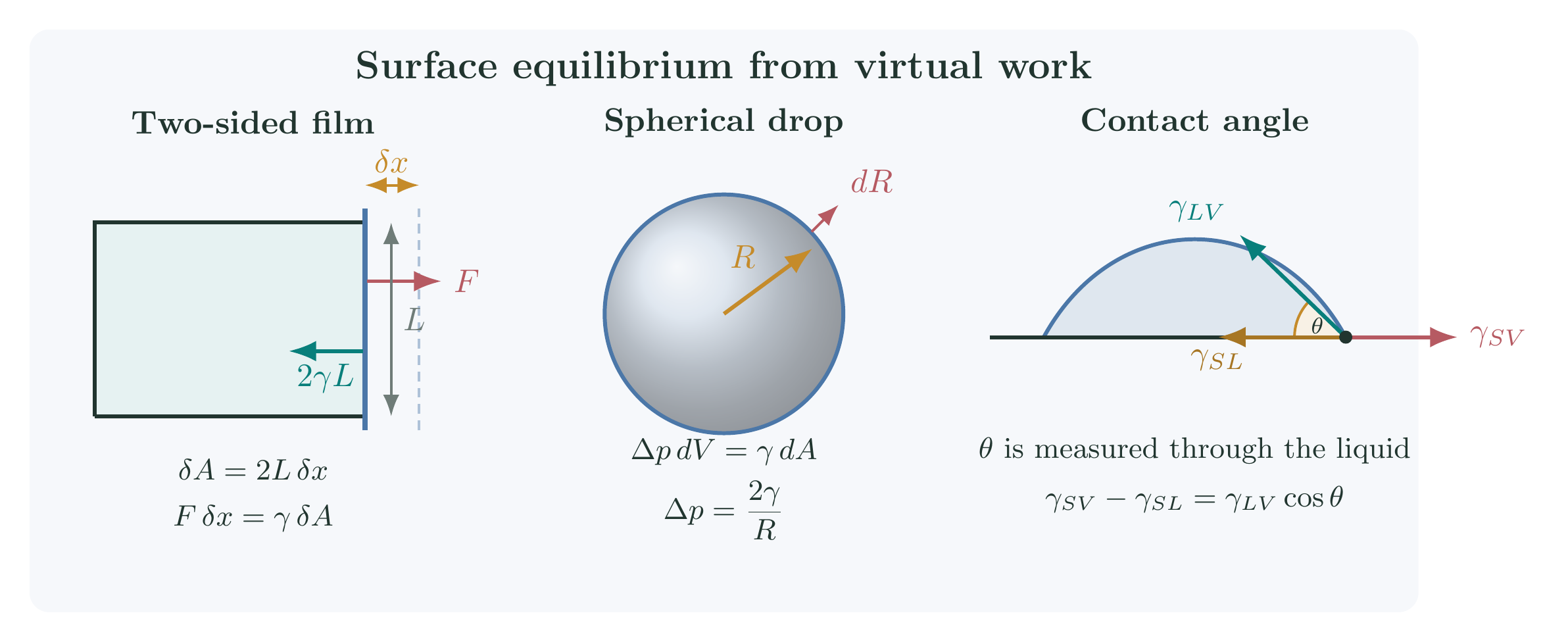
Excess pressure across a curved surface
For one interface whose principal sections bulge toward the lower-pressure phase, take $R_1$ and $R_2$ as their positive radii of curvature. The Young-Laplace relation gives the pressure excess on the opposite, higher-pressure side:
\[\boxed{\Delta p=p_{\rm high}-p_{\rm low} =\gamma\left(\frac{1}{R_1}+\frac{1}{R_2}\right)}.\]The spherical result follows directly from virtual work. Let a liquid drop of radius $R$ expand virtually by $dR$. Then
\[dV=4\pi R^2\,dR, \qquad dA=8\pi R\,dR.\]The pressure work creates surface energy:
\[\Delta p\,dV=\gamma\,dA.\]Therefore
\[\Delta p(4\pi R^2\,dR) =\gamma(8\pi R\,dR),\]and for a liquid drop or an air bubble in a liquid, each of which has one interface,
\[\boxed{\Delta p=\frac{2\gamma}{R}}.\]A soap bubble has an inner and an outer interface. Its surface-energy change is $2\gamma\,dA$, so
\[\boxed{\Delta p=\frac{4\gamma}{R}}.\]For a cylindrical interface of radius $R$ and fixed length $L$,
\[dV=2\pi RL\,dR, \qquad dA=2\pi L\,dR.\]Virtual work then gives
\[\boxed{\Delta p=\frac{\gamma}{R}},\]in agreement with the general relation because the two principal radii are $R$ and $\infty$.
Angle of contact
At the line where solid, liquid and vapour meet, the angle of contact $\theta$ is measured through the liquid between the tangent to the liquid-vapour surface and the solid surface.
Let $\gamma_{SV}$, $\gamma_{SL}$ and $\gamma_{LV}$ denote the solid-vapour, solid-liquid and liquid-vapour interfacial tensions. A virtual advance $dx$ of the contact line replaces solid-vapour area by solid-liquid area. Per unit length of the contact line, the surface-energy change is
\[dU=(\gamma_{SL}-\gamma_{SV})\,dx +\gamma_{LV}\cos\theta\,dx.\]At equilibrium $dU=0$. Hence Young’s equation is
\[\boxed{\gamma_{SV}-\gamma_{SL} =\gamma_{LV}\cos\theta}.\]Thus $\theta<90^\circ$ corresponds to preferential wetting of the solid, while $\theta>90^\circ$ corresponds to non-wetting.
The editable three-part diagram is available as a TikZ file.
Capillary rise and depression
Let a vertical capillary of internal radius $a$ meet a liquid of density $\rho$ at contact angle $\theta$. Surface tension acts along the contact circle. Its vertical component is
\[F_\gamma=2\pi a\gamma\cos\theta.\]Neglecting the meniscus volume, the weight of a column of signed height $h$ relative to the outer free surface is
\[W=\rho g\pi a^2h.\]Equating the two gives Jurin’s relation
\[\boxed{h=\frac{2\gamma\cos\theta}{\rho ga}}.\]The sign is carried by $\cos\theta$: a wetting liquid with $\theta<90^\circ$ rises, whereas a non-wetting liquid with $\theta>90^\circ$ is depressed. The same result follows from the spherical-meniscus pressure jump $2\gamma/R_m$, with $R_m=a/\cos\theta$, balanced by $\rho gh$.
Solved Problems
1. Rise of water in a glass capillary
Water has $\gamma=0.0720\ \mathrm{N\,m^{-1}}$, $\rho=998\ \mathrm{kg\,m^{-3}}$ and contact angle $\theta=20.0^\circ$ in a glass capillary of radius $a=0.250\ \mathrm{mm}$. Find the equilibrium rise and the corresponding capillary pressure.
Jurin’s relation gives
\[\begin{aligned} h &=\frac{2(0.0720)\cos20.0^\circ} {(998)(9.81)(0.250\times10^{-3})}\\ &=5.529\times10^{-2}\ \mathrm{m}. \end{aligned}\]Thus
\[\boxed{h=5.53\ \mathrm{cm}}.\]The hydrostatic pressure difference is
\[\boxed{\rho gh=5.41\times10^2\ \mathrm{Pa}}.\]It is positive as a pressure magnitude, while $h>0$ records a rise. The independent surface value $2\gamma\cos\theta/a$ is also $5.41\times10^2\ \mathrm{Pa}$, checking the force and pressure descriptions.
2. Pressure and work during expansion of a soap bubble
A soap bubble of surface tension $\gamma=0.0300\ \mathrm{N\,m^{-1}}$ expands quasistatically from $R_i=1.00\ \mathrm{mm}$ to $R_f=1.20\ \mathrm{mm}$. Find the initial and final excess pressures and the work done against surface tension.
Because a soap bubble has two interfaces,
\[\Delta p_i=\frac{4\gamma}{R_i} =\frac{4(0.0300)}{1.00\times10^{-3}} =120\ \mathrm{Pa},\] \[\Delta p_f=\frac{4\gamma}{R_f} =\frac{4(0.0300)}{1.20\times10^{-3}} =100\ \mathrm{Pa}.\]The increase in the energy of both surfaces is
\[\begin{aligned} W &=2\gamma[4\pi R_f^2-4\pi R_i^2]\\ &=8\pi\gamma(R_f^2-R_i^2)\\ &=3.318\times10^{-7}\ \mathrm{J}. \end{aligned}\]Therefore
\[\boxed{\Delta p_i=120\ \mathrm{Pa},\quad \Delta p_f=100\ \mathrm{Pa},\quad W=3.318\times10^{-7}\ \mathrm{J}}.\]The falling excess pressure is physically consistent with increasing radius. Direct integration, $\int_{R_i}^{R_f}(4\gamma/R)(4\pi R^2\,dR)$, returns the same work and verifies the two-surface factor.
Descriptive Questions
- Explain why surface energy per unit area and surface tension force per unit length have the same SI unit and physical coefficient.
- Use virtual work to derive the excess pressure inside a liquid drop and then modify the argument for a soap bubble.
- Derive Young’s contact-angle equation by considering a virtual displacement of the three-phase contact line.
- Derive Jurin’s law and explain, using its sign, why water rises but mercury is depressed in clean glass capillaries.
Numerical Problems
-
A soap film of surface tension $0.0250\ \mathrm{N\,m^{-1}}$ supports a movable wire $0.0800\ \mathrm{m}$ long. Find the force required for equilibrium.
Final answer: $F=4.00\times10^{-3}\ \mathrm{N}$.
-
Find the excess pressure inside a water drop of radius $0.500\ \mathrm{mm}$ if $\gamma=0.0720\ \mathrm{N\,m^{-1}}$.
Final answer: $\Delta p=288\ \mathrm{Pa}$.
-
A long cylindrical liquid jet has radius $0.250\ \mathrm{mm}$ and surface tension $\gamma=0.0600\ \mathrm{N\,m^{-1}}$. Neglecting end effects, find its excess pressure.
Final answer: $\Delta p=\gamma/R=240\ \mathrm{Pa}$.
-
For a liquid on a solid, $\gamma_{SV}=0.0500\ \mathrm{N\,m^{-1}}$, $\gamma_{SL}=0.0200\ \mathrm{N\,m^{-1}}$ and $\gamma_{LV}=0.0400\ \mathrm{N\,m^{-1}}$. Find the equilibrium contact angle.
Final answer: $\theta=41.4^\circ$.
-
Mercury in glass has $\gamma=0.485\ \mathrm{N\,m^{-1}}$, $\rho=1.3546\times10^4\ \mathrm{kg\,m^{-3}}$ and $\theta=135^\circ$. Find $h$ in a capillary of radius $0.500\ \mathrm{mm}$.
Final answer: $h=-10.32\ \mathrm{mm}$ (depression).
-
A drop of radius $2.00\ \mathrm{mm}$ and surface tension $0.0500\ \mathrm{N\,m^{-1}}$ breaks into eight equal drops without loss of liquid. Find the increase in surface energy.
Final answer: $\Delta U=2.513\times10^{-6}\ \mathrm{J}$.
The virtual-work identities, capillary balance and all numerical answers are checked in the Unit I Maxima worksheet.


Discussion