

22 Jun 2025
Cauchy-Euler and Simultaneous Differential Equations
Power-law solutions of the Cauchy-Euler equation and normal combinations for coupled first- and second-order systems.
Cauchy-Euler equation
A second-order Cauchy-Euler equation has the form
\[ax^2y^{\prime\prime}+bxy^{\prime}+cy=0, \qquad x>0.\]Every derivative of a power reduces its exponent by one, while the prefactor restores it. With $y=x^m$,
\[y^{\prime}=mx^{m-1}, \qquad y^{\prime\prime}=m(m-1)x^{m-2}.\]Substitution gives
\[x^m\left[am(m-1)+bm+c\right]=0.\]Thus the indicial equation is
\[\boxed{am(m-1)+bm+c=0}.\]For
\[x^2y^{\prime\prime}-3xy^{\prime}+4y=0,\]the indicial polynomial is
\[m(m-1)-3m+4=(m-2)^2.\]The repeated-root solution is
\[\boxed{y=x^2(C_1+C_2\ln x)}.\]The logarithm follows directly from the change of variable $t=\ln x$. Since
\[\frac{dy}{dx}=\frac1x\frac{dy}{dt},\]another differentiation gives
\[\frac{d^2y}{dx^2} =\frac1{x^2}\left(\frac{d^2y}{dt^2}-\frac{dy}{dt}\right).\]The original equation becomes
\[\frac{d^2y}{dt^2}-4\frac{dy}{dt}+4y=0,\]whose repeated root is $2$. Hence $y=(C_1+C_2t)e^{2t}=x^2(C_1+C_2\ln x)$.
Simultaneous first-order equations
Consider
\[x^{\prime}=3x+y, \qquad y^{\prime}=x+3y.\]Add and subtract the equations. With
\[u=x+y, \qquad v=x-y,\]we obtain
\[u^{\prime}=4u, \qquad v^{\prime}=2v.\]Therefore $u=Ae^{4t}$ and $v=Be^{2t}$. Solving $u=x+y$, $v=x-y$ for the original variables gives
\[\boxed{ x=\frac12(Ae^{4t}+Be^{2t}), \qquad y=\frac12(Ae^{4t}-Be^{2t})}.\]Simultaneous second-order equations
For
\[x^{\prime\prime}+2x-y=0, \qquad y^{\prime\prime}+2y-x=0,\]the same combinations decouple the system. Addition gives
\[u^{\prime\prime}+u=0,\]while subtraction gives
\[v^{\prime\prime}+3v=0.\]Thus
\[u=A\cos t+B\sin t, \qquad v=C\cos(\sqrt3t)+D\sin(\sqrt3t),\]and
\[\boxed{x=\frac{u+v}{2},\qquad y=\frac{u-v}{2}}.\]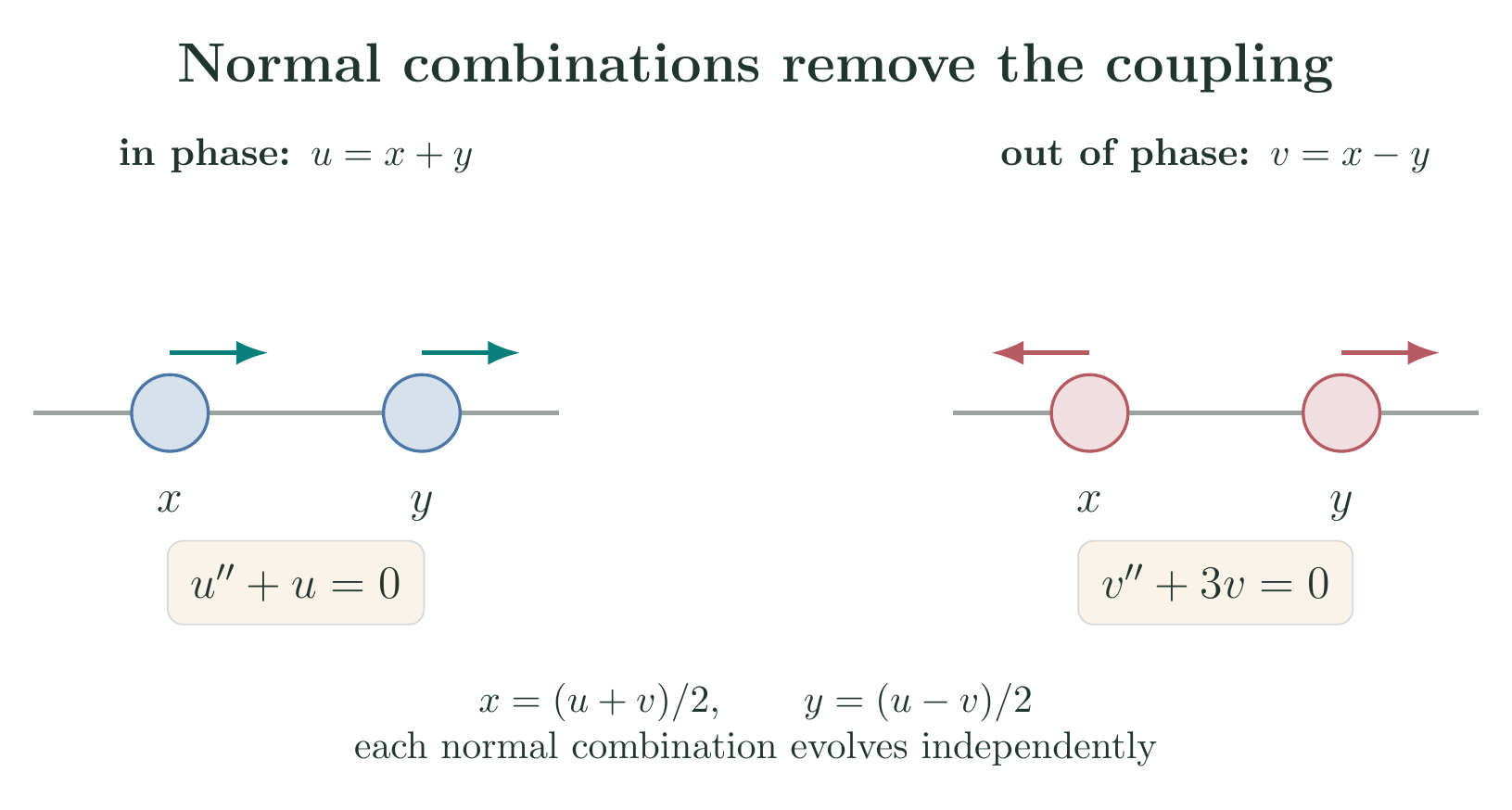
Direct substitution into both coupled systems is carried out in the Unit II Maxima worksheet.
Solved Problems
1. A Cauchy-Euler initial-value problem
Solve, for $x>0$,
\[x^2y^{\prime\prime}+xy^{\prime}-4y=0, \qquad y(1)=5, \qquad y^{\prime}(1)=6.\]With $y=x^m$, the indicial equation is
\[m(m-1)+m-4=m^2-4=0.\]The roots are $m=2,-2$, so
\[y=C_1x^2+C_2x^{-2}.\]At $x=1$,
\[C_1+C_2=5, \qquad 2C_1-2C_2=6.\]Hence $C_1=4$ and $C_2=1$, giving
\[\boxed{y=4x^2+x^{-2}}.\]Substitution gives $x^2y^{\prime\prime}+xy^{\prime}-4y=0$, and both initial conditions are recovered. The restriction $x>0$ is consistent with the logarithmic transformation used for the general theory.
2. A first-order system solved by elimination
Solve
\[x^{\prime}=x+y, \qquad y^{\prime}=4x+y, \qquad x(0)=1, \qquad y(0)=0.\]From the first equation, $y=x^{\prime}-x$. Differentiating and using the second equation gives
\[x^{\prime\prime}-x^{\prime}=4x+(x^{\prime}-x),\]or
\[x^{\prime\prime}-2x^{\prime}-3x=0.\]Its roots are $3$ and $-1$, so
\[x=Ae^{3t}+Be^{-t}, \qquad y=x^{\prime}-x=2Ae^{3t}-2Be^{-t}.\]The initial data give $A+B=1$ and $A-B=0$. Therefore
\[\boxed{ x=\frac{e^{3t}+e^{-t}}2, \qquad y=e^{3t}-e^{-t}}.\]Direct substitution makes both first-order residuals zero. The growing $e^{3t}$ normal component eventually dominates the decaying $e^{-t}$ component.
3. Two second-order normal combinations
Solve
\[x^{\prime\prime}+3x-y=0, \qquad y^{\prime\prime}+3y-x=0,\]subject to $x(0)=1$, $y(0)=0$, and $x^{\prime}(0)=y^{\prime}(0)=0$.
Set $u=x+y$ and $v=x-y$. Adding and subtracting the equations gives
\[u^{\prime\prime}+2u=0, \qquad v^{\prime\prime}+4v=0.\]The initial data become $u(0)=v(0)=1$ and $u^{\prime}(0)=v^{\prime}(0)=0$, hence
\[u=\cos(\sqrt2t), \qquad v=\cos2t.\]Recovering the original variables,
\[\boxed{ x=\frac{\cos(\sqrt2t)+\cos2t}{2}, \qquad y=\frac{\cos(\sqrt2t)-\cos2t}{2}}.\]Both coupled equations and all four initial data are satisfied. If $t$ is measured in seconds, the two normal angular frequencies are $\sqrt2\,\mathrm{rad\,s^{-1}}$ and $2\,\mathrm{rad\,s^{-1}}$.
Descriptive Questions
- Derive the indicial equation for a second-order Cauchy-Euler equation and relate it to the substitution $t=\ln x$.
- Explain the origin of the $x^m\ln x$ term when the indicial equation has a repeated root.
- Show how elimination converts two simultaneous first-order equations into one second-order equation.
- Explain why normal combinations decouple a symmetric pair of simultaneous second-order equations.
Numerical Problems
- For $x^2y^{\prime\prime}+xy^{\prime}+9y=0$, find the logarithmic phase period and the factor by which $x$ must be multiplied to repeat the phase. Final answer: $m=\pm3i$, $\Delta(\ln x)=2\pi/3$, and $x_2/x_1=e^{2\pi/3}=8.1205$.
- Find the normal growth rates of $x^{\prime}=2x+3y$, $y^{\prime}=3x+2y$. Final answer: the rates are $5$ for $x+y$ and $-1$ for $x-y$.
- Find the normal angular frequencies of $x^{\prime\prime}+5x-2y=0$, $y^{\prime\prime}+5y-2x=0$. Final answer: $\omega_{+}=\sqrt3$ and $\omega_{-}=\sqrt7$ in inverse-time units.
- Solve $x^2y^{\prime\prime}-5xy^{\prime}+9y=0$ with $y(1)=2$, $y^{\prime}(1)=7$, and evaluate $y(2)$. Final answer: $y=x^3(2+\ln x)$; $y(2)=8(2+\ln2)=21.5452$.
The three solution residuals and all numerical values are verified in the Unit II problem-check worksheet.
References
- Cauchy-Euler equation — Wikipedia
- William E. Boyce, Richard C. DiPrima, and Douglas B. Meade, Elementary Differential Equations and Boundary Value Problems, 11th ed., chapters “Higher-Order Linear Equations” and “Systems of First-Order Linear Equations,” Wiley.
- Erwin Kreyszig, Advanced Engineering Mathematics, 10th ed., chapters “Second-Order Linear ODEs” and “Systems of ODEs,” Wiley.
- Mary L. Boas, Mathematical Methods in the Physical Sciences, 3rd ed., Chapter 8, “Ordinary Differential Equations,” Wiley.


Discussion