

28 Jun 2025
Vibrational Modes of a Circular Membrane
Angular periodicity, the radial Bessel equation, fixed-rim roots, and circular-membrane frequencies.
For a circular membrane of radius $a$, take the polar wave equation as given:
\[\boxed{ u_{tt}=c^2\left[ \frac1r\frac{\partial}{\partial r} \left(r\frac{\partial u}{\partial r}\right) +\frac1{r^2}\frac{\partial^2u}{\partial\varphi^2} \right]}.\]Use $u(r,\varphi,t)=R(r)\Phi(\varphi)T(t)$. Division by $c^2R\Phi T$ gives
\[\frac{T^{\prime\prime}}{c^2T} =\frac1R\frac1r(rR^{\prime})^{\prime} +\frac1{r^2}\frac{\Phi^{\prime\prime}}{\Phi}.\]Set $T^{\prime\prime}/(c^2T)=-k^2$. After multiplying the remaining equation by $r^2$,
\[\frac rR(rR^{\prime})^{\prime}+k^2r^2=-\frac{\Phi^{\prime\prime}}{\Phi}.\]The two sides depend on different variables, so each equals a constant $m^2$. The angular equation is
\[\Phi^{\prime\prime}+m^2\Phi=0.\]Single-valuedness requires $\Phi(\varphi+2\pi)=\Phi(\varphi)$, hence $m=0,1,2,\ldots$ and
\[\Phi=A\cos m\varphi+B\sin m\varphi.\]The radial equation is
\[r^2R^{\prime\prime}+rR^{\prime}+(k^2r^2-m^2)R=0.\]With $s=kr$, this becomes Bessel’s equation,
\[\boxed{s^2R_{ss}+sR_s+(s^2-m^2)R=0}.\]Its solution finite at the centre is $J_m(s)$. The second independent solution is singular at $r=0$ and is excluded. Therefore
\[R(r)=J_m(kr).\]The fixed rim requires $R(a)=0$, so
\[J_m(ka)=0.\]Let $\alpha_{mn}$ be the $n$th positive zero of $J_m$. Then
\[k_{mn}=\frac{\alpha_{mn}}a, \qquad \boxed{\omega_{mn}=\frac{c\alpha_{mn}}a}.\]A real mode is
\[\boxed{ u_{mn}=J_m\!\left(\alpha_{mn}\frac ra\right) \left(A\cos m\varphi+B\sin m\varphi\right) \cos(\omega_{mn}t+\delta)}.\]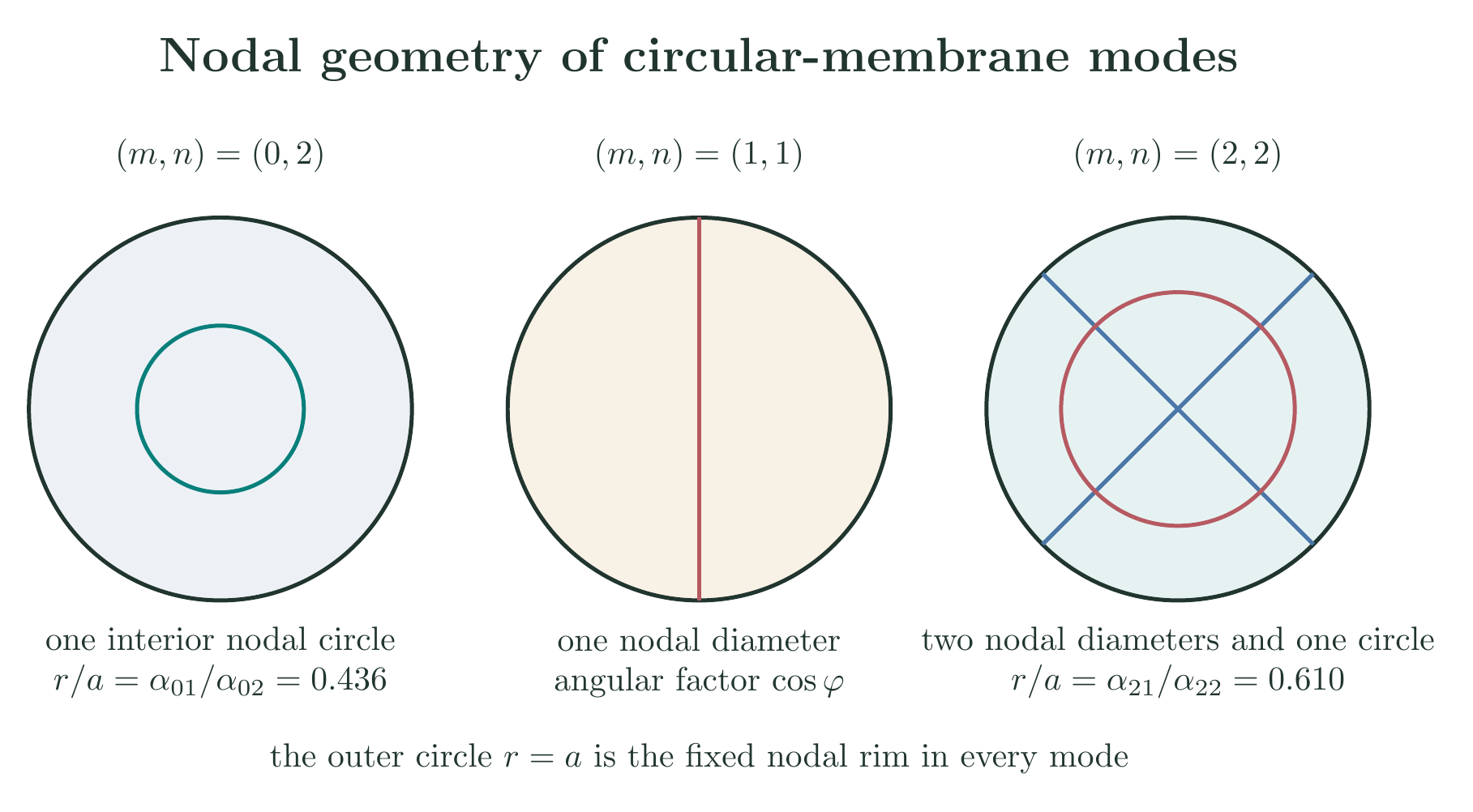
For $m>0$, the cosine and sine angular factors have the same frequency and differ only by a rotation. A mode $(m,n)$ has $m$ nodal diameters and $n-1$ interior nodal circles; the fixed rim is not counted as an interior circle. The frequency has the correct units because $\alpha_{mn}$ is dimensionless and $[c/a]=\mathrm{time}^{-1}$.
The $m=0$ radial function is checked directly in Bessel’s differential equation in the Unit II Maxima worksheet.
Solved Problems
1. The axisymmetric fundamental mode
A circular membrane has radius $a=0.25\,\mathrm{m}$ and wave speed $c=90\,\mathrm{m\,s^{-1}}$. Find its fundamental frequency. The first zero of $J_0$ is
\[\alpha_{01}=2.4048255577.\]For the axisymmetric fundamental,
\[\omega_{01}=\frac{c\alpha_{01}}a =865.737\,\mathrm{rad\,s^{-1}},\]and therefore
\[\boxed{ f_{01}=\frac{\omega_{01}}{2\pi} =\frac{90(2.4048255577)}{2\pi(0.25)} =137.786\,\mathrm{Hz}}.\]Here $m=0$ gives no nodal diameter and $n=1$ gives no interior nodal circle. The displacement is finite at $r=0$, vanishes at $r=a$, and $c/a$ supplies the required inverse-time unit.
2. A non-axisymmetric mode and its nodal circle
For $a=0.40\,\mathrm{m}$ and $c=100\,\mathrm{m\,s^{-1}}$, consider the $(m,n)=(1,2)$ mode. Use
\[\alpha_{11}=3.8317059702, \qquad \alpha_{12}=7.0155866698.\]Its frequency is
\[\boxed{ f_{12}=\frac{c\alpha_{12}}{2\pi a} =279.141\,\mathrm{Hz}}.\]The angular factor has one nodal diameter. An interior nodal circle occurs when the radial argument reaches the preceding zero $\alpha_{11}$:
\[\alpha_{12}\frac{r_1}{a}=\alpha_{11}.\]Thus
\[\boxed{ r_1=a\frac{\alpha_{11}}{\alpha_{12}} =0.218468\,\mathrm{m}}.\]There is one interior nodal circle, as required by $n-1=1$. Substitution of $r=a$ gives $J_1(\alpha_{12})=0$, so the rim condition is also satisfied.
Descriptive Questions
- Starting from the given polar wave equation, derive the angular and radial separated equations.
- Explain how single-valuedness quantizes the angular index and why the singular radial solution is excluded at the centre.
- Derive the fixed-rim frequency condition in terms of positive zeros of $J_m$.
- Explain the rotational degeneracy of the sine and cosine angular factors for $m>0$.
Numerical Problems
- Using $\alpha_{01}=2.4048255577$ and $\alpha_{02}=5.5200781103$, find $f_{02}/f_{01}$. Final answer: $f_{02}/f_{01}=\alpha_{02}/\alpha_{01}=2.29542$.
- State the interior nodal set and number of angular sectors for a $(3,1)$ mode. Final answer: three nodal diameters, no interior nodal circle, and six angular sectors.
- For a membrane of radius $a=0.20\,\mathrm{m}$, normalize the fundamental radial shape $R(r)=A J_0(\alpha_{01}r/a)$ by requiring $\int_0^a R^2r\,dr=1$. Use $J_1(\alpha_{01})=0.5191474973$ and $\int_0^a rJ_0^2(\alpha_{01}r/a)\,dr=a^2J_1^2(\alpha_{01})/2$. Final answer: $A=\sqrt2/[a\lvert J_1(\alpha_{01})\rvert]=13.6205\,\mathrm{m^{-1}}$.
- For $m=2$, rewrite $\sqrt3\cos2\varphi+\sin2\varphi$ as one shifted cosine and find the nodal-diameter orientations in $0\le\varphi<\pi$. Final answer: $2\cos(2\varphi-\pi/6)$; $\varphi=\pi/3$ and $5\pi/6$.
The Bessel-zero ratios, frequencies, nodal radii, radial normalization, and angular identities are verified in the Unit II problem-check worksheet.
References
- Vibration of a circular membrane — Wikipedia
- Richard Haberman, Applied Partial Differential Equations with Fourier Series and Boundary Value Problems, 5th ed., Chapter 7, §7.7, “Vibrating Circular Membrane and Bessel Functions,” Pearson.
- George B. Arfken, Hans J. Weber, and Frank E. Harris, Mathematical Methods for Physicists, 7th ed., chapter “Bessel Functions,” Academic Press.
- Mary L. Boas, Mathematical Methods in the Physical Sciences, 3rd ed., chapters “Special Functions” and “Partial Differential Equations,” Wiley.


Discussion