

29 Jul 2025
Complex Integration and the Cauchy-Goursat Results
Contour parametrization, connected regions, Cauchy-Goursat theorem, Cauchy's integral formula, and Cauchy's inequality.
Let a directed contour $C$ be parametrized by
\[z=z(t),\qquad a\le t\le b.\]Because $dz=z^{\prime}(t)dt$, define
\[\boxed{ \int_C f(z)\,dz =\int_a^b f(z(t))z^{\prime}(t)\,dt}.\]Reversing the direction changes the sign. If $F^{\prime}(z)=f(z)$ throughout a domain containing the contour, the chain rule gives
\[\int_C f(z)dz =\int_a^b\frac{d}{dt}F(z(t))dt =F(z_b)-F(z_a).\]Thus an antiderivative makes the integral path-independent. Conversely, for continuous $f$ on a connected domain, path independence lets one define
\[F(z)=\int_{z_*}^{z}f(\zeta)\,d\zeta,\]and the difference quotient shows that $F^{\prime}(z)=f(z)$.
If $\lvert f(z)\rvert\leq M$ on a contour of length $L$, the parametrized definition and the triangle inequality give
\[\begin{aligned} \left\lvert\int_Cf(z)\,dz\right\rvert &\leq\int_a^b \lvert f(z(t))\rvert\lvert z^{\prime}(t)\rvert\,dt\\ &\leq M\int_a^b\lvert z^{\prime}(t)\rvert\,dt =ML. \end{aligned}\]This is the $ML$ inequality.
Simply and multiply connected regions
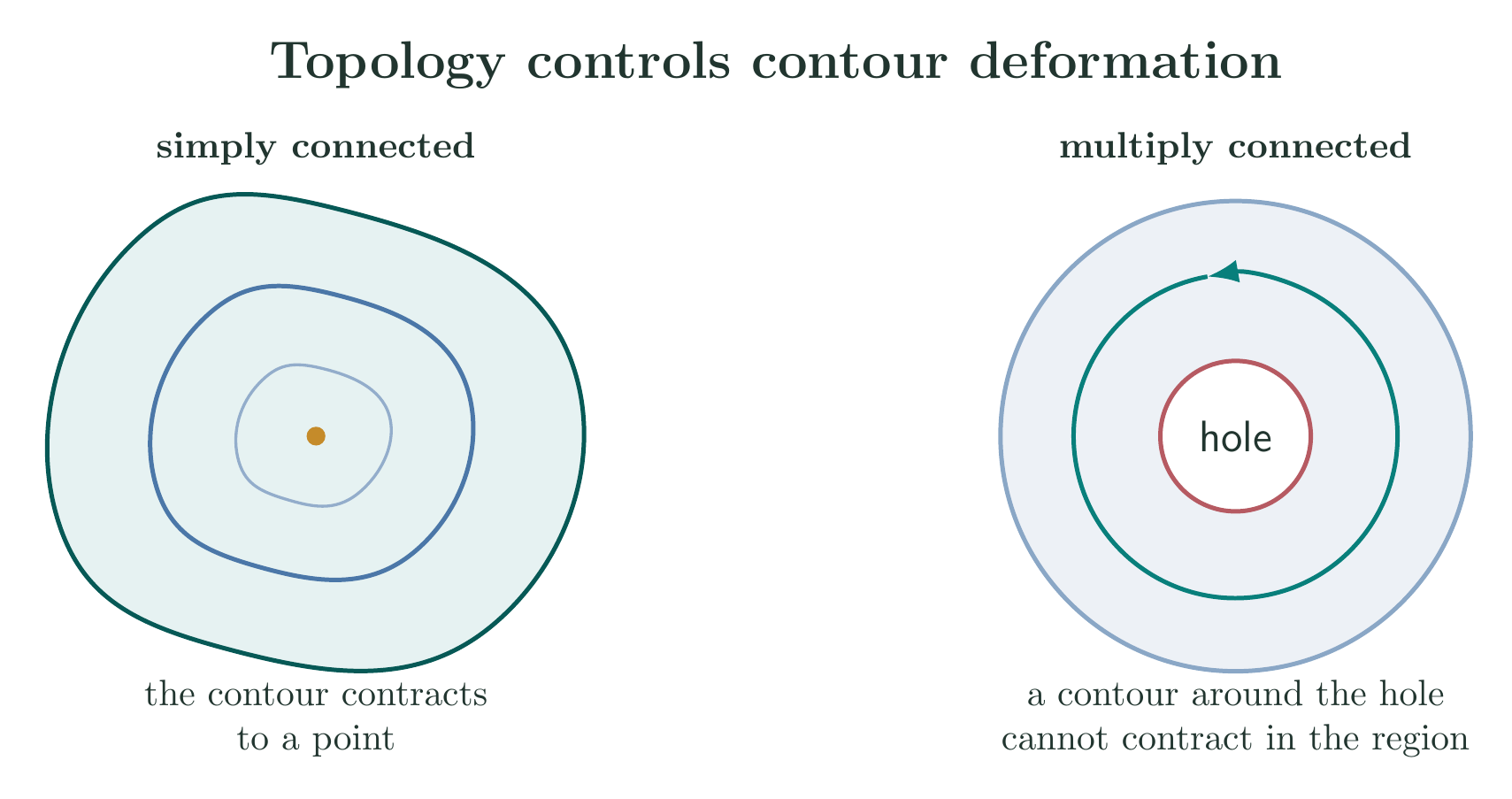
A region is simply connected if every closed contour in it can be continuously contracted to a point without leaving the region. A region with a hole is multiply connected.
For the unit circle $z=e^{it}$,
\[\oint_{\lvert z\rvert=1}\frac{dz}{z} =\int_0^{2\pi}\frac{ie^{it}}{e^{it}}dt =2\pi i.\]The integrand is analytic in the punctured plane, but the contour surrounds its missing point $z=0$. It cannot be contracted to a point while remaining in that domain.
Cauchy-Goursat theorem
If $f$ is analytic throughout a simply connected region and on its boundary $C$, then
\[\boxed{\oint_C f(z)\,dz=0}.\]Under continuous first partial derivatives, the cancellation follows directly from Green’s theorem. With $f=u+iv$ and $dz=dx+i\,dy$,
\[f\,dz=(u\,dx-v\,dy)+i(v\,dx+u\,dy).\]For counterclockwise $C=\partial D$, Green’s theorem gives
\[\oint_C(u\,dx-v\,dy) =\iint_D(-v_x-u_y)dA,\]and
\[\oint_C(v\,dx+u\,dy) =\iint_D(u_x-v_y)dA.\]Both integrands vanish by the Cauchy-Riemann equations. Goursat’s form of the theorem removes the extra assumption that $f^{\prime}$ is continuous.
Cauchy’s integral formula
Let $f$ be analytic on and inside a positively oriented simple contour $C$, and let $z_0$ lie inside it. Remove a small circle $C_\varepsilon$ about $z_0$. The integrand
\[\frac{f(z)}{z-z_0}\]is analytic in the region between the two contours, so Cauchy-Goursat gives
\[\oint_C\frac{f(z)}{z-z_0}dz =\oint_{C_\varepsilon}\frac{f(z)}{z-z_0}dz.\]Split $f(z)=f(z_0)+[f(z)-f(z_0)]$. On
\[z-z_0=\varepsilon e^{it}, \qquad dz=i\varepsilon e^{it}dt,\]the constant part is
\[f(z_0)\int_0^{2\pi}i\,dt=2\pi i f(z_0).\]For the remaining part, continuity makes
\[\max_{C_\varepsilon}\lvert f(z)-f(z_0)\rvert\to0.\]Its integral has magnitude at most this maximum times
\[\frac{\operatorname{length}(C_\varepsilon)}{\varepsilon} =\frac{2\pi\varepsilon}{\varepsilon}=2\pi,\]so it tends to zero. Therefore
\[\boxed{ f(z_0)=\frac{1}{2\pi i} \oint_C\frac{f(z)}{z-z_0}dz}.\]Repeated differentiation with respect to $z_0$ gives
\[\boxed{ f^{(n)}(z_0)=\frac{n!}{2\pi i} \oint_C\frac{f(z)}{(z-z_0)^{n+1}}dz}.\]Cauchy’s inequality
If $\lvert f(z)\rvert\le M$ on the circle $\lvert z-z_0\rvert=R$, then
\[\begin{aligned} \lvert f^{(n)}(z_0)\rvert &\le\frac{n!}{2\pi} \oint_C\frac{\lvert f(z)\rvert}{R^{n+1}}\lvert dz\rvert\\ &\le\frac{n!}{2\pi}\frac{M}{R^{n+1}}(2\pi R). \end{aligned}\]Hence
\[\boxed{\lvert f^{(n)}(z_0)\rvert\le\frac{n!M}{R^n}}.\]The unit-circle integral and sample Cauchy-formula integrals are checked in the Unit III Maxima worksheet.
Solved Problems
-
Evaluate $\int_C\bar z\,dz$ directly when $C$ is the upper semicircle $\lvert z\rvert=2$, directed from $2$ to $-2$.
Parametrize
\[z(t)=2e^{it}, \qquad 0\leq t\leq\pi.\]Then
\[\bar z(t)=2e^{-it}, \qquad dz=2ie^{it}dt.\]Therefore
\[\int_C\bar z\,dz =\int_0^\pi (2e^{-it})(2ie^{it})dt =4i\int_0^\pi dt =\boxed{4\pi i}.\]The nonzero result is consistent with $\bar z$ being nonanalytic; reversing the semicircle would change the sign.
-
Evaluate
\[\oint_{\lvert z\rvert=2} \frac{e^z}{(z-1)^3}\,dz\]for counterclockwise orientation.
Cauchy’s derivative formula with $f(z)=e^z$, $z_0=1$, and $n=2$ gives
\[f^{\prime\prime}(1)=\frac{2!}{2\pi i} \oint_{\lvert z\rvert=2} \frac{e^z}{(z-1)^3}\,dz.\]Since $f^{\prime\prime}(1)=e$,
\[\oint_{\lvert z\rvert=2} \frac{e^z}{(z-1)^3}\,dz =\frac{2\pi i}{2!}e =\boxed{\pi i e}.\]The pole lies inside the contour, and the positive sign follows from counterclockwise orientation.
-
Let $\Gamma$ be the upper semicircle $\lvert z\rvert=1$. Obtain an $ML$ bound for
\[\int_\Gamma\frac{dz}{z^2+9}.\]On $\Gamma$,
\[\lvert z^2+9\rvert \geq 9-\lvert z\rvert^2=8,\]so
\[\left\lvert\frac1{z^2+9}\right\rvert\leq\frac18.\]The arc length is $L=\pi$, hence
\[\boxed{ \left\lvert\int_\Gamma\frac{dz}{z^2+9}\right\rvert \leq\frac{\pi}{8}}.\]The estimate is a bound, not an assertion that the integral equals $\pi/8$.
Descriptive Questions
- Derive the parametrized contour integral and prove the $ML$ inequality.
- Explain the relationship among antiderivatives, path independence, and vanishing closed-contour integrals.
- Derive the Cauchy-Goursat theorem from Green’s theorem under continuous first partial derivatives.
- Derive Cauchy’s integral formula, its derivative form, and Cauchy’s inequality with all orientation assumptions stated.
Numerical Problems
-
Evaluate $\int_C z^2\,dz$ from $0$ to $1+i$ along any path in the complex plane.
Answer: $(-2+2i)/3$.
-
Evaluate $\oint_{\lvert z\rvert=3}dz/(z-2)$ counterclockwise.
Answer: $2\pi i$.
-
Evaluate $\oint_{\lvert z\rvert=1}dz/(z-2)$.
Answer: $0$.
-
Evaluate $\oint_{\lvert z\rvert=2}z^3\,dz/(z-i)^2$ counterclockwise.
Answer: $-6\pi i$.
-
Evaluate $\oint_{\lvert z-1\rvert=1/2}\cos z\,dz/(z-1)$ counterclockwise.
Answer: $2\pi i\cos1$.
-
If $\lvert f(z)\rvert\leq5$ on $\lvert z\rvert=2$ and $f$ is analytic inside, find the Cauchy bound for $\lvert f^{(3)}(0)\rvert$.
Answer: $\lvert f^{(3)}(0)\rvert\leq15/4$.
All added contour integrals, Cauchy-formula values, and bounds are verified in the Unit III Maxima worksheet; every printed residual is zero.
References
- Cauchy’s integral formula — Wikipedia
- MIT OpenCourseWare 18.04, lecture notes: Topics 3 and 4
- James Ward Brown and Ruel V. Churchill, Complex Variables and Applications, 9th ed., Chapter 4.


Discussion