

26 Jul 2025
Complex Numbers, Euler's Formula, De Moivre's Theorem, and Roots
Argand-plane geometry, polar form, complex multiplication, integer powers, and all roots of a complex number.
A complex number is
\[z=x+iy, \qquad i^2=-1,\]and is represented by the point $(x,y)$ in the Argand plane. Its conjugate and modulus are
\[\bar z=x-iy, \qquad \lvert z\rvert=\sqrt{z\bar z}=\sqrt{x^2+y^2}.\]For $z\ne0$, let $\theta$ be an argument of $z$. Then
\[x=r\cos\theta,\qquad y=r\sin\theta,\qquad r=\lvert z\rvert,\]so
\[\boxed{z=r(\cos\theta+i\sin\theta)}.\]Because $\theta$ and $\theta+2\pi k$ represent the same point, the argument is multivalued. A selected principal argument is commonly restricted to one interval of length $2\pi$.
Euler’s formula
Let
\[w(\theta)=\cos\theta+i\sin\theta.\]Differentiation gives
\[\frac{dw}{d\theta} =-\sin\theta+i\cos\theta =i(\cos\theta+i\sin\theta) =iw,\]with $w(0)=1$. The exponential $e^{i\theta}$ is the solution of the same equation $w^{\prime}=iw$ with the same initial value. Hence
\[\boxed{e^{i\theta}=\cos\theta+i\sin\theta}.\]Therefore the polar form is
\[\boxed{z=re^{i\theta}}.\]Multiplication now has a direct geometrical meaning:
\[z_1z_2=r_1r_2e^{i(\theta_1+\theta_2)}.\]The moduli multiply and the arguments add.
For $z_2\ne0$, division follows by multiplying by $e^{-i\theta_2}/r_2$:
\[\boxed{\frac{z_1}{z_2} =\frac{r_1}{r_2}e^{i(\theta_1-\theta_2)}}.\]Thus division divides moduli and subtracts arguments.
De Moivre’s theorem
For an integer $n$,
\[(\cos\theta+i\sin\theta)^n =(e^{i\theta})^n=e^{in\theta}.\]Using Euler’s formula again,
\[\boxed{ (\cos\theta+i\sin\theta)^n =\cos(n\theta)+i\sin(n\theta)}.\]For negative $n$, the result follows by taking reciprocals, since $\lvert e^{i\theta}\rvert=1$.
Roots of a complex number
Let
\[z^n=Re^{i\Theta}, \qquad R>0.\]Write $z=re^{i\theta}$. Then
\[r^ne^{in\theta}=Re^{i(\Theta+2\pi k)}.\]Equality of moduli and arguments gives
\[r=R^{1/n}, \qquad \theta=\frac{\Theta+2\pi k}{n}.\]Only $k=0,1,\ldots,n-1$ give distinct roots, because increasing $k$ by $n$ adds $2\pi$ to $\theta$. Thus
\[\boxed{ z_k=R^{1/n} \exp\!\left[i\frac{\Theta+2\pi k}{n}\right], \quad k=0,\ldots,n-1}.\]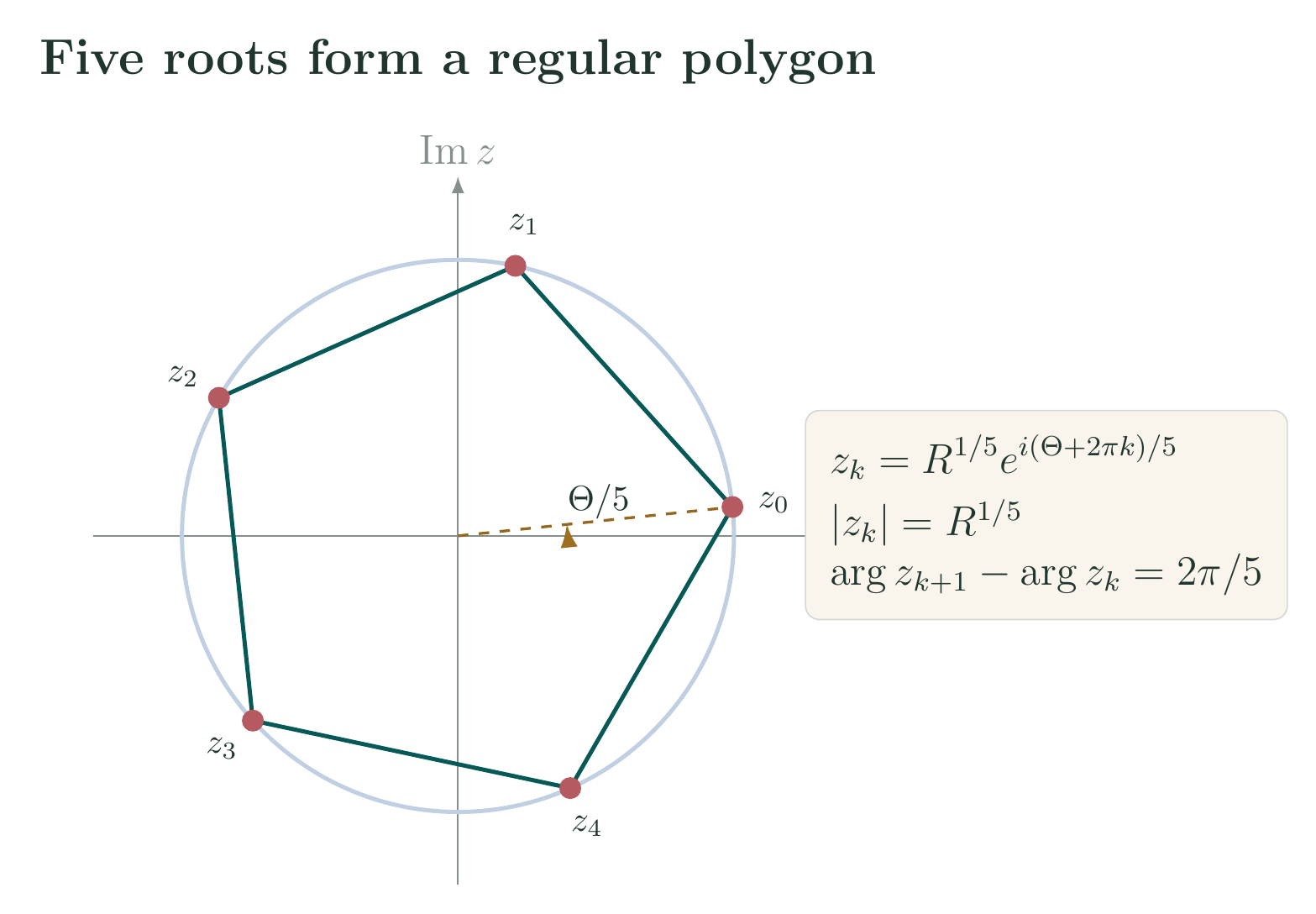
For example, the cube roots of $8=8e^{i2\pi k}$ are
\[z_k=2e^{i2\pi k/3}, \qquad k=0,1,2,\]or
\[\boxed{2,\quad -1+i\sqrt3,\quad -1-i\sqrt3}.\]Cubing each value gives $8$, as verified in the Unit III Maxima worksheet.
Solved Problems
-
Write $z=-\sqrt3+i$ in polar form and evaluate $z^6$ using De Moivre’s theorem.
Its modulus is
\[r=\sqrt{(-\sqrt3)^2+1^2}=2.\]The point is in quadrant II, with reference angle $\pi/6$, so its principal argument is
\[\Theta=\pi-\frac{\pi}{6}=\frac{5\pi}{6}.\]Hence
\[z=2e^{i5\pi/6}.\]De Moivre’s theorem gives
\[z^6=2^6e^{i5\pi} =64(\cos5\pi+i\sin5\pi) =\boxed{-64}.\]The modulus check is $\lvert z^6\rvert=2^6=64$, and the angle $5\pi$ is equivalent to $\pi$ modulo $2\pi$, so the result must lie on the negative real axis.
-
Find all solutions of $z^4=-16$ and verify their geometrical arrangement.
Write
\[-16=16e^{i(\pi+2\pi k)}.\]The fourth-root modulus is $16^{1/4}=2$, and the distinct arguments are
\[\theta_k=\frac{\pi+2\pi k}{4} =\frac{\pi}{4}+\frac{k\pi}{2}, \qquad k=0,1,2,3.\]Therefore
\[\boxed{ z=\sqrt2+i\sqrt2,\; -\sqrt2+i\sqrt2,\; -\sqrt2-i\sqrt2,\; \sqrt2-i\sqrt2}.\]Each root has modulus $2$, consecutive roots differ in argument by $\pi/2$, and raising any root to the fourth power gives modulus $16$ and argument $\pi$ modulo $2\pi$.
Descriptive Questions
- Derive Euler’s formula from the differential equation satisfied by $\cos\theta+i\sin\theta$.
- Explain geometrically why complex multiplication multiplies moduli and adds arguments, while division subtracts arguments.
- Prove De Moivre’s theorem for positive and negative integers.
- Derive all $n$th roots of $Re^{i\Theta}$ and prove that they form a regular polygon.
Numerical Problems
-
Express $(3-4i)/(1+2i)$ in Cartesian form.
Answer: $-1-2i$.
-
Find the modulus and principal argument of $-!1-i\sqrt3$.
Answer: modulus $2$; principal argument $-2\pi/3$.
-
Find the area of the triangle in the Argand plane with vertices $z_1=0$, $z_2=2+i$, and $z_3=1+3i$.
Answer: $5/2$ square units.
-
Solve $z+2\bar z=3+i$.
Answer: $z=1-i$.
-
Describe the locus $\lvert z-(2-i)\rvert=3$ in the Argand plane.
Answer: the circle with center $2-i$ and radius $3$.
-
Find both square roots of $5+12i$.
Answer: $\pm(3+2i)$.
All added algebraic powers, roots, and answer checks are verified in the Unit III Maxima worksheet; every printed residual is zero.
References
- Complex number — Wikipedia
- MIT OpenCourseWare 18.04, lecture notes: Topic 1, Complex Algebra and the Complex Plane
- James Ward Brown and Ruel V. Churchill, Complex Variables and Applications, 9th ed., Chapter 1.


Discussion