

31 Jul 2025
Contour Integration for Definite Integrals
Residue calculations for a real rational integral and a trigonometric integral on the unit circle.
Contour choice is controlled by decay and singularities. If $f(z)=P(z)/Q(z)$ and $\deg Q\geq\deg P+2$, then on a semicircle of radius $R$ the integrand is $O(R^{-2})$ or smaller, while the arc length is $\pi R$; hence the arc contribution tends to zero. For $e^{ibz}$ with $b>0$, the upper half-plane is preferred because
\[\lvert e^{ib(x+iy)}\rvert=e^{-by}\leq1.\]If a pole lies on the real axis, the contour must be indented and the result interpreted as a Cauchy principal value; an ordinary improper integral cannot be assumed to exist.
A rational integral on the real line
Let $a>0$ and consider
\[I=\int_{-\infty}^{\infty}\frac{dx}{x^2+a^2}.\]Use
\[f(z)=\frac1{z^2+a^2} =\frac1{(z-ia)(z+ia)}\]and close the real segment $[-R,R]$ by the upper semicircle. Only the pole $z=ia$ lies inside.
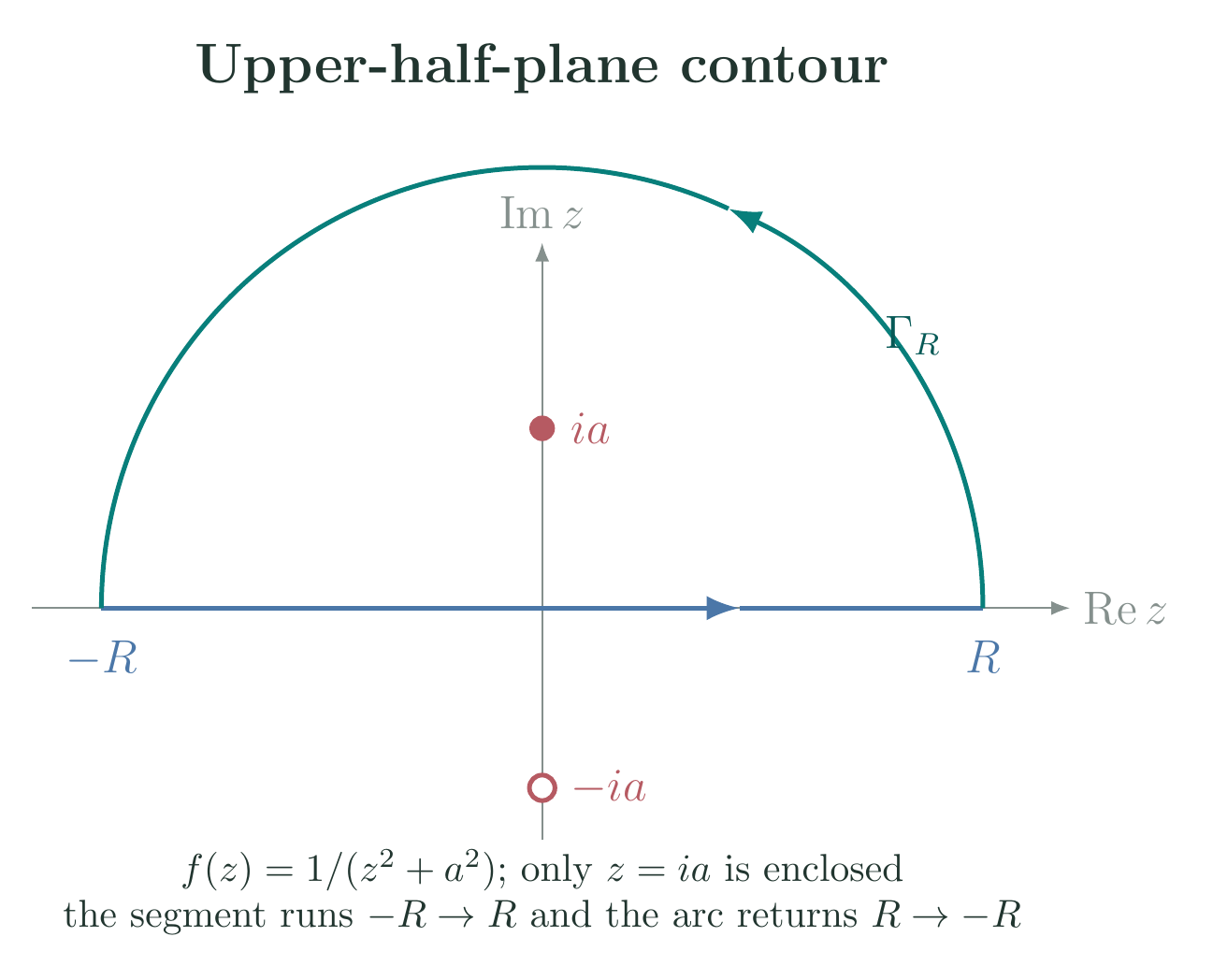
The residue is
\[\operatorname{Res}(f,ia) =\lim_{z\to ia}\frac{z-ia}{(z-ia)(z+ia)} =\frac1{2ia}.\]Thus
\[\int_{-R}^{R}\frac{dx}{x^2+a^2} +\int_{\Gamma_R}\frac{dz}{z^2+a^2} =2\pi i\frac1{2ia} =\frac{\pi}{a}.\]On the arc $\lvert z\rvert=R>a$,
\[\lvert z^2+a^2\rvert\ge \left\lvert\lvert z\rvert^2-a^2\right\rvert=R^2-a^2.\]Since the arc length is $\pi R$,
\[\left\lvert \int_{\Gamma_R}\frac{dz}{z^2+a^2} \right\rvert \le\frac{\pi R}{R^2-a^2} \longrightarrow0.\]Taking $R\to\infty$ gives
\[\boxed{ \int_{-\infty}^{\infty}\frac{dx}{x^2+a^2} =\frac{\pi}{a}}.\]If $x$ and $a$ have units of length, both sides have units of inverse length.
A trigonometric integral
For real $a>\lvert b\rvert>0$, evaluate
\[J=\int_0^{2\pi}\frac{d\theta}{a+b\cos\theta}.\]Set $z=e^{i\theta}$ on the unit circle. Then
\[d\theta=\frac{dz}{iz}, \qquad \cos\theta=\frac12\left(z+\frac1z\right).\]Therefore
\[\begin{aligned} J &=\oint_{\lvert z\rvert=1} \frac{1}{a+\dfrac b2(z+z^{-1})}\frac{dz}{iz}\\ &=\frac2i\oint_{\lvert z\rvert=1} \frac{dz}{bz^2+2az+b}. \end{aligned}\]The poles are the roots
\[z_\pm=\frac{-a\pm\sqrt{a^2-b^2}}{b}.\]Their product is $z_+z_-=1$. Because $a>\lvert b\rvert>0$, $z_+$ has magnitude less than one and $z_-$ has magnitude greater than one. Only $z_+$ is enclosed.
The derivative of the quadratic denominator is $2bz+2a$, so
\[\operatorname{Res} \left(\frac1{bz^2+2az+b},z_+\right) =\frac1{2(bz_++a)}.\]Using $bz_++a=\sqrt{a^2-b^2}$,
\[\begin{aligned} J &=\frac2i(2\pi i) \frac1{2\sqrt{a^2-b^2}}\\ &=\boxed{\frac{2\pi}{\sqrt{a^2-b^2}}}. \end{aligned}\]Both definite-integral results are independently reduced from their residues in the Unit III Maxima worksheet.
Solved Problems
-
Evaluate
\[I=\int_{-\infty}^{\infty}\frac{dx}{(x^2+1)^2}\]by residues.
Close the contour in the upper half-plane. The only enclosed singularity is the double pole $z=i$. Write
\[f(z)=\frac1{(z-i)^2(z+i)^2}.\]Its residue is
\[\begin{aligned} \operatorname{Res}(f,i) &=\left.\frac{d}{dz}\frac1{(z+i)^2}\right\rvert_{z=i}\\ &=\left.-\frac2{(z+i)^3}\right\rvert_{z=i} =-\frac2{(2i)^3} =\frac1{4i}. \end{aligned}\]On $\lvert z\rvert=R>1$,
\[\lvert(z^2+1)^2\rvert \geq(R^2-1)^2,\]so the arc magnitude is at most $\pi R/(R^2-1)^2\to0$. Therefore
\[I=2\pi i\left(\frac1{4i}\right) =\boxed{\frac{\pi}{2}}.\]The integrand is positive and behaves as $x^{-4}$, consistent with a finite positive result.
-
For $a>0$ and $b>0$, evaluate
\[I(a,b)=\int_{-\infty}^{\infty} \frac{\cos(bx)}{x^2+a^2}\,dx.\]Integrate
\[f(z)=\frac{e^{ibz}}{z^2+a^2}\]over the upper semicircle. On its arc,
\[\lvert e^{ibz}\rvert=e^{-b\,\operatorname{Im}z}\leq1,\]and
\[\left\lvert\int_{\Gamma_R}f(z)\,dz\right\rvert \leq\frac{\pi R}{R^2-a^2}\longrightarrow0.\]The enclosed pole is $z=ia$, with residue
\[\operatorname{Res}(f,ia) =\frac{e^{ib(ia)}}{2ia} =\frac{e^{-ab}}{2ia}.\]Hence
\[\int_{-\infty}^{\infty} \frac{e^{ibx}}{x^2+a^2}\,dx =2\pi i\frac{e^{-ab}}{2ia} =\frac{\pi}{a}e^{-ab}.\]The sine part is odd and integrates to zero, so taking the real part gives
\[\boxed{I(a,b)=\frac{\pi}{a}e^{-ab}}.\]At $b\to0^+$ this reduces to $\pi/a$, the rational integral derived above in the article.
Descriptive Questions
- Explain how decay, pole locations, and exponential factors determine the choice and orientation of a contour.
- Derive the semicircle estimate required for rational functions whose denominator degree exceeds the numerator degree by at least two.
- Derive the substitution $z=e^{i\theta}$ for trigonometric integrals and explain how poles inside the unit circle are selected.
- Explain why poles on the real axis require indentation and a Cauchy principal-value prescription.
Numerical Problems
-
Evaluate $\int_0^\infty dx/(x^4+1)$.
Answer: $\pi/(2\sqrt2)$.
-
Evaluate $\int_0^\infty dx/(1+x^6)$.
Answer: $\pi/3$.
-
Evaluate $\int_{-\infty}^{\infty}x\sin(2x)\,dx/(x^2+1)$.
Answer: $\pi e^{-2}$.
-
Evaluate $\int_0^{2\pi}\cos\theta\,d\theta/(5+4\cos\theta)$.
Answer: $-\pi/3$.
-
Evaluate $\operatorname{PV}\int_{-\infty}^{\infty}dx/(x^2-1)$.
Answer: $0$.
All added pole residues, arc reductions, Fourier-type values, and principal-value checks are verified in the Unit III Maxima worksheet; every printed residual is zero.
References
- Contour integration — Wikipedia
- MIT OpenCourseWare 18.04, lecture notes: Topic 9, Definite Integrals Using the Residue Theorem
- James Ward Brown and Ruel V. Churchill, Complex Variables and Applications, 9th ed., Chapter 7.


Discussion