

26 May 2025
Divergence, Curl, and Vector Integrals
Local sources and circulation, followed by line, surface, and volume integrals.
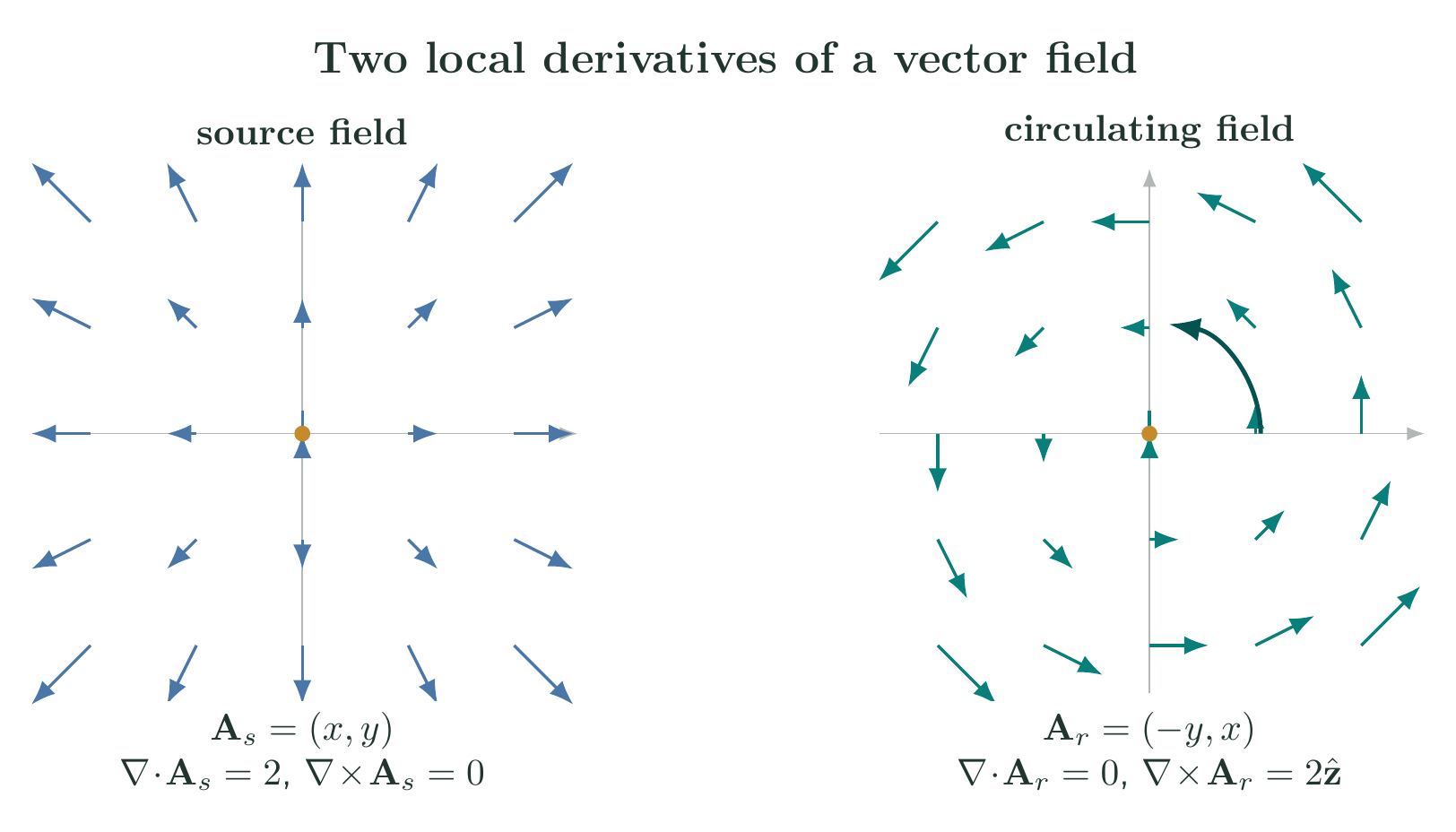
The derivatives of a vector field separate into two local quantities: divergence measures source strength, while curl measures circulation density.
Divergence from flux
For $\mathbf A=A_x\hat{\mathbf x}+A_y\hat{\mathbf y}+A_z\hat{\mathbf z}$, the outward flux through the two faces of a box normal to $x$ is
\[\begin{aligned} d\Phi_x &=[A_x(x+dx)-A_x(x)]dy\,dz\\ &=\frac{\partial A_x}{\partial x}dx\,dy\,dz+O(dx^2)\,dy\,dz. \end{aligned}\]Adding the $y$ and $z$ face pairs gives
\[d\Phi= \left(\frac{\partial A_x}{\partial x} +\frac{\partial A_y}{\partial y} +\frac{\partial A_z}{\partial z}\right)dV.\]Thus
\[\boxed{\nabla\cdot\mathbf A =\lim_{\Delta V\to0}\frac1{\Delta V} \oint_{\partial(\Delta V)}\mathbf A\cdot d\mathbf S}.\]Positive divergence means net outward flux; negative divergence means net inward flux. If $[\mathbf A]=Q$, then $[\nabla\cdot\mathbf A]=Q\,\mathrm{m^{-1}}$.
When $\mathbf A=\mathbf v$ is a fluid velocity, two neighbouring material points separated by $dx$ acquire relative speed $(\partial v_x/\partial x)dx$. Thus $\dot{dx}/dx=\partial v_x/\partial x$, with analogous equations in $y,z$. Since $\Delta V=dx\,dy\,dz$,
\[\boxed{\frac1{\Delta V}\frac{d(\Delta V)}{dt} =\frac{\dot{dx}}{dx}+\frac{\dot{dy}}{dy}+\frac{\dot{dz}}{dz} =\nabla\cdot\mathbf v}.\]Thus an incompressible velocity field is solenoidal, $\nabla\cdot\mathbf v=0$.
Curl from circulation
Traverse a rectangle $dx\times dy$ counterclockwise as seen from $+z$. Its circulation is
\[\begin{aligned} \oint\mathbf A\cdot d\boldsymbol\ell ={}&A_x(x,y)dx+A_y(x+dx,y)dy\\ &-A_x(x,y+dy)dx-A_y(x,y)dy\\ ={}&\left(\frac{\partial A_y}{\partial x} -\frac{\partial A_x}{\partial y}\right)dx\,dy. \end{aligned}\]This coefficient is $(\nabla\times\mathbf A)_z$. Repeating in the other planes,
\[\boxed{ \nabla\times\mathbf A =\begin{vmatrix} \hat{\mathbf x}&\hat{\mathbf y}&\hat{\mathbf z}\\ \partial_x&\partial_y&\partial_z\\ A_x&A_y&A_z \end{vmatrix}}.\]For a unit normal $\hat{\mathbf n}$,
\[\boxed{ \hat{\mathbf n}\cdot(\nabla\times\mathbf A) =\lim_{\Delta S\to0}\frac1{\Delta S} \oint_{\partial(\Delta S)}\mathbf A\cdot d\boldsymbol\ell}.\]The right-hand rule fixes the sign between the circulation and $\hat{\mathbf n}$.
For rigid rotation with angular velocity $\boldsymbol\Omega$,
\[\begin{aligned} \mathbf v=\boldsymbol\Omega\times\mathbf r ={}&(\Omega_y z-\Omega_z y)\hat{\mathbf x}\\ &+(\Omega_z x-\Omega_x z)\hat{\mathbf y} +(\Omega_x y-\Omega_y x)\hat{\mathbf z}. \end{aligned}\]For example,
\[(\nabla\times\mathbf v)_x =\frac{\partial v_z}{\partial y}-\frac{\partial v_y}{\partial z} =\Omega_x-(-\Omega_x)=2\Omega_x,\]and cyclic differentiation gives
\[\boxed{\nabla\times\mathbf v =2\Omega_x\hat{\mathbf x}+2\Omega_y\hat{\mathbf y} +2\Omega_z\hat{\mathbf z}=2\boldsymbol\Omega}.\]Consequently, one-half of the curl is the local angular velocity of a velocity field’s rigid-rotation part.
Line, surface, and volume integrals
For a curve $C$ parametrized by $\mathbf r(t)$,
\[ds=\left\lvert\frac{d\mathbf r}{dt}\right\rvert dt, \qquad \int_C f\,ds =\int_a^b f(\mathbf r(t)) \left\lvert\frac{d\mathbf r}{dt}\right\rvert dt.\]This scalar line integral is unchanged by reversing the parametrization. In contrast, the vector line integral is
\[\boxed{\int_C\mathbf A\cdot d\boldsymbol\ell =\int_a^b\mathbf A(\mathbf r(t))\cdot\frac{d\mathbf r}{dt}dt}.\]Reversing the path reverses the sign. For a gradient field,
\[\int_C\nabla\phi\cdot d\boldsymbol\ell =\int_a^b\frac{d\phi}{dt}dt =\phi(\mathbf r_b)-\phi(\mathbf r_a),\]so the integral depends only on the endpoints.
If $\mathbf r(u,v)$ parametrizes an oriented surface,
\[dS=\left\lvert\frac{\partial\mathbf r}{\partial u} \times\frac{\partial\mathbf r}{\partial v}\right\rvert du\,dv, \qquad \iint_S f\,dS =\iint_D f(\mathbf r(u,v)) \left\lvert\mathbf r_u\times\mathbf r_v\right\rvert du\,dv,\]whereas vector flux uses the oriented area element
\[d\mathbf S=\left(\frac{\partial\mathbf r}{\partial u} \times\frac{\partial\mathbf r}{\partial v}\right)du\,dv, \qquad \boxed{\Phi=\iint_S\mathbf A\cdot d\mathbf S}.\]Changing the orientation changes the sign. On a closed surface, $d\mathbf S$ points outward.
For a scalar volume density $\rho$,
\[\boxed{Q=\iiint_V\rho\,dV}.\]Because $[\rho]=[Q]/\mathrm{m^3}$, the integral has units $[Q]$. A vector volume integral is evaluated component by component.
Equality of mixed partial derivatives gives
\[\boxed{\nabla\times(\nabla\phi)=\mathbf0}, \qquad \boxed{\nabla\cdot(\nabla\times\mathbf A)=0}.\]These identities require the displayed mixed partial derivatives to be continuous. A field with $\nabla\times\mathbf A=\mathbf0$ is irrotational; on a simply connected domain it has a scalar potential. A field with $\nabla\cdot\mathbf A=0$ is solenoidal.
Solved Problems
-
A velocity field is
\[\mathbf v=(2x-y)\hat{\mathbf x}+(x+2y)\hat{\mathbf y}-z\hat{\mathbf z} \quad \mathrm{m\,s^{-1}},\]with the coordinate coefficients understood in SI units. Find its divergence, curl, fractional volume-expansion rate, and local angular velocity.
Direct differentiation gives
\[\nabla\cdot\mathbf v =\frac{\partial(2x-y)}{\partial x} +\frac{\partial(x+2y)}{\partial y} +\frac{\partial(-z)}{\partial z} =2+2-1=3\ \mathrm{s^{-1}}.\]The curl is
\[\begin{aligned} \nabla\times\mathbf v &=(0-0)\hat{\mathbf x}+(0-0)\hat{\mathbf y}\\ &\quad+\left[\frac{\partial(x+2y)}{\partial x} -\frac{\partial(2x-y)}{\partial y}\right]\hat{\mathbf z}\\ &=2\hat{\mathbf z}\ \mathrm{s^{-1}}. \end{aligned}\]Therefore
\[\frac1{\Delta V}\frac{d(\Delta V)}{dt}=3\ \mathrm{s^{-1}}, \qquad \boldsymbol\Omega_{\mathrm{local}}=\frac12\nabla\times\mathbf v =\hat{\mathbf z}\ \mathrm{s^{-1}}.\]The positive divergence describes local expansion, while the positive $z$ curl describes counterclockwise rotation viewed from $+z$. Both dimensions reduce to inverse time, as required.
-
A force field is $\mathbf F=(y,-x,z)$ N, with coordinates measured in metres and coefficients carrying the corresponding units. Evaluate its work along $\mathbf r(t)=(t,t^2,t)$ m from $t=0$ to $t=1$.
Along the path,
\[\mathbf F(\mathbf r(t))=(t^2,-t,t), \qquad \frac{d\mathbf r}{dt}=(1,2t,1)\ \mathrm{m}.\]Hence
\[\mathbf F\cdot\frac{d\mathbf r}{dt} =t^2-2t^2+t=t-t^2,\]and
\[W=\int_0^1(t-t^2)dt =\left[\frac{t^2}{2}-\frac{t^3}{3}\right]_0^1 =\boxed{\frac16\ \mathrm{J}}.\]Force dotted with displacement has joule units. Since $\nabla\times\mathbf F=-2\hat{\mathbf z}$ in the $xy$ part, this result is path-dependent rather than an endpoint-only potential difference.
-
The plane $z=1-x-y$ above $x\geq0$, $y\geq0$, $x+y\leq1$ m is oriented upward. Find the flux of $\mathbf v=(x,y,z)\ \mathrm{s^{-1}}$ through it directly.
Parametrize the surface by
\[\mathbf r(x,y)=(x,y,1-x-y).\]Its upward area vector is
\[\mathbf r_x\times\mathbf r_y =(1,0,-1)\times(0,1,-1)=(1,1,1).\]On the surface,
\[\mathbf v\cdot(\mathbf r_x\times\mathbf r_y) =x+y+(1-x-y)=1\ \mathrm{m\,s^{-1}}.\]Therefore
\[\Phi=\int_0^1\int_0^{1-x}1\,dy\,dx =\int_0^1(1-x)dx =\boxed{\frac12\ \mathrm{m^3\,s^{-1}}}.\]The sign is positive because the flow has a component along the chosen upward normal; reversing the orientation would give $-1/2\ \mathrm{m^3\,s^{-1}}$.
Descriptive Questions
- Derive divergence as outward flux per unit volume by balancing opposite faces of an infinitesimal Cartesian box.
- Derive the normal component of curl from circulation around an infinitesimal oriented rectangle and explain the right-hand-rule sign.
- Compare scalar and vector line, surface, and volume integrals, including parametrization, dimensions, and orientation dependence.
- Prove $\nabla\times\nabla\phi=\mathbf0$ and $\nabla\cdot(\nabla\times\mathbf A)=0$, stating the differentiability assumptions and the domain condition for an irrotational field to possess a potential.
Numerical Problems
-
For
\[\mathbf A=(a x^2,-xy,-xz),\]determine the constant $a$ for which $\mathbf A$ is solenoidal everywhere.
Answer: $\nabla\cdot\mathbf A=2x(a-1)$, so $a=1$.
-
The counterclockwise circulation of a slowly varying planar velocity field around a small square of area $4.0\times10^{-4}\ \mathrm{m^2}$ is $1.2\times10^{-3}\ \mathrm{m^2\,s^{-1}}$. Estimate the normal component of curl, and hence predict the circulation around a nearby counterclockwise loop of area $1.5\times10^{-4}\ \mathrm{m^2}$ if the curl is locally uniform.
Answer: $(\nabla\times\mathbf v)_z=3.0\ \mathrm{s^{-1}}$ and the second circulation is $4.5\times10^{-4}\ \mathrm{m^2\,s^{-1}}$, both positive for the stated counterclockwise orientation.
-
A conservative force field is
\[\mathbf F=k\bigl[(y+z)\hat{\mathbf x} +(x+z)\hat{\mathbf y} +(x+y)\hat{\mathbf z}\bigr], \qquad k=1\ \mathrm{N\,m^{-1}}.\]Find a scalar potential $\Phi$ satisfying $\mathbf F=\nabla\Phi$ and hence find the work from $P=(1,0,0)\ \mathrm{m}$ to $Q=(1,2,3)\ \mathrm{m}$ without parametrizing a path.
Answer: $\Phi=k(xy+xz+yz)+C$ and $W=\Phi(Q)-\Phi(P)=11\ \mathrm{J}$.
-
A quarter-circular wire is parametrized by $\mathbf r(t)=(2\cos t,2\sin t,0)$ m, $0\leq t\leq\pi/2$. Its linear density is $\lambda=(1\ \mathrm{kg\,m^{-2}})(x+y)$. Find its mass.
Answer: $8\ \mathrm{kg}$.
-
Find the area of the part of the paraboloid $z=x^2+y^2$ lying above the disk $x^2+y^2\leq1$, with all coordinates measured in metres.
Answer: $S=\dfrac{\pi}{6}(5\sqrt5-1)\ \mathrm{m^2}$.
-
A cube $0\leq x,y,z\leq L$ contains density $\rho=\rho_0(1+x/L)$. Find its total mass.
Answer: $M=\tfrac32\rho_0L^3$.
All symbolic reductions and numerical answers are checked in the Unit I Maxima worksheet; every printed residual is zero.


Discussion