

27 Jul 2025
Functions of a Complex Variable, Analyticity, and Cauchy-Riemann Equations
Complex differentiation from path-independent limits, derivation of the Cauchy-Riemann equations, and analytic examples.
A function of a complex variable can be written
\[w=f(z)=u(x,y)+iv(x,y), \qquad z=x+iy,\]where $u$ and $v$ are real functions. Its derivative at $z_0$ is
\[\boxed{ f^{\prime}(z_0)=\lim_{\Delta z\to0} \frac{f(z_0+\Delta z)-f(z_0)}{\Delta z}}.\]Unlike a real increment, $\Delta z$ can approach zero from infinitely many directions. The same limit must be obtained along every path.
Derivation of the Cauchy-Riemann equations
First approach along the real direction: $\Delta z=\Delta x$. Then
\[f^{\prime}(z)=\lim_{\Delta x\to0} \left(\frac{\Delta u}{\Delta x} +i\frac{\Delta v}{\Delta x}\right) =u_x+iv_x.\]Now approach along the imaginary direction: $\Delta z=i\Delta y$. Since $1/i=-i$,
\[\begin{aligned} f^{\prime}(z) &=\lim_{\Delta y\to0} \frac{\Delta u+i\Delta v}{i\Delta y}\\ &=\lim_{\Delta y\to0} \left(\frac{\Delta v}{\Delta y} -i\frac{\Delta u}{\Delta y}\right)\\ &=v_y-iu_y. \end{aligned}\]Equality of real and imaginary parts gives
\[\boxed{u_x=v_y,\qquad u_y=-v_x}.\]These are the Cauchy-Riemann equations. When the first partial derivatives are continuous in a neighborhood, these equations are also sufficient for complex differentiability there.
To see the sufficiency, write
\[\Delta f=u_x\Delta x+u_y\Delta y +i(v_x\Delta x+v_y\Delta y)+o(\lvert\Delta z\rvert).\]Use $v_y=u_x$ and $v_x=-u_y$:
\[\begin{aligned} \Delta f &=(u_x-iu_y)(\Delta x+i\Delta y)+o(\lvert\Delta z\rvert)\\ &=(u_x+iv_x)\Delta z+o(\lvert\Delta z\rvert). \end{aligned}\]Division by $\Delta z$ and the limit $\Delta z\to0$ give
\[\boxed{f^{\prime}(z)=u_x+iv_x=v_y-iu_y}.\]A function differentiable throughout an open neighborhood is analytic there.
If $u$ and $v$ have continuous second partial derivatives, the Cauchy-Riemann equations also imply harmonicity. Differentiate $u_x=v_y$ with respect to $x$ and $u_y=-v_x$ with respect to $y$:
\[u_{xx}=v_{yx}, \qquad u_{yy}=-v_{xy}.\]Equality of mixed partials gives
\[\boxed{u_{xx}+u_{yy}=0}.\]The same calculation with $v_x=-u_y$ and $v_y=u_x$ gives $\nabla^2v=0$. The function $v$ is then called a harmonic conjugate of $u$, determined up to an additive real constant on a connected domain.
Examples
For $f(z)=z^2$,
\[z^2=(x^2-y^2)+i(2xy),\]so
\[u_x=2x=v_y, \qquad u_y=-2y=-v_x.\]Thus $z^2$ is analytic everywhere and
\[f^{\prime}(z)=2x+i2y=2z.\]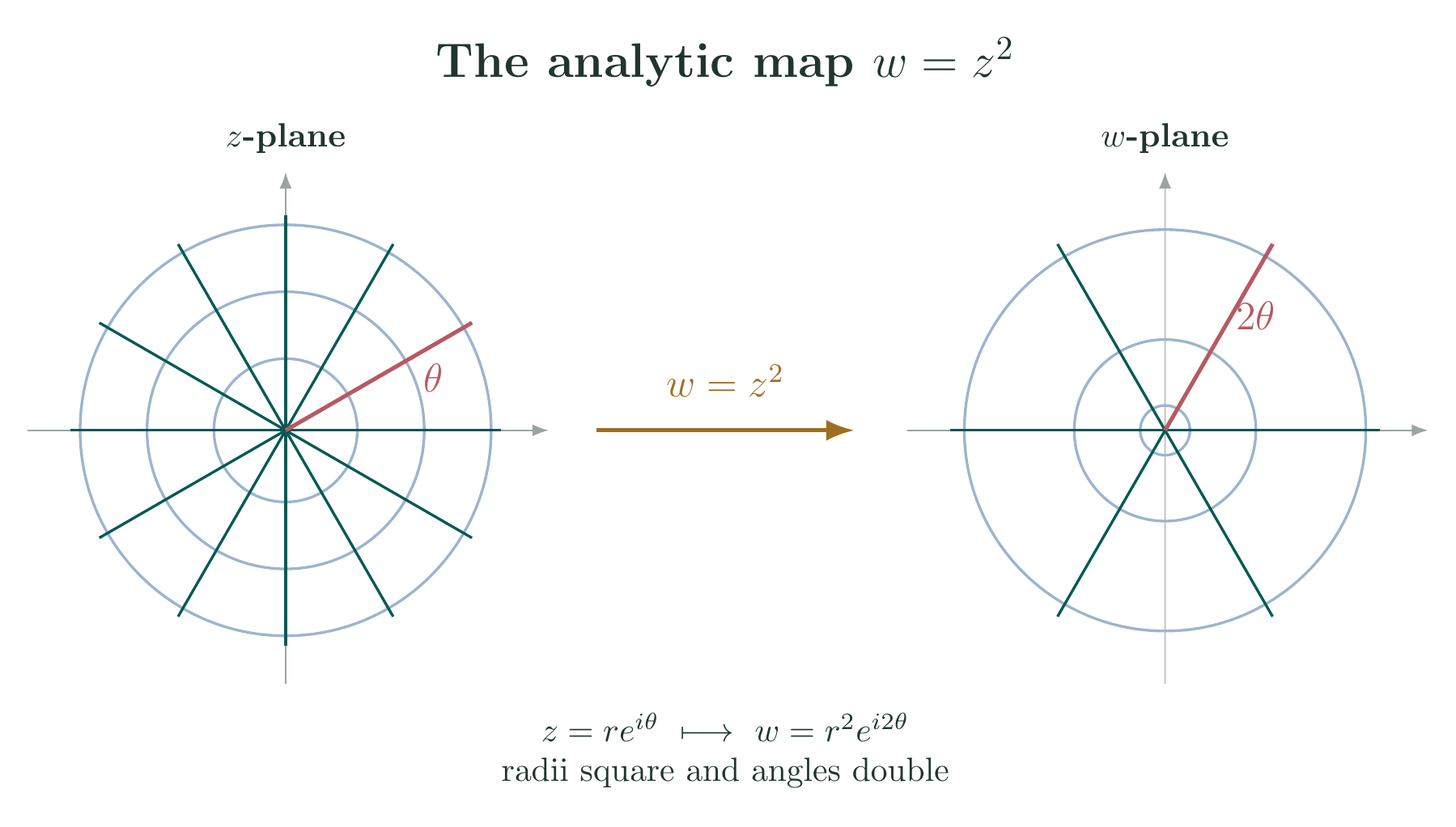
For $f(z)=\bar z=x-iy$,
\[u_x=1,\qquad v_y=-1,\]so the Cauchy-Riemann equations fail everywhere. Indeed,
\[\frac{\overline{\Delta z}}{\Delta z} =e^{-2i\arg(\Delta z)}\]depends on the direction of approach.
For $f(z)=\lvert z\rvert^2=x^2+y^2$, the Cauchy-Riemann equations hold only at the origin. The derivative there exists because
\[\frac{\lvert h\rvert^2}{h}=\bar h\longrightarrow0.\]However, the function is not analytic at the origin because it is not differentiable throughout any neighborhood of it. The Cauchy-Riemann residuals for the analytic and non-analytic examples are checked in the Unit III Maxima worksheet.
Solved Problems
-
Given $u=x^2-y^2+x$, find a harmonic conjugate $v$, construct the analytic function $f=u+iv$, and obtain $f^{\prime}(z)$.
The Cauchy-Riemann equations require
\[v_y=u_x=2x+1, \qquad v_x=-u_y=2y.\]Integrating the first equation with respect to $y$ gives
\[v=(2x+1)y+g(x).\]Differentiation with respect to $x$ gives
\[v_x=2y+g^{\prime}(x).\]Comparison with $v_x=2y$ yields $g^{\prime}(x)=0$, so
\[v=2xy+y+C.\]Therefore
\[f=(x^2-y^2+x)+i(2xy+y+C) =\boxed{z^2+z+iC},\]and
\[\boxed{f^{\prime}(z)=2z+1}.\]The consistency of both first-order equations is equivalent to $\nabla^2u=0$.
-
Determine every point at which $f(z)=x^2+iy^2$ is complex differentiable, find the derivative there, and decide whether it is analytic anywhere.
Here
\[u=x^2,\qquad v=y^2.\]The first Cauchy-Riemann equation gives
\[u_x=v_y \quad\Longrightarrow\quad 2x=2y,\]while the second is
\[u_y=-v_x \quad\Longrightarrow\quad 0=0.\]Since the partial derivatives are continuous, $f$ is complex differentiable exactly on the line $x=y$. At such a point,
\[\boxed{f^{\prime}(z)=u_x+iv_x=2x}.\]No open disk lies inside the line $x=y$, so the function is not analytic in any neighborhood. This separates differentiability at a point from analyticity on an open set.
Descriptive Questions
- Derive the Cauchy-Riemann equations by approaching the derivative along the real and imaginary directions.
- Prove the sufficiency of the Cauchy-Riemann equations when the first partial derivatives are continuous.
- Derive the harmonic equations for the real and imaginary parts of an analytic function.
- Explain, with an example, why complex differentiability at one point does not imply analyticity there.
Numerical Problems
-
Find $f^{\prime}(1-i)$ for $f(z)=z^3$.
Answer: $-6i$.
-
For real constants $a,b$, determine when $f(z)=(x^3-3xy^2+ax)+i(bx^2y-y^3+2y)$ is analytic, and identify the resulting function.
Answer: $a=2$, $b=3$; then $f(z)=z^3+2z$.
-
Determine where $f(z)=\bar z^{\,2}$ is complex differentiable.
Answer: only at $z=0$, where $f^{\prime}(0)=0$.
-
Near $z_0=\ln2+i\pi/3$, give the first-order linearization of $w=e^z$ for an increment $\Delta z$.
Answer: $\Delta w=(1+i\sqrt3)\Delta z+O(\lvert\Delta z\rvert^2)$.
-
Determine where $f(z)=\lvert z\rvert^4$ is complex differentiable.
Answer: only at $z=0$, with derivative $0$.
-
For $f(z)=1/z$, find $f(1+i)$ and $f^{\prime}(1+i)$.
Answer: $f(1+i)=(1-i)/2$; $f^{\prime}(1+i)=i/2$.
All added Cauchy-Riemann, harmonic-conjugate, and derivative checks are verified in the Unit III Maxima worksheet; every printed residual is zero.
References
- Holomorphic function — Wikipedia
- MIT OpenCourseWare 18.04, lecture notes: Topic 2, Analytic Functions
- James Ward Brown and Ruel V. Churchill, Complex Variables and Applications, 9th ed., Chapter 2.


Discussion