

28 May 2025
Gauss, Green, and Stokes Theorems
Integral theorems connecting local derivatives with flux and circulation on boundaries.
The integral theorems express one geometrical principle: an accumulated local derivative inside a region equals a field integral over its boundary.
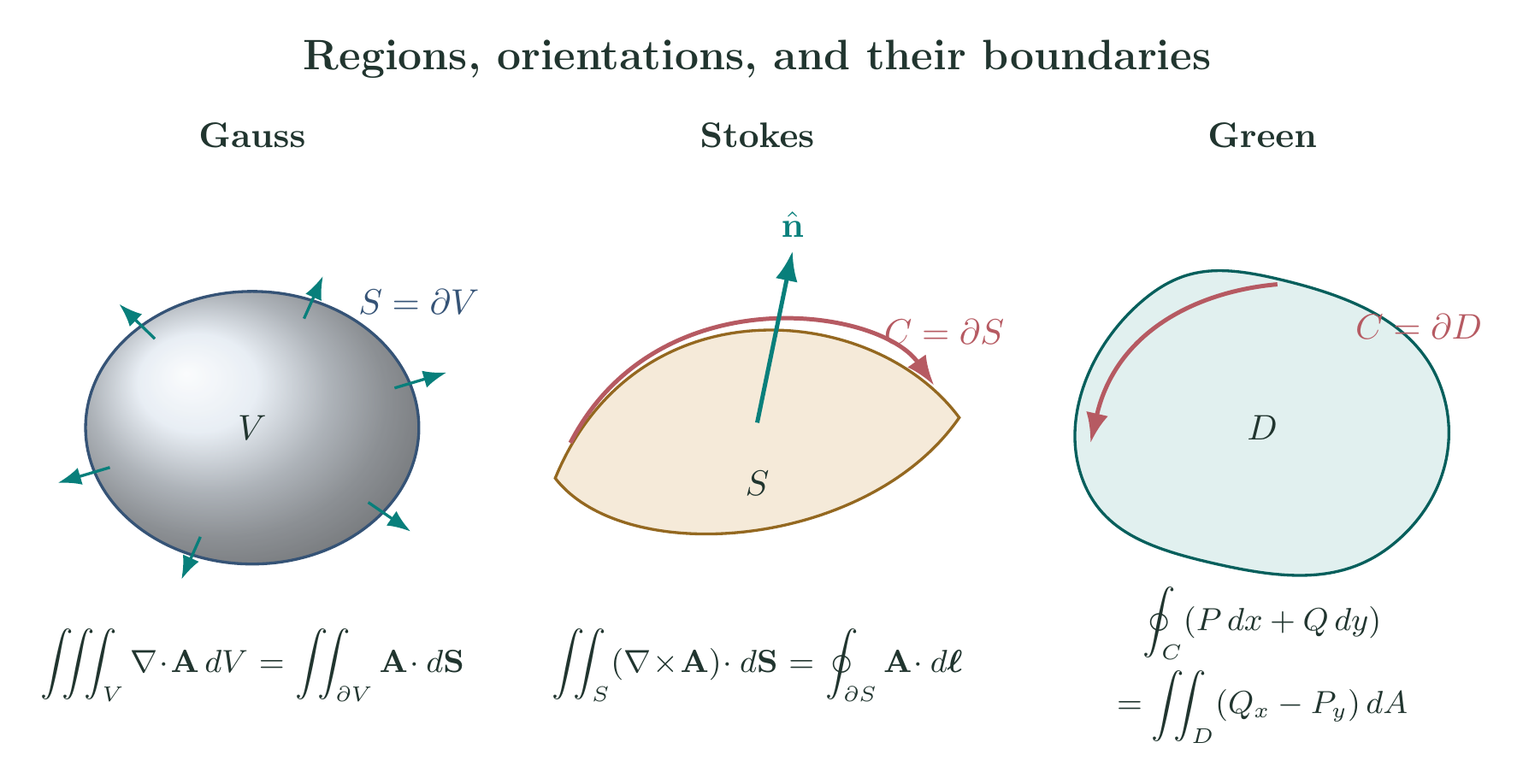
The classical statements require piecewise smooth boundaries and continuously differentiable field components on an open region containing the domain. Orientation is part of each theorem: closed surfaces use the outward normal, while the positive direction around an open surface follows from its chosen normal by the right-hand rule.
Gauss divergence theorem
Let $V$ have closed boundary $S=\partial V$ with outward orientation. For a small cell,
\[\oint_{\partial(\Delta V)}\mathbf A\cdot d\mathbf S =(\nabla\cdot\mathbf A)\Delta V+o(\Delta V).\]On adding all cells, fluxes through shared interior faces cancel because neighbouring outward normals are opposite. In the limit,
\[\boxed{ \iiint_V(\nabla\cdot\mathbf A)\,dV =\iint_{\partial V}\mathbf A\cdot d\mathbf S}.\]For $\mathbf A=x\hat{\mathbf x}+y\hat{\mathbf y}+z\hat{\mathbf z}$ inside $r\leq R$,
\[\iiint_V\nabla\cdot\mathbf A\,dV =3\frac{4\pi R^3}{3}=4\pi R^3.\]On the sphere, $\mathbf A=R\hat{\mathbf r}$ and $d\mathbf S=\hat{\mathbf r}R^2\sin\theta\,d\theta d\varphi$, so
\[\iint_S\mathbf A\cdot d\mathbf S =R^3\int_0^{2\pi}d\varphi\int_0^\pi\sin\theta\,d\theta =4\pi R^3.\]Stokes theorem
Let an oriented surface $S$ have boundary $C=\partial S$. The right-hand rule fixes the positive direction around $C$. Circulations on shared edges of small surface patches cancel, leaving
\[\boxed{ \iint_S(\nabla\times\mathbf A)\cdot d\mathbf S =\oint_{\partial S}\mathbf A\cdot d\boldsymbol\ell}.\]For $\mathbf A=-y\hat{\mathbf x}+x\hat{\mathbf y}$ on $x^2+y^2\leq R^2$,
\[\nabla\times\mathbf A=2\hat{\mathbf z}, \qquad \iint_S2\,dS=2\pi R^2.\]On $C$, $\mathbf r=R(\cos\varphi,\sin\varphi)$ gives
\[\mathbf A=R(-\sin\varphi,\cos\varphi), \quad d\boldsymbol\ell=R(-\sin\varphi,\cos\varphi)d\varphi,\]and therefore
\[\oint_C\mathbf A\cdot d\boldsymbol\ell =R^2\int_0^{2\pi}d\varphi=2\pi R^2.\]Green’s theorems
For a positively oriented curve $C$ bounding a plane region $D$, Stokes theorem applied to $\mathbf A=P\hat{\mathbf x}+Q\hat{\mathbf y}$ gives
\[\boxed{ \oint_C(P\,dx+Q\,dy) =\iint_D\left(Q_x-P_y\right)dA}.\]The planar flux form is
\[\boxed{ \oint_C(P\,dy-Q\,dx) =\iint_D\left(P_x+Q_y\right)dA}.\]From $\nabla\cdot(u\nabla v)=\nabla u\cdot\nabla v+u\nabla^2v$ and Gauss’ theorem,
\[\boxed{ \iiint_V(\nabla u\cdot\nabla v+u\nabla^2v)dV =\iint_Su\frac{\partial v}{\partial n}dS}.\]Subtracting the equation with $u,v$ exchanged gives
\[\boxed{ \iiint_V(u\nabla^2v-v\nabla^2u)dV =\iint_S\left(u\frac{\partial v}{\partial n} -v\frac{\partial u}{\partial n}\right)dS}.\]These are Green’s first and second identities. The surface $S$ is the complete boundary of $V$, and $\partial/\partial n=\hat{\mathbf n}\cdot\nabla$ uses its outward normal.
Conservation law from Gauss’ theorem
Let $\rho(\mathbf r,t)$ be a conserved density and $\mathbf J$ its outward flux density. For any fixed volume $V$,
\[\frac{d}{dt}\iiint_V\rho\,dV =-\iint_{\partial V}\mathbf J\cdot d\mathbf S.\]Gauss’ theorem converts the surface flux to a volume integral:
\[\iiint_V\left(\frac{\partial\rho}{\partial t} +\nabla\cdot\mathbf J\right)dV=0.\]Since this holds for every sufficiently small volume,
\[\boxed{\frac{\partial\rho}{\partial t}+\nabla\cdot\mathbf J=0}.\]If a field is singular inside the region, the usual hypotheses fail. One must excise the singular point or line and include the new inner boundary; applying a theorem as though the field were smooth can miss a finite flux or circulation.
Solved Problems
-
Verify Gauss’ theorem for $\mathbf A=(x^2,y^2,z^2)$ on the unit cube $0\leq x,y,z\leq1$.
The divergence is
\[\nabla\cdot\mathbf A=2x+2y+2z.\]Its volume integral is
\[\begin{aligned} \iiint_V\nabla\cdot\mathbf A\,dV &=2\iiint_V(x+y+z)\,dV\\ &=2\left(\frac12+\frac12+\frac12\right)=3. \end{aligned}\]Directly, the faces $x=0$, $y=0$, and $z=0$ contribute zero. On each opposite face the outward component equals $1$, and its area is $1$, so
\[\iint_{\partial V}\mathbf A\cdot d\mathbf S =1+1+1=3.\]Both sides have dimensions of field times area. The positive value represents net outward flux.
-
Use Green’s circulation theorem to evaluate
\[\oint_C(-y^2\,dx+x^2\,dy)\]around the rectangle $0\leq x\leq2$, $0\leq y\leq1$, traversed counterclockwise.
Here $P=-y^2$ and $Q=x^2$, so
\[Q_x-P_y=2x+2y.\]Therefore
\[\begin{aligned} \oint_C(P\,dx+Q\,dy) &=\int_0^2\int_0^1(2x+2y)\,dy\,dx\\ &=\int_0^2(2x+1)\,dx\\ &=\left[x^2+x\right]_0^2 =\boxed{6}. \end{aligned}\]The sign is positive for counterclockwise orientation. Reversing $C$ would change the answer to $-6$.
-
Let $C$ be the triangular path $O\to B\to C_1\to O$, where $O=(0,0,0)$, $B=(1,0,0)$, and $C_1=(0,1,1)$. Use Stokes’ theorem to find the circulation of
\[\mathbf A=-\frac y2\hat{\mathbf x}+\frac x2\hat{\mathbf y}.\]The ordered vertices give the oriented vector area
\[\mathbf S_{\mathrm{vec}} =\frac12(\overrightarrow{OB}\times\overrightarrow{OC_1}) =\frac12(1,0,0)\times(0,1,1) =\left(0,-\frac12,\frac12\right).\]Since
\[\nabla\times\mathbf A=\hat{\mathbf z},\]Stokes’ theorem gives
\[\oint_C\mathbf A\cdot d\boldsymbol\ell =(\nabla\times\mathbf A)\cdot\mathbf S_{\mathrm{vec}} =\boxed{\frac12}.\]The positive sign follows from the vertex order and its induced normal; reversing the traversal reverses the circulation.
Descriptive Questions
- Derive Gauss’ divergence theorem by subdividing a volume and explaining the cancellation of fluxes across internal faces.
- State and derive Stokes’ theorem by patching oriented surface elements, including the induced boundary orientation.
- Obtain both planar forms of Green’s theorem and derive Green’s first and second identities from the divergence theorem.
- Derive the local continuity equation from integral conservation, and explain why an interior singularity requires an excised boundary.
Numerical Problems
-
Inside the ball $r\leq2\ \mathrm{m}$, an unknown source field satisfies
\[\nabla\cdot\mathbf A=\alpha r^2.\]The measured outward flux through the boundary is $256\pi/5$ in the corresponding field-area units. Use Gauss’ theorem to determine $\alpha$.
Answer: $\Phi=4\pi\alpha\int_0^2r^4\,dr=128\pi\alpha/5$, so $\alpha=2$ in the corresponding units.
-
For the unit ball, use Green’s first identity with $u=1$ and $v=x^2+y^2+z^2$ to evaluate $\iint_S u\,\partial v/\partial n\,dS$.
Answer: $8\pi$.
-
Use Green’s area formula to find the area enclosed by the counterclockwise astroid
\[x=2\cos^3t,\qquad y=2\sin^3t, \qquad 0\leq t\leq2\pi,\]with $x$ and $y$ measured in metres.
Answer: $\mathcal A=\dfrac12\oint_C(x\,dy-y\,dx)=\dfrac{3\pi}{2}\ \mathrm{m^2}$.
-
Find the outward flux of $\mathbf F=(x^3,y^3)$ across the unit circle in the plane.
Answer: $3\pi/2$.
-
Let $S$ be the outward-oriented upper unit hemisphere and let
\[\mathbf A=(z,x,y).\]Use Stokes’ theorem and the equatorial boundary, oriented counterclockwise as viewed from $+z$, to find the flux of $\nabla\times\mathbf A$ through $S$.
Answer: $\iint_S(\nabla\times\mathbf A)\cdot d\mathbf S=\oint_{\partial S}\mathbf A\cdot d\boldsymbol\ell=\pi$.
-
A uniform density in a fixed $5\ \mathrm{m^3}$ region decreases at $0.2\ \mathrm{kg\,m^{-3}\,s^{-1}}$. Find the net outward mass flux through its boundary.
Answer: $1\ \mathrm{kg\,s^{-1}}$ outward.
All symbolic reductions and numerical answers are checked in the Unit I Maxima worksheet; every printed residual is zero.
References
- Vector calculus — Wikipedia
- OpenStax, Calculus Volume 3, §6.4: Green’s Theorem
- OpenStax, Calculus Volume 3, §6.7: Stokes’ Theorem
- OpenStax, Calculus Volume 3, §6.8: The Divergence Theorem
- George B. Arfken, Hans J. Weber, and Frank E. Harris, Mathematical Methods for Physicists, 7th ed., Chapter 3, §§3.7–3.9.


Discussion