

24 Jun 2025
Laplace Equation in Rectangular Geometry
Separation of variables for two- and three-dimensional rectangular boundary-value problems.
In a two-dimensional rectangle $0<x<a$, $0<y<b$, Laplace’s equation is
\[\boxed{\frac{\partial^2u}{\partial x^2} +\frac{\partial^2u}{\partial y^2}=0}.\]Take the separated form $u(x,y)=X(x)Y(y)$. Substitution gives
\[X^{\prime\prime}Y+XY^{\prime\prime}=0.\]After division by $XY$,
\[\frac{X^{\prime\prime}}{X}=-\frac{Y^{\prime\prime}}{Y}.\]The left side depends only on $x$ and the right side only on $y$; because they are equal for all $(x,y)$, both must equal a constant. Choose $-k^2$ so that zero conditions at $x=0,a$ have nonzero solutions:
\[X^{\prime\prime}+k^2X=0, \qquad Y^{\prime\prime}-k^2Y=0.\]Suppose
\[u(0,y)=u(a,y)=u(x,0)=0, \qquad u(x,b)=f(x).\]The first two conditions require
\[X_n(x)=\sin\frac{n\pi x}{a}, \qquad k_n=\frac{n\pi}{a}, \qquad n=1,2,\ldots.\]The condition at $y=0$ removes the $\cosh(k_ny)$ term, leaving $Y_n\propto\sinh(k_ny)$. Superposition gives
\[u(x,y)=\sum_{n=1}^{\infty}A_n \sin\frac{n\pi x}{a}\sinh\frac{n\pi y}{a}.\]At $y=b$,
\[f(x)=\sum_{n=1}^{\infty}A_n \sinh\frac{n\pi b}{a}\sin\frac{n\pi x}{a}.\]Multiply by $\sin(m\pi x/a)$ and integrate from $0$ to $a$. Orthogonality,
\[\int_0^a\sin\frac{n\pi x}{a}\sin\frac{m\pi x}{a}dx =\frac a2\delta_{mn},\]gives
\[A_n=\frac{2}{a\sinh(n\pi b/a)} \int_0^a f(x)\sin\frac{n\pi x}{a}dx.\]Hence
\[\boxed{ u(x,y)=\sum_{n=1}^{\infty}B_n \frac{\sinh(n\pi y/a)}{\sinh(n\pi b/a)} \sin\frac{n\pi x}{a}},\]where
\[\boxed{B_n=\frac2a\int_0^a f(x) \sin\frac{n\pi x}{a}dx}.\]For $f(x)=V_0\sin(\pi x/a)$, only $B_1=V_0$ is nonzero:
\[\boxed{ u=V_0\sin\frac{\pi x}{a} \frac{\sinh(\pi y/a)}{\sinh(\pi b/a)}}.\]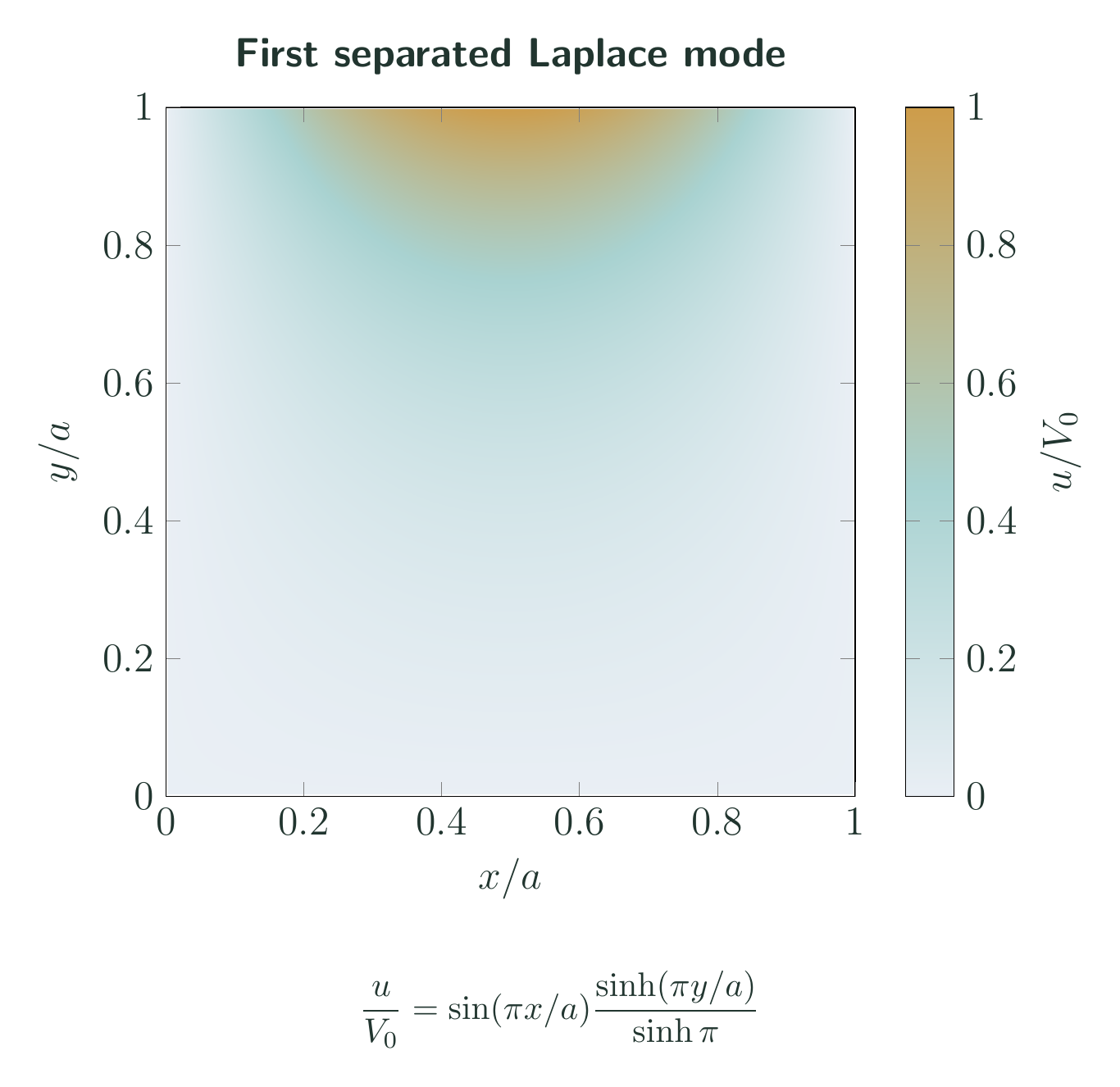
Three independent variables
For a rectangular box, $u=XYZ$ in $u_{xx}+u_{yy}+u_{zz}=0$ gives
\[\frac{X^{\prime\prime}}{X}+\frac{Y^{\prime\prime}}{Y}+\frac{Z^{\prime\prime}}{Z}=0.\]If $u=0$ at $x=0,a$ and $y=0,b$, choose
\[X_m=\sin\frac{m\pi x}{a}, \qquad Y_n=\sin\frac{n\pi y}{b}.\]Then $Z$ obeys
\[Z^{\prime\prime}-\gamma_{mn}^2Z=0, \qquad \gamma_{mn}^2=\left(\frac{m\pi}{a}\right)^2 +\left(\frac{n\pi}{b}\right)^2.\]For each $(m,n)$,
\[Z_{mn}=C_{mn}\cosh(\gamma_{mn}z) +D_{mn}\sinh(\gamma_{mn}z).\]The remaining boundary data determine $C_{mn}$ and $D_{mn}$ in the double sum. If the additional face $z=0$ is held at zero, $C_{mn}=0$ and only the $\sinh(\gamma_{mn}z)$ term remains. The separation step is the same; two independent transverse boundary conditions select the two integer labels.
The two-dimensional mode and its four boundary residuals are checked symbolically in the Unit II Maxima worksheet.
Solved Problems
1. A constant potential on the top edge
In the rectangle $0<x<a$, $0<y<b$, solve Laplace’s equation when three edges are at zero potential and
\[u(x,b)=V_0, \qquad 0<x<a.\]The separated solution derived above applies with $f(x)=V_0$. Its sine coefficients are
\[\begin{aligned} B_n &=\frac{2V_0}{a}\int_0^a\sin\frac{n\pi x}{a}\,dx\\ &=\frac{2V_0}{n\pi}\left[1-(-1)^n\right]. \end{aligned}\]Thus $B_n=0$ for even $n$ and $B_n=4V_0/(n\pi)$ for odd $n$. Therefore
\[\boxed{ u(x,y)=\frac{4V_0}{\pi} \sum_{\substack{n=1\\ n\ \mathrm{odd}}}^{\infty} \frac1n \frac{\sinh(n\pi y/a)}{\sinh(n\pi b/a)} \sin\frac{n\pi x}{a}}.\]Every term has zero Laplacian and vanishes on $x=0$, $x=a$, and $y=0$. At $y=b$, the series is the Fourier sine series of $V_0$ on $0<x<a$. The corner values are discontinuous boundary data; inside the rectangle the solution remains between $0$ and $V_0$ when $V_0>0$.
2. A single mode in a rectangular box
Let $0<x<a$, $0<y<b$, $0<z<c$. All faces are held at zero except
\[u(x,y,c)=V_0 \sin\frac{\pi x}{a} \sin\frac{2\pi y}{b}.\]The transverse indices are $m=1$ and $n=2$, so
\[\gamma_{12} =\sqrt{\left(\frac{\pi}{a}\right)^2 +\left(\frac{2\pi}{b}\right)^2}.\]The condition at $z=0$ selects $\sinh(\gamma_{12}z)$, while normalization at $z=c$ fixes its denominator. Hence
\[\boxed{ u=V_0 \sin\frac{\pi x}{a} \sin\frac{2\pi y}{b} \frac{\sinh(\gamma_{12}z)} {\sinh(\gamma_{12}c)}}.\]Two $x$ derivatives contribute $-(\pi/a)^2u$, two $y$ derivatives contribute $-(2\pi/b)^2u$, and two $z$ derivatives contribute $\gamma_{12}^2u$; their sum is zero. The dimensions are consistent because $\gamma_{12}$ has units of inverse length.
Descriptive Questions
- Explain why the sign of the separation constant is chosen to satisfy homogeneous boundary conditions on two opposite edges.
- Derive the Fourier coefficient formula for arbitrary data prescribed on one edge of a rectangle.
- Explain how two transverse integer labels arise when Laplace’s equation is separated in a rectangular box.
- Discuss how discontinuous data at a corner are represented by the interior Fourier-series solution.
Numerical Problems
- For the first mode with $a=0.40\,\mathrm{m}$, $b=0.20\,\mathrm{m}$, and $V_0=100\,\mathrm{V}$, evaluate $u$ at $x=0.20\,\mathrm{m}$, $y=0.10\,\mathrm{m}$. Final answer: $u=100\sinh(\pi/4)/\sinh(\pi/2)=37.7470\,\mathrm{V}$.
- On a unit square, the top-edge data are $f(x)=x(1-x)\,\mathrm{V}$. Find the first two sine coefficients. Final answer: $B_1=8/\pi^3=0.258012\,\mathrm{V}$ and $B_2=0$.
- In a box with $a=0.30\,\mathrm{m}$ and $b=0.40\,\mathrm{m}$, find $\gamma_{21}$. Final answer: $\gamma_{21}=\pi\sqrt{(2/a)^2+(1/b)^2}=22.3681\,\mathrm{m^{-1}}$.
- In a square with $a=b$, find the vertical amplitude factor of the $n=1$ mode halfway between its zero bottom edge and prescribed top edge. Final answer: $\sinh(\pi/2)/\sinh\pi=0.199268$.
The Fourier coefficients, boundary values, PDE residuals, and numerical evaluations are verified in the Unit II problem-check worksheet.
References
- Laplace’s equation — Wikipedia
- Mary L. Boas, Mathematical Methods in the Physical Sciences, 3rd ed., Chapter 13, “Partial Differential Equations,” Wiley.
- Richard Haberman, Applied Partial Differential Equations with Fourier Series and Boundary Value Problems, 5th ed., Chapter 2, §2.5, “Laplace’s Equation: Solutions and Qualitative Properties,” Pearson.
- Erwin Kreyszig, Advanced Engineering Mathematics, 10th ed., Chapter 12, “Partial Differential Equations,” Wiley.


Discussion