

30 Jun 2025
One-Dimensional Heat-Flow Equation
Separated temperature modes in a finite rod, Fourier coefficients, and exponential decay rates.
The syllabus asks for the solution, not the derivation, of the one-dimensional heat equation. Take
\[\boxed{\frac{\partial T}{\partial t} =\kappa\frac{\partial^2T}{\partial x^2}}\]as given, where $[\kappa]=\mathrm{length}^2/\mathrm{time}$.
Consider a rod $0<x<L$ whose ends are held at zero temperature:
\[T(0,t)=T(L,t)=0, \qquad T(x,0)=f(x).\]Put $T(x,t)=X(x)G(t)$. Then
\[XG^{\prime}=\kappa X^{\prime\prime}G.\]After division by $\kappa XG$,
\[\frac{G^{\prime}}{\kappa G}=\frac{X^{\prime\prime}}{X}=-k^2.\]Thus
\[X^{\prime\prime}+k^2X=0, \qquad G^{\prime}+\kappa k^2G=0.\]The boundary conditions select
\[X_n=\sin\frac{n\pi x}{L}, \qquad k_n=\frac{n\pi}{L},\]and the time equation gives
\[G_n(t)=\exp\!\left[-\kappa \left(\frac{n\pi}{L}\right)^2t\right].\]Therefore
\[\boxed{ T(x,t)=\sum_{n=1}^{\infty}B_n \sin\frac{n\pi x}{L} e^{-\kappa(n\pi/L)^2t}}.\]At $t=0$ this must equal $f(x)$. Multiply by $\sin(m\pi x/L)$ and integrate. Orthogonality gives
\[\boxed{B_n=\frac2L\int_0^L f(x) \sin\frac{n\pi x}{L}dx}.\]As an exact two-mode example, take
\[f(x)=T_0\left(\sin\frac{\pi x}{L} +\frac12\sin\frac{3\pi x}{L}\right).\]Only $B_1=T_0$ and $B_3=T_0/2$ are nonzero, so
\[\boxed{ \frac{T(x,t)}{T_0} =\sin\frac{\pi x}{L}e^{-\kappa\pi^2t/L^2} +\frac12\sin\frac{3\pi x}{L}e^{-9\kappa\pi^2t/L^2}}.\]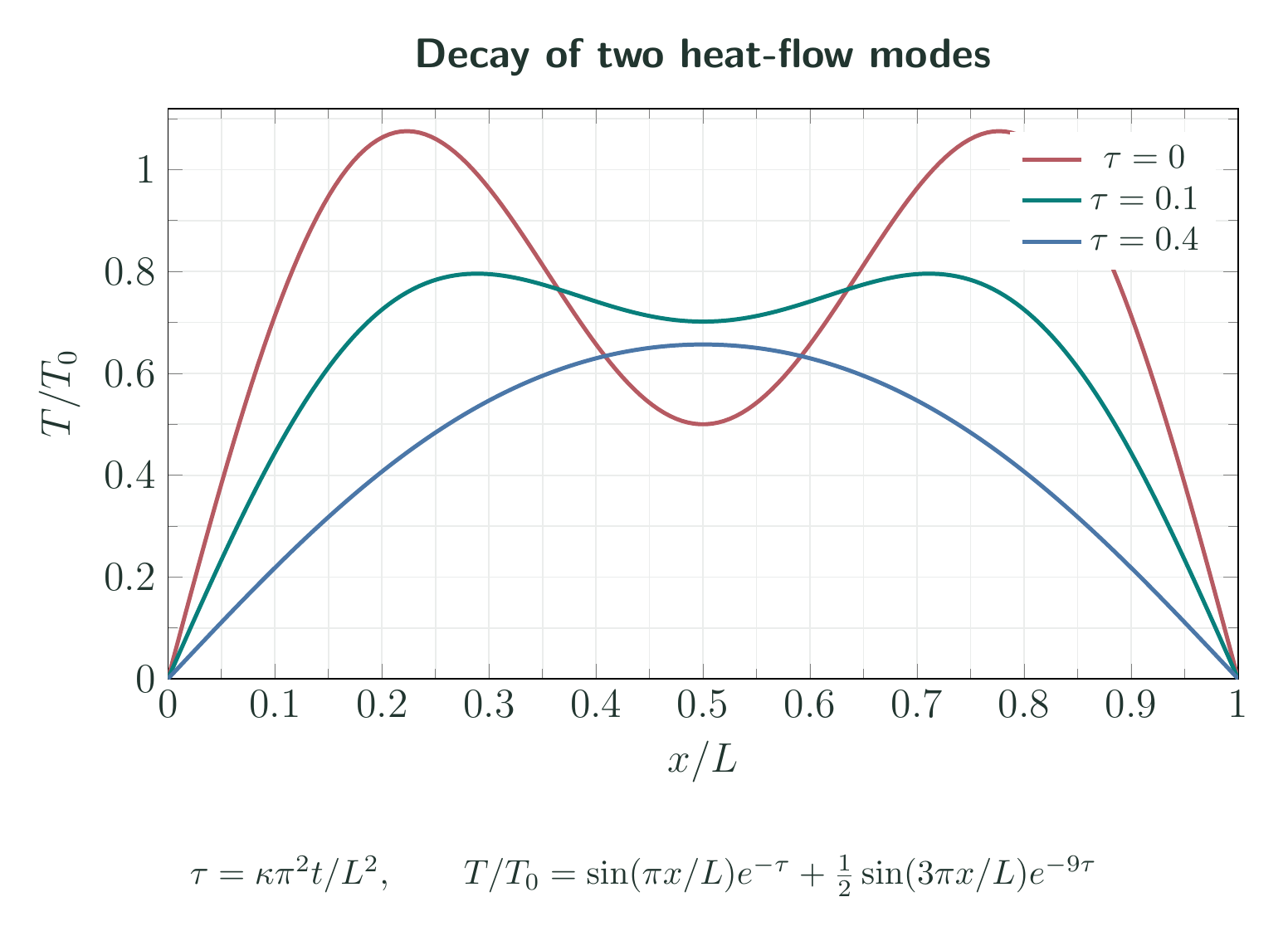
If the endpoints are held at unequal constants $T_a$ and $T_b$, first remove the steady profile
\[S(x)=T_a+\frac{T_b-T_a}{L}x.\]Because $S^{\prime\prime}=0$, the difference $\theta=T-S$ satisfies the same heat equation with $\theta(0,t)=\theta(L,t)=0$. Its initial profile is $f(x)-S(x)$, so
\[\boxed{ T(x,t)=S(x)+\sum_{n=1}^{\infty}C_n \sin\frac{n\pi x}{L} e^{-\kappa(n\pi/L)^2t}},\]where
\[C_n=\frac2L\int_0^L[f(x)-S(x)] \sin\frac{n\pi x}{L}\,dx.\]For one mode, the decay time is
\[\tau_n=\frac{1}{\kappa k_n^2} =\frac{L^2}{\kappa n^2\pi^2}.\]Its units are time, and the $n^{-2}$ dependence shows why fine spatial structure disappears first. The heat-equation and boundary residuals are zero in the Unit II Maxima worksheet.
Solved Problems
1. A rod initially at uniform excess temperature
A rod has both ends held at zero excess temperature and
\[T(x,0)=T_0, \qquad 0<x<L.\]The sine coefficients are
\[\begin{aligned} B_n &=\frac{2T_0}{L}\int_0^L\sin\frac{n\pi x}{L}\,dx\\ &=\frac{2T_0}{n\pi}\left[1-(-1)^n\right]. \end{aligned}\]Thus only odd modes occur:
\[\boxed{ T(x,t)=\frac{4T_0}{\pi} \sum_{\substack{n=1\\ n\ \mathrm{odd}}}^{\infty} \frac1n\sin\frac{n\pi x}{L} e^{-\kappa n^2\pi^2t/L^2}}.\]Each term satisfies the fixed-end conditions and the heat equation. For every $t>0$ the exponential factors make the series convergent, and $T\to0$ as $t\to\infty$. The initial value is understood on the open interval; at the endpoints the imposed temperature changes at $t=0$.
2. Unequal endpoint temperatures with one transient mode
A $1.00\,\mathrm{m}$ rod has $T(0,t)=20^\circ\mathrm{C}$, $T(1,t)=80^\circ\mathrm{C}$ and diffusivity $\kappa=0.010\,\mathrm{m^2\,h^{-1}}$. Initially,
\[T(x,0)=20+60x+10\sin(\pi x) \quad (^\circ\mathrm{C}).\]The steady profile is $S=20+60x$. Hence
\[\theta(x,0)=T(x,0)-S(x)=10\sin(\pi x),\]so only the first transient mode is present:
\[\boxed{ T(x,t)=20+60x +10\sin(\pi x)e^{-0.010\pi^2t}}.\]At the midpoint after $2.00\,\mathrm{h}$,
\[\boxed{ T(0.5,2)=50+10e^{-0.02\pi^2} =58.2087^\circ\mathrm{C}}.\]The transient is positive and decays toward the steady midpoint temperature $50^\circ\mathrm{C}$. The exponent is dimensionless because $\kappa t/L^2$ is dimensionless.
Descriptive Questions
- Starting from the given one-dimensional heat equation, derive the separated fixed-end temperature modes.
- Derive the Fourier sine coefficients from an arbitrary initial temperature profile.
- Explain why the decay time is proportional to $L^2$ and inversely proportional to $\kappa n^2$.
- Show how subtracting a steady linear profile converts unequal fixed-end temperatures into homogeneous boundary conditions.
Numerical Problems
- A rod has $L=0.50\,\mathrm{m}$ and $\kappa=1.2\times10^{-5}\,\mathrm{m^2\,s^{-1}}$. Find the half-life of its first mode. Final answer: $t_{1/2}=L^2\ln2/(\kappa\pi^2)=1463.14\,\mathrm{s}=24.3856\,\mathrm{min}$.
- Two initial modes $n=1$ and $n=3$ have equal amplitudes. For $L=1.00\,\mathrm{m}$, $\kappa=0.010\,\mathrm{m^2\,h^{-1}}$, find their amplitude ratio $A_3/A_1$ after $2.00\,\mathrm{h}$. Final answer: $A_3/A_1=e^{-8\kappa\pi^2t/L^2}=0.206153$.
- For $f(x)=T_0x(L-x)/L^2$ with $T_0=100\,\mathrm{K}$, find the first sine coefficient. Final answer: $B_1=8T_0/\pi^3=25.8012\,\mathrm{K}$.
- For $L=0.40\,\mathrm{m}$ and $\kappa=2.0\times10^{-5}\,\mathrm{m^2\,s^{-1}}$, find the time for the $n=2$ amplitude to fall to $1\%$ of its initial value. Final answer: $t=L^2\ln100/(4\kappa\pi^2)=933.203\,\mathrm{s}=15.5534\,\mathrm{min}$.
The Fourier coefficients, transient solution, decay times, and numerical values are verified in the Unit II problem-check worksheet.
References
- Heat equation — Wikipedia
- Richard Haberman, Applied Partial Differential Equations with Fourier Series and Boundary Value Problems, 5th ed., Chapters 1–2, “Heat Equation” and “Method of Separation of Variables,” Pearson.
- Erwin Kreyszig, Advanced Engineering Mathematics, 10th ed., Chapter 12, “Partial Differential Equations,” Wiley.
- Mary L. Boas, Mathematical Methods in the Physical Sciences, 3rd ed., Chapter 13, “Partial Differential Equations,” Wiley.


Discussion