

28 Jul 2025
Singularities, Branch Points, and Branch Cuts
Removable singularities, poles, essential singularities, and the cuts that make multivalued functions single-valued.
A point $z_0$ is an isolated singularity of $f$ if $f$ is analytic in a punctured disk
\[0<\lvert z-z_0\rvert<R\]but is not analytic at $z_0$ itself.
Removable singularity
If $\lim_{z\to z_0}f(z)=L$ is finite, define $f(z_0)=L$. The singularity is then removed.
For
\[f(z)=\frac{z^2-1}{z-1},\]factorization gives, for $z\ne1$,
\[f(z)=\frac{(z-1)(z+1)}{z-1}=z+1.\]Therefore
\[\lim_{z\to1}f(z)=2.\]Setting $f(1)=2$ makes the function analytic at $z=1$.
Pole
The point $z_0$ is a pole of order $m$ if
\[\boxed{ \lim_{z\to z_0}(z-z_0)^mf(z)=A, \qquad 0<\lvert A\rvert<\infty},\]and no smaller positive integer has this property.
For
\[f(z)=\frac{1}{(z-z_0)^m},\]$z_0$ is a pole of order $m$. The magnitude diverges as $\lvert z-z_0\rvert^{-m}$.
Essential singularity
An isolated singularity that is neither removable nor a pole is essential. For
\[f(z)=e^{1/z},\]take $z=x>0$ and let $x\to0$: then $e^{1/x}\to\infty$. Along $z=x<0$, however, $e^{1/x}\to0$. The limit is not finite, so the singularity is not removable. For every fixed $m$,
\[z^me^{1/z}\to\infty\]along $z=x\to0^+$, so no finite pole order exists. Therefore $z=0$ is essential.
Branch points and branch cuts
Write
\[z=re^{i(\theta+2\pi k)}.\]Then
\[\sqrt z=\sqrt r\,e^{i(\theta+2\pi k)/2} =(-1)^k\sqrt r\,e^{i\theta/2}.\]After one circuit around the origin, $\theta\mapsto\theta+2\pi$ and $\sqrt z$ changes sign. The value does not return to itself, so $z=0$ is a branch point.
Similarly,
\[\log z=\ln r+i(\theta+2\pi k)\]changes by $2\pi i$ after one circuit. A branch cut removes a curve joining branch points or extending from a branch point to infinity, preventing such a circuit inside the chosen domain. For the principal branches, one common choice is the negative real axis, with
\[-\pi<\arg z<\pi.\]More generally, define a branch of a noninteger power by
\[z^\alpha=\exp\!\bigl(\alpha\log z\bigr).\]One positive circuit sends
\[z^\alpha\longmapsto e^{2\pi i\alpha}z^\alpha.\]The value returns after one circuit only when $\alpha$ is an integer. If $\alpha=p/q$ in lowest terms, it returns after $q$ circuits.
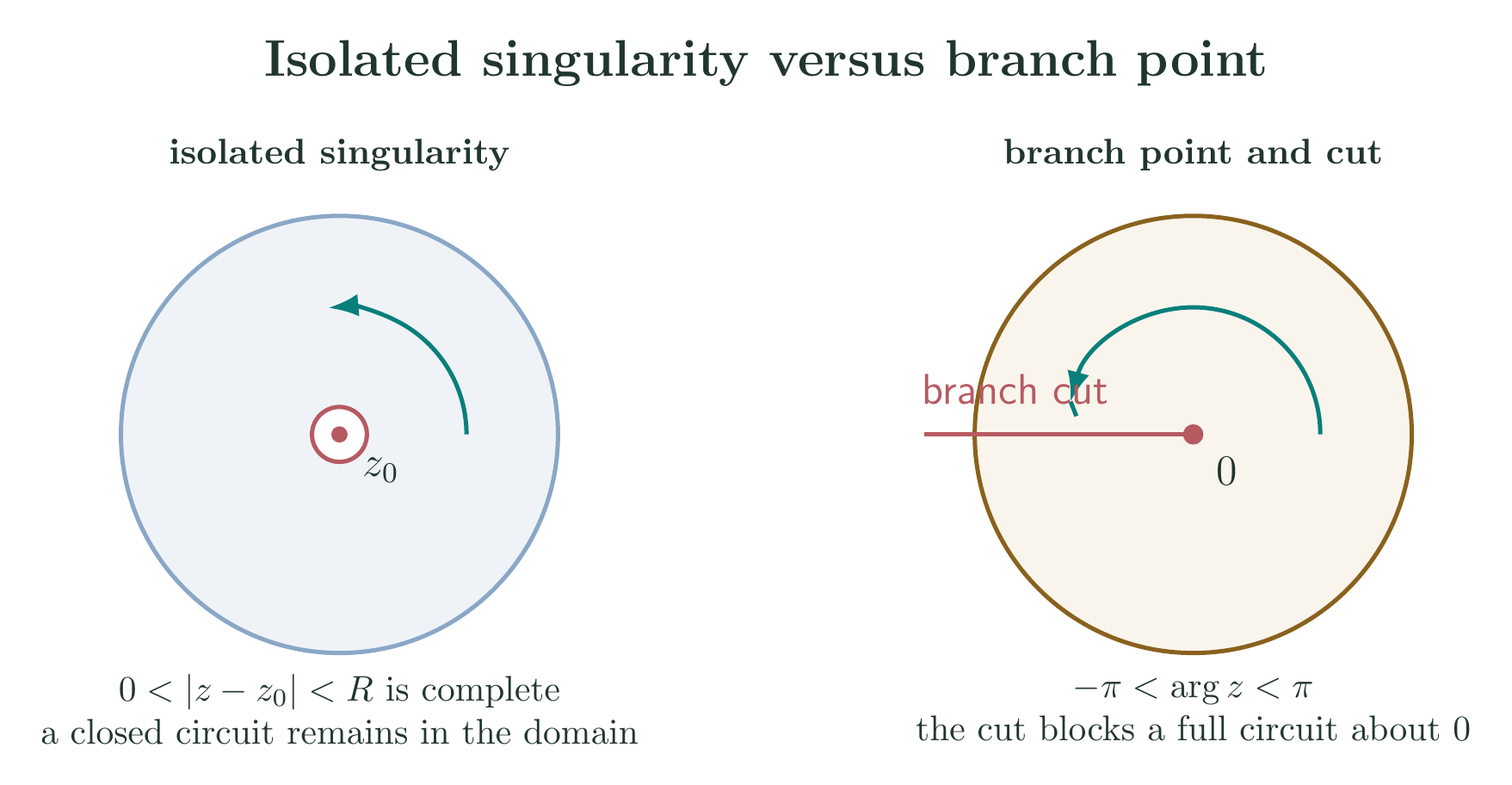
The cut is a convention; the multivalued behavior at the branch point is intrinsic.
Solved Problems
-
Classify the apparent singularity at $z=0$ of
\[f(z)=\frac{e^z-1-z}{z^2},\]and give the value that removes it.
The exponential series gives
\[e^z=1+z+\frac{z^2}{2!}+\frac{z^3}{3!}+\cdots.\]Hence
\[e^z-1-z=\frac{z^2}{2}+\frac{z^3}{6}+O(z^4),\]so, for $z\ne0$,
\[f(z)=\frac12+\frac z6+O(z^2).\]Therefore
\[\lim_{z\to0}f(z)=\frac12,\]and $z=0$ is removable. Defining $\boxed{f(0)=1/2}$ makes the extended function analytic.
-
Classify the exceptional points of
\[f(z)=\frac{\sqrt z}{(z-2)^2}\]when $\sqrt z$ is the principal square root.
The principal root is
\[\sqrt z=\sqrt r\,e^{i\theta/2}, \qquad -\pi<\theta<\pi,\]so its branch cut is the nonpositive real axis. After one circuit around $z=0$, the root changes sign; therefore $z=0$ is a branch point, not an isolated singularity.
The point $z=2$ lies in the cut plane and $\sqrt2\ne0$. Moreover,
\[\lim_{z\to2}(z-2)^2f(z)=\sqrt2.\]Thus $\boxed{z=2\text{ is a pole of order }2}$, while $\boxed{z=0\text{ is a branch point}}$.
-
Find the jump of the principal logarithm across its negative-real-axis cut.
For $r>0$, approach $-r$ from above. The principal argument tends to $\pi$, so
\[\operatorname{Log}(-r+i0)=\ln r+i\pi.\]From below, the principal argument tends to $-\pi$, so
\[\operatorname{Log}(-r-i0)=\ln r-i\pi.\]Their difference is
\[\boxed{\operatorname{Log}(-r+i0) -\operatorname{Log}(-r-i0)=2\pi i}.\]The finite jump records the $2\pi$ change of argument; it cannot be removed while retaining a single-valued logarithm on a domain containing a complete circuit around the origin.
Descriptive Questions
- Distinguish removable singularities, poles, and essential singularities using limiting criteria.
- Explain why a branch point is not an isolated singularity and why introducing a cut makes a selected branch single-valued.
- Derive the monodromy factor for $z^\alpha$ and determine when repeated circuits restore the original value.
- Compare the intrinsic location of branch points with the conventional placement of branch cuts.
Numerical Problems
-
Determine whether $1/[(z-2)(z+5)]$ is analytic on the vertical strip $-1<\operatorname{Re}z<1$, and whether it is analytic on the left half-plane $\operatorname{Re}z<0$.
Answer: analytic on the strip; not analytic on the left half-plane, which contains the simple pole $z=-5$.
-
Locate the poles of $\tan(1/z)$ and determine the consequence for $z=0$.
Answer: $z_k=2/[(2k+1)\pi]$, $k\in\mathbb Z$; they accumulate at $0$, so $z=0$ is a non-isolated singularity.
-
Near $z=z_0$, let $f(z)=(z-z_0)^5F(z)$ and $g(z)=G(z)/(z-z_0)^3$, where $F$ and $G$ are analytic and nonzero at $z_0$. Classify $f(z)g(z)$ and $g(z)/f(z)$ at $z_0$.
Answer: $fg$ has a removable singularity at $z_0$; its analytic extension has a zero of order $2$. The quotient $g/f$ has a pole of order $8$.
-
On the principal square-root branch, solve $\sqrt z=-1+i$.
Answer: no solution. Squaring gives $z=-2i$, but the principal value is $\sqrt{-2i}=1-i$.
-
By what factor does $z^{2/3}$ change after one positive circuit around the origin, and after how many circuits does it return?
Answer: factor $e^{4\pi i/3}$; it returns after $3$ circuits.
-
Find the principal logarithm of $1-i\sqrt3$.
Answer: $\ln2-i\pi/3$.
All added limits, pole orders, series coefficients, and monodromy checks are verified in the Unit III Maxima worksheet; every printed residual is zero.
References
- Isolated singularity — Wikipedia
- NIST Digital Library of Mathematical Functions, §4.2: Logarithm, Exponential, Powers, and Branches
- MIT OpenCourseWare 18.04, complex-variables lecture notes
- James Ward Brown and Ruel V. Churchill, Complex Variables and Applications, 9th ed., Chapters 3 and 6.


Discussion