

26 Jun 2025
Vibrational Modes of a Stretched String and Rectangular Membrane
Separated standing-wave solutions and normal-mode frequencies for fixed string and rectangular membrane boundaries.
The syllabus asks for solutions of the wave equation, not its derivation. We therefore take
\[\boxed{u_{tt}=c^2u_{xx}}\]as given for a string, where $[c]=\mathrm{length}/\mathrm{time}$.
String fixed at both ends
Let $0<x<L$ and impose
\[u(0,t)=u(L,t)=0.\]Set $u(x,t)=X(x)T(t)$. Then
\[XT^{\prime\prime}=c^2X^{\prime\prime}T, \qquad \frac{T^{\prime\prime}}{c^2T}=\frac{X^{\prime\prime}}{X}=-k^2.\]The separated equations are
\[X^{\prime\prime}+k^2X=0, \qquad T^{\prime\prime}+c^2k^2T=0.\]The spatial solution is $X=A\cos kx+B\sin kx$. The condition $X(0)=0$ gives $A=0$, and $X(L)=0$ gives
\[\sin(kL)=0, \qquad k_n=\frac{n\pi}{L}.\]Thus
\[\boxed{ u(x,t)=\sum_{n=1}^{\infty} \left[A_n\cos(\omega_nt)+B_n\sin(\omega_nt)\right] \sin\frac{n\pi x}{L}},\]with
\[\boxed{\omega_n=ck_n=\frac{n\pi c}{L}}, \qquad f_n=\frac{\omega_n}{2\pi}=\frac{nc}{2L}.\]If $u(x,0)=f(x)$ and $u_t(x,0)=g(x)$, sine-series orthogonality gives
\[\boxed{ A_n=\frac2L\int_0^L f(x)\sin\frac{n\pi x}{L}\,dx, \qquad B_n=\frac{2}{\omega_nL}\int_0^L g(x) \sin\frac{n\pi x}{L}\,dx}.\]The factor $1/\omega_n$ in $B_n$ is required because differentiating the time factor contributes $\omega_n$.
Rectangular membrane
For $0<x<a$, $0<y<b$, take the given two-dimensional wave equation
\[u_{tt}=c^2(u_{xx}+u_{yy})\]with all four edges fixed. Put $u=XYT$. Division by $c^2XYT$ gives
\[\frac{T^{\prime\prime}}{c^2T}=\frac{X^{\prime\prime}}{X}+\frac{Y^{\prime\prime}}{Y}.\]Choose
\[\frac{X^{\prime\prime}}{X}=-k_x^2, \qquad \frac{Y^{\prime\prime}}{Y}=-k_y^2.\]Fixed edges require
\[X_m=\sin\frac{m\pi x}{a}, \qquad Y_n=\sin\frac{n\pi y}{b}.\]The time equation is
\[T^{\prime\prime}+\omega_{mn}^2T=0,\]where
\[\boxed{ \omega_{mn}=c\pi \sqrt{\left(\frac ma\right)^2+\left(\frac nb\right)^2}}.\]One normal mode is therefore
\[\boxed{ u_{mn}=A_{mn} \sin\frac{m\pi x}{a} \sin\frac{n\pi y}{b} \cos(\omega_{mn}t+\delta_{mn})}.\]For prescribed displacement $F(x,y)$ and zero initial velocity, the cosine-mode coefficient is
\[\boxed{ A_{mn}=\frac{4}{ab} \int_0^a\int_0^b F(x,y) \sin\frac{m\pi x}{a} \sin\frac{n\pi y}{b}\,dy\,dx}.\]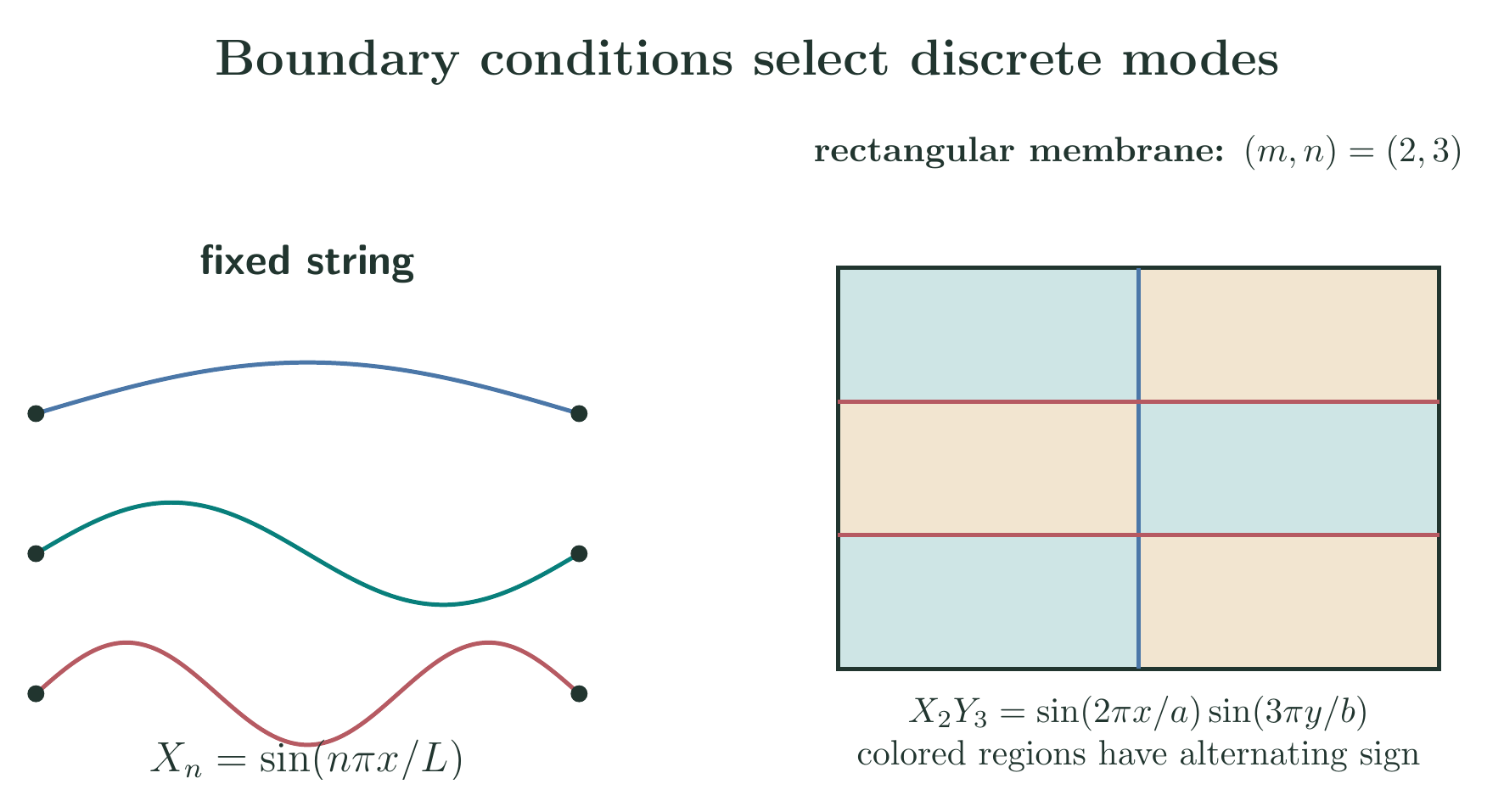
The dimensions are consistent: each term under the square root has dimension $\mathrm{length}^{-2}$, so $[\omega_{mn}]=\mathrm{time}^{-1}$.
The separated string and membrane modes are substituted into their given wave equations in the Unit II Maxima worksheet.
Solved Problems
1. A string released from a triangular displacement
A string of length $L$ is fixed at both ends, displaced to height $h$ at its midpoint in two straight segments, and released from rest:
\[f(x)= \begin{cases} 2hx/L, & 0\le x\le L/2,\\ 2h(1-x/L), & L/2\le x\le L, \end{cases} \qquad g(x)=0.\]The displacement is symmetric about $L/2$. Since
\[\sin\frac{n\pi(L-x)}{L} =(-1)^{n+1}\sin\frac{n\pi x}{L},\]the two halves cancel for even $n$ and reinforce for odd $n$. For odd $n$, with $k_n=n\pi/L$,
\[\begin{aligned} A_n &=\frac4L\int_0^{L/2}\frac{2hx}{L}\sin(k_nx)\,dx\\ &=\frac{8h}{L^2} \left[-\frac{x\cos(k_nx)}{k_n} +\frac{\sin(k_nx)}{k_n^2}\right]_0^{L/2}\\ &=\frac{8h}{n^2\pi^2}\sin\frac{n\pi}{2}. \end{aligned}\]The same formula is zero for even $n$, and release from rest gives $B_n=0$. Thus
\[\boxed{ u(x,t)=\frac{8h}{\pi^2} \sum_{\substack{n=1\\ n\ \mathrm{odd}}}^{\infty} \frac{\sin(n\pi/2)}{n^2} \sin\frac{n\pi x}{L} \cos\frac{n\pi ct}{L}}.\]At $t=0$ the series reconstructs the triangular profile, and $u_t(x,0)=0$. Every coefficient has units of length, matching the displacement.
2. Frequency and nodes of a square membrane mode
A square membrane has side $a=b=0.60\,\mathrm{m}$ and wave speed $c=120\,\mathrm{m\,s^{-1}}$. Find the frequency and nodal set of the $(m,n)=(1,2)$ mode.
The cyclic frequency is
\[\begin{aligned} f_{12} &=\frac{\omega_{12}}{2\pi}\\ &=\frac c2 \sqrt{\left(\frac1a\right)^2+\left(\frac2b\right)^2}\\ &=100\sqrt5\,\mathrm{Hz} =223.607\,\mathrm{Hz}. \end{aligned}\]The factor $\sin(\pi x/a)$ has no interior zero, while $\sin(2\pi y/b)$ vanishes at $y=b/2=0.30\,\mathrm{m}$. Hence the mode has one interior horizontal nodal line. Because the membrane is square, the $(2,1)$ mode has the same frequency; rotation through $90^\circ$ interchanges the two patterns. The units follow from $c/a$, which is inverse time.
Descriptive Questions
- Starting from the given string wave equation, derive the fixed-end normal modes and explain the exclusion of $n=0$.
- Derive both string Fourier-coefficient formulas from prescribed initial displacement and velocity.
- Explain how fixed rectangular boundaries quantize two independent wave numbers.
- Distinguish degeneracy of frequency from equality of mode shapes for a square membrane.
Numerical Problems
- A fixed string has $L=0.75\,\mathrm{m}$ and $c=180\,\mathrm{m\,s^{-1}}$. Find its fundamental frequency. Final answer: $f_1=c/(2L)=120\,\mathrm{Hz}$.
- For the same string, find the fifth-harmonic frequency and its interior node positions. Final answer: $f_5=600\,\mathrm{Hz}$; $x=0.15,0.30,0.45,0.60\,\mathrm{m}$.
- A string with $L=1.00\,\mathrm{m}$ and $c=100\,\mathrm{m\,s^{-1}}$ has $u(x,0)=0$ and $u_t(x,0)=0.20\sin(2\pi x/L)\,\mathrm{m\,s^{-1}}$. Find the displacement coefficient of that mode. Final answer: $B_2=0.20/(200\pi)=3.18310\times10^{-4}\,\mathrm{m}$.
- A rectangular membrane has $a=0.80\,\mathrm{m}$, $b=0.60\,\mathrm{m}$, and $c=120\,\mathrm{m\,s^{-1}}$. Find $f_{23}$ and the numbers of interior vertical and horizontal nodal lines. Final answer: $f_{23}=335.410\,\mathrm{Hz}$; one vertical and two horizontal interior nodal lines.
The Fourier coefficients, frequencies, boundary conditions, and wave-equation residuals are verified in the Unit II problem-check worksheet.
References
- String vibration — Wikipedia
- Richard Haberman, Applied Partial Differential Equations with Fourier Series and Boundary Value Problems, 5th ed., chapter “The Wave Equation: Vibrating Strings and Membranes,” Pearson.
- Erwin Kreyszig, Advanced Engineering Mathematics, 10th ed., Chapter 12, “Partial Differential Equations,” Wiley.
- Mary L. Boas, Mathematical Methods in the Physical Sciences, 3rd ed., Chapter 13, “Partial Differential Equations,” Wiley.


Discussion