

30 Jul 2025
Taylor and Laurent Expansions, Residues, and the Residue Theorem
Series from Cauchy's formula, annular Laurent expansions, residue calculation, and contour sums over enclosed poles.
Taylor expansion
Let $f$ be analytic inside a circle containing $z$ and centered at $z_0$. Cauchy’s formula is
\[f(z)=\frac{1}{2\pi i} \oint_C\frac{f(\zeta)}{\zeta-z}d\zeta.\]Write
\[\frac1{\zeta-z} =\frac1{\zeta-z_0} \frac1{1-\dfrac{z-z_0}{\zeta-z_0}}.\]When $\lvert z-z_0\rvert<\lvert\zeta-z_0\rvert$, the geometric series gives
\[\frac1{\zeta-z} =\sum_{n=0}^{\infty} \frac{(z-z_0)^n}{(\zeta-z_0)^{n+1}}.\]Substitution into Cauchy’s formula yields
\[f(z)=\sum_{n=0}^{\infty}a_n(z-z_0)^n,\]where
\[a_n=\frac{1}{2\pi i} \oint_C\frac{f(\zeta)}{(\zeta-z_0)^{n+1}}d\zeta =\frac{f^{(n)}(z_0)}{n!}.\]Thus
\[\boxed{ f(z)=\sum_{n=0}^{\infty} \frac{f^{(n)}(z_0)}{n!}(z-z_0)^n}.\]Laurent expansion
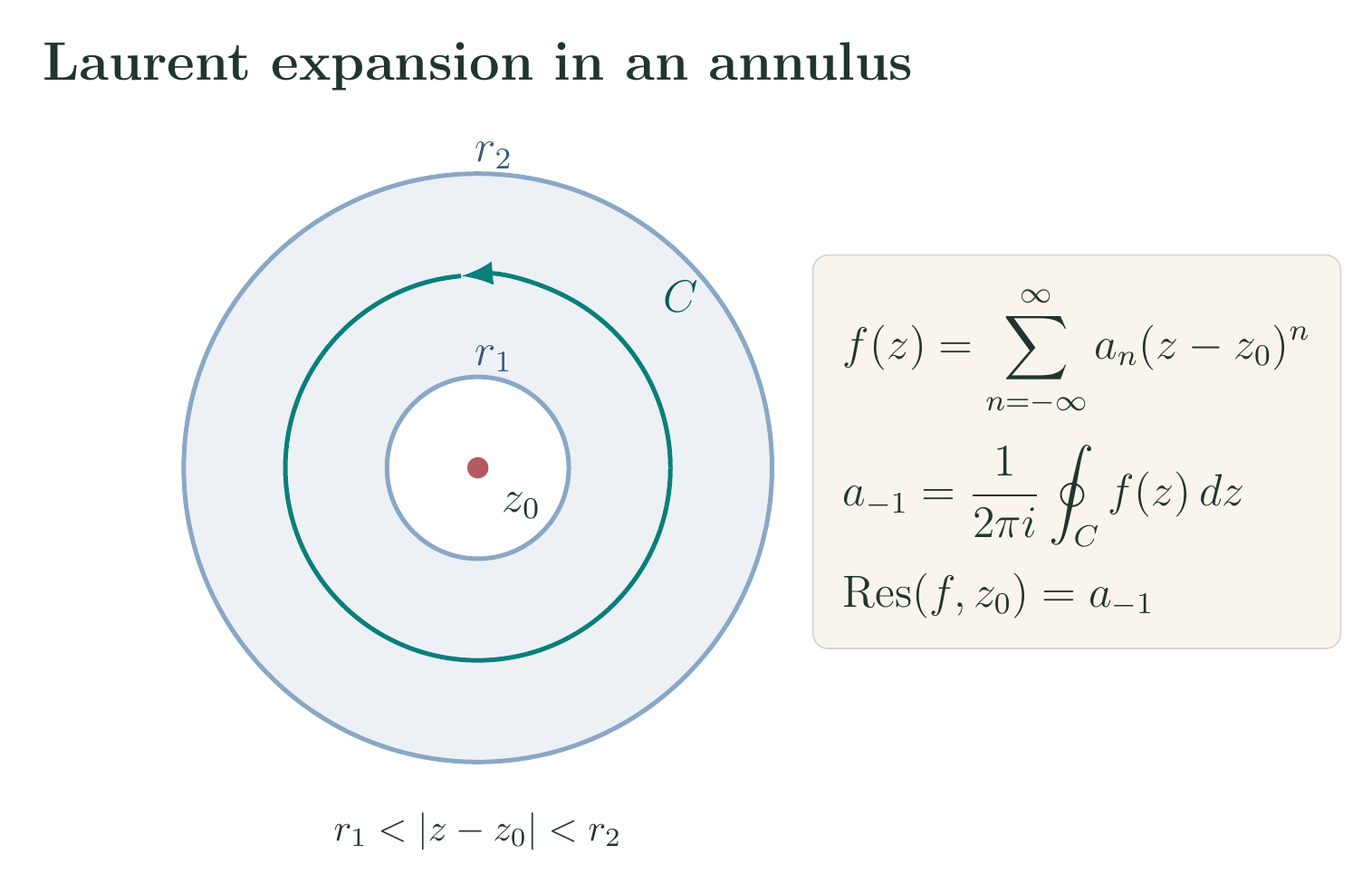
If $f$ is analytic only in an annulus
\[r_1<\lvert z-z_0\rvert<r_2,\]negative as well as nonnegative powers may occur:
\[\boxed{ f(z)=\sum_{n=-\infty}^{\infty} a_n(z-z_0)^n}.\]The coefficients have the single contour formula
\[\boxed{ a_n=\frac{1}{2\pi i} \oint_C\frac{f(\zeta)} {(\zeta-z_0)^{n+1}}d\zeta},\]where $C$ is any positively oriented circle inside the annulus.
For example,
\[\frac1{z(1-z)} =\frac1z(1+z+z^2+\cdots) =\frac1z+1+z+z^2+\cdots\]for $0<\lvert z\rvert<1$. For $\lvert z\rvert>1$,
\[\frac1{z(1-z)} =-\frac1{z^2}\frac1{1-1/z} =-\frac1{z^2}-\frac1{z^3}-\cdots.\]The same function has different Laurent expansions in different annuli.
The boundaries of an annulus of convergence pass through singularities of the function. A Laurent expansion about $z_0$ is therefore determined not only by its center but also by which singularities lie inside and outside the chosen annulus.
Residues
The residue of $f$ at an isolated singularity $z_0$ is
\[\boxed{\operatorname{Res}(f,z_0)=a_{-1}}.\]For a simple pole,
\[\boxed{ \operatorname{Res}(f,z_0) =\lim_{z\to z_0}(z-z_0)f(z)}.\]For a pole of order $m$,
\[\boxed{ \operatorname{Res}(f,z_0) =\frac1{(m-1)!} \lim_{z\to z_0} \frac{d^{m-1}}{dz^{m-1}} \left[(z-z_0)^mf(z)\right]}.\]Residue theorem
Let $f$ be analytic inside and on a positively oriented contour $C$ except for isolated singularities $z_1,\ldots,z_N$. Remove small positively oriented circles around them. Cauchy-Goursat on the remaining region gives the outer integral equal to the sum of the small-circle integrals:
\[\oint_Cf(z)dz =\sum_{k=1}^N\oint_{C_k}f(z)dz.\]In each Laurent series, every term integrates to zero except $a_{-1}(z-z_k)^{-1}$:
\[\oint_{C_k}(z-z_k)^n dz = \begin{cases} 2\pi i,&n=-1,\\ 0,&n\ne-1. \end{cases}\]Therefore
\[\boxed{ \oint_C f(z)dz =2\pi i\sum_{k=1}^N\operatorname{Res}(f,z_k)}.\]The Laurent coefficients and sample residues are checked in the Unit III Maxima worksheet.
Solved Problems
-
Find the Laurent expansions about $z=0$ of
\[f(z)=\frac1{(z-1)(z-3)}\]in the three regions separated by its singularities.
Partial fractions give
\[f(z)=-\frac1{2(z-1)}+\frac1{2(z-3)}.\]For $\lvert z\rvert<1$, expand both factors in nonnegative powers:
\[-\frac1{2(z-1)} =\frac12\sum_{n=0}^{\infty}z^n,\] \[\frac1{2(z-3)} =-\frac16\sum_{n=0}^{\infty}\left(\frac z3\right)^n.\]Thus
\[\boxed{ f(z)=\frac12\sum_{n=0}^{\infty}z^n -\frac16\sum_{n=0}^{\infty}\left(\frac z3\right)^n, \quad \lvert z\rvert<1}.\]For $1<\lvert z\rvert<3$, the first factor must use powers of $1/z$:
\[\boxed{ f(z)=-\frac12\sum_{n=0}^{\infty}z^{-n-1} -\frac16\sum_{n=0}^{\infty}\left(\frac z3\right)^n}.\]Finally, for $\lvert z\rvert>3$, both factors use negative powers:
\[\boxed{ f(z)=-\frac12\sum_{n=0}^{\infty}z^{-n-1} +\frac12\sum_{n=0}^{\infty}3^nz^{-n-1}}.\]Each geometric expansion converges precisely in the stated annulus; crossing $\lvert z\rvert=1$ or $\lvert z\rvert=3$ crosses a pole.
-
Evaluate
\[\oint_{\lvert z\rvert=3} \frac{z\,dz}{(z-1)^2(z+2)}\]counterclockwise.
At the double pole $z=1$,
\[\begin{aligned} \operatorname{Res}(f,1) &=\left.\frac{d}{dz}\left(\frac z{z+2}\right)\right\rvert_{z=1}\\ &=\left.\frac{2}{(z+2)^2}\right\rvert_{z=1} =\frac29. \end{aligned}\]At the simple pole $z=-2$,
\[\operatorname{Res}(f,-2) =\left.\frac z{(z-1)^2}\right\rvert_{z=-2} =-\frac29.\]Both poles lie inside the circle, but their residues cancel. Hence
\[\boxed{ \oint_{\lvert z\rvert=3} \frac{z\,dz}{(z-1)^2(z+2)}=0}.\] -
Find the residue of $f(z)=ze^{1/z}$ at the essential singularity $z=0$ and evaluate its integral around the positively oriented unit circle.
Expand
\[ze^{1/z} =z\left(1+\frac1z+\frac1{2!z^2} +\frac1{3!z^3}+\cdots\right).\]Therefore
\[ze^{1/z} =z+1+\frac1{2z}+\frac1{6z^2}+\cdots.\]The coefficient of $z^{-1}$ is $1/2$, so
\[\operatorname{Res}(ze^{1/z},0)=\frac12.\]The residue theorem gives
\[\boxed{ \oint_{\lvert z\rvert=1}ze^{1/z}\,dz =2\pi i\left(\frac12\right)=\pi i}.\]
Descriptive Questions
- Derive Taylor’s expansion from Cauchy’s integral formula and state how the nearest singularity determines its radius of convergence.
- Explain why Laurent expansions about the same center differ in distinct annuli.
- Derive the residue formulas for simple and higher-order poles.
- Prove the residue theorem by excising small circles around all enclosed isolated singularities.
Numerical Problems
-
Find the coefficient of $z^5$ in the Taylor expansion of $e^{2z}$.
Answer: $4/15$.
-
Find the radius of convergence about $z=0$ of the Taylor series for $1/(1+z^2)$.
Answer: $1$.
-
Find $\operatorname{Res}(1/(z^2+4),2i)$.
Answer: $1/(4i)=-i/4$.
-
Find $\operatorname{Res}(\sin z/z^3,0)$.
Answer: $0$.
-
Evaluate $\oint_{\lvert z\rvert=2}(z^2+1)\,dz/[z(z-1)]$ counterclockwise.
Answer: $2\pi i$.
-
Find the coefficient $a_{-1}$ in the Laurent expansion of $e^z/z^4$ about $z=0$.
Answer: $1/6$.
All added series coefficients, residues, and contour sums are verified in the Unit III Maxima worksheet; every printed residual is zero.
References
- Laurent series — Wikipedia
- MIT OpenCourseWare 18.04, lecture notes: Topics 7 and 8
- James Ward Brown and Ruel V. Churchill, Complex Variables and Applications, 9th ed., Chapters 5 and 6.


Discussion