

25 Jun 2025
Electric Fields in Dielectrics
Polarization and polarizability, bound charge, susceptibility, dielectric constant, displacement field, dielectric Gauss law, and Clausius-Mossotti theory.
An applied electric field slightly separates positive and negative charge inside matter and can also orient permanent molecular dipoles. The macroscopic electric dipole moment per unit volume is the polarization
\[\boxed{\mathbf P(\mathbf r) =\frac{\text{electric dipole moment}}{\text{volume}}},\]with SI unit $\mathrm{C\,m^{-2}}$.
Polarization and bound charge
A volume element $\mathrm d\tau^{\prime}$ has dipole moment $\mathbf P(\mathbf r^{\prime})\,\mathrm d\tau^{\prime}$. Its potential at $\mathbf r$ is
\[\mathrm dV =\frac{1}{4\pi\epsilon_0} \mathbf P(\mathbf r^{\prime})\cdot \boldsymbol\nabla^{\prime}\!\left(\frac{1}{\lvert\mathbf r-\mathbf r^{\prime}\rvert}\right) \mathrm d\tau^{\prime}.\]Use
\[\boldsymbol\nabla^{\prime}\cdot \left(\frac{\mathbf P}{\lvert\mathbf r-\mathbf r^{\prime}\rvert}\right) =\frac{\boldsymbol\nabla^{\prime}\cdot\mathbf P}{\lvert\mathbf r-\mathbf r^{\prime}\rvert} +\mathbf P\cdot\boldsymbol\nabla^{\prime} \left(\frac{1}{\lvert\mathbf r-\mathbf r^{\prime}\rvert}\right).\]Integration over the polarized body and the divergence theorem give
\[V(\mathbf r)=\frac{1}{4\pi\epsilon_0} \left[ \oint_S\frac{\mathbf P\cdot\hat{\mathbf n}} {\lvert\mathbf r-\mathbf r^{\prime}\rvert}\,\mathrm da^{\prime} +\int_V\frac{-\boldsymbol\nabla^{\prime}\cdot\mathbf P} {\lvert\mathbf r-\mathbf r^{\prime}\rvert}\,\mathrm d\tau^{\prime} \right].\]The field of polarized matter is therefore the field of the equivalent bound charges
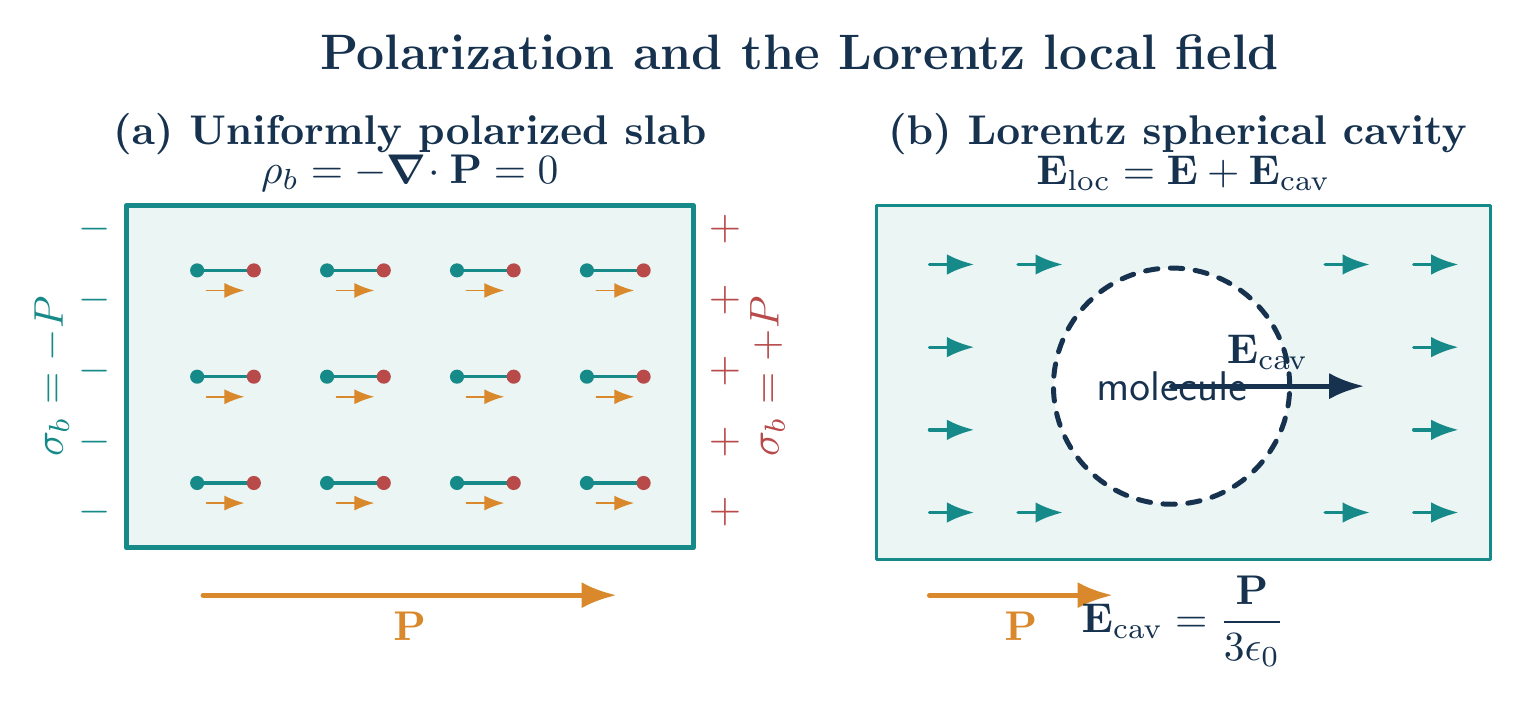
\[\boxed{\rho_b=-\boldsymbol\nabla\cdot\mathbf P}, \qquad \boxed{\sigma_b=\mathbf P\cdot\hat{\mathbf n}}.\]Uniform $\mathbf P$ gives $\rho_b=0$ inside, but generally leaves bound charge on surfaces whose normal has a component along $\mathbf P$.
Electric field and displacement field in matter
The total charge is $\rho=\rho_f+\rho_b$, where $\rho_f$ denotes charge not included in the polarization description. Gauss’s law is
\[\boldsymbol\nabla\cdot\mathbf E =\frac{\rho_f-\boldsymbol\nabla\cdot\mathbf P}{\epsilon_0}.\]Move the polarization term to the left and define
\[\boxed{\mathbf D=\epsilon_0\mathbf E+\mathbf P}.\]Then Gauss’s law in a dielectric becomes
\[\boxed{\boldsymbol\nabla\cdot\mathbf D=\rho_f}, \qquad \boxed{\oint_S\mathbf D\cdot\mathrm d\mathbf a=Q_{f,\mathrm{enc}}}.\]For an interface with unit normal from medium 1 to medium 2, a pillbox gives
\[\boxed{\hat{\mathbf n}\cdot(\mathbf D_2-\mathbf D_1)=\sigma_f}.\]Electrostatics still has $\boldsymbol\nabla\times\mathbf E=0$, so a narrow loop gives
\[\boxed{\hat{\mathbf n}\times(\mathbf E_2-\mathbf E_1)=0}.\]Only the free surface charge appears in the normal-$\mathbf D$ condition; bound charge is already contained in $\mathbf P$.
Susceptibility, dielectric constant, and polarizability
For a linear, isotropic dielectric,
\[\boxed{\mathbf P=\epsilon_0\chi_e\mathbf E},\]where the electric susceptibility $\chi_e$ is dimensionless. Hence
\[\mathbf D =\epsilon_0(1+\chi_e)\mathbf E =\epsilon\mathbf E =\epsilon_0\epsilon_r\mathbf E,\]so
\[\boxed{\epsilon_r=1+\chi_e}, \qquad \boxed{\epsilon=\epsilon_0\epsilon_r}.\]The relative permittivity $\epsilon_r$ is also called the dielectric constant in the static, linear regime.
Microscopically, an isotropic molecule with induced dipole moment $\mathbf p$ has polarizability $\alpha$ defined by
\[\boxed{\mathbf p=\alpha\mathbf E_{\mathrm{loc}}}.\]In SI, $[\alpha]=\mathrm{C\,m^2\,V^{-1}}=\mathrm{F\,m^2}$. The local field $\mathbf E_{\mathrm{loc}}$ acting on a molecule need not equal the macroscopic field $\mathbf E$.
Clausius-Mossotti equation
For a homogeneous isotropic or cubic dielectric, the Lorentz spherical-cavity construction gives
\[\boxed{\mathbf E_{\mathrm{loc}} =\mathbf E+\frac{\mathbf P}{3\epsilon_0}}.\]If $N$ is the molecular number density, then
\[\mathbf P=N\mathbf p =N\alpha\left(\mathbf E+\frac{\mathbf P}{3\epsilon_0}\right).\]Collect the $\mathbf P$ terms:
\[\mathbf P\left(1-\frac{N\alpha}{3\epsilon_0}\right) =N\alpha\mathbf E.\]Insert $\mathbf P=\epsilon_0(\epsilon_r-1)\mathbf E$, cancel $\mathbf E$, and define
\[x=\frac{N\alpha}{3\epsilon_0}.\]Then
\[(\epsilon_r-1)(1-x)=3x.\]Expanding and collecting $x$,
\[\epsilon_r-1=x(\epsilon_r+2).\]Therefore
\[\boxed{\frac{\epsilon_r-1}{\epsilon_r+2} =\frac{N\alpha}{3\epsilon_0}}.\]The derivation assumes a linear, homogeneous, isotropic or cubic, nonpolar dielectric whose molecules can be treated as weakly interacting polarizable units. Strong correlations, anisotropy, permanent-dipole orientation, or large fields require a more detailed model.
Solved Problems
1. Linear dielectric between charged parallel plates
Large plates carry free surface charge densities $+\sigma_f$ and $-\sigma_f$. A linear dielectric of relative permittivity $\epsilon_r$ fills the gap. Find $\mathbf D$, $\mathbf E$, and $\mathbf P$ away from the edges.
Solution. A pillbox enclosing either free plate gives
\[\boxed{\mathbf D=\sigma_f\hat{\mathbf n}},\]where $\hat{\mathbf n}$ points from the positive to the negative plate. Since $\mathbf D=\epsilon_0\epsilon_r\mathbf E$,
\[\boxed{\mathbf E=\frac{\sigma_f}{\epsilon_0\epsilon_r}\hat{\mathbf n}}.\]Using $\mathbf P=\epsilon_0(\epsilon_r-1)\mathbf E$,
\[\boxed{\mathbf P=\sigma_f\left(1-\frac1{\epsilon_r}\right)\hat{\mathbf n}}.\]The dielectric faces therefore carry bound densities $\sigma_b=\pm P$, with the negative bound charge facing the positive free plate. Substitution confirms $\epsilon_0\mathbf E+\mathbf P=\mathbf D$.
2. Two dielectric layers in series
Two linear dielectric slabs of thicknesses $d_1,d_2$ and permittivities $\epsilon_1,\epsilon_2$ fill a parallel-plate gap held at potential difference $V$. There is no free charge at their interface. Find the fields.
Solution. The normal component of $\mathbf D$ is the same in both layers:
\[D_1=D_2=D.\]Hence $E_1=D/\epsilon_1$ and $E_2=D/\epsilon_2$. The applied voltage is
\[V=E_1d_1+E_2d_2 =D\left(\frac{d_1}{\epsilon_1}+\frac{d_2}{\epsilon_2}\right).\]Therefore
\[\boxed{D=\frac{V}{d_1/\epsilon_1+d_2/\epsilon_2}}, \qquad \boxed{E_i=\frac{D}{\epsilon_i}}.\]The layer with the smaller permittivity has the larger electric field.
Descriptive Questions
- How are polarization and molecular polarizability distinguished?
- Why does the normal boundary condition for $\mathbf D$ contain only free surface charge?
- Under what assumptions does $\epsilon_r=1+\chi_e$ hold?
- Which microscopic assumptions enter the Clausius-Mossotti equation?
Numerical Problems
1. Polarization and displacement
A dielectric has $\chi_e=3.20$ in a field $E=2.00\times10^5\,\mathrm{V\,m^{-1}}$. Find $P$ and $D$.
Answer: $P=5.67\times10^{-6}\,\mathrm{C\,m^{-2}}$ and $D=7.44\times10^{-6}\,\mathrm{C\,m^{-2}}$.
2. Clausius-Mossotti parameter
For a material, $x=N\alpha/(3\epsilon_0)=0.200$. Find $\epsilon_r$.
Answer: $\epsilon_r=1.75$.
3. Bound charge from nonuniform polarization
Inside a sphere of radius $R=0.100\,\mathrm m$, the polarization is $\mathbf P=kr\hat{\mathbf r}$ with $k=2.00\,\mathrm{\mu C\,m^{-3}}$. Find the bound volume density, the bound surface density, and the net bound charge.
Answer: $\rho_b=-6.00\,\mathrm{\mu C\,m^{-3}}$, $\sigma_b=0.200\,\mathrm{\mu C\,m^{-2}}$, and $Q_b^{\mathrm{net}}=0$.
The symbolic solutions and all printed numerical answers are verified in the Unit II dielectric worksheet.
References
- Dielectric: Wikipedia
- David J. Griffiths, Introduction to Electrodynamics, 4th ed., Cambridge University Press, 2017.
- B. I. Bleaney and B. Bleaney, Electricity and Magnetism, 3rd ed., Oxford University Press, 1976.
- Charles Kittel, Introduction to Solid State Physics, 8th ed., Wiley, 2004.


Discussion