

27 Jul 2025
Electromagnetic Induction and Magnetic Measurement
Faraday-Lenz induction, self and mutual inductance, reciprocity, magnetic energy, displacement current, current-loop torque, and ballistic galvanometers.
Choose the positive direction around a loop by the right-hand rule from its oriented area. The magnetic flux is
\[\Phi_B=\int_S\mathbf B\cdot\mathrm d\mathbf a.\]Faraday’s law for a fixed loop is
\[\boxed{\mathcal E=\oint_C\mathbf E\cdot\mathrm d\mathbf l =-\frac{\mathrm d\Phi_B}{\mathrm dt}}.\]The minus sign is Lenz’s law: the induced current produces a magnetic effect that opposes the change of flux, not the flux itself. For a coil of $N$ tightly coupled turns, the flux linkage is $\Lambda=N\Phi_B$, and
\[\boxed{\mathcal E=-\frac{\mathrm d\Lambda}{\mathrm dt}}.\]For a fixed spanning surface, Stokes’s theorem gives
\[\int_S(\boldsymbol\nabla\times\mathbf E)\cdot\mathrm d\mathbf a =-\int_S\frac{\partial\mathbf B}{\partial t}\cdot\mathrm d\mathbf a.\]Since this holds for every surface,
\[\boxed{\boldsymbol\nabla\times\mathbf E =-\frac{\partial\mathbf B}{\partial t}}.\]Unlike an electrostatic field, an induced electric field generally has nonzero circulation.
Self-inductance
For a fixed circuit in a linear magnetic medium, its flux linkage is proportional to its current:
\[\boxed{\Lambda=LI}.\]The constant $L$ is the self-inductance, measured in henrys:
\[1\ \mathrm H=1\ \mathrm{Wb\,A^{-1}}=1\ \mathrm{V\,s\,A^{-1}}.\]If $L$ is constant,
\[\boxed{\mathcal E_L=-L\frac{\mathrm dI}{\mathrm dt}}.\]The induced emf opposes an increase or decrease of the current that created the linkage.
Mutual inductance and reciprocity
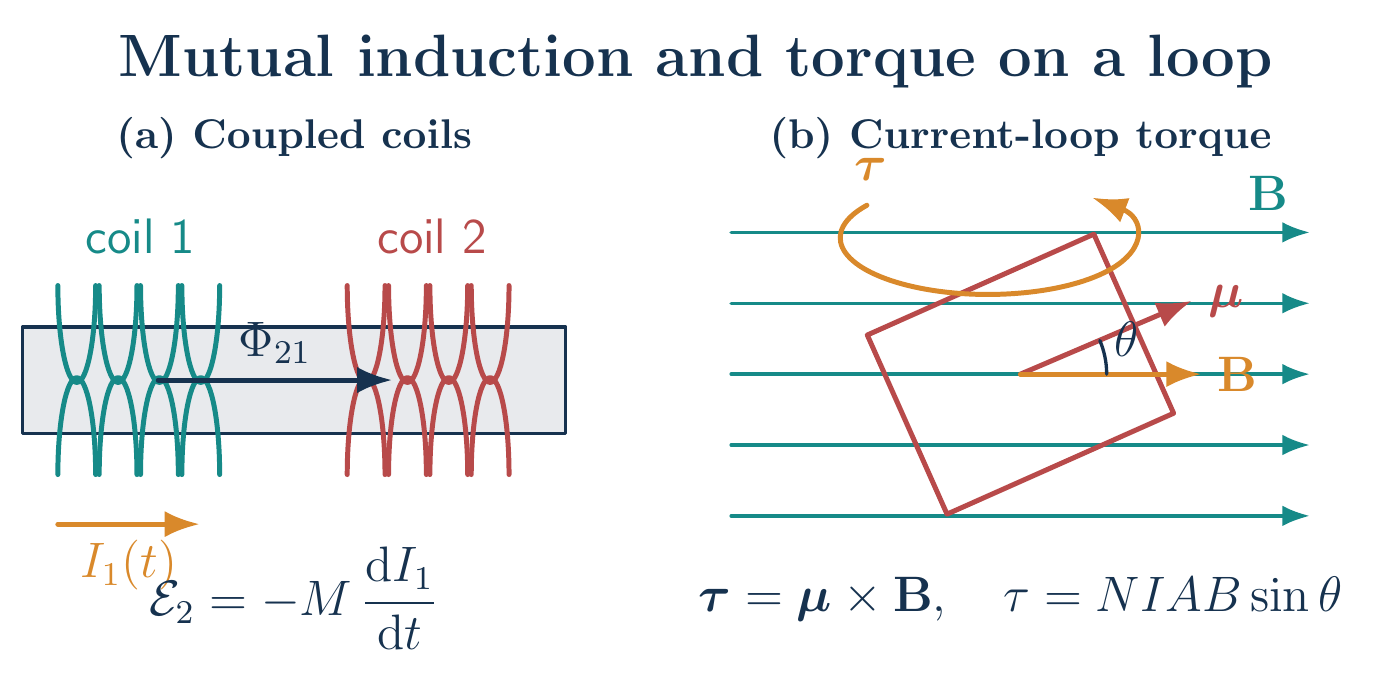
For two fixed coils in a linear reciprocal medium,
\[\Lambda_1=L_1I_1+M_{12}I_2, \qquad \Lambda_2=M_{21}I_1+L_2I_2.\]Thus a changing $I_1$ produces
\[\mathcal E_2=-M_{21}\frac{\mathrm dI_1}{\mathrm dt},\]and similarly with $1$ and $2$ interchanged.
Neglecting resistance while the currents are established quasistatically, the source work entering the magnetic field is
\[\mathrm dW=I_1\,\mathrm d\Lambda_1+I_2\,\mathrm d\Lambda_2.\]Use
\[\mathrm d\Lambda_1=L_1\,\mathrm dI_1+M_{12}\,\mathrm dI_2,\] \[\mathrm d\Lambda_2=M_{21}\,\mathrm dI_1+L_2\,\mathrm dI_2.\]Then
\[\mathrm dW =\left(L_1I_1+M_{21}I_2\right)\mathrm dI_1 +\left(M_{12}I_1+L_2I_2\right)\mathrm dI_2.\]Because $W(I_1,I_2)$ is a state function, its mixed derivatives are equal:
\[\frac{\partial}{\partial I_2} \left(L_1I_1+M_{21}I_2\right) = \frac{\partial}{\partial I_1} \left(M_{12}I_1+L_2I_2\right).\]Therefore
\[\boxed{M_{12}=M_{21}\equiv M}.\]This is the reciprocity theorem. Integrating the exact differential from zero currents gives
\[\boxed{ W=\frac12L_1I_1^2+MI_1I_2+\frac12L_2I_2^2}.\]Energy stored in a magnetic field
For one inductor, the source must supply the opposing voltage $L\,\mathrm dI/\mathrm dt$. Its power is
\[P=I L\frac{\mathrm dI}{\mathrm dt}.\]Hence
\[W=\int_0^I LI^{\prime}\,\mathrm dI^{\prime} =\boxed{\frac12LI^2}.\]For a long solenoid of length $\ell$, area $A$, turn density $n$, and linear permeability $\mu$,
\[H=nI,\qquad B=\mu H,\qquad L=\mu n^2A\ell.\]Therefore
\[\frac12LI^2 =\frac12\mu n^2I^2A\ell =\frac12BH(A\ell).\]This identifies the magnetic energy density in a linear medium:
\[\boxed{u_B=\frac12\mathbf B\cdot\mathbf H}, \qquad \boxed{W=\frac12\int_V\mathbf B\cdot\mathbf H\,\mathrm d\tau}.\]In vacuum, $u_B=B^2/(2\mu_0)$.
Charge conservation and displacement current
Local conservation of free charge is
\[\boxed{\boldsymbol\nabla\cdot\mathbf J_f +\frac{\partial\rho_f}{\partial t}=0}.\]The magnetostatic equation $\boldsymbol\nabla\times\mathbf H=\mathbf J_f$ cannot hold unchanged when charge accumulates, because the divergence of a curl is zero. Gauss’s law in matter gives
\[\rho_f=\boldsymbol\nabla\cdot\mathbf D.\]Differentiate it and use the continuity equation:
\[\boldsymbol\nabla\cdot \left(\mathbf J_f+\frac{\partial\mathbf D}{\partial t}\right)=0.\]Maxwell’s correction is therefore
\[\boxed{\boldsymbol\nabla\times\mathbf H =\mathbf J_f+\frac{\partial\mathbf D}{\partial t}}.\]The displacement-current density is
\[\boxed{\mathbf J_d=\frac{\partial\mathbf D}{\partial t}},\]with the same SI unit $\mathrm{A\,m^{-2}}$ as conduction-current density. Its integral form is
\[\boxed{\oint_C\mathbf H\cdot\mathrm d\mathbf l =I_{f,\mathrm{enc}} +\frac{\mathrm d}{\mathrm dt}\int_S\mathbf D\cdot\mathrm d\mathbf a}.\]For a charging capacitor, $\int_S\mathbf D\cdot\mathrm d\mathbf a=Q_f$, so the displacement current between its plates is $\mathrm dQ_f/\mathrm dt$, equal to the wire current.
Torque on a current loop
For a planar $N$-turn loop carrying current $I$, define
\[\boldsymbol\mu=NI\mathbf A,\]where $\mathbf A=A\hat{\mathbf n}$ follows the current by the right-hand rule. Opposite sides of a rectangular loop in a uniform field experience equal and opposite forces $I\,\mathrm d\mathbf l\times\mathbf B$; their net force is zero but their moments form a couple. If $\theta$ is the angle between $\boldsymbol\mu$ and $\mathbf B$,
\[\tau=NIAB\sin\theta.\]In vector form,
\[\boxed{\boldsymbol\tau=\boldsymbol\mu\times\mathbf B}.\]Since $\tau_\theta=-\mathrm dU/\mathrm d\theta$,
\[\frac{\mathrm dU}{\mathrm d\theta}=NIAB\sin\theta.\]Choosing $U=0$ at $\theta=\pi/2$,
\[\boxed{U=-\boldsymbol\mu\cdot\mathbf B}.\]Ballistic galvanometer
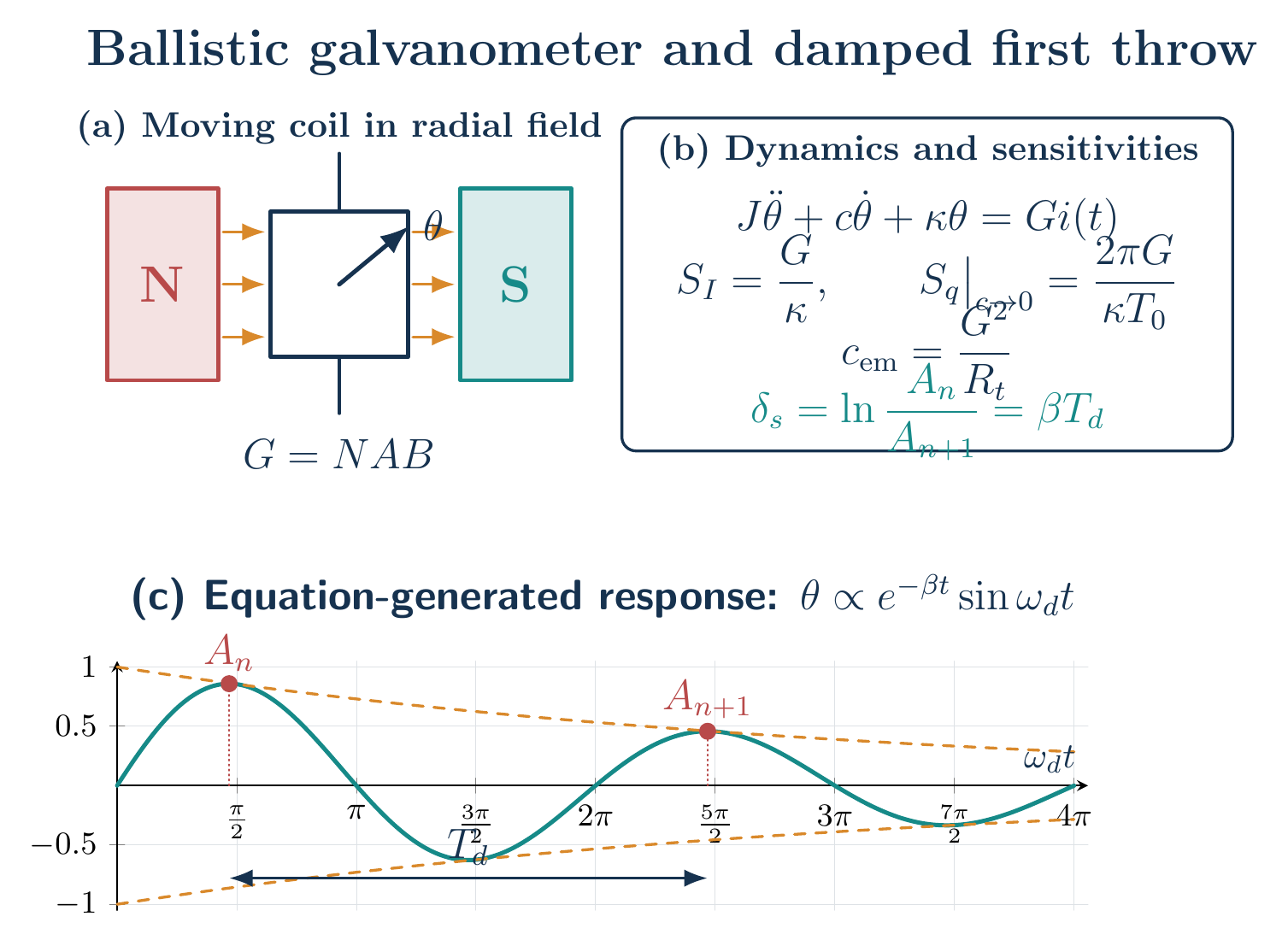
Let a moving coil have $N$ turns, area $A$, radial field $B$, moment of inertia $J$, torsion constant $\kappa$, and total damping coefficient $c$. Define its torque constant
\[\boxed{G=NAB}.\]For small angular displacement,
\[\boxed{J\ddot\theta+c\dot\theta+\kappa\theta=G\,i(t)}.\]Current sensitivity
For steady current, $\dot\theta=\ddot\theta=0$. Thus
\[\kappa\theta=GI\]and the current sensitivity is
\[\boxed{S_I=\frac{\theta}{I} =\frac{G}{\kappa} =\frac{NAB}{\kappa}}.\]A small $\kappa$, large $NAB$, and a stable radial field increase current sensitivity.
Charge sensitivity and first throw
Suppose a charge pulse
\[q=\int i(t)\,\mathrm dt\]passes in a time $t_p$ much shorter than the galvanometer period. During the pulse, $\theta$ remains negligible, so the damping and restoring impulses may be neglected. Integrating the equation of motion across the pulse gives
\[J\dot\theta(0^+)=Gq.\]Write
\[\beta=\frac{c}{2J},\qquad \omega_0=\sqrt{\frac{\kappa}{J}},\qquad \omega_d=\sqrt{\omega_0^2-\beta^2}.\]For underdamping $(\beta<\omega_0)$, the subsequent free motion with $\theta(0)=0$ is
\[\boxed{ \theta(t)=\frac{Gq}{J\omega_d} e^{-\beta t}\sin\omega_dt}.\]At the first maximum $t_1$,
\[\frac{\mathrm d\theta}{\mathrm dt}=0 \quad\Longrightarrow\quad \tan(\omega_dt_1)=\frac{\omega_d}{\beta}.\]Let
\[\eta=\frac{\beta}{\omega_d}, \qquad \alpha=\tan^{-1}\!\left(\frac{1}{\eta}\right), \qquad t_1=\frac{\alpha}{\omega_d}.\]Because $\sin\alpha=\omega_d/\omega_0$, the observed first throw $\theta_1$ is
\[\theta_1 =\frac{Gq}{J\omega_0} e^{-\eta\alpha}.\]With $T_0=2\pi/\omega_0$ and $J\omega_0=\kappa T_0/(2\pi)$,
\[\boxed{ q=\frac{\kappa T_0}{2\pi G}\, \theta_1 \exp\!\left[ \eta\tan^{-1}\!\left(\frac1\eta\right) \right]}.\]Therefore the exact charge sensitivity in the underdamped model is
\[\boxed{ S_q=\frac{\theta_1}{q} =\frac{2\pi G}{\kappa T_0} \exp\!\left[ -\eta\tan^{-1}\!\left(\frac1\eta\right) \right]}.\]In the negligible-damping limit,
\[\boxed{q=\frac{\kappa T_0}{2\pi NAB}\theta_1}, \qquad \boxed{S_q=\frac{2\pi NAB}{\kappa T_0}}.\]The ballistic condition is $t_p\ll T_d=2\pi/\omega_d$, and the motion must remain within the linear angular range.
Electromagnetic damping
Motion of the coil generates the back emf
\[e_b=G\dot\theta.\]If the total closed-circuit resistance is $R_t$, the induced current opposes the motion:
\[i_b=-\frac{G}{R_t}\dot\theta.\]Its torque is
\[\tau_{\mathrm{em}}=Gi_b =-\frac{G^2}{R_t}\dot\theta.\]Thus
\[\boxed{c_{\mathrm{em}}=\frac{G^2}{R_t}}, \qquad c=c_{\mathrm{mechanical}}+c_{\mathrm{em}}.\]Lower circuit resistance produces stronger electromagnetic damping. Ballistic operation requires an underdamped coil; critical damping occurs at $c=2\sqrt{J\kappa}$.
Logarithmic decrement and damping correction
Let $A_n$ and $A_{n+1}$ be successive maxima on the same side, separated by $T_d$. Since the envelope is $e^{-\beta t}$,
\[\boxed{\delta_s=\ln\frac{A_n}{A_{n+1}} =\beta T_d =\frac{2\pi\beta}{\omega_d} =2\pi\eta}.\]If successive absolute throws on alternating sides are used instead, their decrement is
\[\boxed{\delta_a=\frac{\delta_s}{2}=\pi\eta}.\]For weak damping,
\[\eta\tan^{-1}(1/\eta) =\frac{\delta_s}{4}+O(\delta_s^2) =\frac{\delta_a}{2}+O(\delta_a^2).\]Hence
\[\boxed{ q\simeq\frac{\kappa T_0}{2\pi G}\theta_1 \left(1+\frac{\delta_s}{4}\right)}\]or, equivalently,
\[\boxed{ q\simeq\frac{\kappa T_0}{2\pi G}\theta_1 \left(1+\frac{\delta_a}{2}\right)}.\]The factor is $1+\delta_s/4$, not $1+\delta_s/2$, when the logarithmic decrement is defined from same-side maxima.
Solved Problems
1. Mutual inductance of two coaxial solenoids
Two tightly coupled solenoids of common length $\ell$ and area $A$ have $N_1$ and $N_2$ turns. The core has linear permeability $\mu$. Find their mutual inductance and verify reciprocity.
Solution. Current $I_1$ produces the interior field
\[B_1=\mu\frac{N_1}{\ell}I_1.\]The flux linkage of coil 2 is
\[\Lambda_{21}=N_2B_1A =\mu\frac{N_1N_2A}{\ell}I_1.\]Therefore
\[M_{21}=\frac{\Lambda_{21}}{I_1} =\mu\frac{N_1N_2A}{\ell}.\]Interchanging the coils gives the identical expression, so
\[\boxed{M_{12}=M_{21}=\mu\frac{N_1N_2A}{\ell}}.\]2. Displacement current inside a charging capacitor
A circular parallel-plate capacitor of plate radius $R$ is charged by current $I$. Neglect fringing. Find the displacement current enclosed by a circular path of radius $r<R$ and the magnetic field on that path.
Solution. The free charge is uniform, so
\[D=\frac{Q}{\pi R^2}.\]The displacement flux through radius $r$ is $D\pi r^2$. Hence
\[I_d(r)=\frac{\mathrm d}{\mathrm dt}(D\pi r^2) =\frac{r^2}{R^2}\frac{\mathrm dQ}{\mathrm dt} =\boxed{I\frac{r^2}{R^2}}.\]Ampere-Maxwell law gives
\[B(2\pi r)=\mu_0 I_d(r),\]so
\[\boxed{B(r)=\frac{\mu_0Ir}{2\pi R^2}},\qquad r<R.\]At $r=R$ this joins continuously to the exterior field $\mu_0I/(2\pi r)$.
Descriptive Questions
- How does Lenz’s law determine the sign in Faraday’s law without opposing the magnetic flux itself?
- Under what physical assumptions is mutual-inductance reciprocity valid?
- Why is displacement current required for local charge conservation in a charging capacitor?
- How do electromagnetic damping and logarithmic decrement affect a ballistic-galvanometer first throw?
Numerical Problems
1. Induced emf
A $200$-turn coil has flux per turn decreasing uniformly from $4.00\,\mathrm{mWb}$ to $1.00\,\mathrm{mWb}$ in $20.0\,\mathrm{ms}$. Find the induced-emf magnitude.
Answer: $\lvert\mathcal E\rvert=30.0\,\mathrm V$.
2. Magnetic energy
Find the energy stored by an inductor $L=0.500\,\mathrm H$ carrying $I=3.00\,\mathrm A$.
Answer: $W=2.25\,\mathrm J$.
3. Torque on a coil
A $50$-turn coil carries $0.200\,\mathrm A$, has area $4.00\,\mathrm{cm^2}$, and is in $B=0.300\,\mathrm T$. Find the torque when its normal makes $30.0^\circ$ with the field.
Answer: $\tau=6.00\times10^{-4}\,\mathrm{N\,m}$.
4. Ballistic-galvanometer charge
A galvanometer has $\kappa=2.00\times10^{-7}\,\mathrm{N\,m\,rad^{-1}}$, $T_0=4.00\,\mathrm s$, $N=100$, $A=2.00\times10^{-4}\,\mathrm{m^2}$, and $B=0.200\,\mathrm T$. Neglect damping and find the charge corresponding to first throw $\theta_1=0.0800\,\mathrm{rad}$.
Answer: $q=2.55\,\mathrm{\mu C}$.
The symbolic solutions and all printed numerical answers are verified in the Unit III induction and galvanometer worksheet.
References
- Electromagnetic induction: Wikipedia
- David J. Griffiths, Introduction to Electrodynamics, 4th ed., Cambridge University Press, 2017.
- Richard P. Feynman, Robert B. Leighton, and Matthew Sands, The Feynman Lectures on Physics, Vol. II, Basic Books, 2011.
- D. C. Tayal, Electricity and Magnetism, Himalaya Publishing House.


Discussion