

27 Jun 2025
Interference, Thin Films, and Newton's Rings
Coherent superposition, fringe visibility, division of wavefront and amplitude, equal-inclination and equal-thickness fringes, and Newton's rings.
Two-beam interference and visibility
At a point where two coherent fields have the same polarization,
\[E_1=E_{01}\cos\omega t, \qquad E_2=E_{02}\cos(\omega t+\delta).\]Since intensity is proportional to the time average of the squared field,
\[\left\langle(E_1+E_2)^2\right\rangle =\frac{E_{01}^2}{2}+\frac{E_{02}^2}{2} +E_{01}E_{02}\cos\delta.\]Writing the separate intensities as $I_1$ and $I_2$ gives
\[\boxed{I=I_1+I_2+2\sqrt{I_1I_2}\cos\delta}.\]Therefore
\[I_{\max}=(\sqrt{I_1}+\sqrt{I_2})^2, \qquad I_{\min}=(\sqrt{I_1}-\sqrt{I_2})^2,\]and the fringe visibility is
\[\boxed{\mathcal V=\frac{I_{\max}-I_{\min}}{I_{\max}+I_{\min}} =\frac{2\sqrt{I_1I_2}}{I_1+I_2}}.\]Visibility reaches one only for equal intensities and complete mutual coherence. Division of wavefront makes coherent secondary sources from different portions of one wavefront, as in a two-slit arrangement. Division of amplitude splits one beam and later recombines its parts, as in thin films and interferometers.
Thin-film phase and reflection convention
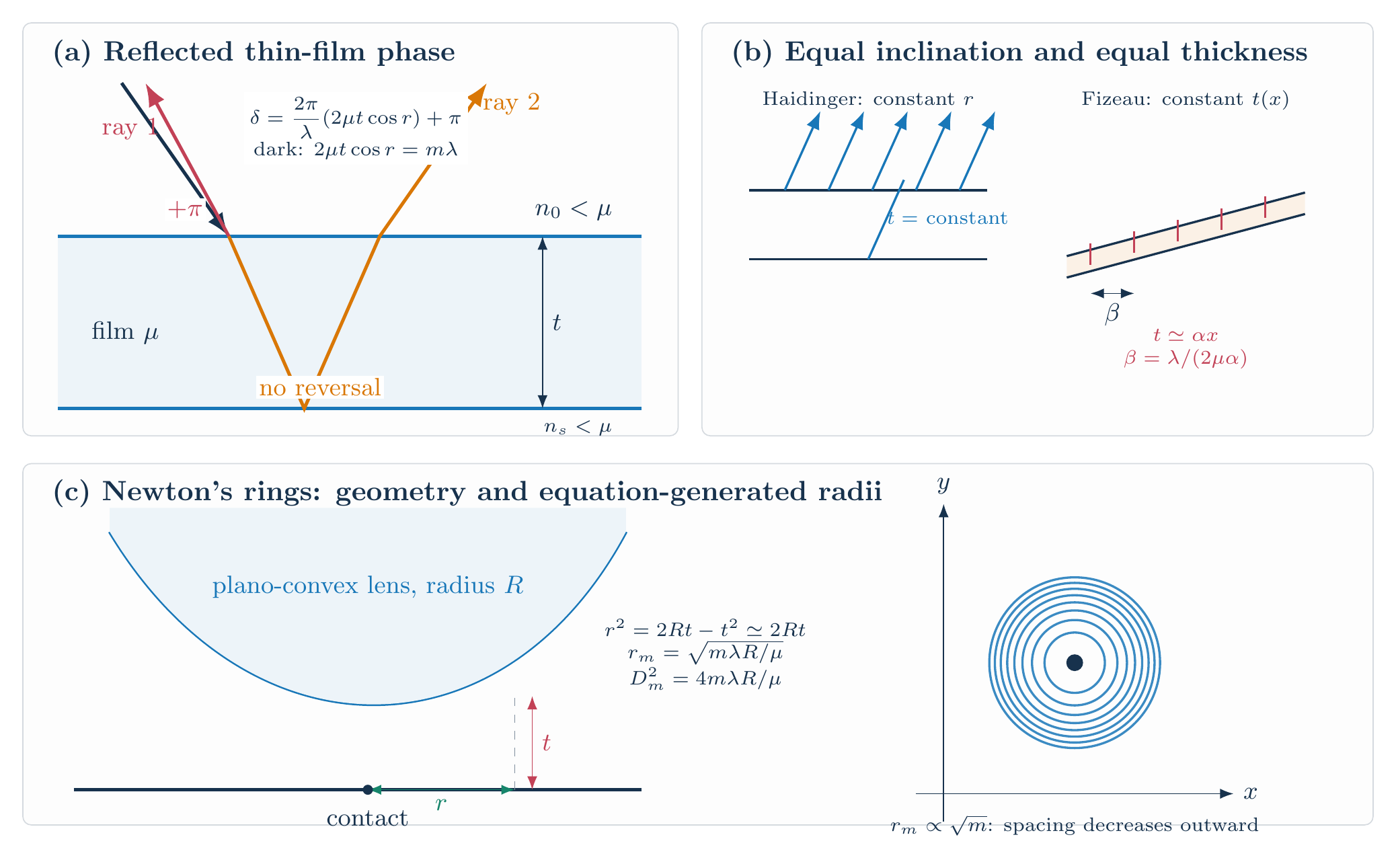
Consider a film of refractive index $\mu$, thickness $t$, and internal ray angle $r$. The normal component of the wave vector in the film is
\[k_z=\frac{2\pi\mu}{\lambda}\cos r.\]A down-and-back traversal therefore adds propagation phase $2k_zt$, equivalent to the optical-path difference
\[\boxed{\Delta_g=2\mu t\cos r}.\]A reflection from a lower to a higher refractive index changes the field phase by $\pi$; reflection from higher to lower does not. Thus, when exactly one of the two reflected rays undergoes phase reversal,
\[\delta=\frac{2\pi}{\lambda}(2\mu t\cos r)+\pi.\]Reflected maxima require $\delta=2q\pi$, and reflected minima require $\delta=(2q+1)\pi$. Re-indexing with $m=0,1,2,\ldots$ gives
\[\boxed{2\mu t\cos r=m\lambda \quad\text{(reflected dark)}},\] \[\boxed{2\mu t\cos r=\left(m+\frac12\right)\lambda \quad\text{(reflected bright)}}.\]If there are zero or two reflection phase reversals, these bright and dark conditions interchange. Transmitted maxima and minima are complementary for a non-absorbing film.
Haidinger and Fizeau fringes
For a parallel film, $t$ is fixed. A given interference order therefore selects a fixed $r$. The resulting circular Haidinger fringes are fringes of equal inclination and are localized at infinity; a lens brings rays of equal inclination together in its focal plane.
For a wedge of small angle $\alpha$, the thickness at distance $x$ from the contact is
\[t(x)=x\tan\alpha\simeq x\alpha.\]At nearly normal incidence and with one phase reversal, the $m$th reflected dark fringe obeys
\[2\mu\alpha x_m=m\lambda.\]Hence neighboring fringes have constant spacing
\[\boxed{\beta=x_{m+1}-x_m=\frac{\lambda}{2\mu\alpha}}.\]These straight, parallel Fizeau fringes are fringes of equal thickness and are localized near the film.
Newton’s rings and measurements
A plano-convex lens of radius of curvature $R$ rests on a plane plate. At radial distance $r$ from the contact, geometry gives
\[R^2=(R-t)^2+r^2 =R^2-2Rt+t^2+r^2,\]so
\[r^2=2Rt-t^2.\]Because $t\ll R$, the $t^2$ term is negligible and
\[\boxed{t\simeq\frac{r^2}{2R}}.\]The film between lens and plate has one reflected phase reversal. Thus the contact is dark in reflected light. Combining $2\mu t=m\lambda$ with the geometrical thickness gives the dark-ring radii and diameters:
\[\boxed{r_m^2=\frac{m\lambda R}{\mu}}, \qquad \boxed{D_m^2=\frac{4m\lambda R}{\mu}}.\]For bright reflected rings,
\[\boxed{r_{m,{\rm bright}}^2 =\frac{(m+1/2)\lambda R}{\mu}}.\]For an air film, $\mu=1$. Subtracting the squared diameters of orders $m$ and $m+p$ removes the uncertain position of contact:
\[D_{m+p}^2-D_m^2=4p\lambda R.\]Therefore the wavelength is
\[\boxed{\lambda= \frac{D_{m+p}^2-D_m^2}{4pR}}.\]If a liquid fills the gap, then $D_{m,\ell}^2=4m\lambda R/\mu$. Comparing the same order in air and liquid gives
\[\boxed{\mu=\frac{D_{m,{\rm air}}^2}{D_{m,\ell}^2}}.\]More robustly, using two orders in each medium,
\[\boxed{\mu= \frac{D_{m+p,{\rm air}}^2-D_{m,{\rm air}}^2} {D_{m+p,\ell}^2-D_{m,\ell}^2}}.\]Every diameter must be measured in the same length unit; then the ratios are dimensionless and the wavelength formula returns the unit used for $D^2/R$.
Solved Problems
Problem 1: Visibility for unequal beams
Two coherent beams have intensities $I_1=9I_0$ and $I_2=4I_0$. Find the extreme intensities and fringe visibility.
The interference extremes are
\[I_{\max}=(\sqrt{I_1}+\sqrt{I_2})^2 =(3+2)^2I_0=25I_0,\] \[I_{\min}=(\sqrt{I_1}-\sqrt{I_2})^2 =(3-2)^2I_0=I_0.\]Therefore
\[\mathcal V=\frac{I_{\max}-I_{\min}}{I_{\max}+I_{\min}} =\frac{25-1}{25+1} =\boxed{\frac{12}{13}}.\]The check $0<12/13<1$ is consistent with unequal but coherent beams.
Problem 2: Wavelength from Newton’s rings
For an air film with lens curvature radius $R=1.00\,\mathrm m$, the diameters of the 10th and 20th dark rings are $3.00\,\mathrm{mm}$ and $5.00\,\mathrm{mm}$. Find the wavelength.
For orders separated by $p=10$,
\[\lambda=\frac{D_{m+p}^2-D_m^2}{4pR}.\]Using SI units,
\[\begin{aligned} \lambda &=\frac{(5.00\times10^{-3})^2-(3.00\times10^{-3})^2} {4(10)(1.00)}\\ &=\frac{16.0\times10^{-6}}{40} =4.00\times10^{-7}\,\mathrm m. \end{aligned}\]Thus $\boxed{\lambda=400\,\mathrm{nm}}$. Substitution gives $D_{20}^2-D_{10}^2=4(10)\lambda R=16.0\,\mathrm{mm^2}$, matching the data.
Descriptive Questions
- How do division of wavefront and division of amplitude produce coherent beams, and what is one example of each?
- Why does reflection from a lower-index medium to a higher-index medium reverse the electric-field phase?
- How do Haidinger fringes differ from Fizeau fringes in geometry and localization?
- Why is the point of contact dark in reflected Newton’s rings, and why is $D_m^2$ linear in order $m$?
Numerical Problems
-
A wedge-shaped air film has angle $\alpha=0.50\,\mathrm{mrad}$ and is illuminated normally with $\lambda=600\,\mathrm{nm}$. Since $\beta=\lambda/(2\alpha)$,
Answer: $\boldsymbol{\beta=0.600\,\mathrm{mm}}$.
-
A film of index $\mu=1.50$ has one reflection phase reversal. Find its least non-zero thickness for a reflected maximum at $\lambda=600\,\mathrm{nm}$, using $2\mu t=\lambda/2$.
Answer: $\boldsymbol{t=100\,\mathrm{nm}}$.
-
The same Newton-ring order has diameter $4.20\,\mathrm{mm}$ in air and $3.50\,\mathrm{mm}$ after a liquid is introduced. Use $\mu=D_{\mathrm{air}}^2/D_{\ell}^2$.
Answer: $\boldsymbol{\mu=1.44}$.
-
An air-film Newton ring has diameter $4.00\,\mathrm{mm}$ for $\lambda=500\,\mathrm{nm}$ and $R=1.00\,\mathrm m$. Find its dark-ring order from $D_m^2=4m\lambda R$.
Answer: $\boldsymbol{m=8}$.
The intensity, visibility, film phase, wedge spacing, ring-diameter identities, and all worked answers are checked in the Unit II Maxima worksheet.


Discussion