

29 Jul 2025
Polarization by Reflection and Double Refraction
Brewster's law from the Fresnel boundary conditions, ordinary and extraordinary waves in a uniaxial crystal, and the Nicol prism.
Light propagating along $\hat{\mathbf k}$ is transverse: its electric field lies in the plane perpendicular to $\hat{\mathbf k}$. Unpolarized light has no fixed transverse direction, whereas plane-polarized light oscillates along one fixed direction.
Polarization by reflection
Let light pass from a non-magnetic medium of refractive index $n_1$ into one of index $n_2$. The plane containing the incident ray and the surface normal is the plane of incidence. Resolve the electric field into
- $s$ polarization, perpendicular to that plane, and
- $p$ polarization, parallel to that plane.
For the $p$ component, let $E_i,E_r,E_t$ be signed field amplitudes. Continuity of tangential $\mathbf E$ and $\mathbf H$, together with $H=nE/Z_0$ in a non-magnetic dielectric, gives
\[(E_i-E_r)\cos i=E_t\cos r, \qquad n_1(E_i+E_r)=n_2E_t.\]Put $r_p=E_r/E_i$ and eliminate $E_t$. The second equation gives
\[\frac{E_t}{E_i}=\frac{n_1}{n_2}(1+r_p).\]Substitution in the first gives
\[n_2(1-r_p)\cos i=n_1(1+r_p)\cos r,\]so
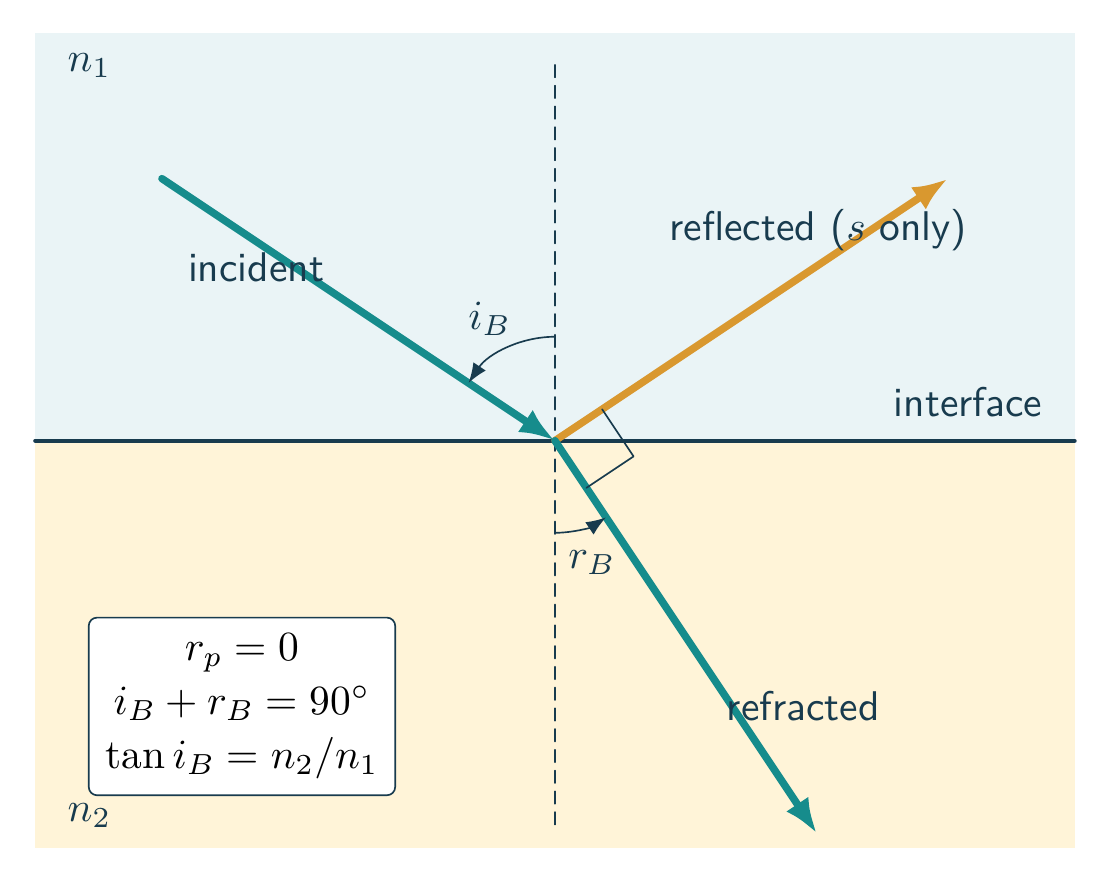
\[\boxed{r_p= \frac{n_2\cos i-n_1\cos r} {n_2\cos i+n_1\cos r}}.\]At the polarizing, or Brewster, angle $i_B$, the reflected $p$ amplitude vanishes. Therefore
\[n_2\cos i_B=n_1\cos r_B. \tag{1}\]Snell’s law gives
\[n_1\sin i_B=n_2\sin r_B. \tag{2}\]Equations (1) and (2) give two expressions for the same index ratio:
\[\frac{n_2}{n_1} =\frac{\cos r_B}{\cos i_B} =\frac{\sin i_B}{\sin r_B} \quad\Longrightarrow\quad \sin i_B\cos i_B=\sin r_B\cos r_B.\]For distinct media and angles between $0$ and $\pi/2$, this requires
\[i_B+r_B=\frac{\pi}{2}.\]Using this in Snell’s law,
\[n_1\sin i_B=n_2\cos i_B,\]and hence Brewster’s law is
\[\boxed{\tan i_B=\frac{n_2}{n_1}}.\]Thus the reflected and refracted rays are perpendicular at $i_B$. The reflected beam contains no $p$ component, so reflection of unpolarized light at this angle produces completely $s$-polarized reflected light.
Double refraction in a uniaxial crystal
In an isotropic dielectric, $\mathbf D=\epsilon\mathbf E$ and every transverse direction has the same refractive index. In a uniaxial crystal with optic axis $z$,
\[\mathbf D= \begin{pmatrix} \epsilon_\perp&0&0\\ 0&\epsilon_\perp&0\\ 0&0&\epsilon_\parallel \end{pmatrix}\mathbf E, \qquad n_o^2=\frac{\epsilon_\perp}{\epsilon_0}, \qquad n_e^2=\frac{\epsilon_\parallel}{\epsilon_0}.\]Consider a plane wave with wave normal
\[\hat{\mathbf k}=(\sin\theta,0,\cos\theta),\]where $\theta$ is measured from the optic axis. Substituting a field proportional to $e^{i(\mathbf k\cdot\mathbf r-\omega t)}$ into Maxwell’s equations gives
\[n^2\!\left[\hat{\mathbf k}(\hat{\mathbf k}\cdot\mathbf E)-\mathbf E\right] +\boldsymbol\epsilon_r\mathbf E=0, \qquad n=\frac{ck}{\omega}.\]For $\mathbf E=E_y\hat{\mathbf y}$ this immediately gives $n=n_o$. This is the ordinary wave: its refractive index is independent of direction and its electric field is perpendicular to the principal section formed by $\hat{\mathbf k}$ and the optic axis.
For the extraordinary wave, $\mathbf E=(E_x,0,E_z)$ lies in the principal section. Its two component equations are
\[(n_o^2-n^2\cos^2\theta)E_x +n^2\sin\theta\cos\theta\,E_z=0,\] \[n^2\sin\theta\cos\theta\,E_x +(n_e^2-n^2\sin^2\theta)E_z=0.\]A non-zero field requires the determinant to vanish:
\[(n_o^2-n^2\cos^2\theta) (n_e^2-n^2\sin^2\theta) -n^4\sin^2\theta\cos^2\theta=0.\]Expanding and cancelling the two $n^4\sin^2\theta\cos^2\theta$ terms,
\[n_o^2n_e^2 -n^2(n_o^2\sin^2\theta+n_e^2\cos^2\theta)=0.\]Therefore the extraordinary phase index is
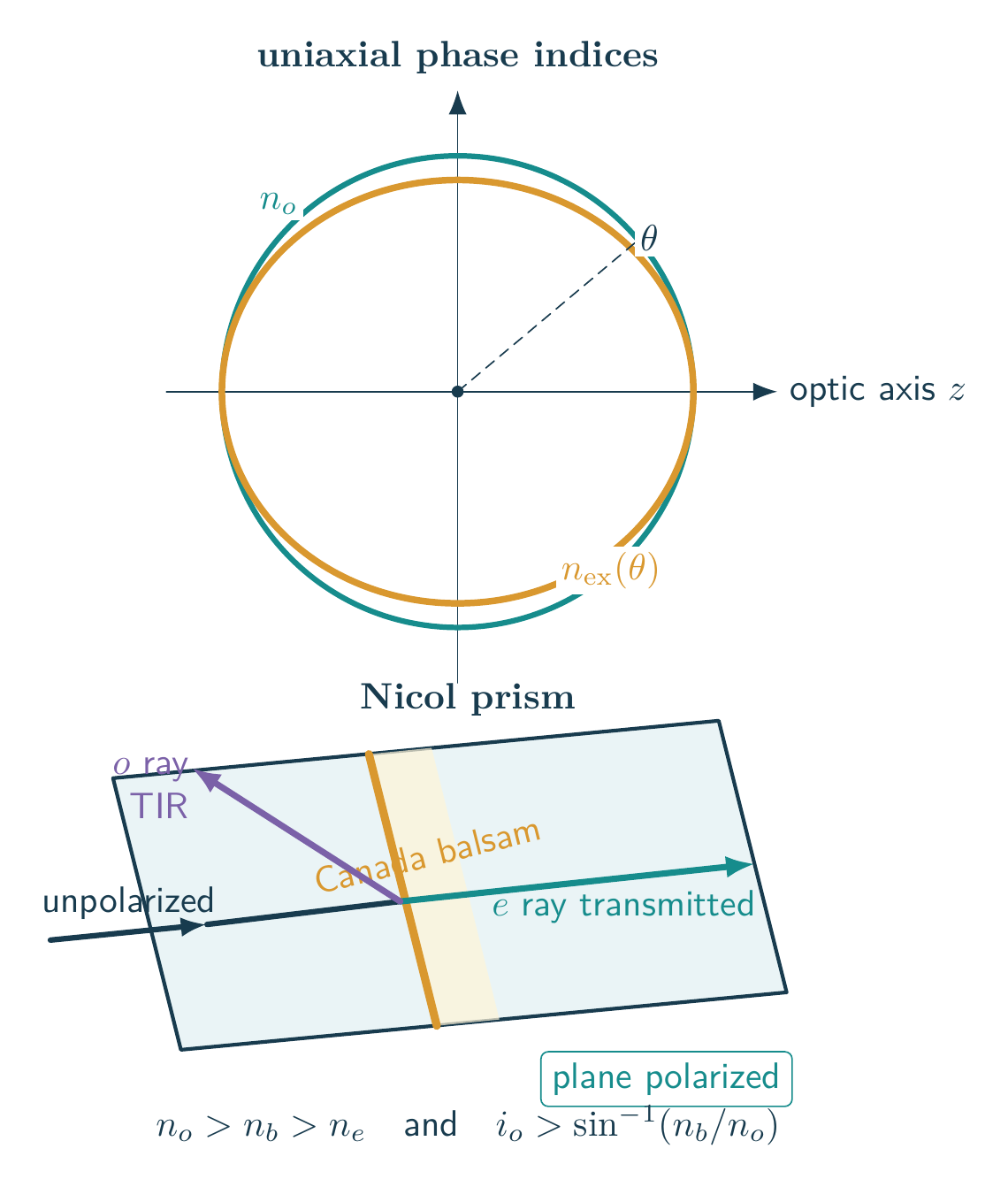
\[\boxed{ \frac{1}{n_{\rm ex}^2(\theta)} =\frac{\cos^2\theta}{n_o^2} +\frac{\sin^2\theta}{n_e^2}}.\]When $\theta=0$, $n_{\rm ex}=n_o$, so a ray along the optic axis is not split. When $\theta=\pi/2$, $n_{\rm ex}=n_e$. A crystal is positive if $n_e>n_o$ and negative if $n_e<n_o$. Calcite is negative. For the extraordinary wave, $\mathbf D\perp\mathbf k$ but $\mathbf E$ need not be perpendicular to $\mathbf k$; consequently its energy-flow direction can differ from its wave normal. The ordinary and extraordinary beams therefore emerge in different directions and with mutually perpendicular linear polarizations.
Nicol prism
A Nicol prism is made from calcite cut obliquely and cemented with Canada balsam. At visible wavelengths the approximate indices are
\[n_o\simeq1.658, \qquad n_e\simeq1.486, \qquad n_b\simeq1.55.\]At the calcite-balsam interface, the ordinary ray travels from $n_o$ to the smaller $n_b$. Its critical angle is
\[\boxed{\theta_c=\sin^{-1}\!\left(\frac{n_b}{n_o}\right) \simeq69.2^\circ}.\]The prism is cut so that the ordinary ray meets the cement layer at an angle greater than $\theta_c$ and is totally internally reflected into a blackened side. The extraordinary ray has the smaller effective index and crosses the balsam layer instead of undergoing total internal reflection. The emerging beam therefore contains only the extraordinary vibration and is plane polarized. Reversing the role of the prism makes it an analyzer.
Solved Problems
1. Brewster angle for an air-glass boundary
Unpolarized light is incident from air on glass of refractive index $1.50$. Find the Brewster angle and the corresponding refracted angle.
Step 1: Apply Brewster’s law.
\[\tan i_B=\frac{n_2}{n_1}=1.50.\]Therefore
\[i_B=\tan^{-1}(1.50)\simeq56.31^\circ.\]Step 2: Use ray orthogonality at the Brewster condition.
\[r_B=90^\circ-i_B\simeq33.69^\circ.\]Step 3: Check Snell’s law. Because $r_B=90^\circ-i_B$,
\[n_2\sin r_B=n_2\cos i_B =n_1\sin i_B,\]where the last equality follows from $\tan i_B=n_2/n_1$. The reflected and refracted rays are therefore exactly perpendicular.
2. Extraordinary index at $45^\circ$ to the optic axis
For calcite, take $n_o=1.658$ and $n_e=1.486$. Find the extraordinary phase index for a wave normal at $\theta=45^\circ$ to the optic axis.
Step 1: Substitute into the directional-index relation.
\[\frac1{n_{\rm ex}^2} =\frac{\cos^245^\circ}{n_o^2} +\frac{\sin^245^\circ}{n_e^2} =\frac12\left(\frac1{n_o^2}+\frac1{n_e^2}\right).\]Step 2: Invert the relation.
\[n_{\rm ex} =\sqrt{\frac{2n_o^2n_e^2}{n_o^2+n_e^2}} \simeq1.565.\]This lies between $n_e$ and $n_o$, as required for an intermediate propagation direction.
Descriptive Questions
- How do the Fresnel boundary conditions lead to Brewster’s law for the $p$ component?
- Why is the ordinary refractive index independent of direction in a uniaxial crystal while the extraordinary index is not?
- Why is there no double refraction for propagation along the optic axis?
- How does a Nicol prism remove the ordinary ray and transmit a plane-polarized extraordinary ray?
Numerical Problems
-
Light is incident at $45^\circ$ from air on a dielectric of index $\sqrt2$, for which Snell’s law gives $r=30^\circ$. Use the displayed $p$-polarized Fresnel coefficient to find the reflected field-amplitude ratio and intensity fraction.
Answer: $r_p=7-4\sqrt3\simeq0.0718$ and $\mathcal R_p=r_p^2\simeq5.15\times10^{-3}$.
-
A ray travels from a crystal of index $1.66$ toward a cement layer of index $1.55$. Find the critical angle at their boundary.
Answer: $\theta_c=\sin^{-1}(1.55/1.66)\simeq69.02^\circ$.
-
A uniaxial crystal has principal indices $n_o=1.60$ and $n_e=1.50$. Find $\epsilon_\perp/\epsilon_0$ and $\epsilon_\parallel/\epsilon_0$, and classify the crystal as positive or negative.
Answer: $\epsilon_\perp/\epsilon_0=2.56$, $\epsilon_\parallel/\epsilon_0=2.25$; the crystal is negative because $n_e<n_o$.
-
For principal indices $n_o=1.66$ and $n_e=1.49$, find the corresponding principal phase speeds using $c=3.00\times10^8\,\mathrm{m\,s^{-1}}$.
Answer: $v_o\simeq1.81\times10^8\,\mathrm{m\,s^{-1}}$ and $v_e\simeq2.01\times10^8\,\mathrm{m\,s^{-1}}$.
The solved results and all numerical answers are verified by exact residuals in the Unit III polarization Maxima worksheet.
References
- Brewster’s angle - Wikipedia
- F. A. Jenkins and H. E. White, Fundamentals of Optics, McGraw-Hill, sections on polarization by reflection and double refraction.
- Max Born and Emil Wolf, Principles of Optics, Cambridge University Press, sections on Fresnel coefficients and crystal optics.
- Ajoy Ghatak, Optics, McGraw Hill Education, chapters on polarization and Nicol prisms.


Discussion