

30 Jul 2025
Retardation Plates, the Babinet Compensator, and Polarization States
Quarter- and half-wave plates, continuously variable retardation, and linear, circular, and elliptical polarization states.
At a fixed point in a monochromatic beam travelling along $z$, resolve the electric field along two perpendicular transverse axes:
\[E_x=a\cos\psi, \qquad E_y=b\cos(\psi-\delta), \qquad \psi=\omega t-kz.\]The phase difference $\delta$ determines the path traced by the tip of $\mathbf E$.
Derivation of the polarization ellipse
Define
\[X=\frac{E_x}{a}=\cos\psi, \qquad Y=\frac{E_y}{b}=\cos\psi\cos\delta+\sin\psi\sin\delta.\]Then
\[Y-X\cos\delta=\sin\psi\sin\delta.\]Squaring this equation and using $\sin^2\psi=1-X^2$,
\[(Y-X\cos\delta)^2=(1-X^2)\sin^2\delta.\]Expanding and collecting terms gives
\[X^2+Y^2-2XY\cos\delta=\sin^2\delta,\]or
\[\boxed{ \frac{E_x^2}{a^2}+\frac{E_y^2}{b^2} -\frac{2E_xE_y}{ab}\cos\delta =\sin^2\delta}.\]This equation classifies the polarization:
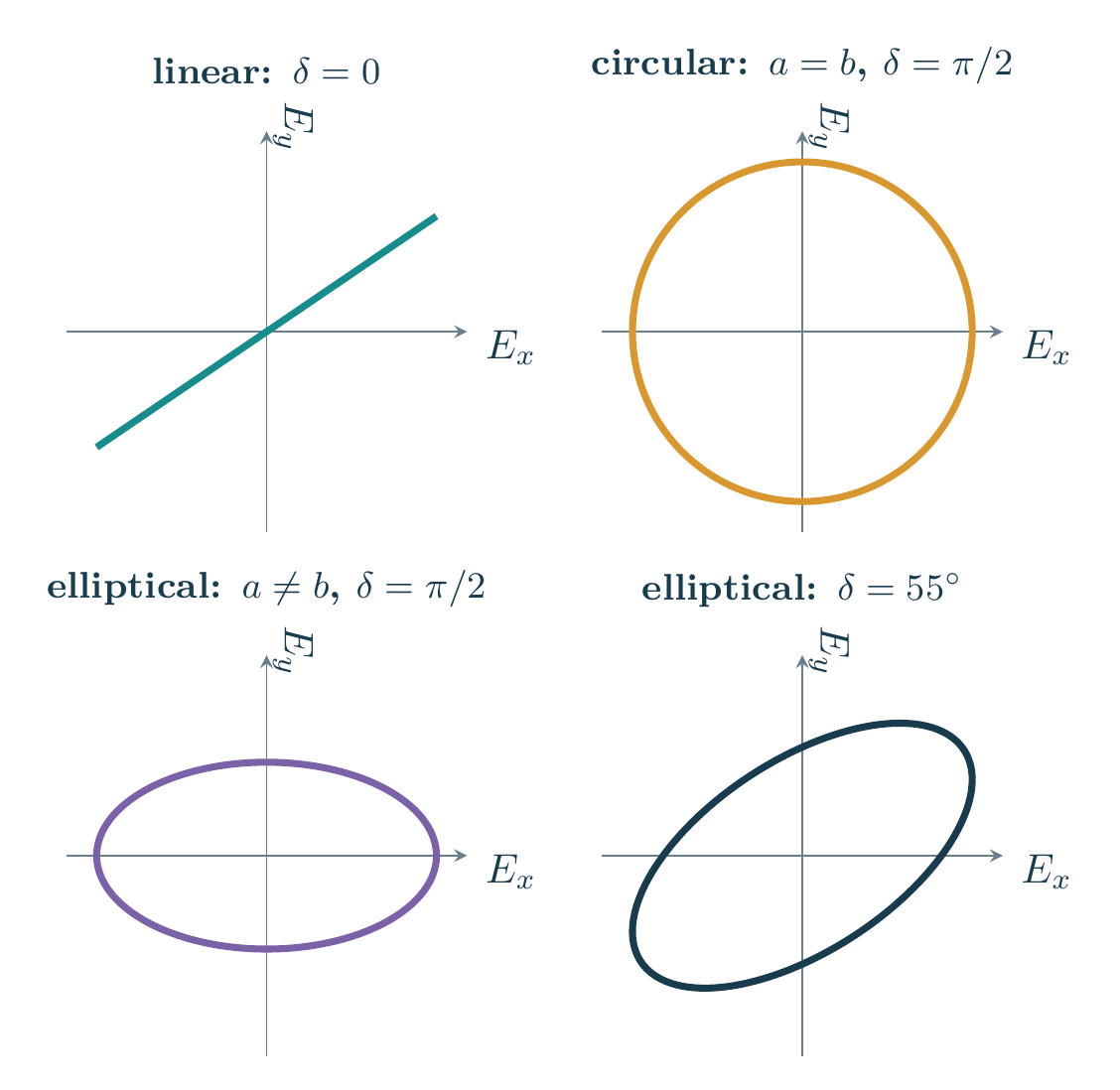
- Linear polarization: If $\delta=m\pi$, then $E_y/b=(-1)^mE_x/a$, so the tip moves on a straight line. A field along either coordinate axis is also linear.
- Circular polarization: If $a=b$ and $\delta=(2m+1)\pi/2$, then $E_x^2+E_y^2=a^2$. The field magnitude is constant while its direction rotates.
- Elliptical polarization: In the general case the tip traces an ellipse. The sign of $\delta$ fixes the sense of rotation; a handedness label is meaningful only after specifying whether the observer looks with or against the direction of propagation.
Linear and circular polarization are therefore limiting cases of elliptical polarization.
Retardation by a birefringent plate
Let the plate’s fast and slow axes have refractive indices $n_f$ and $n_s$, with $n_s>n_f$. A vacuum wavelength $\lambda$ accumulates phases
\[\phi_f=\frac{2\pi n_fd}{\lambda}, \qquad \phi_s=\frac{2\pi n_sd}{\lambda}\]while crossing thickness $d$. The slow component therefore lags the fast component by
\[\boxed{\delta=\phi_s-\phi_f =\frac{2\pi}{\lambda}(n_s-n_f)d}.\]The plate changes relative phase, not the component amplitudes, when absorption and reflection losses are neglected.
Quarter-wave plate
A quarter-wave plate produces an odd multiple of $\pi/2$ retardation:
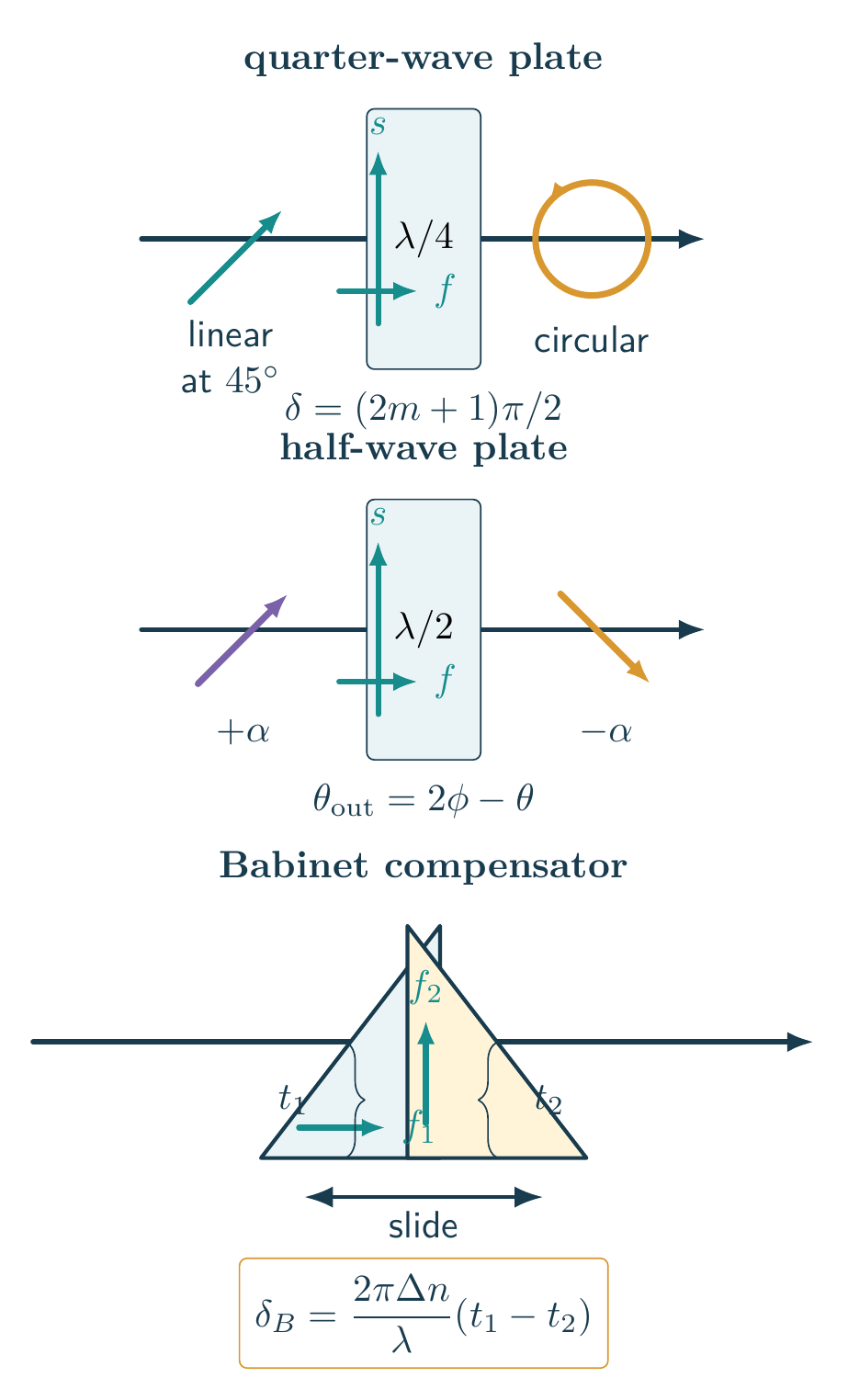
\[\delta=\frac{(2m+1)\pi}{2}, \qquad \boxed{d=\frac{(2m+1)\lambda}{4(n_s-n_f)}}.\]If incident linear polarization makes $45^\circ$ with the plate axes, its components are equal. The plate makes them differ in phase by $\pi/2$, so the output is circular. At any other non-zero angle to both axes, the component amplitudes are unequal and the output is elliptical. Conversely, a suitable quarter-wave plate converts circular or elliptical light into linear light.
Half-wave plate
A half-wave plate produces an odd multiple of $\pi$ retardation:
\[\delta=(2m+1)\pi, \qquad \boxed{d=\frac{(2m+1)\lambda}{2(n_s-n_f)}}.\]Let the incident linear field make angle $\alpha$ with the fast axis. Before the plate its components are proportional to
\[\begin{pmatrix}\cos\alpha\\ \sin\alpha\end{pmatrix}.\]The half-wave retardation changes the relative sign, giving
\[\begin{pmatrix}\cos\alpha\\ -\sin\alpha\end{pmatrix}.\]Thus the output makes angle $-\alpha$ with the fast axis. If the fast axis is at angle $\phi$ and the incident azimuth is $\theta$, then $\alpha=\theta-\phi$ and
\[\boxed{\theta_{\rm out}=2\phi-\theta}.\]The half-wave plate therefore rotates the plane of polarization through twice the angle between the incident vibration and the plate axis, with the sign set by their relative orientation.
Babinet compensator
A Babinet compensator uses two birefringent wedges with mutually perpendicular fast axes. Let the local thicknesses traversed in the two wedges be $t_1$ and $t_2$. Because their axes are interchanged, their retardations have opposite signs. The net retardation is
\[\boxed{\delta_B=\frac{2\pi(n_s-n_f)}{\lambda}(t_1-t_2)}.\]Sliding one wedge changes $t_1-t_2$ continuously. At the position where $t_1=t_2$, the two retardations cancel. The compensator can therefore supply a continuously adjustable retardation of either sign, unlike a fixed quarter- or half-wave plate. An unknown retardation is measured by adjusting the compensator until an analyzer shows the chosen compensation condition; the calibrated wedge displacement then gives $t_1-t_2$.
Solved Problems
1. Minimum thickness of a quarter-wave plate
A birefringent material has $n_s-n_f=0.00900$ at wavelength $600\,\mathrm{nm}$. Find the least thickness that acts as a quarter-wave plate.
Step 1: Set the least quarter-wave retardation. For $m=0$,
\[\frac{2\pi}{\lambda}(n_s-n_f)d=\frac{\pi}{2}.\]Step 2: Solve for the thickness.
\[\begin{aligned} d&=\frac{\lambda}{4(n_s-n_f)}\\ &=\frac{600\times10^{-9}}{4(0.00900)}\,\mathrm{m}\\ &=1.667\times10^{-5}\,\mathrm{m} =16.67\,\mu\mathrm{m}. \end{aligned}\]Substitution gives $2\pi(0.00900)(16.67\,\mu\mathrm{m})/(600\,\mathrm{nm})=\pi/2$ to the stated precision.
2. Rotation by a half-wave plate
The incident plane-polarization azimuth is $\theta=20^\circ$, and the fast axis of a half-wave plate is at $\phi=35^\circ$ in the same reference frame. Find the output azimuth and the rotation of the plane.
Step 1: Use the half-wave mapping.
\[\theta_{\rm out}=2\phi-\theta.\]Step 2: Substitute the angles.
\[\theta_{\rm out}=2(35^\circ)-20^\circ=50^\circ.\]The polarization-plane rotation is therefore
\[\theta_{\rm out}-\theta=50^\circ-20^\circ=30^\circ.\]The incident and output directions make equal and opposite angles, $-15^\circ$ and $+15^\circ$, with the plate axis, which checks the reflection-like azimuth rule.
Descriptive Questions
- How is the polarization ellipse obtained by eliminating the common phase from two perpendicular field components?
- Under what input conditions does a quarter-wave plate produce circular rather than elliptical polarization?
- Why does a half-wave plate rotate a plane-polarized vibration through twice its angle with the plate axis?
- How does a Babinet compensator provide a continuously adjustable retardation of either sign?
Numerical Problems
-
A plate has thickness $75.0\,\mu\mathrm{m}$ and $n_s-n_f=0.0100$ at $\lambda=500\,\mathrm{nm}$. Find its retardation and identify its equivalent first-order action.
Answer: $\delta=3\pi\,\mathrm{rad}$, equivalent modulo $2\pi$ to a half-wave plate.
-
Right-circularly polarized light has normalized Jones vector $\mathbf J_{\mathrm{in}}=2^{-1/2}(1,i)^{\mathsf T}$. It enters a quarter-wave plate whose fast axis is $x$ and slow axis is $y$; take the slow-component phase factor as $e^{-i\pi/2}=-i$. Find the output Jones vector and identify the polarization.
Answer: $\mathbf J_{\mathrm{out}}=2^{-1/2}(1,1)^{\mathsf T}$; the output is linearly polarized at $+45^\circ$ to the fast axis.
-
A Babinet compensator has $n_s-n_f=0.00900$, local thickness difference $t_1-t_2=20.0\,\mu\mathrm{m}$, and $\lambda=600\,\mathrm{nm}$. Find its net retardation.
Answer: $\delta_B=0.600\pi\,\mathrm{rad}=108^\circ$.
-
A field has components $E_x=3\cos\psi$ and $E_y=4\sin\psi$ in common amplitude units. Identify the polarization and give the maximum-to-minimum transmitted-intensity ratio for an analyzer aligned successively with the principal axes.
Answer: Elliptical polarization with semiaxes $3$ and $4$; $I_{\max}/I_{\min}=16/9$.
The solved results and all numerical answers are verified by exact residuals in the Unit III polarization Maxima worksheet.
References
- Waveplate - Wikipedia
- F. A. Jenkins and H. E. White, Fundamentals of Optics, McGraw-Hill, sections on retardation plates and compensators.
- Max Born and Emil Wolf, Principles of Optics, Cambridge University Press, sections on polarization states and birefringent plates.
- Ajoy Ghatak, Optics, McGraw Hill Education, chapters on wave plates and polarization analysis.


Discussion