

31 Jul 2025
Production and Detection of Polarized Light and Optical Activity
Polarizer-analyzer tests for linear, circular, and elliptical light, Malus's law, and optical rotation from circular birefringence.
An ideal polarizer transmits the electric-field component along its transmission axis. The same element used to test an unknown state is called an analyzer.
Malus’s law and the test for plane polarization
Let plane-polarized light of amplitude $E_0$ meet an analyzer whose axis $\hat{\mathbf a}$ makes angle $\theta$ with the incident vibration direction $\hat{\mathbf p}$. Projection on the analyzer axis gives
\[\mathbf E_{\mathrm{out}} =(E_0\hat{\mathbf p}\cdot\hat{\mathbf a})\hat{\mathbf a} =E_0\cos\theta\,\hat{\mathbf a}.\]Since time-averaged intensity is proportional to the squared amplitude,
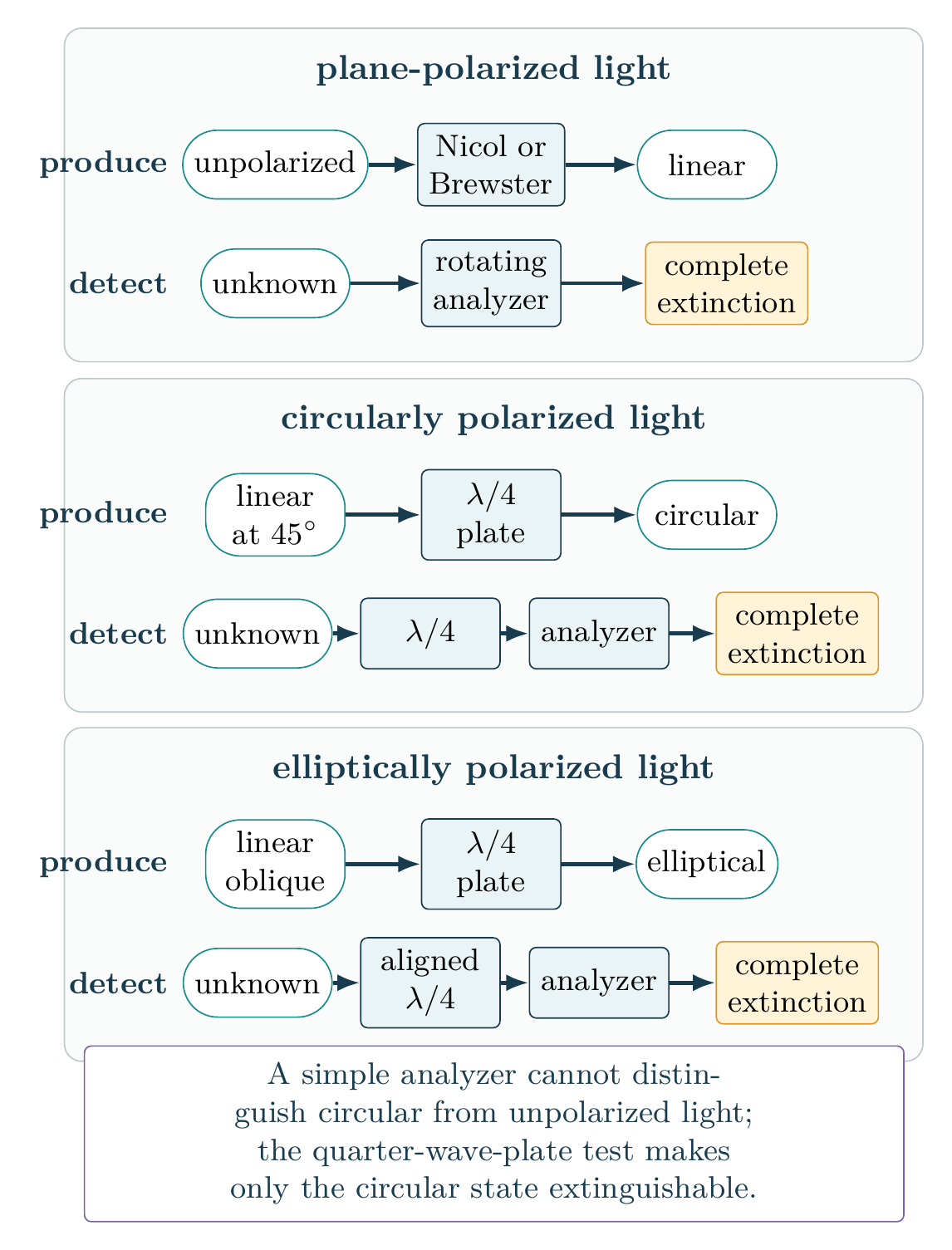
\[\boxed{I=I_P\cos^2\theta}.\]This is Malus’s law. A rotating analyzer gives two maxima and two complete extinctions in one revolution, identifying plane-polarized light. Plane polarization can be produced by a Nicol prism or by reflection at the Brewster angle.
An unpolarized beam has all transverse azimuths with equal probability. Averaging Malus’s factor gives
\[\left\langle\cos^2\theta\right\rangle =\frac{1}{2\pi}\int_0^{2\pi}\cos^2\theta\,\mathrm d\theta =\frac12,\]so an ideal polarizer transmits half its intensity.
Circular polarization
To produce circular polarization:
- use a polarizer to obtain a linear field;
- set its vibration at $45^\circ$ to the fast and slow axes of a quarter-wave plate;
- let the plate introduce a relative phase $\pm\pi/2$ between the equal components.
The resulting field can be written
\[E_x=E_0\cos\psi, \qquad E_y=\pm E_0\sin\psi.\]For an analyzer at azimuth $\beta$,
\[E_a=E_0(\cos\psi\cos\beta \pm\sin\psi\sin\beta).\]Time averaging gives
\[\left\langle E_a^2\right\rangle =\frac{E_0^2}{2}(\cos^2\beta+\sin^2\beta) =\frac{E_0^2}{2},\]independent of $\beta$. A rotating analyzer alone therefore cannot distinguish circular light from unpolarized light. Insert a quarter-wave plate first: it adds or removes a quarter-wave retardation, turning circular light into linear light. The following analyzer then gives complete extinction.
Elliptical polarization
Linearly polarized light incident on a quarter-wave plate at an angle other than $0^\circ$, $45^\circ$, or $90^\circ$ has two unequal non-zero components in quadrature and becomes elliptically polarized. In axes along the ellipse,
\[E_x=a\cos\psi, \qquad E_y=b\sin\psi, \qquad a\ne b.\]A rotating analyzer transmits average intensity proportional to
\[\left\langle(E_x\cos\beta+E_y\sin\beta)^2\right\rangle =\frac12\left(a^2\cos^2\beta+b^2\sin^2\beta\right).\]It varies between values proportional to $a^2$ and $b^2$ but never vanishes when both axes are non-zero. To confirm elliptical polarization, align a quarter-wave plate with the ellipse axes. It cancels their $\pi/2$ phase difference, producing linear light; a following analyzer then gives extinction.
Optical activity
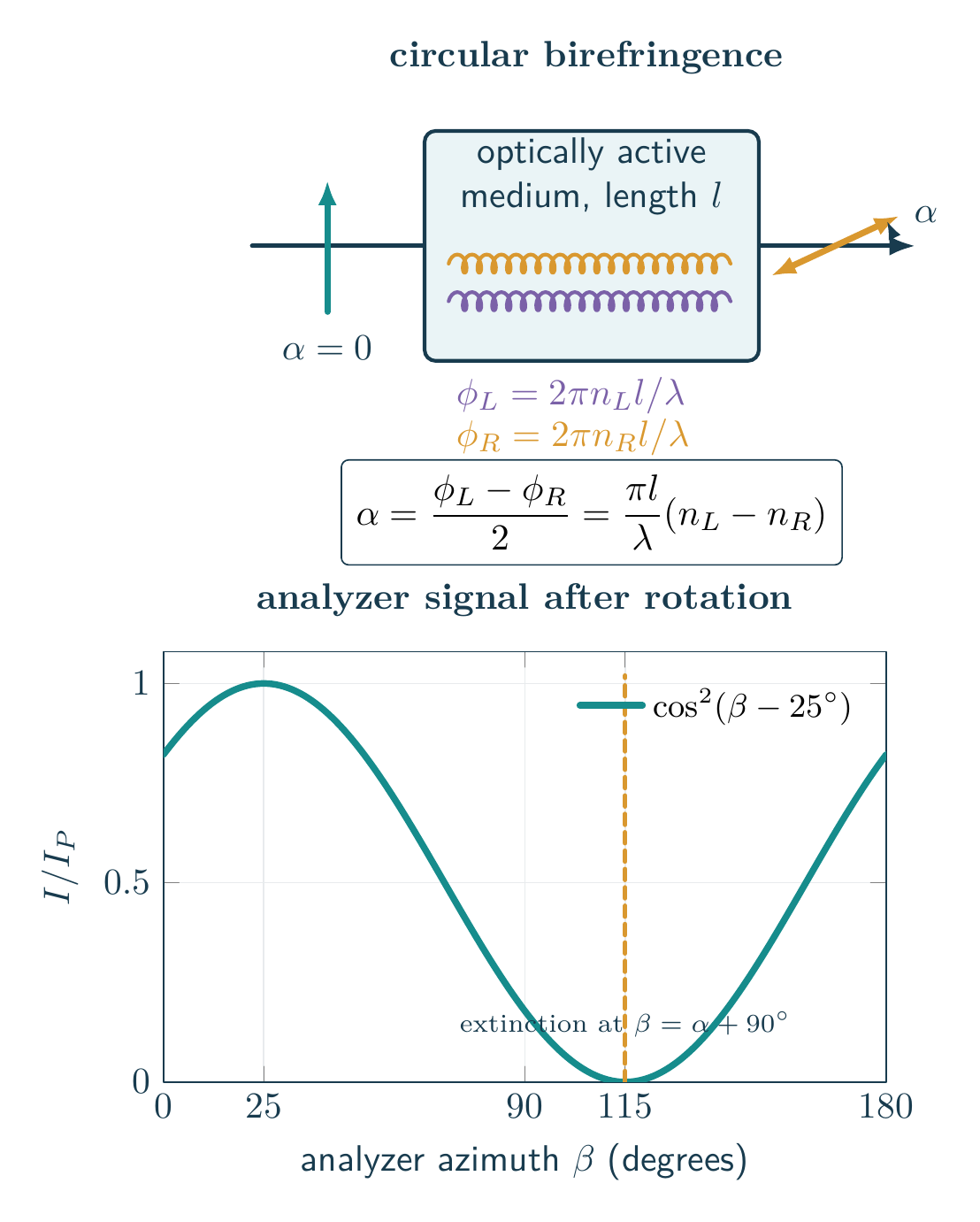
An optically active medium rotates the azimuth of plane-polarized light without changing it into an ellipse in the ideal lossless case. The mechanism is circular birefringence: left- and right-circular components propagate with different refractive indices $n_L$ and $n_R$.
Choose circular unit vectors
\[\hat{\mathbf e}_L=\frac{\hat{\mathbf x}-i\hat{\mathbf y}}{\sqrt2}, \qquad \hat{\mathbf e}_R=\frac{\hat{\mathbf x}+i\hat{\mathbf y}}{\sqrt2}.\]A field initially along $x$ is their equal superposition:
\[\hat{\mathbf x}=\frac{\hat{\mathbf e}_L+\hat{\mathbf e}_R}{\sqrt2}.\]After travelling distance $l$ through the medium, the two phase advances are
\[\phi_L=\frac{2\pi n_Ll}{\lambda}, \qquad \phi_R=\frac{2\pi n_Rl}{\lambda}.\]With $\bar\phi=(\phi_L+\phi_R)/2$ and $\Delta\phi=\phi_L-\phi_R$, the output field is
\[\begin{aligned} \mathbf E_{\mathrm{out}} &\propto \frac{e^{i\phi_L}\hat{\mathbf e}_L +e^{i\phi_R}\hat{\mathbf e}_R}{\sqrt2}\\ &=e^{i\bar\phi} \left[ \hat{\mathbf x}\cos\left(\frac{\Delta\phi}{2}\right) +\hat{\mathbf y}\sin\left(\frac{\Delta\phi}{2}\right) \right]. \end{aligned}\]The common phase $e^{i\bar\phi}$ does not affect the vibration direction. The plane has rotated through
\[\boxed{\alpha=\frac{\Delta\phi}{2} =\frac{\pi l}{\lambda}(n_L-n_R)},\]with the sign fixed by the circular-basis and viewing convention. A rotating analyzer measures this rotation because its extinction position shifts by $\alpha$.
For a solution of concentration $c$, the specific rotation at stated temperature $T$ and wavelength $\lambda$ is defined by
\[\boxed{[\alpha]^T_\lambda=\frac{\alpha}{lc}}.\]When $l$ is measured in decimetres and $c$ in $\mathrm{g\,mL^{-1}}$, its conventional unit is $\mathrm{degree\,dm^{-1}(g\,mL^{-1})^{-1}}$. Positive and negative rotations are called dextrorotatory and levorotatory, respectively, after the observation convention has been fixed.
Solved Problems
1. Successive polarizer and analyzer
Unpolarized light of intensity $12.0\,\mathrm{W\,m^{-2}}$ passes through an ideal polarizer and then an analyzer whose axis is $30^\circ$ from the polarizer axis. Find the final intensity.
Step 1: Average over the unpolarized input. An ideal polarizer transmits half:
\[I_P=\frac{I_0}{2}=6.00\,\mathrm{W\,m^{-2}}.\]Step 2: Apply Malus’s law to the analyzer.
\[\begin{aligned} I&=I_P\cos^230^\circ\\ &=6.00\left(\frac{\sqrt3}{2}\right)^2\\ &=4.50\,\mathrm{W\,m^{-2}}. \end{aligned}\]The total transmission fraction is $(1/2)(3/4)=3/8$, and $(3/8)(12.0)=4.50$, which independently checks the result.
2. Specific rotation and a second solution
A solution rotates plane-polarized light through $+13.2^\circ$ in a tube of length $2.00\,\mathrm{dm}$ at concentration $0.200\,\mathrm{g\,mL^{-1}}$. Find its specific rotation and predict the rotation for a $3.00\,\mathrm{dm}$ tube at concentration $0.100\,\mathrm{g\,mL^{-1}}$ at the same temperature and wavelength.
Step 1: Calculate the specific rotation.
\[[\alpha]^T_\lambda =\frac{\alpha}{lc} =\frac{13.2}{(2.00)(0.200)} =33.0\,\mathrm{degree\,dm^{-1}(g\,mL^{-1})^{-1}}.\]Step 2: Apply it to the second tube.
\[\alpha^{\prime}=[\alpha]^T_\lambda l^{\prime}c^{\prime} =(33.0)(3.00)(0.100)=9.90^\circ.\]The positive sign is retained because neither the substance nor the viewing convention has changed.
Descriptive Questions
- How does a rotating analyzer distinguish plane-polarized light from circular and unpolarized light?
- How are circularly polarized light and its handedness produced and detected with a quarter-wave plate?
- Why does elliptically polarized light show unequal analyzer maxima and minima but no complete extinction?
- How does circular birefringence rotate a plane-polarized vibration without making it elliptical in an ideal medium?
Numerical Problems
-
Without an active sample, an analyzer gives extinction at $15^\circ$. After inserting the sample, the nearest recorded extinction is at $167^\circ$. Since an analyzer axis repeats after $180^\circ$, find the signed rotation of smallest magnitude.
Answer: $\alpha=(167^\circ-15^\circ)-180^\circ=-28.0^\circ$, a negative rotation under the stated convention.
-
Circularly polarized light has intensity $8.00\,\mathrm{W\,m^{-2}}$. Find the intensity after an ideal linear analyzer at any azimuth.
Answer: $I=4.00\,\mathrm{W\,m^{-2}}$, independent of analyzer azimuth.
-
Principal electric-field amplitudes of elliptically polarized light are in the ratio $3:1$. Find the ratio of maximum to minimum analyzer intensities and state whether complete extinction occurs.
Answer: $I_{\max}/I_{\min}=9$; no complete extinction occurs.
-
An optically active medium has $n_L-n_R=2.00\times10^{-6}$ at $\lambda=500\,\mathrm{nm}$. Find the rotation after $l=0.100\,\mathrm{m}$.
Answer: $\alpha=0.400\pi\,\mathrm{rad}=72.0^\circ$.
The solved results and all numerical answers are verified by exact residuals in the Unit III polarization Maxima worksheet.
References
- Optical rotation - Wikipedia
- F. A. Jenkins and H. E. White, Fundamentals of Optics, McGraw-Hill, sections on polarization analysis and optical activity.
- Max Born and Emil Wolf, Principles of Optics, Cambridge University Press, sections on polarization and circular birefringence.
- Ajoy Ghatak, Optics, McGraw Hill Education, chapters on production and detection of polarized light.


Discussion