

29 May 2025
Progressive Waves and Superposition
Plane and spherical waves, longitudinal and transverse motion, the wave equation, particle and wave velocities, beats, and Lissajous figures.
A wave is a disturbance that transports energy without a net transport of the medium. In a transverse wave the displacement is perpendicular to the direction of propagation; in a longitudinal wave it is parallel.
Wave equation and travelling waves
For a stretched string of tension $T$ and linear mass density $\mu$, take an element $dx$ whose slope is small. The transverse resultant of the tensions is
\[T\left[\frac{\partial y}{\partial x}(x+dx,t) -\frac{\partial y}{\partial x}(x,t)\right] =T\frac{\partial^2y}{\partial x^2}\,dx.\]Newton’s second law therefore gives
\[\mu\,dx\frac{\partial^2y}{\partial t^2} =T\frac{\partial^2y}{\partial x^2}\,dx,\]or
\[\boxed{\frac{\partial^2y}{\partial x^2} =\frac1{v^2}\frac{\partial^2y}{\partial t^2}}, \qquad \boxed{v=\sqrt{\frac{T}{\mu}}}.\]The dimensions are $[T/\mu]={\rm m^2\,s^{-2}}$, so $v$ has units ${\rm m\,s^{-1}}$. For a right-moving profile $y=f(x-vt)$, put $\xi=x-vt$. Then
\[y_{xx}=f^{\prime\prime}(\xi), \qquad y_{tt}=v^2f^{\prime\prime}(\xi),\]so the profile satisfies the wave equation. Similarly, $g(x+vt)$ travels in the $-x$ direction. The general one-dimensional solution is
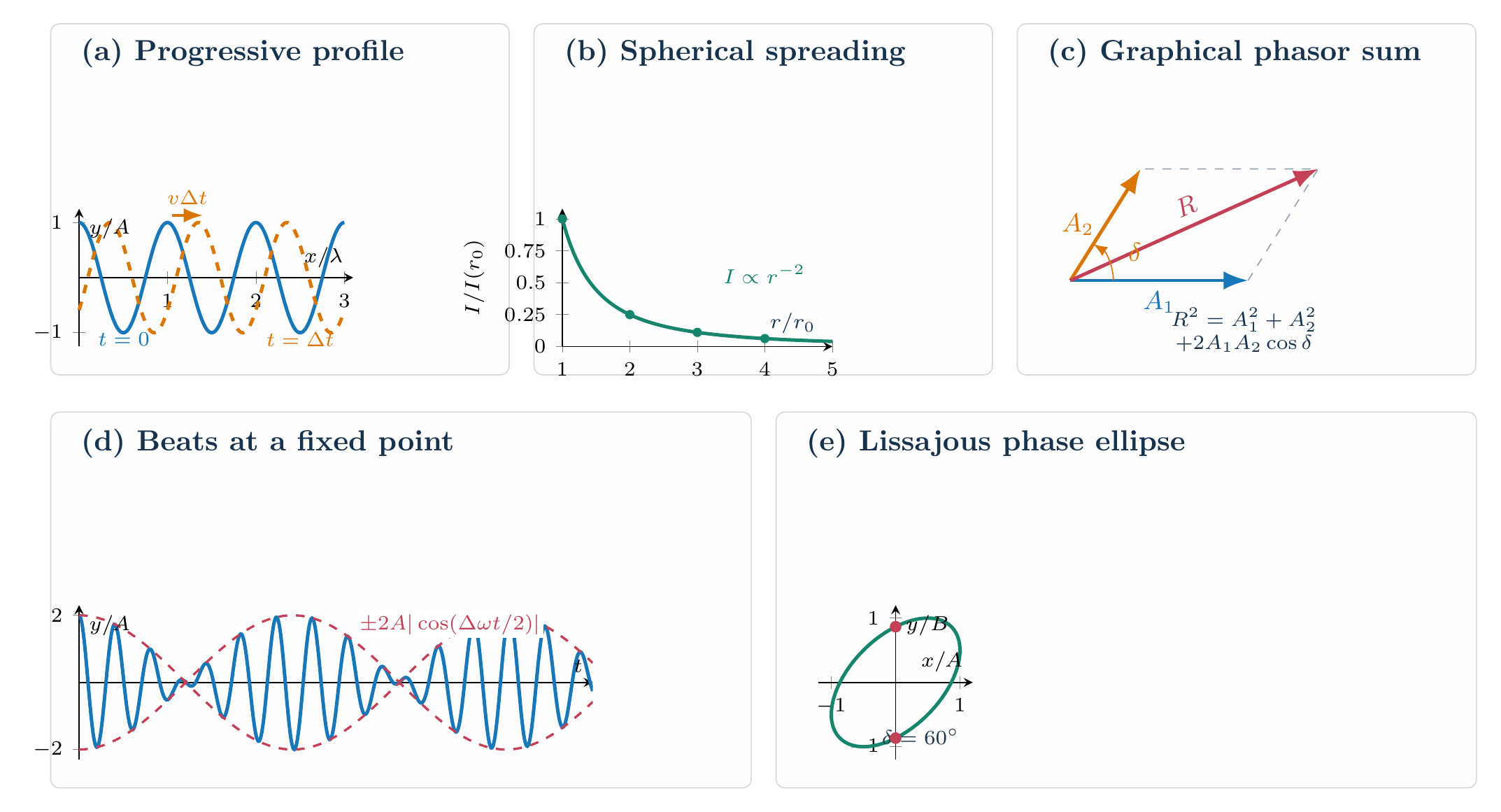
\[\boxed{y(x,t)=f(x-vt)+g(x+vt)}.\]For a harmonic progressive wave,
\[y=A\cos(kx-\omega t+\phi), \qquad k=\frac{2\pi}{\lambda}, \qquad \omega=2\pi f,\]a point of constant phase obeys $kx-\omega t={\rm constant}$; hence
\[\boxed{v=\frac{dx}{dt}=\frac{\omega}{k}=f\lambda}.\]This wave velocity is distinct from the transverse velocity of a string particle:
\[\boxed{u_y(x,t)=\frac{\partial y}{\partial t} =\omega A\sin(kx-\omega t+\phi)}.\]The particle velocity oscillates and can be positive, negative, or zero while the profile continues to move in $+x$.
In three dimensions the scalar wave equation is $\nabla^2\psi=v^{-2}\psi_{tt}$. A plane harmonic wave is
\[\psi(\mathbf r,t)=A\cos(\mathbf k\cdot\mathbf r-\omega t+\phi),\]whose constant-phase surfaces are planes normal to $\mathbf k$. For spherical symmetry, setting $U=r\psi$ reduces the radial equation (for $r>0$) to $U_{rr}=v^{-2}U_{tt}$. Thus an outgoing spherical wave is
\[\boxed{\psi(r,t)=\frac{1}{r}F(r-vt)}\]and, for a harmonic source, $\psi=(A/r)\cos(kr-\omega t+\phi)$. Since intensity is proportional to amplitude squared,
\[I(r)\propto\frac1{r^2},\]so $4\pi r^2I(r)$ is constant when there is no absorption.
Linearity and equal-frequency superposition
If $L[y]=y_{xx}-v^{-2}y_{tt}$, then
\[L[ay_1+by_2]=aL[y_1]+bL[y_2].\]Therefore any linear combination of solutions is also a solution. For two collinear oscillations of the same angular frequency,
\[y_1=A_1\cos\omega t, \qquad y_2=A_2\cos(\omega t+\delta),\]their sum is
\[y=(A_1+A_2\cos\delta)\cos\omega t -A_2\sin\delta\sin\omega t.\]Write this as $y=R\cos(\omega t+\alpha)$. Comparing the cosine and sine coefficients,
\[R\cos\alpha=A_1+A_2\cos\delta, \qquad R\sin\alpha=A_2\sin\delta.\]Squaring and adding gives
\[\boxed{R=\sqrt{A_1^2+A_2^2+2A_1A_2\cos\delta}}, \qquad \boxed{\tan\alpha= \frac{A_2\sin\delta}{A_1+A_2\cos\delta}}.\]The same result is obtained graphically by adding phasors of lengths $A_1$ and $A_2$ separated by $\delta$. In particular, $R=A_1+A_2$ for $\delta=0$, while $R=\lvert A_1-A_2\rvert$ for $\delta=\pi$.
Different frequencies and beats
Take two equal-amplitude waves:
\[y_1=A\cos(k_1x-\omega_1t), \qquad y_2=A\cos(k_2x-\omega_2t).\]Using $\cos p+\cos q=2\cos[(p-q)/2]\cos[(p+q)/2]$,
\[\boxed{y=2A\cos\left(\frac{\Delta k\,x-\Delta\omega\,t}{2}\right) \cos(\bar kx-\bar\omega t)},\]where $\Delta k=k_1-k_2$, $\Delta\omega=\omega_1-\omega_2$, $\bar k=(k_1+k_2)/2$, and $\bar\omega=(\omega_1+\omega_2)/2$. At a fixed position the rapidly oscillating factor has frequency close to $\bar f$, while the magnitude of the envelope is
\[A_{\rm env}=2A\left\lvert\cos\left(\frac{\Delta k\,x-\Delta\omega\,t}{2}\right)\right\rvert.\]Successive envelope maxima are separated by $T_b=2\pi/\lvert\Delta\omega\rvert$. Hence
\[\boxed{f_b=\frac1{T_b}=\frac{\lvert\Delta\omega\rvert}{2\pi} =\lvert f_1-f_2\rvert}.\]Because intensity is proportional to $A_{\rm env}^2$, the sound or light intensity rises and falls at this beat frequency.
Lissajous figures and their uses
Two perpendicular simple harmonic motions,
\[x=A\sin\omega_xt, \qquad y=B\sin(\omega_yt+\delta),\]trace a Lissajous figure. For equal frequencies, put $X=x/A=\sin\omega t$ and expand
\[\frac yB=\sin\omega t\cos\delta+\cos\omega t\sin\delta.\]Thus $y/B-X\cos\delta=\cos\omega t\sin\delta$. Squaring and using $\cos^2\omega t=1-X^2$ gives
\[\boxed{\frac{x^2}{A^2}+\frac{y^2}{B^2} -2\frac{x}{A}\frac{y}{B}\cos\delta=\sin^2\delta}.\]It is generally an ellipse. It becomes a straight line for $\delta=0$ or $\pi$, and a circle for $A=B$ with $\delta=\pi/2$ or $3\pi/2$. If the ellipse cuts the $y$-axis at $y_0$, then
\[\boxed{\lvert\sin\delta\rvert=\frac{\lvert y_0\rvert}{B}},\]while the slope/orientation identifies the appropriate phase quadrant.
If $\omega_x/\omega_y=p/q$ with coprime integers $p,q$, the curve closes after a common period. Counting non-degenerate vertical and horizontal tangencies gives
\[\boxed{\frac{f_x}{f_y}=\frac{N_{\rm vertical}}{N_{\rm horizontal}}}.\]On an oscilloscope in $X$-$Y$ mode, these facts allow measurement of an unknown frequency against a standard and measurement of phase difference for equal frequencies.
Solved Problems
1. Resultant of two equal-frequency oscillations
Two collinear oscillations have amplitudes $A_1=3\,\mathrm{mm}$ and $A_2=4\,\mathrm{mm}$, with the second leading the first by $90^\circ$. Find the resultant amplitude and phase lead.
Step 1: Use the phasor components. With $\delta=\pi/2$,
\[R\cos\alpha=A_1+A_2\cos\delta=3\,\mathrm{mm},\] \[R\sin\alpha=A_2\sin\delta=4\,\mathrm{mm}.\]Step 2: Determine the amplitude.
\[R=\sqrt{3^2+4^2}\,\mathrm{mm}=5\,\mathrm{mm}.\]Step 3: Determine the phase.
\[\tan\alpha=\frac{4}{3} \quad\Longrightarrow\quad \alpha=\tan^{-1}\!\left(\frac43\right)\simeq53.13^\circ.\]The component check is $5\cos\alpha=3$ and $5\sin\alpha=4$, so both the amplitude and quadrant are consistent.
2. Phase from an equal-frequency Lissajous figure
An equal-frequency Lissajous ellipse has vertical semiaxis $B=6\,\mathrm{cm}$ and crosses the positive $y$-axis at $y_0=3\,\mathrm{cm}$. Its major axis has positive slope. Find the phase difference.
Step 1: Use the intercept relation.
\[\left\lvert\sin\delta\right\rvert =\frac{\lvert y_0\rvert}{B}=\frac{3}{6}=\frac12.\]Thus the possible phases in $0\leq\delta\leq\pi$ are $30^\circ$ and $150^\circ$.
Step 2: Use the orientation. A positive-slope ellipse has $\cos\delta>0$, which selects the first quadrant:
\[\boxed{\delta=30^\circ}.\]Substitution gives $\lvert\sin30^\circ\rvert=1/2$, reproducing the measured intercept.
Descriptive Questions
- How does particle velocity differ from wave velocity in a transverse progressive wave?
- Why does the amplitude of an ideal spherical wave vary as $1/r$ while its intensity varies as $1/r^2$?
- How does linearity of the wave equation lead to the superposition principle?
- How can a Lissajous figure determine an unknown frequency and an equal-frequency phase difference?
Numerical Problems
-
A string has tension $64\,\mathrm{N}$ and linear density $1.00\times10^{-2}\,\mathrm{kg\,m^{-1}}$. A travelling wave on it has wavelength $0.400\,\mathrm{m}$. Find its speed and frequency.
Answer: $v=80.0\,\mathrm{m\,s^{-1}}$ and $f=200\,\mathrm{Hz}$.
-
The displacement amplitude of an outgoing spherical wave is $3.00\,\mathrm{mm}$ at $r=2.00\,\mathrm{m}$. Find its amplitude at $r=5.00\,\mathrm{m}$ and the corresponding intensity ratio $I(5)/I(2)$.
Answer: $A(5)=1.20\,\mathrm{mm}$ and $I(5)/I(2)=4/25=0.160$.
-
Two tuning forks of frequencies $256\,\mathrm{Hz}$ and $260\,\mathrm{Hz}$ sound together. Find the beat frequency and the time between successive intensity maxima.
Answer: $f_b=4.00\,\mathrm{Hz}$ and $T_b=0.250\,\mathrm{s}$.
-
A closed Lissajous figure has three vertical tangencies and two horizontal tangencies. If the standard signal applied along $y$ has frequency $f_y=200\,\mathrm{Hz}$, find the unknown frequency $f_x$ using the tangency-count relation stated above.
Answer: $f_x=(3/2)f_y=300\,\mathrm{Hz}$.
The solved results and all numerical answers are verified by exact residuals in the Unit I Maxima worksheet.
References
- Wave equation - Wikipedia
- F. S. Crawford Jr., Waves, Berkeley Physics Course, Vol. 3, McGraw-Hill, sections on progressive waves and superposition.
- H. J. Pain, The Physics of Vibrations and Waves, Wiley, chapters on travelling waves and beats.
- A. P. French, Vibrations and Waves, MIT Introductory Physics Series, W. W. Norton, chapters on coupled harmonic motions and Lissajous figures.


Discussion