

30 May 2025
Standing Waves, Phase and Group Velocities, and Energy Transfer
Fixed and free string boundaries, phase and group velocities, stationary-wave kinematics, and vibrating-string energy transfer.
Formation and boundary phase
Superpose equal waves travelling in opposite directions:
\[y_+=A\sin(kx-\omega t), \qquad y_-=A\sin(kx+\omega t).\]The identity $\sin p+\sin q=2\sin[(p+q)/2]\cos[(p-q)/2]$ gives
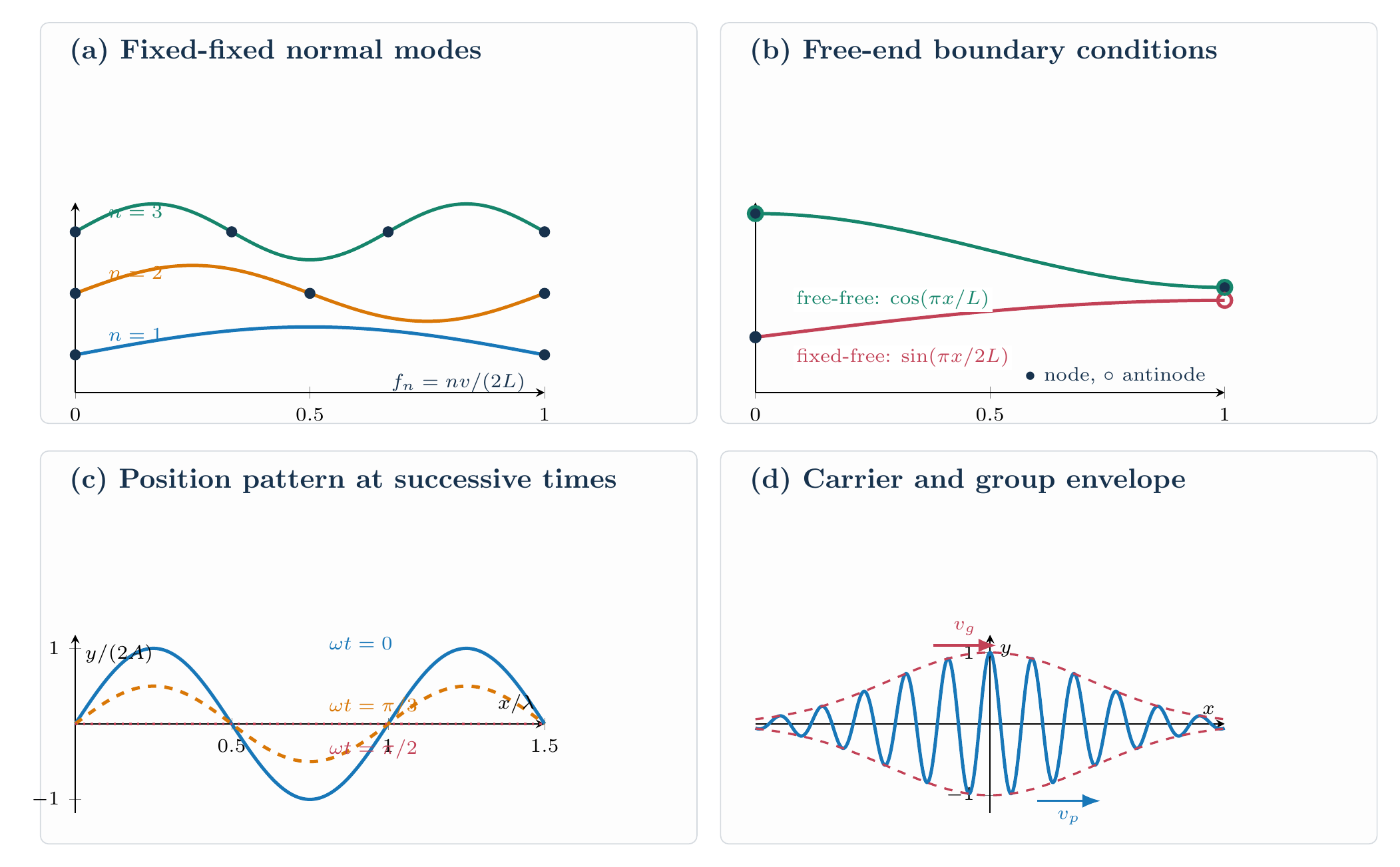
\[\boxed{y(x,t)=2A\sin kx\cos\omega t}.\]There is no factor of the form $kx\mp\omega t$, so the pattern does not travel. Reflection at an ideal fixed end reverses displacement and adds phase $\pi$, producing a node. At an ideal free end the reflected displacement has no phase reversal, producing an antinode.
At a fixed end, $y=0$. At a free end, the transverse force must vanish. For a small slope that force is $-T\,\partial y/\partial x$, so the boundary condition is
\[\boxed{y=0\quad\text{(fixed end)}}, \qquad \boxed{\frac{\partial y}{\partial x}=0\quad\text{(free end)}}.\]Fixed-fixed, free-free, and fixed-free strings
Let the string occupy $0\le x\le L$.
For two fixed ends, use $y=X(x)\cos\omega t$. The condition $X(0)=0$ selects $X=C\sin kx$, while $X(L)=0$ requires
\[\sin kL=0 \quad\Longrightarrow\quad k_n=\frac{n\pi}{L}.\]Since $\omega_n=vk_n$,
\[\boxed{y_n=C_n\sin\left(\frac{n\pi x}{L}\right)\cos(\omega_nt+\phi_n)}, \qquad \boxed{f_n=\frac{nv}{2L}}, \quad n=1,2,3,\ldots\]For two free ends, $X^{\prime}(0)=0$ selects $X=C\cos kx$, and $X^{\prime}(L)=0$ again gives $k_n=n\pi/L$. The $n=0$ solution is a rigid translation with zero frequency; the vibrational modes have $n\ge1$ and the same frequencies $nv/(2L)$.
For a fixed end at $x=0$ and a free end at $x=L$, $X=C\sin kx$ and
\[X^{\prime}(L)=Ck\cos kL=0.\]Therefore
\[k_nL=\frac{(2n-1)\pi}{2}, \qquad \boxed{f_n=\frac{(2n-1)v}{4L}}, \quad n=1,2,3,\ldots\]Only odd multiples of the fundamental occur in the fixed-free case.
Changes with position and time
For $y=2A\sin kx\cos\omega t$, fixing $t$ gives the spatial sinusoid $2A\cos\omega t\sin kx$. Its nodes and antinodes are
\[\boxed{x_{\rm node}=\frac{n\pi}{k}=\frac{n\lambda}{2}}, \qquad \boxed{x_{\rm antinode}=\frac{(2n+1)\pi}{2k} =\frac{(2n+1)\lambda}{4}}.\]Fixing $x$ instead gives simple harmonic motion of signed amplitude $2A\sin kx$:
\[u_y=\frac{\partial y}{\partial t} =-2A\omega\sin kx\sin\omega t, \qquad \frac{\partial^2y}{\partial t^2}=-\omega^2y.\]All points within one loop are in phase. Since $\sin kx$ changes sign across a node, neighboring loops differ in phase by $\pi$. When $\cos\omega t=0$, the whole string passes through equilibrium and particle speeds are greatest; at $\cos\omega t=\pm1$, displacement is extremal and all particle speeds vanish.
Energy density and transfer on a string
For linear density $\mu$, tension $T$, and small slope, the kinetic and elastic potential energies per unit length are
\[\boxed{u_K=\frac12\mu y_t^2}, \qquad \boxed{u_U=\frac12T y_x^2}.\]For the progressive wave $y=A\cos(kx-\omega t)$,
\[y_t=A\omega\sin(kx-\omega t), \qquad y_x=-Ak\sin(kx-\omega t).\]Because $v^2=T/\mu$ and $\omega=vk$, $Tk^2=\mu\omega^2$. Hence
\[u_K=u_U=\frac12\mu A^2\omega^2\sin^2(kx-\omega t),\]and the time-averaged total energy density is
\[\boxed{\langle u\rangle =\frac12\mu A^2\omega^2}\qquad({\rm J\,m^{-1}}).\]The transverse force does work across a section of string at the rate
\[\boxed{P=-T y_x y_t}.\]For the right-moving wave this becomes $P=Tk\omega A^2\sin^2(kx-\omega t)$, so
\[\boxed{\langle P\rangle =\frac12Tk\omega A^2 =\frac12\mu v\omega^2A^2}\qquad({\rm W}).\]For the standing wave,
\[u_K=2\mu A^2\omega^2\sin^2kx\sin^2\omega t,\] \[u_U=2Tk^2A^2\cos^2kx\cos^2\omega t,\]and
\[P=4TA^2k\omega\sin kx\cos kx\sin\omega t\cos\omega t.\]Thus energy alternates locally between kinetic and elastic forms, but
\[\boxed{\langle P\rangle_t=0}.\]A perfect standing wave therefore has no net time-averaged energy transfer.
Phase and group velocities
For a component $\cos(kx-\omega t)$, constant phase gives
\[\boxed{v_p=\frac{\omega}{k}}.\]Now add two nearby components:
\[y=\cos(k_1x-\omega_1t)+\cos(k_2x-\omega_2t).\]With $\bar k=(k_1+k_2)/2$, $\Delta k=k_1-k_2$, $\bar\omega=(\omega_1+\omega_2)/2$, and $\Delta\omega=\omega_1-\omega_2$,
\[y=2\cos\left(\frac{\Delta k\,x-\Delta\omega\,t}{2}\right) \cos(\bar kx-\bar\omega t).\]The carrier phase travels at approximately $\bar\omega/\bar k$. A point of constant envelope phase satisfies $\Delta k\,x-\Delta\omega\,t={\rm constant}$, so
\[v_{\rm env}=\frac{\Delta\omega}{\Delta k}.\]For a narrow packet, take the limit:
\[\boxed{v_g=\frac{d\omega}{dk}}.\]In a nondispersive medium $\omega=vk$, hence $v_p=v_g=v$. In a dispersive medium the two velocities need not be equal.
Solved Problems
1. Fundamental and next allowed mode of a fixed-free string
A string of length $L=0.800\,\mathrm{m}$ has tension $100\,\mathrm{N}$ and linear density $1.00\times10^{-2}\,\mathrm{kg\,m^{-1}}$. One end is fixed and the other is free. Find its fundamental frequency and the next allowed frequency.
Step 1: Find the wave speed.
\[v=\sqrt{\frac{T}{\mu}} =\sqrt{\frac{100}{0.0100}} =100\,\mathrm{m\,s^{-1}}.\]Step 2: Apply the fixed-free spectrum. Only odd harmonics occur:
\[f_n=\frac{(2n-1)v}{4L}.\]Therefore
\[f_1=\frac{100}{4(0.800)}=31.25\,\mathrm{Hz},\]and the next allowed frequency is
\[f_2=3f_1=93.75\,\mathrm{Hz}.\]The ratio $f_2/f_1=3$ confirms the odd-harmonic boundary condition.
2. Energy density and power of a progressive string wave
A sinusoidal wave on a string has $\mu=5.00\times10^{-3}\,\mathrm{kg\,m^{-1}}$, $v=80.0\,\mathrm{m\,s^{-1}}$, amplitude $A=2.00\,\mathrm{mm}$, and frequency $f=50.0\,\mathrm{Hz}$. Find its time-averaged energy per unit length and power.
Step 1: Write the angular frequency.
\[\omega=2\pi f=100\pi\,\mathrm{rad\,s^{-1}}.\]Step 2: Evaluate the mean energy density.
\[\begin{aligned} \langle u\rangle &=\frac12\mu A^2\omega^2\\ &=\frac12(0.00500)(0.00200)^2(100\pi)^2\\ &=10^{-4}\pi^2\,\mathrm{J\,m^{-1}} \simeq9.87\times10^{-4}\,\mathrm{J\,m^{-1}}. \end{aligned}\]Step 3: Evaluate the power.
\[\langle P\rangle=v\langle u\rangle =0.008\pi^2\,\mathrm{W} \simeq7.90\times10^{-2}\,\mathrm{W}.\]The equality $\langle P\rangle/v=\langle u\rangle$ provides an independent dimensional and numerical check.
Descriptive Questions
- Why does reflection at a fixed end reverse displacement while reflection at a free end does not?
- How do displacement and particle velocity vary with position and time in a standing wave?
- Why is the time-averaged energy flux of an ideal standing wave zero?
- Under what condition are phase velocity and group velocity equal?
Numerical Problems
-
A string fixed at both ends has length $1.20\,\mathrm{m}$ and wave speed $240\,\mathrm{m\,s^{-1}}$. Find its fundamental and fourth-harmonic frequencies.
Answer: $f_1=100\,\mathrm{Hz}$ and $f_4=400\,\mathrm{Hz}$.
-
A standing wave has wavelength $0.800\,\mathrm{m}$. Find the separation of adjacent nodes and the distance from a node to the nearest antinode.
Answer: $0.400\,\mathrm{m}$ and $0.200\,\mathrm{m}$, respectively.
-
A dispersive mode obeys $\omega=ak^2$, where $a=0.500\,\mathrm{m^2\,s^{-1}}$. Find $v_p$ and $v_g$ at $k=4.00\,\mathrm{m^{-1}}$.
Answer: $v_p=2.00\,\mathrm{m\,s^{-1}}$ and $v_g=4.00\,\mathrm{m\,s^{-1}}$.
-
For $y=(4.00\,\mathrm{mm})\sin(5\pi x)\cos(200\pi t)$ in SI units, find the antinode amplitude, node spacing, and frequency.
Answer: $4.00\,\mathrm{mm}$, $0.200\,\mathrm{m}$, and $100\,\mathrm{Hz}$.
The solved results and all numerical answers are verified by exact residuals in the Unit I Maxima worksheet.
References
- Standing wave - Wikipedia
- F. S. Crawford Jr., Waves, Berkeley Physics Course, Vol. 3, McGraw-Hill, sections on normal modes and wave packets.
- H. J. Pain, The Physics of Vibrations and Waves, Wiley, chapters on vibrating strings and energy transport.
- A. P. French, Vibrations and Waves, MIT Introductory Physics Series, W. W. Norton, chapters on standing waves and dispersion.


Discussion