

19 Jun 2025
Consciousness, Time, Cyclic Universe, and Mind-Matter
Indian models of consciousness and cosmic time examined alongside operational modern physics.
Consciousness as a philosophical primitive
Several Vedānta schools treat consciousness as fundamental, although they disagree about the relation between self, world and ultimate reality. Sāṃkhya posits many conscious puruṣas distinct from unconscious prakṛti. These are metaphysical accounts of experience and liberation.
Physics uses operational quantities: a preparation procedure defines a state, an apparatus defines an observable, and a reproducible record supplies data. No accepted experiment shows that a conscious mind is required to produce a quantum outcome. Interpretations that discuss consciousness must therefore be separated from the predictive core of quantum mechanics.
Operational does not mean philosophically complete. It means that two investigators who follow the same preparation and measurement protocol can compare probabilities without first agreeing on a metaphysics of mind.
Time in the two domains
Indian cosmological traditions describe nested cycles of creation, maintenance and dissolution, often on immense time scales. Their cycles express recurrence and cosmic order. Relativity, by contrast, defines elapsed proper time along a worldline. In flat spacetime,
\[d\tau^2=dt^2-\frac{dx^2+dy^2+dz^2}{c^2}.\]This expression uses metric signature $(+,-,-,-)$, Cartesian inertial coordinates and flat spacetime. Both $t$ and $\tau$ have units of time. For constant speed $v<c$ it reduces to
\[\Delta\tau=\Delta t\sqrt{1-\frac{v^2}{c^2}},\]so $0<\Delta\tau\leq\Delta t$, with equality only when the clock is at rest in the chosen inertial frame. Curved spacetime requires the appropriate metric rather than this special-relativistic form.
Two clocks following different paths can accumulate different $\tau$, a quantitative effect tested with particles and precision clocks. A traditional cosmic cycle and relativistic proper time both challenge an everyday idea of one universal clock, but they are not the same theory.
Cyclic universes
A modern cyclic model needs a dynamical scale factor that passes repeatedly through expansion and contraction or through a nonsingular bounce. The simple curve
\[a(\eta)=a_0+A(1-\cos\eta),\qquad a_0>0,\]is an illustrative periodic function: $a(0)=a(2\pi)$ and it never reaches zero.
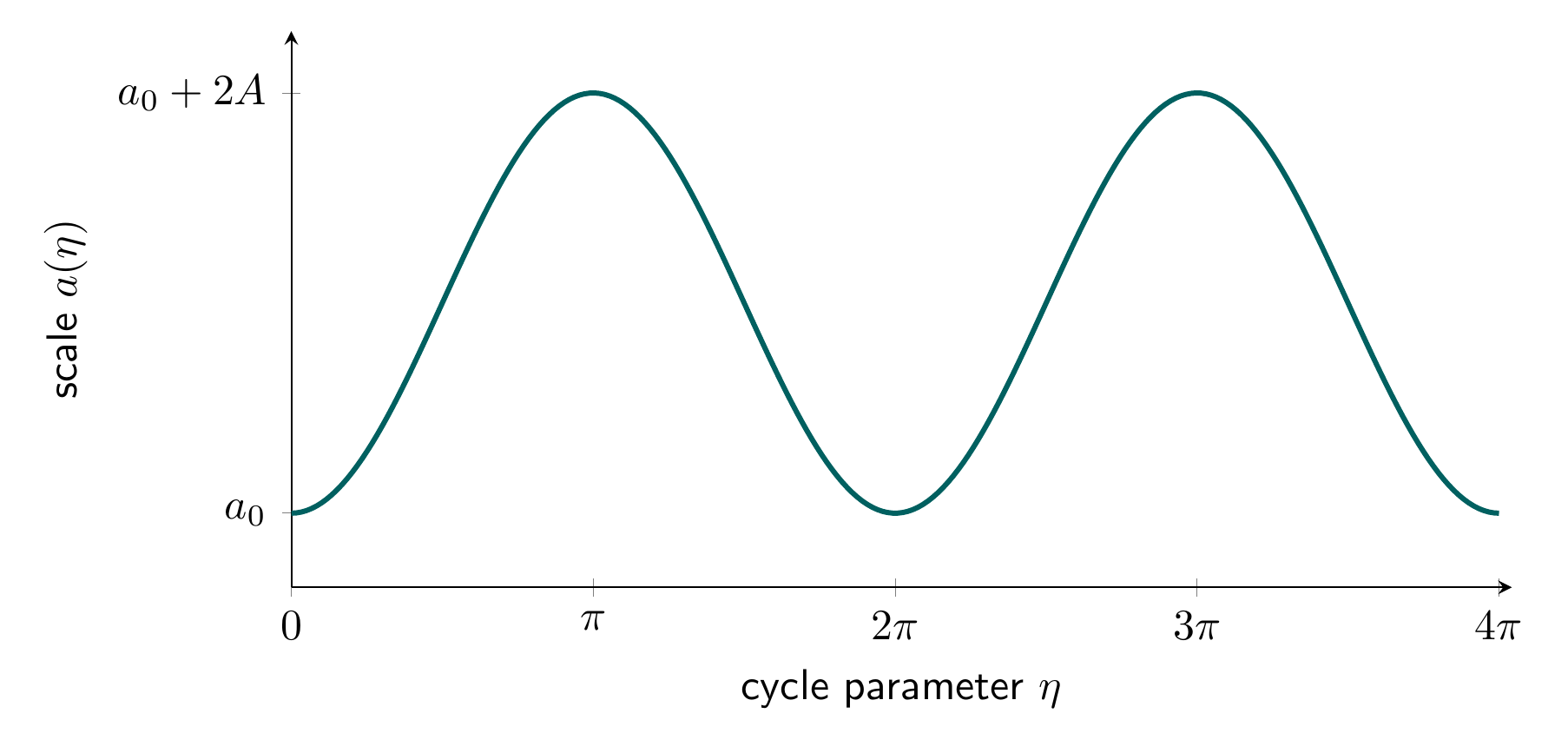
The editable graph is cyclic-cosmology.tex. The symbolic checks give a zero endpoint residual.
Here $a_0$ and $A$ have the same units and $\eta$ is dimensionless. Direct differentiation gives
\[\frac{da}{d\eta}=A\sin\eta, \qquad \frac{d^2a}{d\eta^2}=A\cos\eta.\]Thus $a_{\min}=a_0$ at $\eta=2n\pi$ and $a_{\max}=a_0+2A$ at $\eta=(2n+1)\pi$. Although $a_0>0$ removes a zero of this curve, calling it a physical bounce additionally requires a relation between $\eta$ and proper cosmic time and a stress-energy model that satisfies the gravitational field equations.
Real cyclic cosmology must also explain the bounce mechanism, entropy from one cycle to the next, structure formation and current observations. Philosophical recurrence suggests a comparison; it does not solve those physical constraints.
Mind-matter interaction and measurement
If a mind changes a physical system, the proposed theory must state how information or energy enters measurable variables. Quantum entanglement can correlate a system $S$ with an apparatus $A$,
\[\left(\sum_i c_i\lvert s_i\rangle\right)\lvert A_0\rangle \longrightarrow \sum_i c_i\lvert s_i\rangle\lvert A_i\rangle.\]Environmental decoherence suppresses interference between macroscopically distinct apparatus records, but it does not by itself establish that consciousness causes collapse. Indian theories of mind and awareness may contribute to philosophy of mind; a physical mind-matter mechanism still requires a mathematical interaction and testable evidence.
If the environment states are $\lvert E_i\rangle$, tracing out the environment multiplies a reduced-density-matrix coherence $\rho_{ij}$ by $\langle E_j\vert E_i\rangle$. Nearly orthogonal records therefore suppress interference whether or not a person reads the apparatus. Decoherence explains the local loss of observable phase coherence; it does not select a unique interpretation of the measurement formalism.
Solved Problems
1. Proper time for a uniformly moving clock
An inertial laboratory records $\Delta t=10.0\ \mathrm{y}$ while a spacecraft moves at $v=0.8c$. The spacecraft clock records
\[\Delta\tau =10.0\sqrt{1-0.8^2}\ \mathrm{y} =10.0(0.6)\ \mathrm{y} =6.0\ \mathrm{y}.\]The $4.0\ \mathrm{y}$ difference follows from the spacetime path. It is not a statement that subjective awareness changes the flow of a physical clock.
2. Extrema of the illustrative cyclic scale factor
Take $a_0=2.0$ and $A=3.0$ in a length-valued convention:
\[a(\eta)=2+3(1-\cos\eta).\]Stationary points satisfy $da/d\eta=3\sin\eta=0$, so $\eta=n\pi$. At even $n$, $d^2a/d\eta^2=+3$ and
\[a_{\min}=2.\]At odd $n$, $d^2a/d\eta^2=-3$ and
\[a_{\max}=2+2(3)=8.\]The parameter period is $2\pi$ and $a$ never vanishes. These mathematical facts alone do not supply a gravitational bounce mechanism.
Descriptive Questions
- Contrast consciousness as a metaphysical primitive with an operational observable in physics.
- State the assumptions behind the flat-spacetime proper-time formula.
- Why is a positive periodic scale factor not by itself a complete cyclic cosmology?
- What does environmental decoherence explain, and what interpretive question does it leave open?
Numerical Problems
-
Each of $50$ independent environmental records multiplies a coherence by $\lvert\gamma\rvert=0.95$. Find the remaining magnitude relative to its initial value.
Final answer: $0.95^{50}=0.0769$.
-
In a cyclic toy model the scale factor grows from $a_{\min}=1$ to $a_{\max}=5$. Find the redshift of light emitted at the minimum and observed at the maximum.
Final answer: $z=a_{\max}/a_{\min}-1=4$.
The derivations and rounded values are checked in the Maxima worksheet.
References
- Wikipedia: Hindu cosmology – an overview of traditional cosmological time scales and cycles.
- M. Hiriyanna, Outlines of Indian Philosophy, George Allen & Unwin, 1932, chapters on Sāṃkhya and Vedānta.
- Franz Schwabl, Advanced Quantum Mechanics, 4th ed., Springer, 2008, section on measurement and density operators.
- Erich Joos et al., Decoherence and the Appearance of a Classical World in Quantum Theory, 2nd ed., Springer, 2003, Chapters 2–3.
- Bernard Schutz, A First Course in General Relativity, 2nd ed., Cambridge University Press, 2009, Chapters 1–2.


Discussion