

24 May 2025
Siddhāntic Astronomy and Planetary Models
Sūrya Siddhānta, jyotiṣa computation, and the planetary models of Āryabhaṭa and Nīlakaṇṭha.
Indian jyotiṣa includes several historically distinct activities. Early calendrical reckoning fixed seasons and ritual times from the Sun and Moon. The later siddhānta tradition developed numerical astronomy: tables and algorithms for longitudes, eclipses, conjunctions and rising phenomena. “Siddhāntic jyotiṣa” is therefore a tradition or genre, not the title of one timeless book.
Mean and corrected motion
If a body completed uniform revolutions with period $T$, its mean longitude would be
\[\bar\lambda(t)=\lambda_0+\frac{2\pi}{T}t\pmod{2\pi}.\]Observed planetary motion is nonuniform and includes retrograde loops. Siddhāntic algorithms begin with mean motions and apply geometrical corrections, commonly represented through eccentric or epicyclic constructions. Their output is a predicted direction on the sky. This is mathematical modelling, even though the physical dynamics is not Newtonian.
Geometry of a correction
A simple modern reconstruction of epicyclic geometry writes a planar position as
\[z=Re^{iM}+re^{i\phi} =Re^{iM}\left[1+\varepsilon e^{i(\phi-M)}\right], \qquad \varepsilon=\frac rR.\]The observed longitude is $\lambda=\arg z$. When $\varepsilon\ll1$,
\[\lambda\approx M+\varepsilon\sin(\phi-M).\]Thus a geometrical offset becomes a signed angular correction, largest near a quarter-cycle phase difference and zero when the two radius vectors are aligned. This equation illustrates the mathematics of correction; it is not a replacement for the historically specific manda and śīghra algorithms or their tables.
Sūrya Siddhānta
The received Sūrya Siddhānta is a layered astronomical text. It gives rules for mean and true planetary positions, time-reckoning, eclipses, celestial coordinates and trigonometric tables. Its planetary algorithms are expressed in a geocentric computational frame and use manda and śīghra corrections to reproduce varying speed and retrograde motion.
The text should not be assigned one simple “Vedic” date: the surviving form reflects revision and transmission across centuries. Its importance lies in a durable computational system, not in being a modern heliocentric theory.
Āryabhaṭa
The Āryabhaṭīya of 499 CE uses a rotating Earth to explain the daily apparent motion of the stars. Āryabhaṭa’s boat analogy captures relative motion: a person in a moving boat sees stationary objects appear to move backward. His planetary calculations nevertheless remain within an Earth-centred computational astronomy with epicyclic corrections. Calling the whole system Copernican heliocentrism is inaccurate.
Nīlakaṇṭha Somayāji
In the Tantrasaṅgraha (1501), Nīlakaṇṭha reorganized the planetary model so that the five visible planets move in solar-centred loops while the Sun’s motion is referred to Earth. In modern vector language, the geocentric position can be written schematically as
\[\mathbf r_{P/E}=\mathbf r_{S/E}+\mathbf r_{P/S}.\]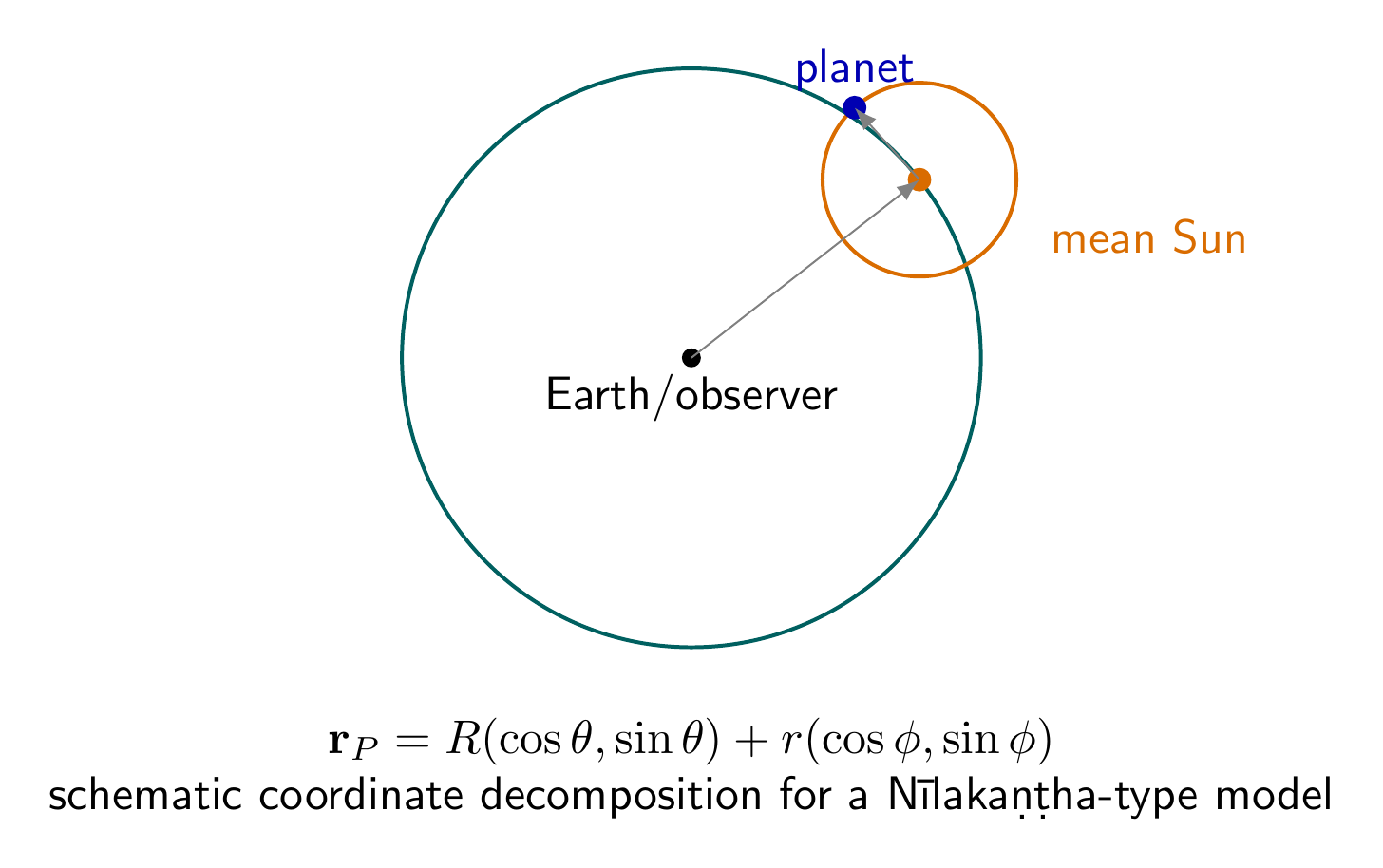
The editable construction is planetary-models.tex.
Nīlakaṇṭha’s scheme is often called quasi-heliocentric. It is not a Newtonian solar system: Earth remains the reference centre, and no inverse-square dynamics determines the curves. Its achievement is a mathematically effective reorganization of planetary longitudes.
A longitude becomes retrograde whenever $d\lambda/dt<0$. For example, the toy correction model
\[\lambda(t)=nt+A\sin(\omega t)\]has $d\lambda/dt=n+A\omega\cos(\omega t)$. A reversal is possible only if $A\omega>n$. This criterion clarifies how a correction can temporarily overcome the mean eastward drift without implying that the planet physically stops in space.
Solved Problems
1. Find a mean longitude
Let $\lambda_0=40^\circ$, $T=225\ \mathrm{d}$ and $t=50\ \mathrm{d}$. Then
\[\bar\lambda=40^\circ+360^\circ\frac{50}{225} =120^\circ.\]The modulus is unnecessary here because the result already lies between $0^\circ$ and $360^\circ$.
2. Apply a small epicyclic correction
Take $r/R=0.08$ and $\phi-M=60^\circ$. The first-order correction is
\[\delta\lambda\approx0.08\sin60^\circ =0.06928\ \mathrm{rad}=3.97^\circ.\]Applied to the preceding mean longitude, it gives $\lambda\approx123.97^\circ$. The exact value from $\arg[1+0.08e^{i60^\circ}]$ is about $3.81^\circ$; the difference indicates the size of the first-order approximation.
3. Use the Earth–Sun–planet vector decomposition
Suppose $\mathbf r_{S/E}=(1,0)\ \mathrm{AU}$ and a planet is $0.5\ \mathrm{AU}$ from the Sun at $120^\circ$ from the positive $x$-axis. Then
\[\mathbf r_{P/S}=0.5(\cos120^\circ,\sin120^\circ) =(-0.25,0.433)\ \mathrm{AU},\] \[\mathbf r_{P/E}=(0.75,0.433)\ \mathrm{AU}.\]Hence $\lvert\mathbf r_{P/E}\rvert=0.866\ \mathrm{AU}$ and its geocentric direction is $\tan^{-1}(0.433/0.75)=30.0^\circ$. Vector addition changes the reference origin; it does not by itself supply a force law.
Descriptive Questions
- Distinguish mean longitude, true longitude and a geometrical correction in siddhāntic computation.
- Explain why Āryabhaṭa’s rotating Earth does not make his complete planetary system Copernican.
- Describe the roles of manda and śīghra corrections without identifying them with Newtonian forces.
- In what precise sense is Nīlakaṇṭha’s model called quasi-heliocentric, and what are the limits of that label?
Numerical Problems
-
Use $S=\lvert1/T_V-1/T_E\rvert^{-1}$ to find the Earth–Venus synodic period for $T_V=224.7\ \mathrm{d}$ and $T_E=365.25\ \mathrm{d}$.
Final answer: $583.9\ \mathrm{d}$.
-
In $\lambda(t)=nt+A\sin(\omega t)$, let $n=0.50^\circ\mathrm{d^{-1}}$, $A=2.0^\circ$ and $\omega=0.40\ \mathrm{rad\,d^{-1}}$. Decide whether retrograde motion is possible and find the minimum $d\lambda/dt$.
Final answer: yes; the minimum is $-0.30^\circ\mathrm{d^{-1}}$.
-
Estimate the Moon’s equatorial horizontal parallax from the small-angle relation $p\approx R_E/D$, using $R_E=6371\ \mathrm{km}$ and $D=384400\ \mathrm{km}$. Give radians and degrees.
Final answer: $p=0.01657\ \mathrm{rad}=0.9496^\circ$.
The angular corrections, vector decomposition and period calculations are checked in the Maxima worksheet.
References
- Indian astronomy — Wikipedia
- “Essentials of Indian Astronomy: Concepts and Literature” — Bhāvanā
- “Model of Planetary Motion in the Works of Kerala Astronomers” — Indian Institute of Astrophysics Repository
- Āryabhaṭa — MacTutor History of Mathematics
- Nīlakaṇṭha Somayājī — MacTutor History of Mathematics


Discussion