

22 Jun 2025
Heat Engines, Carnot Cycle, and Refrigerators
Second-law statements, reversible engines, Carnot efficiency, refrigeration, and coefficients of performance.
A heat engine operates cyclically between a hot reservoir at $T_h$ and a cold reservoir at $T_c<T_h$. Let $Q_h>0$ be heat absorbed from the hot reservoir, $Q_c>0$ the magnitude rejected to the cold reservoir, and $W>0$ the net work output. Since the working substance returns to its initial state,
\[W=Q_h-Q_c.\]Its thermal efficiency is
\[\boxed{\eta=\frac{W}{Q_h}=1-\frac{Q_c}{Q_h}}.\]Statements of the second law
The Kelvin-Planck statement says that no cyclic device can take heat from a single reservoir and convert it completely into work. Thus $Q_c$ cannot vanish for an engine operating in a cycle.
The Clausius statement says that no cyclic device can have as its sole effect the transfer of heat from a colder body to a hotter body. Such a transfer requires work input.
The statements are equivalent. A perfect single-reservoir engine could drive a refrigerator without net work and violate Clausius; a refrigerator that required no work could combine with an ordinary engine to convert the heat taken from one reservoir completely into work and violate Kelvin-Planck.
Reversible Carnot cycle
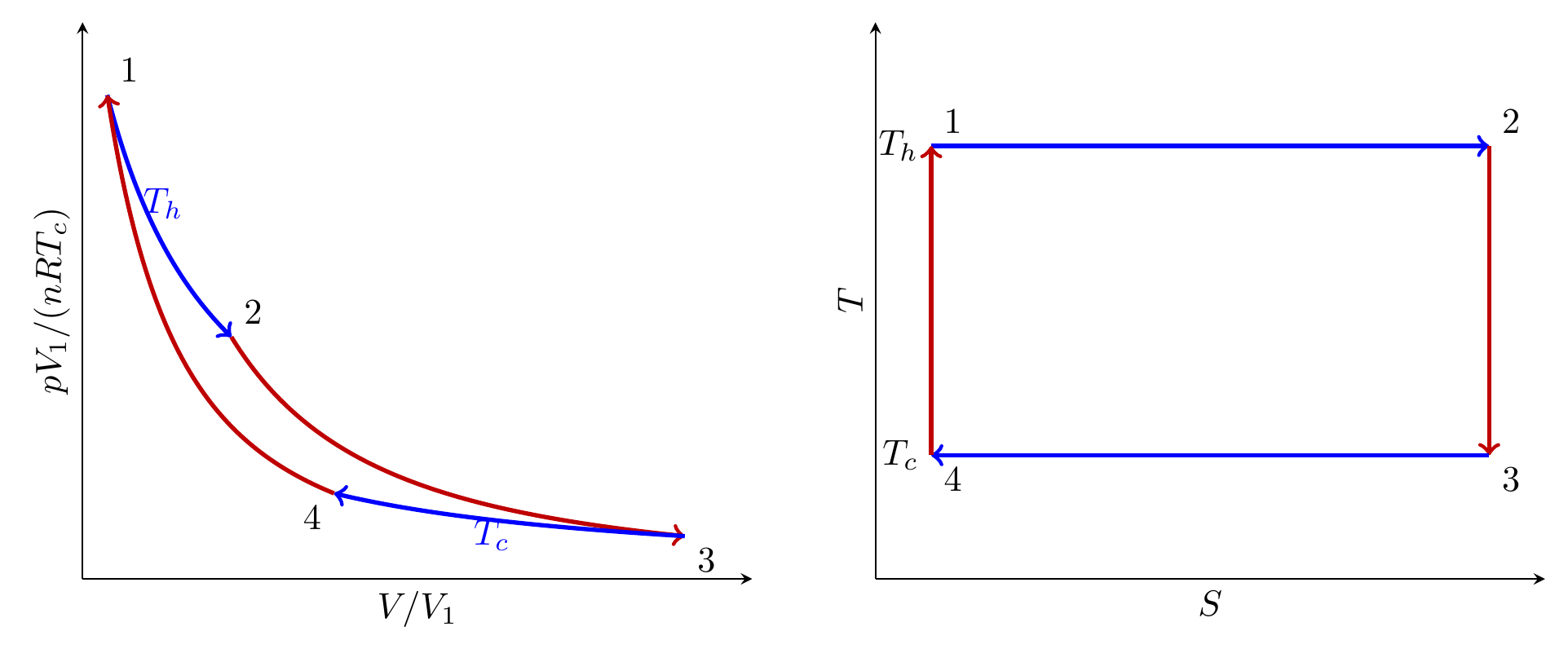
For $n$ moles of ideal gas with constant heat capacities, the Carnot engine consists of four reversible processes:
- $1\to2$: isothermal expansion at $T_h$, absorbing $Q_h$;
- $2\to3$: adiabatic expansion from $T_h$ to $T_c$;
- $3\to4$: isothermal compression at $T_c$, rejecting $Q_c$;
- $4\to1$: adiabatic compression from $T_c$ to $T_h$.
The two isothermal steps give
\[Q_h=nRT_h\ln\!\frac{V_2}{V_1}, \qquad Q_c=nRT_c\ln\!\frac{V_3}{V_4}.\]On each reversible adiabat, $TV^{\gamma-1}$ is constant. Hence
\[T_hV_2^{\gamma-1}=T_cV_3^{\gamma-1}, \qquad T_cV_4^{\gamma-1}=T_hV_1^{\gamma-1},\]which imply
\[\frac{V_2}{V_1}=\frac{V_3}{V_4}.\]Therefore
\[\frac{Q_c}{Q_h}=\frac{T_c}{T_h}, \qquad \boxed{\eta_{\mathrm C}=1-\frac{T_c}{T_h}}.\]Temperatures must be absolute. Unit efficiency would require $T_c=0$, which is unattainable.
Carnot theorem
No engine operating between two fixed reservoirs can be more efficient than a reversible engine between them. Suppose an engine were more efficient than a reversible Carnot engine while absorbing the same $Q_h$. It would produce more work and reject less heat. Use part of its work to run the Carnot engine backward. The hot-reservoir exchanges cancel, leaving net work while an equal amount of heat is removed from the cold reservoir: a Kelvin-Planck violation. Thus the supposed engine cannot exist.
Running either of two reversible engines backward gives the same contradiction unless their efficiencies are equal. Therefore all reversible engines between $T_h$ and $T_c$ have the same Carnot efficiency, independent of working substance.
Refrigerator and coefficient of performance
A refrigerator is the reversed heat-engine cycle. It removes $Q_c$ from the cold reservoir, receives work $W$, and rejects
\[Q_h=Q_c+W\]to the hot reservoir. Its coefficient of performance is
\[\boxed{\mathrm{COP}_{R}=\frac{Q_c}{W}}.\]For a reversible refrigerator,
\[\boxed{\mathrm{COP}_{R,\mathrm C}=\frac{T_c}{T_h-T_c}}.\]If the desired output is heating, the same reversed device is a heat pump with
\[\mathrm{COP}_{H}=\frac{Q_h}{W} =\frac{T_h}{T_h-T_c}=\mathrm{COP}_{R}+1.\]The linked Unit II Maxima worksheet verifies
\[\eta_{\mathrm C}-\left(1-\frac{T_c}{T_h}\right)=0.\]Solved Problems
1. Derive Carnot efficiency from reservoir entropy balance
Over one reversible cycle the working substance has zero net entropy change. The hot reservoir loses $Q_h/T_h$ and the cold reservoir gains $Q_c/T_c$. Reversibility requires zero entropy generation, hence
\[-\frac{Q_h}{T_h}+\frac{Q_c}{T_c}=0.\]Therefore $Q_c/Q_h=T_c/T_h$. With $W=Q_h-Q_c$,
\[\boxed{\eta=\frac{W}{Q_h}=1-\frac{T_c}{T_h}}.\]No ideal-gas equation has been used, demonstrating why Carnot efficiency is independent of working substance. If either heat transfer occurred through a finite temperature difference, entropy generation would be positive and the efficiency would be smaller.
2. Couple an engine directly to a refrigerator
Let an engine of efficiency $\eta_E$ absorb $Q_h^{(E)}$. Its work output is
\[W_E=\eta_EQ_h^{(E)}.\]If all of this work drives a refrigerator of coefficient of performance $\mathrm{COP}_R$, the heat removed from the refrigerator’s cold space is
\[\boxed{Q_c^{(R)}=\mathrm{COP}_R\,\eta_EQ_h^{(E)}}.\]The refrigerator rejects $Q_h^{(R)}=Q_c^{(R)}+W_E$. These relations separately conserve energy in both cyclic devices; they do not imply reversibility unless each device reaches its corresponding Carnot bound.
Descriptive Questions
- Show logically why the Kelvin-Planck and Clausius statements of the second law are equivalent.
- Why must all temperatures in Carnot formulae be thermodynamic temperatures rather than Celsius temperatures?
- State Carnot’s theorem and explain which step would fail for an irreversible comparison engine.
- Distinguish thermal efficiency, refrigerator COP, and heat-pump COP.
Numerical Problems
-
Find the maximum efficiency of an engine operating between $600\ \mathrm K$ and $300\ \mathrm K$.
Final answer: $\eta_C=1-300/600=0.500$ or $50.0\%$.
-
Such a reversible engine absorbs $1.20\ \mathrm{kJ}$ per cycle. Find its work output and rejected heat.
Final answer: $W=0.600\ \mathrm{kJ}$ and $Q_c=0.600\ \mathrm{kJ}$.
-
Find the maximum refrigerator COP between $270\ \mathrm K$ and a room at $300\ \mathrm K$.
Final answer: $\mathrm{COP}_{R,C}=270/(300-270)=9.00$.
-
A real engine absorbs $2.00\ \mathrm{kJ}$ and rejects $1.30\ \mathrm{kJ}$ per cycle. Find its efficiency.
Final answer: $\eta=(2.00-1.30)/2.00=0.350$ or $35.0\%$.
The Carnot and refrigerator Maxima worksheet verifies the heat-sign convention, energy balances, efficiency and COP identities, and all numerical answers.
References
- Carnot cycle, Wikipedia.
- H. B. Callen, Thermodynamics and an Introduction to Thermostatistics, 2nd ed., Wiley, 1985, chapter 4.
- M. W. Zemansky and R. H. Dittman, Heat and Thermodynamics, 7th ed., McGraw-Hill, 1997, chapters “The second law” and “Ideal engines.”


Discussion