

26 May 2025
Maxwell Distribution, Equipartition, and Specific Heats
Equilibrium molecular speeds, active degrees of freedom, equipartition, and ideal-gas heat capacities.
Consider a dilute gas of identical, non-interacting molecules of mass $m$ in thermal equilibrium at absolute temperature $T$. Collisions randomize direction, so the velocity distribution is isotropic. The Cartesian components are also statistically independent. Boltzmann’s constant is $k_{\mathrm B}$ and $R=N_{\mathrm A}k_{\mathrm B}$.
Maxwell-Boltzmann velocity distribution
Independence gives
\[F(v_x,v_y,v_z)=\phi(v_x)\phi(v_y)\phi(v_z),\]where $F\,dv_xdv_ydv_z$ is the probability of finding a molecule in the indicated velocity-space element. Isotropy requires $F$ to depend on the components only through
\[v^2=v_x^2+v_y^2+v_z^2.\]The product of three one-variable functions can depend only on this sum if each factor is Gaussian. Hence
\[F=A\exp[-\alpha(v_x^2+v_y^2+v_z^2)].\]Normalization and $\langle \tfrac12mv_x^2\rangle=\tfrac12k_{\mathrm B}T$ determine $A$ and $\alpha$:
\[\boxed{F(v_x,v_y,v_z)= \left(\frac{m}{2\pi k_{\mathrm B}T}\right)^{3/2} \exp\!\left(-\frac{mv^2}{2k_{\mathrm B}T}\right)}.\]$F$ has units $(\mathrm{m\,s^{-1}})^{-3}$. Velocities with magnitude between $v$ and $v+dv$ occupy the spherical shell $4\pi v^2dv$ in velocity space. The speed probability density is therefore
\[\boxed{f(v)=4\pi\left(\frac{m}{2\pi k_{\mathrm B}T}\right)^{3/2} v^2\exp\!\left(-\frac{mv^2}{2k_{\mathrm B}T}\right)}, \qquad v\geq0,\]with $\int_0^\infty f(v)\,dv=1$ and units $(\mathrm{m\,s^{-1}})^{-1}$.
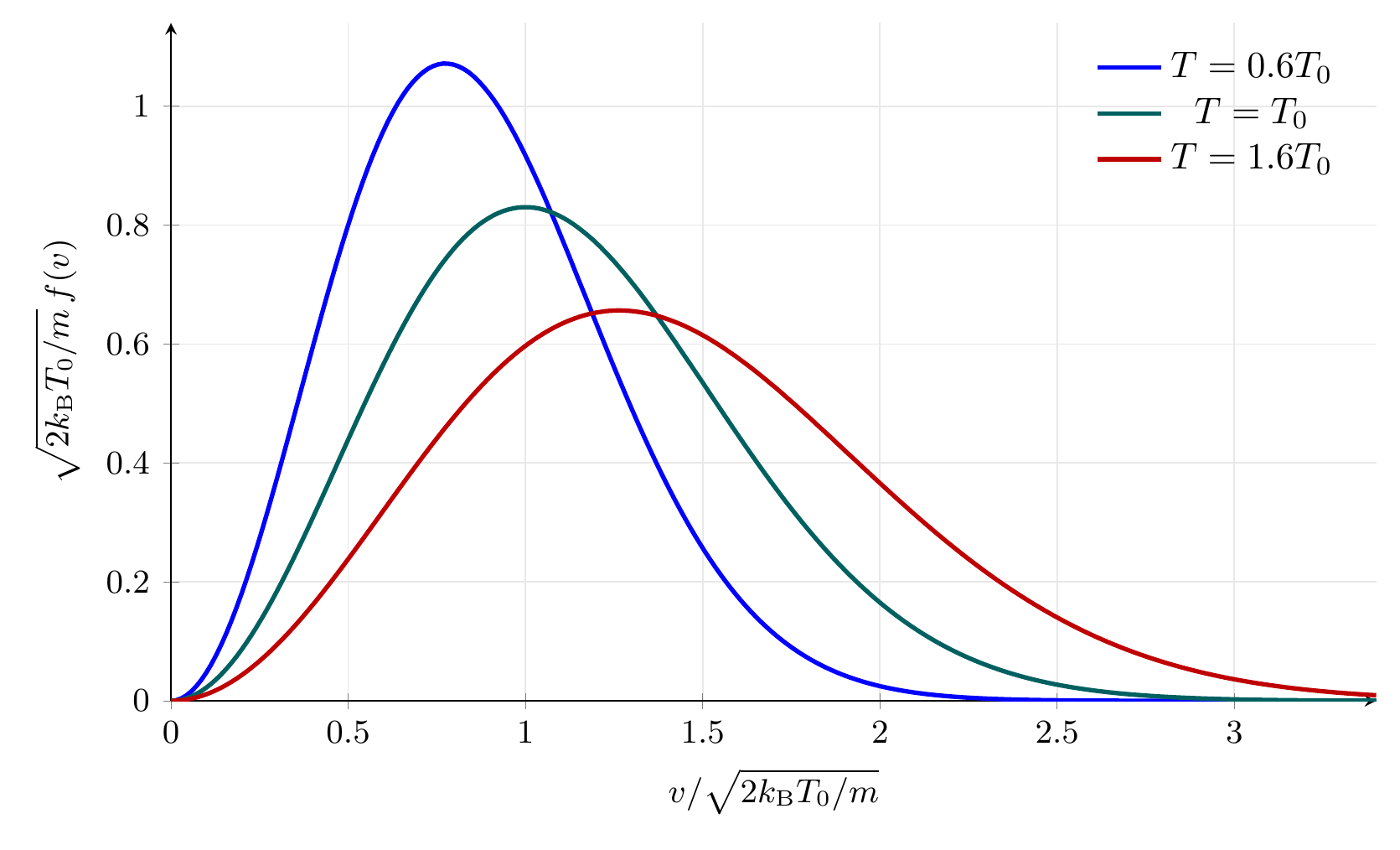
For the nonzero maximum, $df/dv=0$ gives
\[\frac{df}{dv}\propto 2v\left(1-\frac{mv^2}{2k_{\mathrm B}T}\right) e^{-mv^2/(2k_{\mathrm B}T)},\]so the most probable speed is
\[v_{\mathrm{mp}}=\sqrt{\frac{2k_{\mathrm B}T}{m}}.\]Using
\[\int_0^\infty x^n e^{-ax^2}\,dx =\frac12a^{-(n+1)/2}\Gamma\!\left(\frac{n+1}{2}\right)\]gives the mean and root-mean-square speeds:
\[\bar v=\int_0^\infty vf(v)\,dv =\sqrt{\frac{8k_{\mathrm B}T}{\pi m}},\] \[\langle v^2\rangle=\int_0^\infty v^2f(v)\,dv =\frac{3k_{\mathrm B}T}{m}, \qquad v_{\mathrm{rms}}=\sqrt{\frac{3k_{\mathrm B}T}{m}}.\]Thus $v_{\mathrm{mp}}<\bar v<v_{\mathrm{rms}}$, and every characteristic speed varies as $\sqrt{T/m}$.
Degrees of freedom and equipartition
A degree of freedom is an independent coordinate needed to specify molecular motion. In classical equilibrium, every independent quadratic energy term contributes mean energy $k_{\mathrm B}T/2$ per molecule. For example,
\[\epsilon_{\mathrm{tr}}= \frac{p_x^2}{2m}+\frac{p_y^2}{2m}+\frac{p_z^2}{2m}\]contains three quadratic terms and contributes $3k_{\mathrm B}T/2$. A linear molecule has two rotational quadratic terms; a nonlinear molecule has three. Each vibrational normal mode has one kinetic and one potential quadratic term, so an active vibrational mode contributes $k_{\mathrm B}T$.
If $g$ quadratic terms are active, the mean molecular energy and the internal energy of $n$ moles are
\[\bar\epsilon=\frac{g}{2}k_{\mathrm B}T, \qquad U=N\bar\epsilon=\frac{g}{2}nRT.\]For an ideal gas, $U$ depends only on $T$. Therefore
\[C_V=\left(\frac{\partial U}{\partial T}\right)_V =\frac{g}{2}nR.\]Since $H=U+pV=U+nRT$,
\[C_P=\left(\frac{\partial H}{\partial T}\right)_p =C_V+nR=\frac{g+2}{2}nR, \qquad \gamma=\frac{C_P}{C_V}=\frac{g+2}{g}.\]For one mole, a monatomic gas has $g=3$ and
\[C_{V,m}=\frac32R,\qquad C_{P,m}=\frac52R,\qquad \gamma=\frac53.\]A rigid diatomic gas at ordinary temperatures has $g=5$ and
\[C_{V,m}=\frac52R,\qquad C_{P,m}=\frac72R,\qquad \gamma=\frac75.\]Molar heat capacities have units $\mathrm{J\,mol^{-1}K^{-1}}$; division by molar mass gives mass-specific heat in $\mathrm{J\,kg^{-1}K^{-1}}$. A rotational or vibrational mode whose energy spacing is much larger than $k_{\mathrm B}T$ is effectively frozen and does not contribute its classical value.
The classical distribution requires non-relativistic particles, dilute-gas conditions, equilibrium, and negligible quantum degeneracy. Its $T\to0$ limit is therefore not physical: quantum statistics and discrete rotational or vibrational levels enter before that limit. Normalization is dimensionless, while every $r$th speed moment has units $(\mathrm{m\,s^{-1}})^r$.
Solved Problems
1. Obtain a general moment of the Maxwell speed distribution
Put $A=m/(2k_{\mathrm B}T)$. The normalized density becomes
\[f(v)=\frac{4}{\sqrt\pi}A^{3/2}v^2e^{-Av^2}.\]For $r>-3$, use the Gaussian integral stated above:
\[\begin{aligned} \langle v^r\rangle &=\frac{4}{\sqrt\pi}A^{3/2} \int_0^\infty v^{r+2}e^{-Av^2}\,dv\\ &=\frac{2}{\sqrt\pi}A^{-r/2} \Gamma\!\left(\frac{r+3}{2}\right). \end{aligned}\]For $r=0$ this gives $1$, checking normalization. For $r=1$ and $2$ it gives $\bar v=2/(\sqrt{\pi A})$ and $\langle v^2\rangle=3/(2A)$. Thus
\[v_{\mathrm{mp}}^2:\bar v^2:v_{\mathrm{rms}}^2 =2:\frac8\pi:3,\]so $v_{\mathrm{mp}}<\bar v<v_{\mathrm{rms}}$. The factor $A^{-r/2}$ supplies the required speed-to-the-$r$ dimensions.
2. Heat capacities when only two vibration modes of a linear triatomic molecule are active
A linear triatomic molecule has three translations, two rotations, and $3N-5=4$ normal vibration modes. Suppose only two vibration modes satisfy $k_{\mathrm B}T$ large compared with their level spacings. Each active vibration supplies two quadratic terms, so
\[g=3+2+2(2)=9.\]For one mole,
\[C_{V,m}=\frac92R,\qquad C_{P,m}=C_{V,m}+R=\frac{11}{2}R,\]and therefore
\[\boxed{\gamma=\frac{C_{P,m}}{C_{V,m}}=\frac{11}{9}}.\]The result lies between the rigid-molecule value $7/5$ and the value obtained when all four vibrations are active. It assumes ideal-gas behaviour and classical equipartition for the stated active modes.
Descriptive Questions
- Why do isotropy and statistical independence force the Cartesian velocity distributions to be Gaussian?
- Distinguish a velocity distribution from a speed distribution, including their domains and units.
- Explain why a vibrational normal mode contributes twice as much classical energy as one translational coordinate.
- Why can measured heat capacities depart from equipartition predictions at low temperature?
Numerical Problems
-
Find the most probable speed of oxygen molecules at $300\ \mathrm K$, taking $M=0.032\ \mathrm{kg\,mol^{-1}}$.
Final answer: $v_{\mathrm{mp}}=\sqrt{2RT/M}=394.8\ \mathrm{m\,s^{-1}}$.
-
Find the rms speed of helium at $400\ \mathrm K$ for $M=0.004\ \mathrm{kg\,mol^{-1}}$.
Final answer: $v_{\mathrm{rms}}=1.579\times10^3\ \mathrm{m\,s^{-1}}$.
-
Two moles of a monatomic ideal gas are heated through $50\ \mathrm K$ at constant volume. Calculate $\Delta U$.
Final answer: $\Delta U=(3/2)nR\Delta T=1.247\times10^3\ \mathrm J$.
-
A classical ideal gas has $\gamma=1.40$. Infer its number $g$ of active quadratic degrees of freedom.
Final answer: $g=2/(\gamma-1)=5$.
The Maxwell and equipartition Maxima worksheet verifies normalization, the first two moments, heat-capacity identities, and every numerical answer above.
References
- Maxwell-Boltzmann distribution, Wikipedia.
- F. Reif, Fundamentals of Statistical and Thermal Physics, McGraw-Hill, 1965, chapters 6-7.
- F. W. Sears and G. L. Salinger, Thermodynamics, Kinetic Theory, and Statistical Thermodynamics, 3rd ed., Addison-Wesley, 1975, chapters 9-10.


Discussion