

27 May 2025
Real Gases, Virial Equation, and Critical Constants
Compressibility, virial corrections, Boyle temperature, and the van der Waals critical point.
An ideal gas neglects molecular size and intermolecular forces. A real gas approaches $pV=nRT$ only in the low-density limit. For one mole, define the compressibility factor
\[Z=\frac{pV_m}{RT},\]where $V_m$ is molar volume. An ideal gas has $Z=1$ at every state. Attraction commonly gives $Z<1$ at moderate density, while short-range repulsion and finite molecular size give $Z>1$ at high density.
Virial equation
At sufficiently low density, the equation of state can be expanded as
\[\boxed{Z=1+\frac{B(T)}{V_m}+\frac{C(T)}{V_m^2}+\cdots}.\]$B(T)$, $C(T)$, and higher virial coefficients describe two-body, three-body, and higher correlations. Since $Z$ is dimensionless, $B$ has units $\mathrm{m^3\,mol^{-1}}$ and $C$ has units $\mathrm{m^6\,mol^{-2}}$.
van der Waals equation
Let $b$ be the excluded molar volume. Molecular centres then move in $V_m-b$, not $V_m$. Attractions reduce the measured pressure below the kinetic pressure by $a/V_m^2$. The van der Waals equation is
\[\boxed{\left(p+\frac{a}{V_m^2}\right)(V_m-b)=RT},\]or
\[p=\frac{RT}{V_m-b}-\frac{a}{V_m^2}.\]Here $b$ has units $\mathrm{m^3\,mol^{-1}}$ and $a$ has units $\mathrm{Pa\,m^6\,mol^{-2}}$. For $V_m\gg b$,
\[\frac{1}{V_m-b}=\frac1{V_m} \left(1+\frac b{V_m}+\cdots\right).\]Multiplying the equation of state by $V_m/(RT)$ and retaining the leading correction gives
\[Z=1+\frac1{V_m}\left(b-\frac{a}{RT}\right)+\cdots.\]Thus the van der Waals second virial coefficient is
\[B(T)=b-\frac{a}{RT}.\]The Boyle temperature is the temperature at which this leading correction vanishes:
\[B(T_B)=0 \quad\Longrightarrow\quad \boxed{T_B=\frac{a}{Rb}}.\]Near $T_B$ and at low pressure, a real gas therefore obeys Boyle’s law to first order in density.
Critical constants
At the critical point, the liquid and vapour become indistinguishable. The critical isotherm has a horizontal inflection:
\[\left(\frac{\partial p}{\partial V_m}\right)_{T_c}=0, \qquad \left(\frac{\partial^2p}{\partial V_m^2}\right)_{T_c}=0.\]For the van der Waals equation,
\[\left(\frac{\partial p}{\partial V_m}\right)_T =-\frac{RT}{(V_m-b)^2}+\frac{2a}{V_m^3},\] \[\left(\frac{\partial^2p}{\partial V_m^2}\right)_T =\frac{2RT}{(V_m-b)^3}-\frac{6a}{V_m^4}.\]Solving the two critical-point conditions and substituting into the equation of state gives
\[\boxed{V_c=3b},\qquad \boxed{T_c=\frac{8a}{27Rb}},\qquad \boxed{p_c=\frac{a}{27b^2}}.\]Consequently,
\[Z_c=\frac{p_cV_c}{RT_c}=\frac38, \qquad T_B=\frac{27}{8}T_c.\]With reduced variables $p_r=p/p_c$, $v_r=V_m/V_c$, and $T_r=T/T_c$, all van der Waals gases obey the reduced equation
\[\boxed{p_r=\frac{8T_r}{3v_r-1}-\frac{3}{v_r^2}}.\]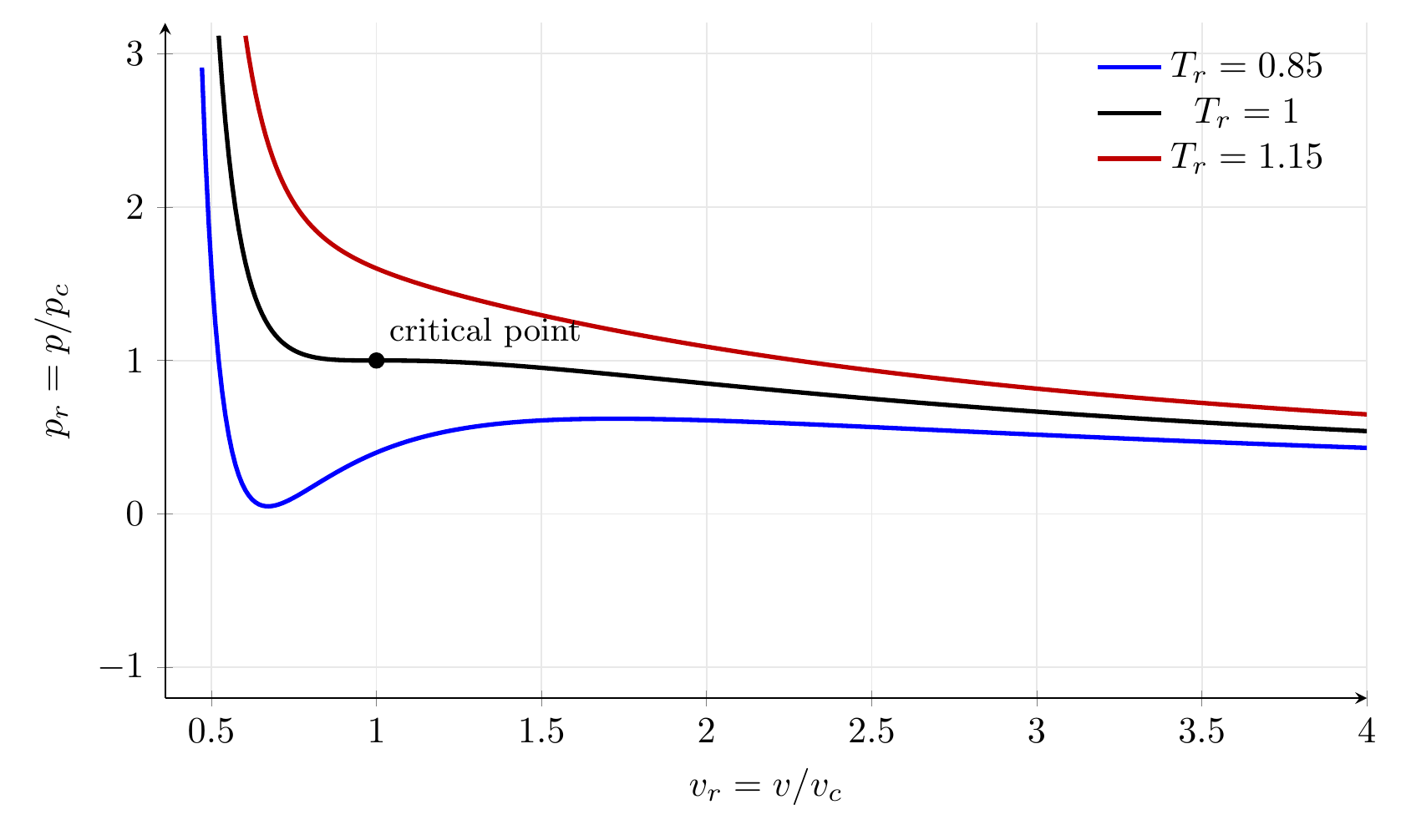
For $T_r<1$, the analytic isotherm contains mechanically unstable portions. A real sample instead separates into liquid and vapour over the coexistence interval. At $T_r=1$, the inflection is $(v_r,p_r)=(1,1)$; for $T_r>1$, compression alone does not produce a discontinuous gas-liquid transition.
The Unit I Maxima worksheet substitutes the critical and Boyle values directly. Its displayed residuals are
\[p(V_c,T_c)-p_c=0,\qquad \left.\frac{\partial p}{\partial V_m}\right\rvert_c=0,\] \[\left.\frac{\partial^2p}{\partial V_m^2}\right\rvert_c=0, \qquad B(T_B)=0.\]Mechanical stability requires $\kappa_T>0$, equivalently $(\partial p/\partial V_m)_T<0$. A positive isothermal slope on the analytic van der Waals loop is therefore unstable. The virial series, by contrast, is a low-density expansion and should not be extrapolated through the liquid region or too close to the critical point.
Solved Problems
1. Locate the critical point in reduced variables and test its stability boundary
For
\[p_r=\frac{8T_r}{3v_r-1}-\frac{3}{v_r^2},\]the first two volume derivatives are
\[\left(\frac{\partial p_r}{\partial v_r}\right)_{T_r} =-\frac{24T_r}{(3v_r-1)^2}+\frac6{v_r^3},\] \[\left(\frac{\partial^2p_r}{\partial v_r^2}\right)_{T_r} =\frac{144T_r}{(3v_r-1)^3}-\frac{18}{v_r^4}.\]At $(T_r,v_r)=(1,1)$ both expressions vanish and the equation gives $p_r=1$. Hence the reduced critical point is $(1,1,1)$, independent of $a$ and $b$. Below $T_r=1$, roots of the first derivative mark spinodal boundaries; between them the positive slope violates $\kappa_T>0$.
2. Determine the leading pressure correction on the Boyle isotherm
At $T_B$, the second virial coefficient is zero, so retain the next term:
\[Z=1+\frac{C(T_B)}{V_m^2}+O(V_m^{-3}).\]In the low-pressure limit, use the leading approximation $V_m\simeq RT_B/p$. Then
\[\boxed{Z=1+C(T_B)\left(\frac{p}{RT_B}\right)^2+O(p^3)}.\]Thus the linear-in-density departure has vanished; the first surviving correction to $Z$ is quadratic in pressure. The combination $C/V_m^2$ is dimensionless because $[C]=\mathrm{m^6\,mol^{-2}}$.
Descriptive Questions
- Explain separately the physical meanings and SI units of the van der Waals constants $a$ and $b$.
- Why is the Boyle temperature defined by $B(T_B)=0$ rather than by requiring all virial coefficients to vanish?
- State the thermodynamic meaning of the two critical-point derivative conditions.
- Why must the van der Waals loop below $T_c$ be replaced by phase coexistence for a real sample?
Numerical Problems
-
For carbon dioxide take $a=0.364\ \mathrm{Pa\,m^6\,mol^{-2}}$ and $b=4.27\times10^{-5}\ \mathrm{m^3\,mol^{-1}}$. Find $B$ at $350\ \mathrm K$.
Final answer: $B=b-a/(RT)=-8.24\times10^{-5}\ \mathrm{m^3\,mol^{-1}}$.
-
Using the same constants, calculate the van der Waals Boyle temperature.
Final answer: $T_B=a/(Rb)=1.025\times10^3\ \mathrm K$.
-
Calculate the predicted critical temperature and pressure for those constants.
Final answer: $T_c=304\ \mathrm K$ and $p_c=7.394\ \mathrm{MPa}$.
-
Evaluate the reduced pressure at $T_r=1.20$ and $v_r=2.00$.
Final answer: $p_r=8(1.20)/(3\times2-1)-3/2^2=1.17$.
The real-gas Maxima worksheet verifies the virial values, critical derivatives, reduced equation, and all printed numerical answers.
References
- Van der Waals equation, Wikipedia.
- P. Atkins, J. de Paula, and J. Keeler, Atkins’ Physical Chemistry, 11th ed., Oxford University Press, 2018, chapter “The properties of gases.”
- M. W. Zemansky and R. H. Dittman, Heat and Thermodynamics, 7th ed., McGraw-Hill, 1997, chapter “Equations of state.”


Discussion