

31 May 2025
Energy Bands and Density of States
Band formation and the three-dimensional conduction- and valence-band densities of states.
When $N$ isolated identical atoms are brought together to form a crystal, overlap between corresponding atomic orbitals removes their $N$-fold degeneracy. The resulting closely spaced levels form allowed bands in a macroscopic solid. Energy intervals containing no allowed states are forbidden gaps. For an intrinsic semiconductor at $0\ \mathrm K$, the valence band is full, the conduction band is empty, and
\[\boxed{E_g=E_c-E_v}.\]The density of states answers how many one-electron states are available in an energy interval; the Fermi-Dirac function separately answers what fraction of them is occupied.
Parabolic band edges and effective mass
Expand a band about an extremum $\mathbf k_0$. Since the first derivative vanishes there, the leading one-dimensional term is
\[E(k)\simeq E(k_0)+\frac12 \left.\frac{d^2E}{dk^2}\right\rvert_{k_0}(k-k_0)^2.\]Defining
\[\boxed{\frac1{m^*}=\frac1{\hbar^2}\frac{d^2E}{dk^2}},\]and measuring $k$ from the extremum gives, for one isotropic conduction-band valley,
\[\boxed{E(k)=E_c+\frac{\hbar^2k^2}{2m_n^*}}.\]At a valence-band maximum the electron-band curvature is negative. Describing the missing electron as a positive-mass hole gives
\[\boxed{E(k)=E_v-\frac{\hbar^2k^2}{2m_p^*}},\qquad m_p^*>0.\]Thus an electron effective mass follows the sign of band curvature, whereas the conventional hole mass is the positive magnitude associated with the downward valence-band curvature.
Counting states in three dimensions
For a cube of volume $V=L^3$ with periodic boundary conditions, adjacent allowed components of $\mathbf k$ differ by $2\pi/L$. Each orbital state occupies the $k$-space volume $(2\pi)^3/V$. Including the two spin states, the number of states inside a sphere of radius $k$ is
\[\mathcal N(k) =2\frac{V}{(2\pi)^3}\frac{4\pi k^3}{3} =\frac{Vk^3}{3\pi^2}.\]For the conduction band,
\[k=\frac{\sqrt{2m_n^*(E-E_c)}}{\hbar}.\]Substitution gives the number of states per unit volume between $E_c$ and $E$:
\[\frac{\mathcal N_c(E)}V =\frac{1}{3\pi^2} \left(\frac{2m_n^*}{\hbar^2}\right)^{3/2}(E-E_c)^{3/2}.\]The density of states per unit volume per unit energy is its derivative:
\[\begin{aligned} g_c(E) &=\frac1V\frac{d\mathcal N_c}{dE}\\ &=\boxed{\frac{1}{2\pi^2} \left(\frac{2m_n^*}{\hbar^2}\right)^{3/2}\sqrt{E-E_c}}, \qquad E\ge E_c. \end{aligned}\]The same counting about a valence-band maximum gives
\[\boxed{g_v(E)=\frac{1}{2\pi^2} \left(\frac{2m_p^*}{\hbar^2}\right)^{3/2}\sqrt{E_v-E}}, \qquad E\le E_v.\]Both densities have units $\mathrm{J^{-1}m^{-3}}$ when energy is measured in joules. Integrating the conduction-band result over an interval $\Delta E$ recovers
\[\int_{E_c}^{E_c+\Delta E}g_c(E)\,dE =\frac{1}{3\pi^2}\left(\frac{2m_n^*}{\hbar^2}\right)^{3/2}(\Delta E)^{3/2}.\]The square-root density vanishes at the band edge but rises with energy. If there are $g_{\rm d}$ equivalent valleys, the total density of states is $g_{\rm d}$ times the single-valley result. When a quoted density-of-states effective mass already incorporates this degeneracy, it must not be multiplied again.
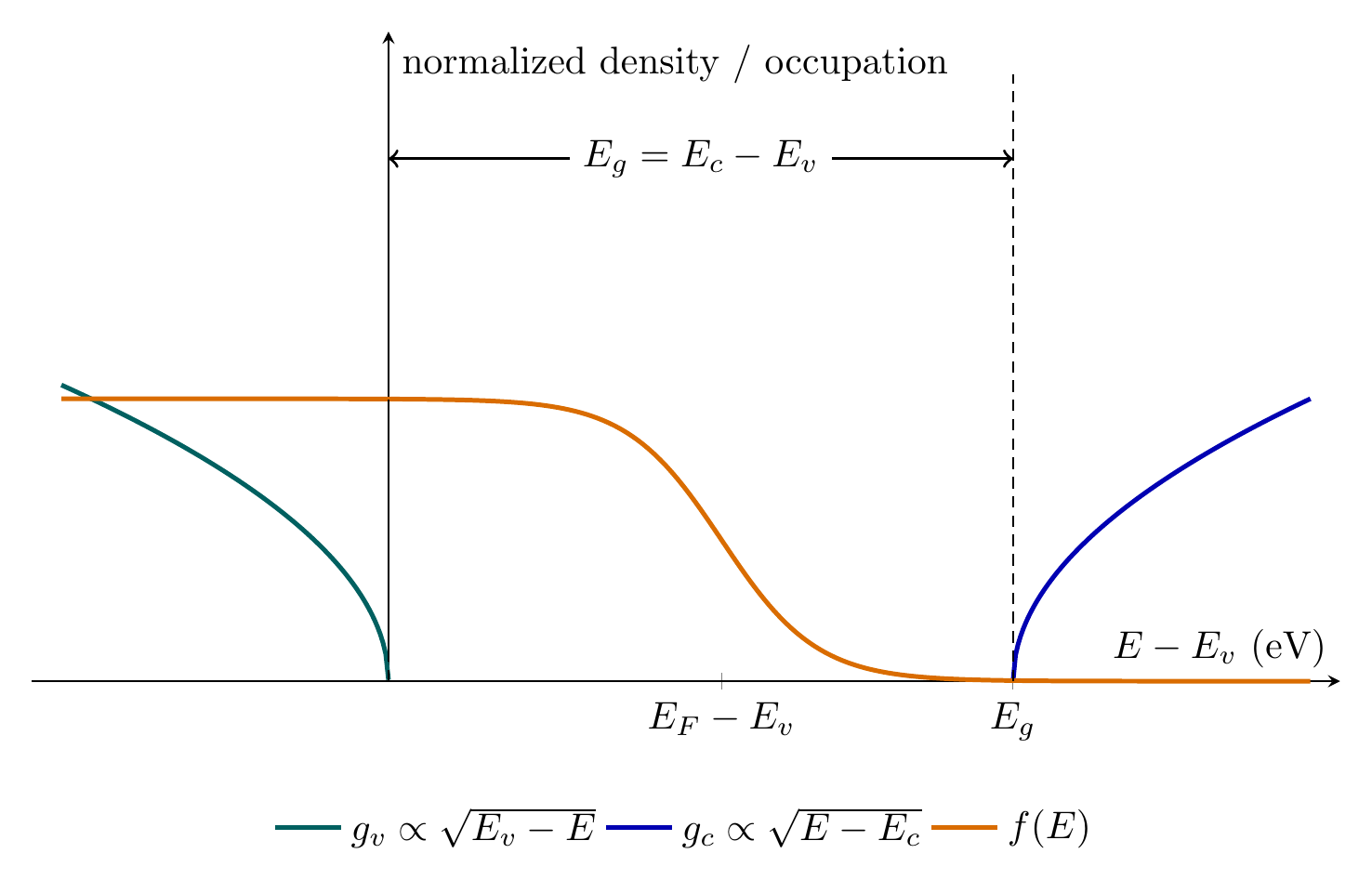
The editable source is bands-dos-fermi.tex.
Solved Problems
1. Effective mass from a measured band curvature
Near its minimum, a conduction band is fitted by
\[E(k)=E_c+(0.500\ \mathrm{eV\,nm^2})k^2,\]where $k$ is in $\mathrm{nm^{-1}}$. Find $m_n^*/m_0$.
Comparing $E-E_c=Ak^2$ with $\hbar^2k^2/(2m_n^*)$ gives
\[m_n^*=\frac{\hbar^2}{2A}.\]Since $\hbar^2/(2m_0)=0.0380998\ \mathrm{eV\,nm^2}$,
\[\frac{m_n^*}{m_0} =\frac{0.0380998}{0.500} =0.07620.\]The positive curvature gives a positive electron effective mass. The units $\mathrm{eV\,nm^2}$ cancel in the ratio, and substituting $m_n^$ back into $\hbar^2/(2m_n^)$ returns the stated coefficient.
2. States near a conduction-band edge
For one isotropic valley with $m_n^*=0.26m_0$, find the number of states per unit volume from $E_c$ to $E_c+0.100\ \mathrm{eV}$ and the density of states at the upper edge.
Using SI units, $\Delta E=1.60218\times10^{-20}\ \mathrm J$. Hence
\[\frac{\mathcal N_c}V =\frac{1}{3\pi^2}\left(\frac{2m_n^*}{\hbar^2}\right)^{3/2}(\Delta E)^{3/2} =1.904\times10^{25}\ \mathrm{m^{-3}}.\]At the upper edge,
\[g_c(E_c+\Delta E) =1.783\times10^{45}\ \mathrm{J^{-1}m^{-3}} =2.856\times10^{20}\ \mathrm{eV^{-1}cm^{-3}}.\]Both quantities are positive. A compact integration check is
\[\frac{\mathcal N_c}V=\frac23g_c(E_c+\Delta E)\Delta E =1.904\times10^{19}\ \mathrm{cm^{-3}}.\]Descriptive Questions
- Explain how discrete atomic levels form allowed energy bands and forbidden gaps in a crystal.
- Derive the effective-mass relation from the curvature of $E(k)$ and interpret the valence-band sign.
- Count the allowed $k$ states in a three-dimensional sphere, including spin degeneracy.
- Derive the conduction- and valence-band densities of states for isotropic parabolic bands.
Numerical Problems
-
A conduction band follows $E(k)=E_c+(0.400\ \mathrm{eV\,nm^2})k^2$. Find the group velocity at $k=0.500\ \mathrm{nm^{-1}}$ using $v_g=\hbar^{-1}dE/dk$.
Final answer: $v_g=6.077\times10^5\ \mathrm{m\,s^{-1}}$ in the positive-$k$ direction.
-
Find $k$ for a conduction electron $0.0800\ \mathrm{eV}$ above $E_c$ when $m_n^*=0.20m_0$.
Final answer: $k=6.480\times10^8\ \mathrm{m^{-1}}=0.6480\ \mathrm{nm^{-1}}$.
-
Electrons occupy all spin-degenerate $k$ states inside a sphere of radius $k_0=1.00\ \mathrm{nm^{-1}}$ in a cubic sample of side $100\ \mathrm{nm}$. Using periodic boundary conditions, estimate the number of states $N=Vk_0^3/(3\pi^2)$.
Final answer: $N=3.377\times10^4$ spin-degenerate states.
-
A parabolic conduction-band DOS obeys $g_c^2=B(E-E_c)$. Measurements give $g_c=2.00\times10^{20}\ \mathrm{eV^{-1}cm^{-3}}$ at $E=1.10\ \mathrm{eV}$ and $4.00\times10^{20}\ \mathrm{eV^{-1}cm^{-3}}$ at $E=1.40\ \mathrm{eV}$. Eliminate $B$ and infer the band-edge energy $E_c$.
Final answer: $(4.00/2.00)^2=(1.40-E_c)/(1.10-E_c)=4$, so $E_c=1.00\ \mathrm{eV}$.
-
Six equivalent valleys each have a single-valley DOS of $4.00\times10^{19}\ \mathrm{eV^{-1}cm^{-3}}$ at a specified energy. Find the total DOS. If the single-valley density-of-states mass is $0.320m_0$, find the equivalent mass that incorporates valley degeneracy.
Final answer: $g_{\rm total}=2.40\times10^{20}\ \mathrm{eV^{-1}cm^{-3}}$ and $m_{\rm DOS}=6^{2/3}(0.320m_0)=1.057m_0$.
-
At equal energy offsets from their edges, compare $g_v$ and $g_c$ when $m_p^=0.50m_0$ and $m_n^=0.25m_0$.
Final answer: $g_v/g_c=(m_p^/m_n^)^{3/2}=2.828$.
All curvature identities, state-counting reductions, and numerical values are reproducible in the accessible Maxima worksheet for energy bands and density of states.


Discussion