

30 Jun 2025
LED, Photodiode, Solar Cell, and Semiconductor Laser
Operating principles and electrical-optical characteristics of four semiconductor optoelectronic devices.
Photons couple most efficiently to a direct-gap semiconductor because electron-hole recombination can conserve crystal momentum without a phonon. The photon energy and free-space wavelength obey
\[h\nu=\frac{hc}{\lambda}.\]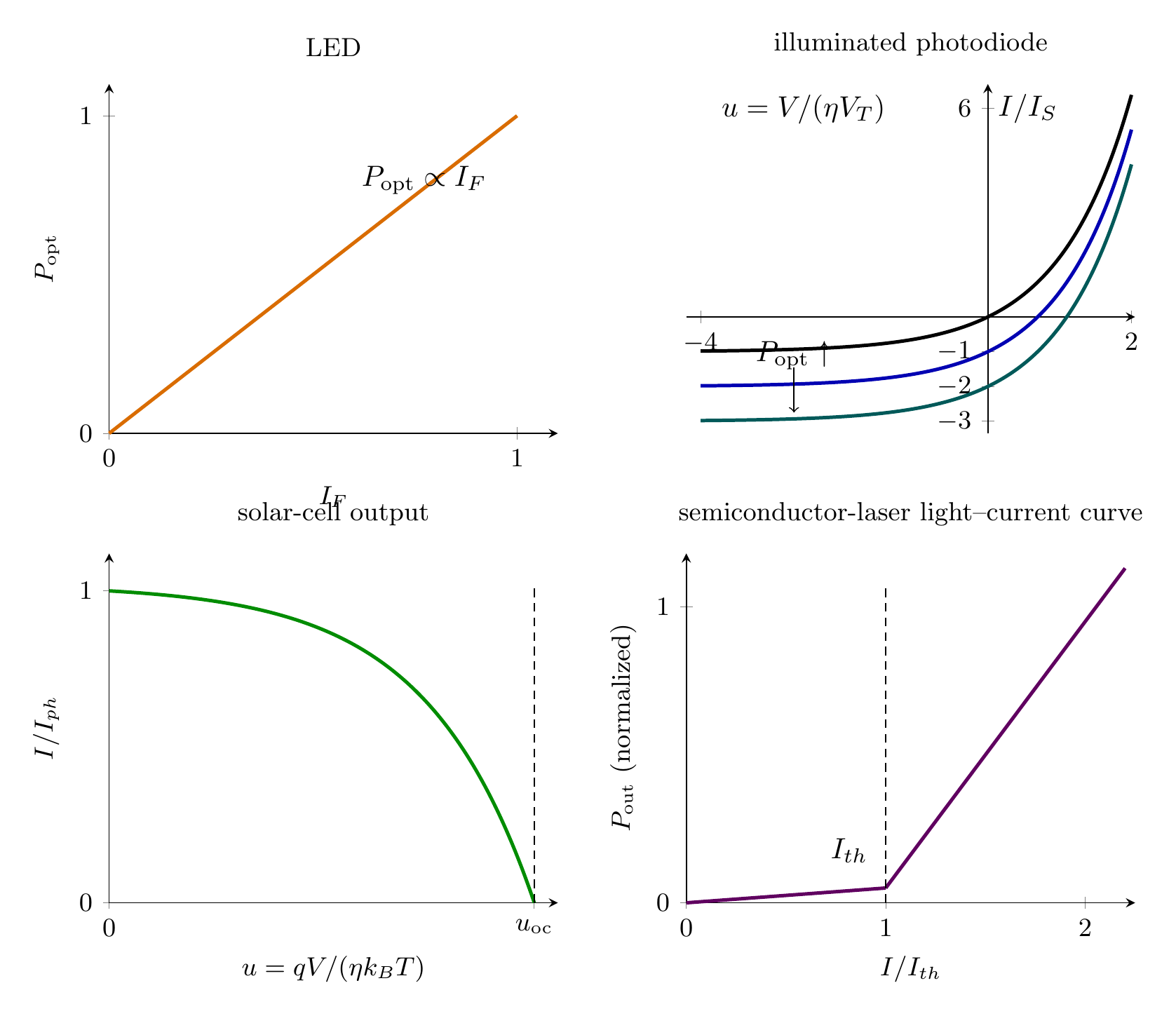
The editable source is optoelectronic-characteristics.tex.
Light-emitting diode
Forward bias injects electrons and holes into an active direct-gap region. Their radiative recombination emits photons with energy concentrated near $E_g$:
\[\lambda\simeq\frac{hc}{E_g}, \qquad \lambda(\mu\mathrm m)\simeq\frac{1.240}{E_g(\mathrm{eV})}.\]The electrical characteristic is diode-like. Above its knee, emitted optical power is approximately proportional to forward current until heating, non-radiative recombination, or efficiency droop becomes important. The forward voltage is of order $E_g/q$ but also contains junction, series-resistance, and temperature contributions; it is not exactly $E_g/q$.
Photodiode
A reverse-biased photodiode absorbs photons with $h\nu\ge E_g$. Electron-hole pairs created in or close to the depletion region are separated by its electric field, producing a reverse photocurrent. With forward diode current defined positive,
\[\boxed{I=I_S\!\left(e^{V/(\eta V_T)}-1\right)-I_{ph}}, \qquad I_{ph}=\mathcal R P_{opt}.\]$\mathcal R$ is responsivity in $\mathrm{A\,W^{-1}}$. If each collected photon produces at most one electron and the external quantum efficiency is $\eta_q$,
\[\boxed{\mathcal R=\eta_q\frac{q}{h\nu} =\eta_q\frac{q\lambda}{hc}}.\]Reverse bias widens the depletion region, lowers junction capacitance, and improves speed, but increases dark-current and breakdown constraints. Below breakdown the reverse current changes nearly linearly with optical power.
Solar cell
A solar cell is a large-area illuminated junction operated without an externally imposed reverse bias. Define delivered current as positive from the cell to the load. Its ideal characteristic is
\[\boxed{I=I_{ph}-I_0\!\left(e^{V/(\eta V_T)}-1\right)}.\]At short circuit,
\[I_{sc}=I(V=0)=I_{ph},\]and at open circuit,
\[\boxed{V_{oc}=\eta V_T\ln\!\left(1+\frac{I_{ph}}{I_0}\right)}.\]The maximum-power point $(V_{mp},I_{mp})$ maximizes $P=VI$. The fill factor and conversion efficiency are
\[FF=\frac{V_{mp}I_{mp}}{V_{oc}I_{sc}}, \qquad \eta_{cell}=\frac{V_{mp}I_{mp}}{P_{in}}.\]Series resistance reduces the high-voltage part of the curve; shunt leakage reduces current near short circuit.
Semiconductor laser
A forward-biased direct-gap double-heterostructure confines electrons, holes, and light to a thin active layer. Sufficient injection creates population inversion. A photon of energy near $E_g$ then stimulates recombination and produces a second photon with the same frequency, phase, direction, and polarization.
Two cleaved or fabricated facets form a Fabry-Perot resonator. Longitudinal modes approximately satisfy
\[2nL=m\lambda,\]where $L$ is cavity length, $n$ refractive index, and $m$ an integer. Lasing begins when modal gain balances internal and mirror losses:
\[\boxed{\Gamma g(N_{th}) =\alpha_i+\frac1{2L}\ln\!\left(\frac1{R_1R_2}\right)}.\]Here $g$ and $\alpha_i$ are in $\mathrm{m^{-1}}$, $\Gamma$ is dimensionless confinement factor, and $R_1,R_2$ are facet power reflectivities. Below threshold the output is mainly spontaneous emission; above threshold $P_{out}$ rises approximately linearly with $I-I_{th}$ and is narrowband, coherent, and directional.
Solved Problems
1. LED wavelength and wall-plug efficiency
A direct-gap LED has $E_g=1.90\,\mathrm{eV}$, operates at $V_F=2.00\,\mathrm V$ and $I_F=20.0\,\mathrm{mA}$, and emits $15.0\,\mathrm{mW}$ of optical power.
Its approximate peak wavelength is
\[\lambda\simeq\frac{1.240}{1.90}\,\mu\mathrm m =0.6526\,\mu\mathrm m=653\,\mathrm{nm}.\]The electrical input is
\[P_{el}=V_FI_F=(2.00)(20.0\,\mathrm{mA})=40.0\,\mathrm{mW},\]so the wall-plug efficiency is
\[\eta_{wp}=\frac{15.0}{40.0}=0.375=37.5\%.\]The photon relation predicts colour from the band gap; the efficiency calculation separately accounts for non-radiative and extraction losses.
2. Photodiode responsivity and photocurrent
A photodiode has external quantum efficiency $\eta_q=0.800$ at $\lambda=850\,\mathrm{nm}$. Using $hc/q=1.240\,\mathrm{V\,\mu m}$,
\[\mathcal R=\eta_q\frac{\lambda(\mu\mathrm m)}{1.240} =0.800\frac{0.850}{1.240} =0.5484\,\mathrm{A\,W^{-1}}.\]For $P_{opt}=200\,\mu\mathrm W$,
\[I_{ph}=\mathcal RP_{opt} =(0.5484)(200\,\mu\mathrm W)=109.7\,\mu\mathrm A.\]The sign in the diode equation is negative relative to forward current; $109.7\,\mu\mathrm A$ is the positive photocurrent magnitude.
3. Solar-cell fill factor and efficiency
A cell has $I_{sc}=0.800\,\mathrm A$, $V_{oc}=0.620\,\mathrm V$, $I_{mp}=0.720\,\mathrm A$, $V_{mp}=0.500\,\mathrm V$, and incident power $P_{in}=1.50\,\mathrm W$.
\[P_{\max}=V_{mp}I_{mp}=(0.500)(0.720)=0.360\,\mathrm W,\] \[FF=\frac{0.360}{(0.620)(0.800)}=0.7258, \qquad \eta_{cell}=\frac{0.360}{1.50}=0.240=24.0\%.\]Both dimensionless quantities are below unity, providing an immediate consistency check.
Descriptive Questions
- Explain why direct-gap materials are preferred for LEDs and semiconductor lasers and relate band gap to wavelength.
- Derive photodiode responsivity from quantum efficiency and describe the effects of reverse bias.
- Derive $V_{oc}$ for an ideal solar cell and define fill factor and conversion efficiency.
- Explain optical confinement, population inversion, longitudinal modes, and the threshold-gain condition of a semiconductor laser.
Numerical Problems
-
An LED emitting at $620\,\mathrm{nm}$ produces $12.4\,\mathrm{mW}$ of optical power while drawing $25.0\,\mathrm{mA}$. Using $hc/q=1.240\,\mathrm{V\,\mu m}$ and $q=1.602\times10^{-19}\,\mathrm C$, find the photon emission rate and the external quantum efficiency in photons emitted per injected electron.
Final answer: Each photon has energy $E_\gamma=q(1.240/0.620)=2q=3.204\times10^{-19}\,\mathrm J$, so $\dot N_\gamma=P_{opt}/E_\gamma=3.870\times10^{16}\,\mathrm{s^{-1}}$. The injection rate is $I/q=1.561\times10^{17}\,\mathrm{s^{-1}}$, hence $\eta_{ext}=\dot N_\gamma/(I/q)=0.248$, or $24.8\%$.
-
An $850\,\mathrm{nm}$ photodiode receives $5.00\times10^{12}$ photons per second and has external quantum efficiency $0.750$. Find its collected-electron rate, photocurrent, and incident optical power using $hc/q=1.240\,\mathrm{V\,\mu m}$.
Final answer: The collected rate is $0.750(5.00\times10^{12})=3.75\times10^{12}\,\mathrm{s^{-1}}$, so $I_{ph}=q\dot N_e=0.6008\,\mu\mathrm A$. The incident power is $\dot N_\gamma q(1.240/0.850)=1.169\,\mu\mathrm W$.
-
A semiconductor laser has cavity length $L=300\,\mu\mathrm m$, equal facet power reflectivities $R_1=R_2=0.320$, internal loss $\alpha_i=10.0\,\mathrm{cm^{-1}}$, and confinement factor $\Gamma=0.300$. Find the material gain required at threshold.
Final answer: With $L=0.0300\,\mathrm{cm}$, the mirror loss is $[2L]^{-1}\ln[1/(R_1R_2)]=37.98\,\mathrm{cm^{-1}}$. Therefore $g_{th}=(\alpha_i+37.98)/\Gamma=159.94\,\mathrm{cm^{-1}}\approx160\,\mathrm{cm^{-1}}$.
-
An ideal solar cell has $I_{ph}=0.350\,\mathrm A$, $I_0=1.00\,\mathrm{nA}$, $\eta=1.30$, and $V_T=25.9\,\mathrm{mV}$. Find its open-circuit voltage and the minimum number of identical series cells required to exceed $12.0\,\mathrm V$ at open circuit.
Final answer: $V_{oc}=\eta V_T\ln(1+I_{ph}/I_0)=0.6624\,\mathrm V$. Eighteen cells give $11.92\,\mathrm V$, whereas nineteen give $12.59\,\mathrm V$, so the minimum is $19$ cells.
-
A laser cavity has $L=300\,\mu\mathrm m$, $n=3.50$, and $\lambda=850\,\mathrm{nm}$. Estimate the adjacent longitudinal-mode spacing $\Delta\lambda\simeq\lambda^2/(2nL)$.
Final answer: $\Delta\lambda=3.44\times10^{-10}\,\mathrm m=0.344\,\mathrm{nm}$, much smaller than the optical wavelength.
The photon, responsivity, photovoltaic, and cavity-mode calculations are reproducible in optoelectronic-devices-check.mac; every printed residual is zero.


Discussion