

26 Jul 2025
Boundary Conditions, Rigid-Wall Box, and Square Wells
The stationary one-dimensional Schrödinger equation is
\[-\frac{\hbar^2}{2m}\frac{d^2\psi}{dx^2}+V(x)\psi=E\psi.\]It is a second-order differential equation, so two boundary conditions are needed. Those conditions, together with normalizability, turn an apparently continuous energy parameter into a discrete set for a bound system.
Continuity at a finite potential step
Integrate the equation across a small interval containing a finite step at $x=x_0$:
\[-\frac{\hbar^2}{2m} \left[\psi^{\prime}(x_0+\epsilon)-\psi^{\prime}(x_0-\epsilon)\right] +\int_{x_0-\epsilon}^{x_0+\epsilon}(V-E)\psi\,dx=0.\]If $V$ and $\psi$ are finite, the integral tends to zero as $\epsilon\to0$. Hence
\[\boxed{\psi^{\prime}(x_0^+)=\psi^{\prime}(x_0^-)}.\]The wavefunction itself must also be continuous. A finite jump in $\psi$ would produce a delta function in $\psi^{\prime}$ and a derivative of a delta function in $\psi^{\prime\prime}$, but the equation contains no term able to cancel it for a finite step. Thus
\[\boxed{\psi(x_0^+)=\psi(x_0^-)}.\]At an infinite wall this finite-step argument does not apply. The accessible wavefunction must vanish at the wall, while derivative continuity with the forbidden exterior is not required.
Free particle in a rigid one-dimensional box
Let
\[V(x)= \begin{cases} 0,&0<x<L,\\ \infty,&x\leq0\ \text{or}\ x\geq L. \end{cases}\]Inside the box the particle is free, so
\[\psi^{\prime\prime}+k^2\psi=0, \qquad k^2=\frac{2mE}{\hbar^2}.\]The general interior solution is
\[\psi(x)=A\sin kx+B\cos kx.\]The rigid walls impose $\psi(0)=0$ and $\psi(L)=0$. The first condition gives $B=0$. A non-zero state then requires
\[A\sin kL=0 \quad\Longrightarrow\quad kL=n\pi,\]where $n=1,2,3,\ldots$; $n=0$ would make the wavefunction identically zero. Therefore
\[\boxed{k_n=\frac{n\pi}{L}}, \qquad \boxed{E_n=\frac{n^2\pi^2\hbar^2}{2mL^2}}.\]The energy has units $\hbar^2/(mL^2)=\mathrm J$. Normalization gives
\[1=\lvert A\rvert^2\int_0^L\sin^2\!\left(\frac{n\pi x}{L}\right)dx =\lvert A\rvert^2\frac L2,\]so a real phase convention gives
\[\boxed{ \psi_n(x)=\sqrt{\frac2L} \sin\!\left(\frac{n\pi x}{L}\right) },\qquad 0<x<L.\]The boundary conditions allow only integer half-wavelengths, $L=n\lambda_n/2$. This is the direct emergence of discrete energy levels from confinement.
Finite one-dimensional square well
Use a symmetric well of half-width $a$ and depth $V_0>0$:
\[V(x)= \begin{cases} -V_0,&\lvert x\rvert<a,\\ 0,&\lvert x\rvert\geq a. \end{cases}\]A bound state must satisfy $-V_0<E<0$. Define positive real wave numbers
\[k=\frac{\sqrt{2m(E+V_0)}}{\hbar}, \qquad \kappa=\frac{\sqrt{-2mE}}{\hbar}.\]Both have units $\mathrm{m^{-1}}$, and
\[k^2+\kappa^2=\frac{2mV_0}{\hbar^2}.\]Inside the well, $\psi^{\prime\prime}+k^2\psi=0$, so the solutions oscillate. Outside, $\psi^{\prime\prime}-\kappa^2\psi=0$. Normalizability removes the exponentials that grow as $x\to\pm\infty$.
Because $V(x)=V(-x)$, bound eigenfunctions may be chosen even or odd.
Even states
Choose
\[\psi_e(x)= \begin{cases} A\cos kx,&\lvert x\rvert<a,\\ A\cos(ka)e^{-\kappa(\lvert x\rvert-a)},&\lvert x\rvert\geq a. \end{cases}\]Continuity of $\psi$ at $x=a$ is already built into this expression. Derivative continuity gives
\[-Ak\sin(ka)=-A\kappa\cos(ka),\]and hence
\[\boxed{k\tan(ka)=\kappa}.\]Odd states
Choose
\[\psi_o(x)= \begin{cases} A\sin kx,&\lvert x\rvert<a,\\ A\,\operatorname{sgn}(x)\sin(ka)e^{-\kappa(\lvert x\rvert-a)},&\lvert x\rvert\geq a. \end{cases}\]At $x=a$, derivative continuity gives
\[Ak\cos(ka)=-A\kappa\sin(ka),\]so
\[\boxed{-k\cot(ka)=\kappa}.\]Introduce dimensionless quantities
\[z=ka,\qquad z_0=\frac{a\sqrt{2mV_0}}{\hbar}.\]Then $\kappa a=\sqrt{z_0^2-z^2}$, and the allowed bound energies are the isolated roots
\[\boxed{z\tan z=\sqrt{z_0^2-z^2}} \quad\text{(even)},\] \[\boxed{-z\cot z=\sqrt{z_0^2-z^2}} \quad\text{(odd)}.\]Once a root $z$ is found,
\[\boxed{E=-\frac{\hbar^2\kappa^2}{2m} =-V_0+\frac{\hbar^2z^2}{2ma^2}}.\]The matching equations have solutions only at discrete intersections. Unlike the rigid box, a finite well has exponentially decaying tails outside and only finitely many bound levels. In the limit $V_0\to\infty$, $\kappa\to\infty$ and the boundary values approach zero. Measured upward from the well bottom, $E+V_0$, the levels approach the rigid-wall spectrum for the full width $2a$.
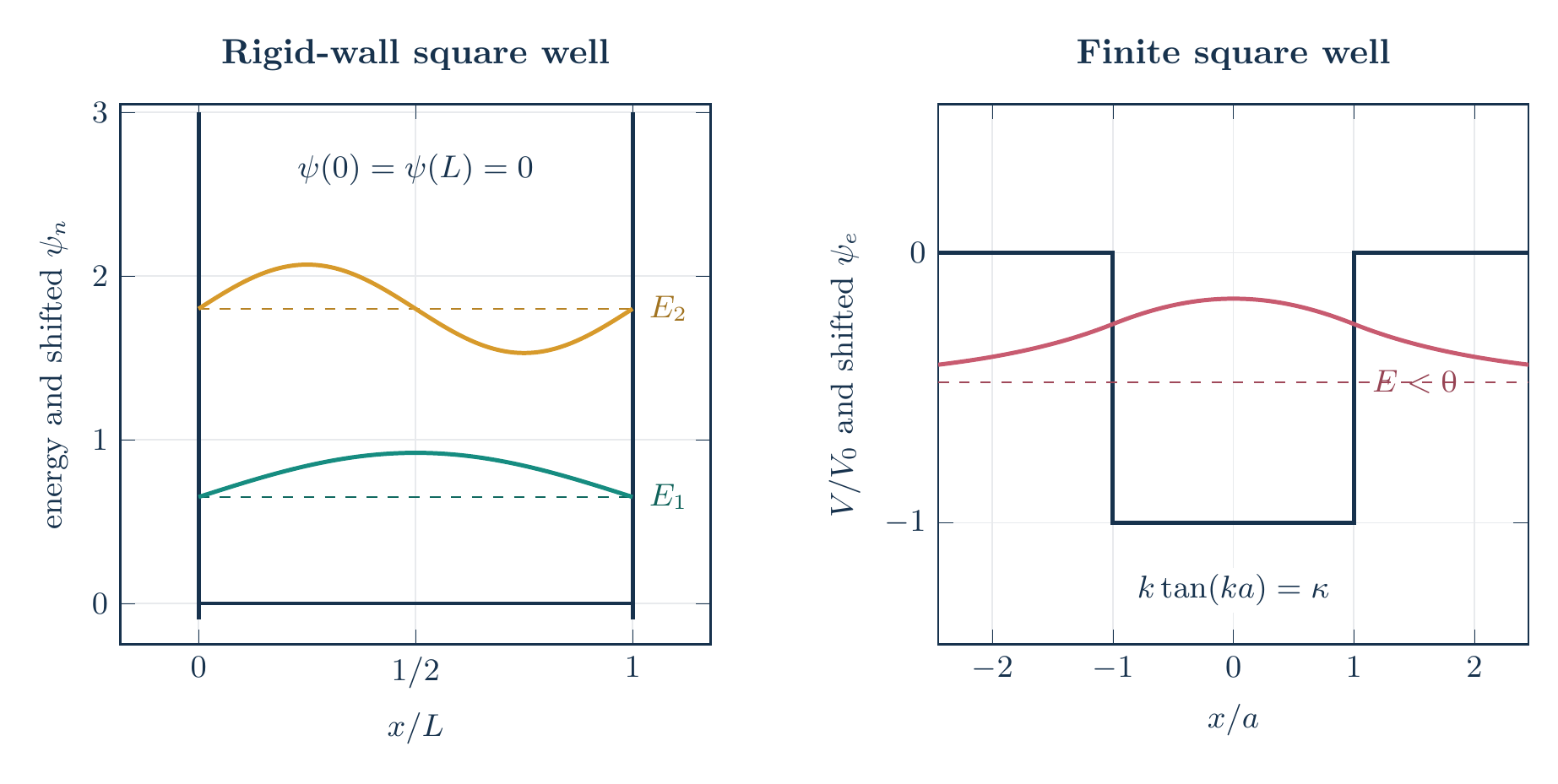
The editable TikZ source generates the figure. Schrödinger-equation and matching residuals are checked in the Maxima worksheet.
Solved Problems
1. Electron levels and a photon from a rigid nanometre box
An electron is confined to an infinite one-dimensional box of width $L=1.00\ \mathrm{nm}$. Find $E_1$, $E_2$, and the photon wavelength for a transition from $n=2$ to $n=1$.
Solution. Energies are measured upward from the zero potential inside the box and are positive:
\[E_n=\frac{n^2\pi^2\hbar^2}{2m_eL^2}.\]Thus
\[\boxed{E_1=0.3760\ \mathrm{eV}},\qquad \boxed{E_2=4E_1=1.504\ \mathrm{eV}}.\]For downward emission, the photon carries the positive energy difference
\[E_\gamma=E_2-E_1=3E_1=1.1281\ \mathrm{eV}.\]Therefore
\[\lambda_\gamma=\frac{hc}{E_\gamma} =\boxed{1.099\times10^3\ \mathrm{nm}}.\]The scale $\hbar^2/(mL^2)$ has energy units. A smaller box raises every level as $L^{-2}$ and shortens the transition wavelength. In the limit $L\to\infty$, the spacing tends to zero and the spectrum approaches the continuum of a free particle.
2. Ground even state of a finite symmetric well
For a finite well with dimensionless strength $z_0=2.00$, find the lowest even root and express its bound-state energy as a fraction of the depth $V_0$.
Solution. An even state obeys
\[z\tan z=\sqrt{z_0^2-z^2},\]with the lowest root in $0<z<\pi/2$. Numerical solution gives
\[\boxed{z=1.02987}.\]The dimensionless exterior decay constant is
\[\kappa a=\sqrt{z_0^2-z^2} =\boxed{1.71446}.\]Because the potential is $-V_0$ inside and zero outside,
\[\frac E{V_0} =-1+\frac{z^2}{z_0^2} =\boxed{-0.73484}.\]The negative sign is essential: a bound state lies below the exterior zero, while $-1<E/V_0<0$ keeps it above the well bottom. All quantities in the matching equation are dimensionless. The positive $\kappa$ selects exponential decay away from either boundary; choosing $-\kappa$ would produce a non-normalizable growing tail. As the depth increases, the exterior decay becomes sharper and the spectrum approaches that of a rigid box of width $2a$.
Descriptive Questions
- Why are both $\psi$ and $\psi^{\prime}$ continuous at a finite potential step, and why does the derivative condition change at an infinite wall?
- Explain how rigid-wall boundary conditions exclude $n=0$ and generate a discrete one-dimensional energy spectrum.
- How do parity and normalizability reduce the finite-well matching problem to separate even and odd eigenvalue equations?
- Compare the number, energies, and spatial tails of finite-well bound states with those of an infinite square well.
Numerical Problems
- Find the probability that an electron in the ground state of a rigid box lies in its central half, $L/4<x<3L/4$.
Final answer: $\boxed{P=\tfrac12+\tfrac1\pi=0.8183}$. - An electron’s ground-state energy in an infinite one-dimensional box is $1.00\ \mathrm{eV}$. Find the box width.
Final answer: $\boxed{L=0.6132\ \mathrm{nm}}$. - A finite-well tail is proportional to $e^{-\kappa(x-a)}$. Find its amplitude relative to the boundary value one decay length beyond the boundary.
Final answer: $\boxed{\psi(a+\kappa^{-1})/\psi(a)=e^{-1}=0.3679}$.
The original boundary and matching identities are checked in the topic worksheet linked above. Every added level, matching root, and probability value is checked in the MJ-11 problem-verification worksheet; every printed residual and check is zero.


Discussion