

28 Jun 2025
Free Gaussian Wave Packet and Momentum Space
A free-particle momentum eigenfunction extends over all space. A localized free particle must therefore be a wave packet: a continuous superposition of plane waves with different momenta.
Use the symmetric Fourier-transform pair
\[\boxed{ \phi(p,t)=\frac1{\sqrt{2\pi\hbar}} \int_{-\infty}^{\infty}\Psi(x,t)e^{-ipx/\hbar}dx },\] \[\boxed{ \Psi(x,t)=\frac1{\sqrt{2\pi\hbar}} \int_{-\infty}^{\infty}\phi(p,t)e^{ipx/\hbar}dp }.\]The opposite signs make the two operations inverse because
\[\frac1{2\pi\hbar}\int_{-\infty}^{\infty} e^{ip(x-x^{\prime})/\hbar}dp=\delta(x-x^{\prime}).\]Parseval’s relation then gives
\[\int\lvert\Psi(x,t)\rvert^2dx=\int\lvert\phi(p,t)\rvert^2dp=1.\]Thus $\Psi$ has units $\mathrm{m^{-1/2}}$, while $\phi$ has units $(\mathrm{kg\,m\,s^{-1}})^{-1/2}$.
Operators in momentum space
Fourier transformation of $-i\hbar\partial_x\Psi$ and integration by parts give
\[\begin{aligned} \mathcal F[-i\hbar\partial_x\Psi] &=\frac1{\sqrt{2\pi\hbar}} \left[-i\hbar\Psi e^{-ipx/\hbar}\right]_{-\infty}^{\infty}\\ &\quad-\frac1{\sqrt{2\pi\hbar}} \int\Psi(-i\hbar)\left(-\frac{ip}{\hbar}\right)e^{-ipx/\hbar}dx\\ &=p\phi(p,t), \end{aligned}\]where the boundary term vanishes for a localized packet and $(-i)(-i)=-1$ supplies the displayed sign. Also,
\[i\hbar\frac{\partial}{\partial p}e^{-ipx/\hbar} =x e^{-ipx/\hbar}.\]Therefore
\[\boxed{\hat p=p},\qquad \boxed{\hat x=i\hbar\frac{\partial}{\partial p}}\]in momentum representation.
For a free particle, $\hat H=p^2/(2m)$, so
\[i\hbar\frac{\partial\phi}{\partial t} =\frac{p^2}{2m}\phi.\]At fixed $p$ this is a first-order equation with solution
\[\boxed{\phi(p,t)=\phi(p,0)e^{-ip^2t/(2m\hbar)}}.\]The momentum probability $\lvert\phi(p,t)\rvert^2$ is constant; only its phase evolves.
Initial minimum-uncertainty Gaussian
Take a packet centred at $x_0$ with mean momentum $p_0$ and initial position standard deviation $\sigma_0$:
\[\Psi(x,0)=\frac1{(2\pi\sigma_0^2)^{1/4}} \exp\!\left[-\frac{(x-x_0)^2}{4\sigma_0^2} +\frac{ip_0(x-x_0)}{\hbar}\right].\]Its density is a normalized Gaussian,
\[\lvert\Psi(x,0)\rvert^2 =\frac1{\sqrt{2\pi}\sigma_0} e^{-(x-x_0)^2/(2\sigma_0^2)}.\]To transform it, put $y=x-x_0$ and complete the square:
\[-\frac{y^2}{4\sigma_0^2} -\frac{i(p-p_0)y}{\hbar} =-\frac1{4\sigma_0^2} \left[y+\frac{2i\sigma_0^2(p-p_0)}{\hbar}\right]^2 -\frac{\sigma_0^2(p-p_0)^2}{\hbar^2}.\]Using $\int_{-\infty}^{\infty}e^{-y^2/(4\sigma_0^2)}dy=2\sqrt\pi\sigma_0$ gives
\[\boxed{ \phi(p,0)= \left(\frac{2\sigma_0^2}{\pi\hbar^2}\right)^{1/4} \exp\!\left[-\frac{\sigma_0^2(p-p_0)^2}{\hbar^2} -\frac{ipx_0}{\hbar}\right] }.\]The momentum density is Gaussian with
\[\langle p\rangle=p_0,\qquad \Delta p=\frac{\hbar}{2\sigma_0}.\]Since $\Delta x(0)=\sigma_0$,
\[\Delta x(0)\Delta p=\frac\hbar2.\]Free evolution and spreading
Insert $\phi(p,t)$ into the inverse transform. Completing its complex Gaussian square gives
\[\boxed{ \begin{aligned} \Psi(x,t)={}&\frac{1}{(2\pi\sigma_0^2)^{1/4}} \frac{1}{\sqrt{1+i\tau}}\\ &\times\exp\!\left[ -\frac{(x-x_0-p_0t/m)^2}{4\sigma_0^2(1+i\tau)} +\frac{ip_0}{\hbar} \left(x-x_0-\frac{p_0t}{2m}\right) \right], \end{aligned}}\]where
\[\tau=\frac{\hbar t}{2m\sigma_0^2}.\]The parameter $\tau$ is dimensionless: both $\hbar t$ and $m\sigma_0^2$ have units $\mathrm{kg\,m^2}$. Since
\[\operatorname{Re}\!\left(\frac1{1+i\tau}\right) =\frac1{1+\tau^2},\]taking the modulus squared gives
\[\boxed{ \lvert\Psi(x,t)\rvert^2 =\frac1{\sqrt{2\pi}\,\sigma_t} \exp\!\left[ -\frac{(x-x_0-p_0t/m)^2}{2\sigma_t^2} \right] },\] \[\boxed{ \sigma_t=\sigma_0 \sqrt{1+\left(\frac{\hbar t}{2m\sigma_0^2}\right)^2} }.\]The centre moves at $p_0/m$, the group velocity for $E=p^2/(2m)$. The momentum distribution does not broaden, but its components acquire different phases proportional to $p^2$, so the position distribution spreads. At $t=0$, $\sigma_t=\sigma_0$; for $\lvert t\rvert\gg2m\sigma_0^2/\hbar$, the width grows approximately as $\sigma_t\simeq\hbar\lvert t\rvert/(2m\sigma_0)$.
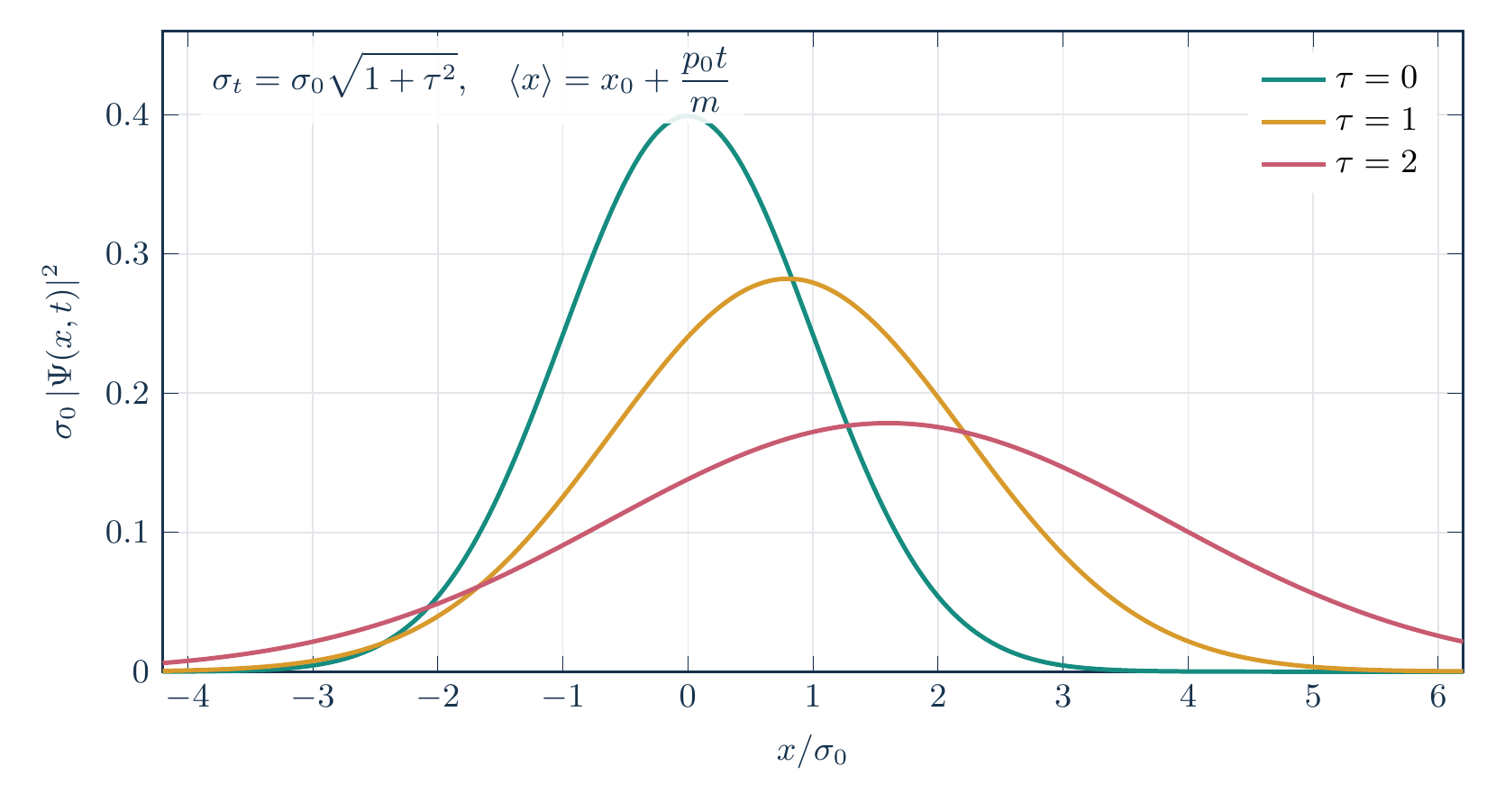
The plotted curves use the derived centre and width. The editable TikZ source generates the figure, and the normalization, mean, variance, width, group-velocity, and free Schrödinger-equation checks return zero residuals in the Maxima worksheet.
Solved Problems
1. Centre motion and spreading of an electron packet
A minimum-uncertainty electron packet starts at $x_0=0$ with $\sigma_0=0.100\ \mathrm{nm}$ and mean velocity $v_0=+1.00\times10^6\ \mathrm{m\,s^{-1}}$. Find its centre and width after $1.00\ \mathrm{fs}$.
Solution. The positive sign of $v_0$ fixes motion toward $+x$. The dimensionless spreading parameter is
\[\tau=\frac{\hbar t}{2m_e\sigma_0^2} =5.788.\]The packet centre follows the free group velocity:
\[x_c(t)=x_0+v_0t =\boxed{1.00\ \mathrm{nm}}.\]Its standard deviation becomes
\[\begin{aligned} \sigma_t &=\sigma_0\sqrt{1+\tau^2}\\ &=(0.100\ \mathrm{nm})\sqrt{1+(5.788)^2}\\ &=\boxed{0.587\ \mathrm{nm}}. \end{aligned}\]The factor $\hbar t/(m_e\sigma_0^2)$ is dimensionless because numerator and denominator both have units $\mathrm{kg\,m^2}$. Spreading enlarges the width but does not change its sign or the mean momentum. At $t=0$, $\tau=0$ and $\sigma_t=\sigma_0$; replacing $t$ by $-t$ reverses centre motion but gives the same width because $\tau$ is squared.
2. Spatial width inferred from a Gaussian momentum spread
A minimum-uncertainty Gaussian has momentum standard deviation $\Delta p=2.00\times10^{-24}\ \mathrm{kg\,m\,s^{-1}}$. Find its position standard deviation and the full width at half maximum of its position density.
Solution. For this Gaussian the uncertainty bound is saturated:
\[\sigma_x\Delta p=\frac{\hbar}{2}.\]Hence
\[\sigma_x=\frac{\hbar}{2\Delta p} =2.636\times10^{-11}\ \mathrm m =\boxed{0.02636\ \mathrm{nm}}.\]For a Gaussian probability density, the full width at half maximum is
\[\begin{aligned} \mathrm{FWHM} &=2\sqrt{2\ln2}\,\sigma_x\\ &=\boxed{0.06208\ \mathrm{nm}}. \end{aligned}\]Momentum spread is non-negative; it does not specify the sign of the mean momentum. The product has action units, and the FWHM-to-standard-deviation ratio is dimensionless. As $\Delta p\to0$, $\sigma_x\to\infty$, so a momentum eigenstate cannot also be localized.
Descriptive Questions
- Why do the opposite signs and common normalization in the Fourier-transform pair make the position and momentum representations inverse descriptions?
- Derive the position and momentum operators in momentum space, including the boundary term needed in the integration by parts.
- Why does the momentum distribution of a free Gaussian remain unchanged while its position distribution spreads?
- Explain how the packet centre, group velocity, spreading time, and long-time width follow from the free-particle dispersion relation.
Numerical Problems
- An electron packet has $x_0=2.00\ \mathrm{nm}$ and $p_0=3.00\times10^{-24}\ \mathrm{kg\,m\,s^{-1}}$. Find its centre after $0.500\ \mathrm{ps}$.
Final answer: $\boxed{x_c=1.649\ \mathrm{\mu m}}$. - Find $\sigma_t/\sigma_0$ when the dimensionless spreading parameter is $\tau=2.00$.
Final answer: $\boxed{\sigma_t/\sigma_0=\sqrt5=2.236}$. - A minimum-uncertainty Gaussian has $\sigma_0=0.200\ \mathrm{nm}$. Find its momentum standard deviation.
Final answer: $\boxed{\Delta p=2.636\times10^{-25}\ \mathrm{kg\,m\,s^{-1}}}$.
The original Gaussian identities are checked in the topic worksheet linked above. Every added width, centre, and uncertainty value is checked in the MJ-11 problem-verification worksheet; every printed residual and check is zero.


Discussion