

27 Jul 2025
Linear Harmonic Oscillator in One and Three Dimensions
One-dimensional harmonic oscillator
For
\[V(x)=\frac12m\omega^2x^2,\]the stationary Schrödinger equation is
\[-\frac{\hbar^2}{2m}\frac{d^2\psi}{dx^2} +\frac12m\omega^2x^2\psi=E\psi.\]Introduce the dimensionless coordinate and energy
\[\xi=\sqrt{\frac{m\omega}{\hbar}}x, \qquad \epsilon=\frac{E}{\hbar\omega}.\]The factor $m\omega/\hbar$ has units $\mathrm{m^{-2}}$. Since $d^2/dx^2=(m\omega/\hbar)d^2/d\xi^2$, division by $\hbar\omega/2$ gives
\[\boxed{ \frac{d^2\psi}{d\xi^2}+(2\epsilon-\xi^2)\psi=0 }.\]For $\lvert\xi\rvert\gg1$, the $\xi^2$ term dominates and the equation is approximately $\psi^{\prime\prime}-\xi^2\psi\simeq0$. Its leading behaviours are $e^{-\xi^2/2}$ and $e^{+\xi^2/2}$; normalizability excludes the growing sign. Write
\[\psi(\xi)=e^{-\xi^2/2}H(\xi).\]Differentiation gives
\[\psi^{\prime}=e^{-\xi^2/2}(H^{\prime}-\xi H),\] \[\psi^{\prime\prime}=e^{-\xi^2/2} \left[H^{\prime\prime}-2\xi H^{\prime}+(\xi^2-1)H\right].\]Substitution cancels the $\xi^2H$ terms and leaves
\[\boxed{H^{\prime\prime}-2\xi H^{\prime}+(2\epsilon-1)H=0}.\]Let $H=\sum_{j=0}^{\infty}a_j\xi^j$. Equating the coefficient of $\xi^j$ gives
\[(j+2)(j+1)a_{j+2} +(2\epsilon-1-2j)a_j=0,\]or
\[\boxed{ a_{j+2}=\frac{2j+1-2\epsilon}{(j+2)(j+1)}a_j }.\]If the series does not terminate, its large-$j$ behaviour reconstructs $e^{+\xi^2}$, making $\psi$ non-normalizable. Termination at degree $n$ requires the numerator to vanish at $j=n$:
\[2n+1-2\epsilon=0.\]Hence
\[\boxed{E_n=\left(n+\frac12\right)\hbar\omega}, \qquad n=0,1,2,\ldots .\]The terminating polynomials are Hermite polynomials $H_n(\xi)$. With the standard convention $H_n(\xi)=(-1)^ne^{\xi^2}d^n(e^{-\xi^2})/d\xi^n$, the normalized eigenfunctions are
\[\boxed{ \psi_n(x)= \left(\frac{m\omega}{\pi\hbar}\right)^{1/4} \frac{H_n(\xi)}{\sqrt{2^n n!}} e^{-\xi^2/2} }.\]The normalization follows from
\[\int_{-\infty}^{\infty}e^{-\xi^2}H_n(\xi)H_m(\xi)d\xi =\sqrt\pi\,2^n n!\,\delta_{nm},\]and $dx=\sqrt{\hbar/(m\omega)}d\xi$. The eigenfunction parity is $(-1)^n$. The ground state has $E_0=\hbar\omega/2$, the zero-point energy required by the uncertainty principle.
Three-dimensional isotropic oscillator
For
\[V(x,y,z)=\frac12m\omega^2(x^2+y^2+z^2),\]the Hamiltonian separates exactly:
\[\hat H=\hat H_x+\hat H_y+\hat H_z,\] \[\hat H_x=-\frac{\hbar^2}{2m}\frac{\partial^2}{\partial x^2} +\frac12m\omega^2x^2,\]with analogous expressions for $y$ and $z$. Put
\[\Psi(x,y,z)=X(x)Y(y)Z(z).\]After substitution and division by $XYZ$,
\[\frac{\hat H_xX}{X} +\frac{\hat H_yY}{Y} +\frac{\hat H_zZ}{Z}=E.\]Each term depends on a different coordinate, so each equals a constant $E_x,E_y,E_z$ with $E=E_x+E_y+E_z$. Applying the one-dimensional result to every factor gives
\[\boxed{ \Psi_{n_xn_yn_z}(x,y,z) =\psi_{n_x}(x)\psi_{n_y}(y)\psi_{n_z}(z) },\] \[\boxed{ E_{n_xn_yn_z} =\left(n_x+n_y+n_z+\frac32\right)\hbar\omega }.\]Here $n_x,n_y,n_z$ are independent non-negative integers. For total quantum number $N=n_x+n_y+n_z$, the energy is $(N+3/2)\hbar\omega$. The number of non-negative integer triples with that sum is
\[g_N=\frac{(N+1)(N+2)}2.\]The normalized ground state is
\[\boxed{ \Psi_{000}(\mathbf r)= \left(\frac{m\omega}{\pi\hbar}\right)^{3/4} e^{-m\omega r^2/(2\hbar)} },\]with energy $3\hbar\omega/2$, one zero-point contribution from each Cartesian direction.
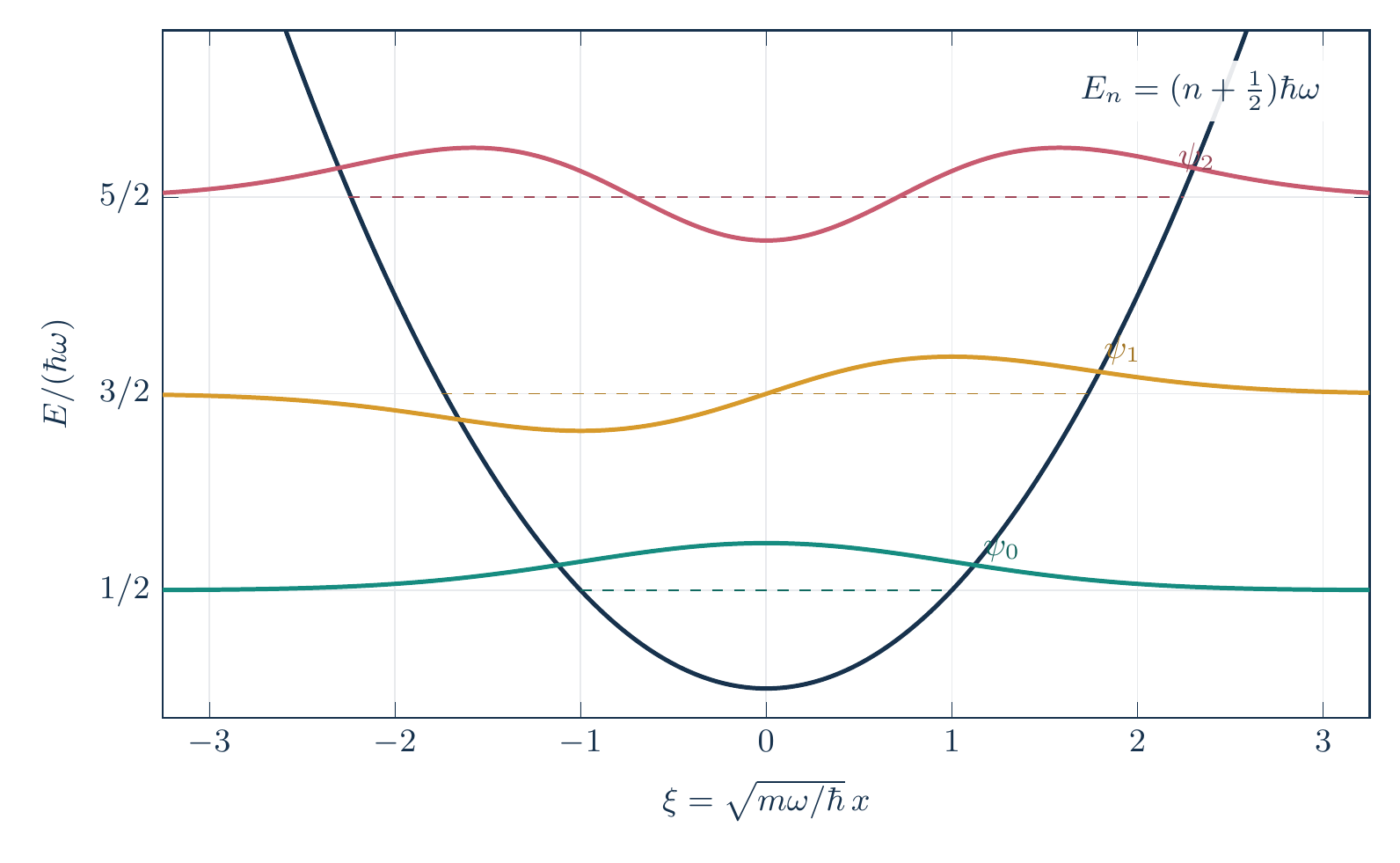
The editable TikZ source generates the figure. The dimensionless differential equation, Hermite-polynomial residuals, and 3D energy sum are checked in the Maxima worksheet.
Solved Problems
1. Electron oscillator energies and ground-state widths
An electron is in a one-dimensional oscillator with $\omega=5.00\times10^{13}\ \mathrm{rad\,s^{-1}}$. Find $E_0$, $E_3$, and the ground-state standard deviations $\Delta x$ and $\Delta p$.
Solution. The allowed energies are positive:
\[E_n=\left(n+\frac12\right)\hbar\omega.\]Therefore
\[\boxed{E_0=0.01646\ \mathrm{eV}},\qquad \boxed{E_3=0.1152\ \mathrm{eV}}.\]The normalized ground-state Gaussian has zero mean position and momentum but nonzero spreads,
\[\Delta x=\sqrt{\frac{\hbar}{2m_e\omega}} =\boxed{1.076\ \mathrm{nm}},\] \[\Delta p=\sqrt{\frac{m_e\hbar\omega}{2}} =\boxed{4.90\times10^{-26}\ \mathrm{kg\,m\,s^{-1}}}.\]Their product is
\[\Delta x\,\Delta p=\frac{\hbar}{2},\]with action units. Neither standard deviation carries a sign. Raising $\omega$ narrows $\Delta x$ as $\omega^{-1/2}$ and broadens $\Delta p$ as $\omega^{1/2}$, while their product remains fixed. In the formal limit $\omega\to0^+$, the level spacing and zero-point energy vanish as confinement is removed.
2. Degeneracy of a three-dimensional oscillator shell
Find the energy and degeneracy of the isotropic three-dimensional oscillator shell with total quantum number $N=4$.
Solution. Since $N=n_x+n_y+n_z$,
\[\boxed{E_{N=4}=\left(4+\frac32\right)\hbar\omega =\frac{11}{2}\hbar\omega}.\]The number of ordered non-negative triples is
\[g_4=\frac{(4+1)(4+2)}2 =\boxed{15}.\]The count can be checked explicitly: permutations of $(4,0,0)$ contribute $3$, $(3,1,0)$ contribute $6$, $(2,2,0)$ contribute $3$, and $(2,1,1)$ contribute $3$, for a total of $15$. Degeneracy is dimensionless, while $\hbar\omega$ has energy units. All states in the shell have positive energy. If the three Cartesian frequencies cease to be equal, this isotropic degeneracy is generally lifted.
Descriptive Questions
- Why does normalizability force the oscillator power series to terminate, and how does that condition quantize the energy?
- Explain the roles of the Gaussian factor, Hermite polynomial, and parity in a one-dimensional oscillator eigenfunction.
- Why is the oscillator ground-state energy nonzero, and how is it connected to the uncertainty principle?
- Derive the energy and degeneracy of an isotropic three-dimensional oscillator from three independent Cartesian oscillators.
Numerical Problems
- For $\omega=5.00\times10^{13}\ \mathrm{rad\,s^{-1}}$, find the energy emitted in a transition from $n=4$ to $n=2$.
Final answer: $\boxed{\Delta E=2\hbar\omega=0.06582\ \mathrm{eV}}$. - Find the photon wavelength for an adjacent-level transition in the same oscillator.
Final answer: $\boxed{\lambda=2\pi c/\omega=37.67\ \mathrm{\mu m}}$. - Find the classical turning-point magnitude for the $n=2$ electron level at the same $\omega$.
Final answer: $\boxed{x_t=\sqrt{2E_2/(m_e\omega^2)}=3.402\ \mathrm{nm}}$.
The original oscillator differential identities are checked in the topic worksheet linked above. Every added energy, width, degeneracy, and turning-point value is checked in the MJ-11 problem-verification worksheet; every printed residual and check is zero.


Discussion