

28 Jul 2025
Three-Dimensional Free Particle, Box, Rigid Rotator, and Hydrogen Ground State
Free particle in three dimensions
For $V(\mathbf r)=0$, the time-independent Schrödinger equation is
\[-\frac{\hbar^2}{2m}\nabla^2\psi=E\psi.\]Try the plane wave
\[\psi_{\mathbf k}(\mathbf r)=A e^{i\mathbf k\cdot\mathbf r}.\]Each spatial derivative supplies a factor $ik_j$, so
\[\nabla^2e^{i\mathbf k\cdot\mathbf r} =-(k_x^2+k_y^2+k_z^2)e^{i\mathbf k\cdot\mathbf r} =-k^2e^{i\mathbf k\cdot\mathbf r}.\]Therefore
\[\boxed{E=\frac{\hbar^2k^2}{2m}}, \qquad \boxed{\mathbf p=\hbar\mathbf k}.\]The time-dependent state is
\[\Psi_{\mathbf k}(\mathbf r,t) =A e^{i(\mathbf k\cdot\mathbf r-\omega t)}, \qquad \omega=\frac{\hbar k^2}{2m}.\]No boundary restricts $\mathbf k$, so the energy is continuous. A plane wave is delta-normalized rather than square-normalized:
\[\langle\mathbf r\vert\mathbf k\rangle =\frac{e^{i\mathbf k\cdot\mathbf r}}{(2\pi)^{3/2}}, \qquad \langle\mathbf k\vert\mathbf k^{\prime}\rangle =\delta^{(3)}(\mathbf k-\mathbf k^{\prime}).\]Three-dimensional rigid box potential
Let $V=0$ inside the rectangular region
\[0<x<L_x,\qquad0<y<L_y,\qquad0<z<L_z,\]and $V=\infty$ outside. Set $\psi=X(x)Y(y)Z(z)$. Division of the interior equation by $XYZ$ gives
\[-\frac{\hbar^2}{2m} \left(\frac{X^{\prime\prime}}{X}+\frac{Y^{\prime\prime}}{Y} +\frac{Z^{\prime\prime}}{Z}\right)=E.\]Each ratio depends on only one coordinate, so introduce constants $k_x^2,k_y^2,k_z^2$ satisfying
\[X^{\prime\prime}+k_x^2X=0, \quad Y^{\prime\prime}+k_y^2Y=0, \quad Z^{\prime\prime}+k_z^2Z=0.\]The six rigid-wall conditions make every factor vanish at both of its endpoints. Hence
\[k_x=\frac{n_x\pi}{L_x},\quad k_y=\frac{n_y\pi}{L_y},\quad k_z=\frac{n_z\pi}{L_z},\]where $n_x,n_y,n_z=1,2,3,\ldots$. The normalized product eigenfunctions are
\[\boxed{ \psi_{n_xn_yn_z}= \sqrt{\frac{8}{L_xL_yL_z}} \sin\!\frac{n_x\pi x}{L_x} \sin\!\frac{n_y\pi y}{L_y} \sin\!\frac{n_z\pi z}{L_z} },\]and the discrete energies are
\[\boxed{ E_{n_xn_yn_z}=\frac{\pi^2\hbar^2}{2m} \left(\frac{n_x^2}{L_x^2} +\frac{n_y^2}{L_y^2} +\frac{n_z^2}{L_z^2}\right) }.\]Each sine contributes a normalization integral $L_j/2$, which explains the factor $\sqrt{8/(L_xL_yL_z)}$. The unconfined free particle has continuous $\mathbf k$; the same local differential equation acquires discrete $\mathbf k$ when rigid boundaries are imposed.
Rigid rotator
A rigid rotator consists of a particle of reduced mass $\mu$ constrained to a fixed distance $a$ from a centre. Its moment of inertia is
\[I=\mu a^2,\]and radial kinetic energy is absent. The Hamiltonian is
\[\boxed{\hat H=\frac{\hat L^2}{2I}},\]where
\[\hat L^2=-\hbar^2 \left[ \frac1{\sin\theta}\frac{\partial}{\partial\theta} \left(\sin\theta\frac{\partial}{\partial\theta}\right) +\frac1{\sin^2\theta}\frac{\partial^2}{\partial\phi^2} \right].\]Set $Y(\theta,\phi)=\Theta(\theta)\Phi(\phi)$ in $\hat L^2Y=\lambda\hbar^2Y$. Multiplication by $\sin^2\theta/(\Theta\Phi)$ separates the variables:
\[\frac1\Phi\frac{d^2\Phi}{d\phi^2} =-m_\ell^2,\] \[\frac1{\sin\theta}\frac d{d\theta} \left(\sin\theta\frac{d\Theta}{d\theta}\right) +\left[\lambda-\frac{m_\ell^2}{\sin^2\theta}\right]\Theta=0.\]The azimuthal solution is $\Phi\propto e^{im_\ell\phi}$. Single-valuedness, $\Phi(\phi+2\pi)=\Phi(\phi)$, requires
\[m_\ell=0,\pm1,\pm2,\ldots .\]Regularity at the poles $\theta=0,\pi$ turns the polar equation into the associated Legendre problem and permits only
\[\lambda=\ell(\ell+1), \qquad \ell=0,1,2,\ldots, \qquad \lvert m_\ell\rvert\leq\ell.\]The normalized angular eigenfunctions are the spherical harmonics $Y_\ell^{m_\ell}(\theta,\phi)$. Thus
\[\boxed{E_\ell=\frac{\hbar^2}{2I}\ell(\ell+1)},\]with $2\ell+1$ allowed values of $m_\ell$ at each $\ell$. The factor $\hbar^2/I$ has units of energy.
Hydrogen atom: s-state ground state
For electron-proton reduced mass $\mu$ and Coulomb potential
\[V(r)=-\frac{e^2}{4\pi\varepsilon_0r} =-\frac{\alpha}{r}, \qquad \alpha=\frac{e^2}{4\pi\varepsilon_0},\]an s-state has $\ell=0$ and no angular dependence beyond the constant $Y_0^0=1/\sqrt{4\pi}$. Absorb that constant into the normalization and denote the complete spherically symmetric spatial wavefunction by $R(r)$. Then
\[\nabla^2R=\frac1{r^2}\frac d{dr}\left(r^2\frac{dR}{dr}\right).\]The ground state must be finite at $r=0$ and decay as $r\to\infty$. Try the simplest function with those properties,
\[R(r)=C e^{-r/a},\qquad a>0.\]Direct differentiation gives
\[\nabla^2R =\left(\frac1{a^2}-\frac{2}{ar}\right)R.\]Substitution into $\hat HR=ER$ yields
\[\hat HR= \left[ -\frac{\hbar^2}{2\mu a^2} +\frac1r\left(\frac{\hbar^2}{\mu a}-\alpha\right) \right]R.\]For this to be an eigenvalue equation with constant $E$, the coefficient of $1/r$ must vanish. Therefore
\[\boxed{a=a_0=\frac{\hbar^2}{\mu\alpha} =\frac{4\pi\varepsilon_0\hbar^2}{\mu e^2}},\]and
\[\boxed{ E_1=-\frac{\hbar^2}{2\mu a_0^2} =-\frac{\mu e^4}{2(4\pi\varepsilon_0)^2\hbar^2} }.\]For $\mu\simeq m_e$, these are $a_0\simeq5.29\times10^{-11}\,\mathrm m$ and $E_1\simeq-13.6\,\mathrm{eV}$. Normalization over three-dimensional space requires
\[1=4\pi\lvert C\rvert^2\int_0^\infty r^2e^{-2r/a_0}dr =\pi a_0^3\lvert C\rvert^2.\]Thus the complete normalized s-state ground wavefunction is
\[\boxed{ \psi_{100}(r)=\frac1{\sqrt{\pi a_0^3}}e^{-r/a_0} }.\]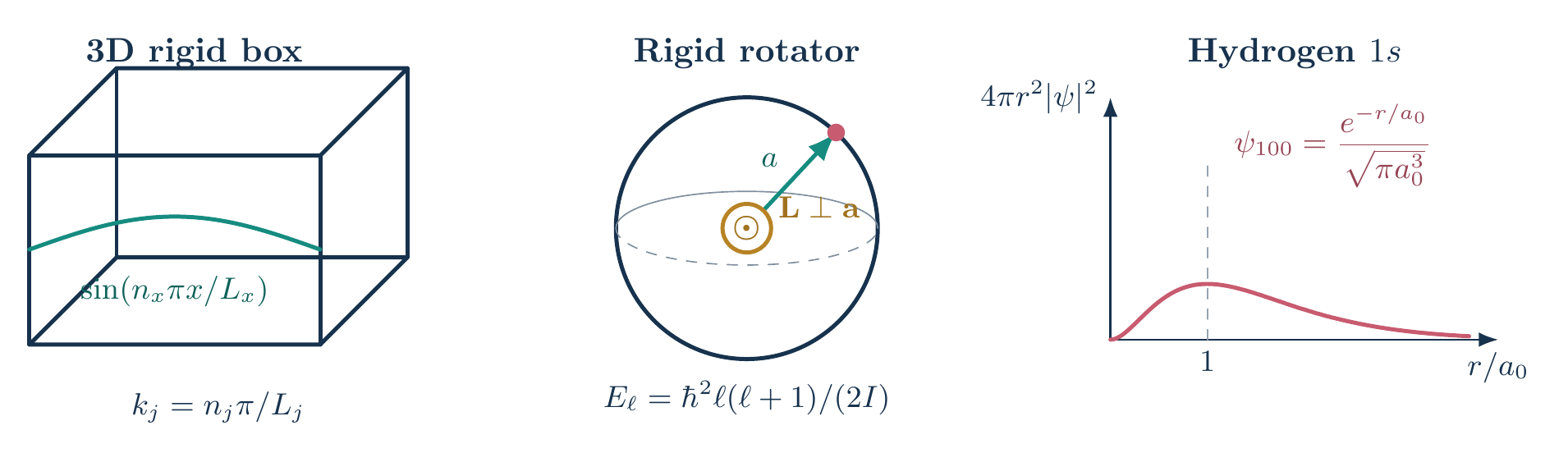
The editable TikZ source generates the figure. Plane-wave, box, rotator, hydrogen eigenvalue, and hydrogen normalization residuals are checked in the Maxima worksheet.
Solved Problems
1. Energy and degeneracy in a cubic quantum box
An electron is confined to a cubic rigid box of side $L=0.500\ \mathrm{nm}$. Find the energy and spatial degeneracy of the state labelled $(n_x,n_y,n_z)=(1,1,2)$.
Solution. For a cube,
\[E_{n_xn_yn_z} =\frac{\pi^2\hbar^2}{2m_eL^2} \left(n_x^2+n_y^2+n_z^2\right).\]Here the positive integer sum is
\[1^2+1^2+2^2=6,\]while the one-unit energy scale is
\[\frac{\pi^2\hbar^2}{2m_eL^2} =1.5041\ \mathrm{eV}.\]Therefore
\[\boxed{E_{112}=6(1.5041)=9.025\ \mathrm{eV}}.\]The distinct permutations $(1,1,2)$, $(1,2,1)$, and $(2,1,1)$ have the same energy, so the spatial degeneracy is
\[\boxed{g=3}.\]The energy is positive because an infinite box has zero interior potential and nonzero confinement kinetic energy. The factor $\hbar^2/(mL^2)$ has energy units. As $L\to\infty$, this energy and the separation between neighbouring box levels tend to zero.
2. Rotational energy spacing and characteristic frequency
A rigid rotator has moment of inertia $I=1.50\times10^{-46}\ \mathrm{kg\,m^2}$. Find the energy and degeneracy of its $\ell=2$ level, then express the energy spacing between the $\ell=2$ and $\ell=1$ levels as a frequency.
Solution. The level energy is
\[E_\ell=\frac{\hbar^2}{2I}\ell(\ell+1).\]For $\ell=2$,
\[\boxed{E_2=\frac{3\hbar^2}{I} =1.388\times10^{-3}\ \mathrm{eV}},\]and the allowed $m_\ell=-2,-1,0,1,2$ give
\[\boxed{g_2=2\ell+1=5}.\]The positive spacing between the two levels is
\[\begin{aligned} \Delta E &=E_2-E_1\\ &=\frac{\hbar^2}{2I}[6-2] =\frac{2\hbar^2}{I} =9.255\times10^{-4}\ \mathrm{eV}. \end{aligned}\]Thus
\[\boxed{\nu=\frac{\Delta E}{h} =2.24\times10^{11}\ \mathrm{Hz}}.\]Since $I$ has units $\mathrm{kg\,m^2}$, $\hbar^2/I$ has energy units. The frequency is simply the positive level spacing divided by Planck’s constant; it characterizes the $\ell=2$ to $\ell=1$ separation without adding assumptions about a particular interaction. At $\ell=0$, the rotational energy is zero; as $I\to\infty$, all rotational spacings collapse toward zero.
Descriptive Questions
- Why is the spectrum continuous for a three-dimensional free particle but discrete when rigid boundaries are imposed?
- Derive the rectangular-box eigenfunctions and explain how equal side lengths create degeneracies through quantum-number permutations.
- How do single-valuedness in $\phi$ and regularity at the polar axes quantize $m_\ell$ and $\ell$ for a rigid rotator?
- Why does the hydrogen ground-state exponential determine both the Bohr radius and the negative binding energy when substituted into the radial Schrödinger equation?
Numerical Problems
- Find the kinetic energy of a free electron with wave-number magnitude $5.00\times10^9\ \mathrm{m^{-1}}$.
Final answer: $\boxed{E=\hbar^2k^2/(2m_e)=0.9525\ \mathrm{eV}}$. - Find the ground-state energy of an electron in a cubic box of side $1.00\ \mathrm{nm}$.
Final answer: $\boxed{E_{111}=1.128\ \mathrm{eV}}$. - For hydrogen in its ground state, find the probability of locating the electron within one Bohr radius.
Final answer: $\boxed{P(r<a_0)=1-5e^{-2}=0.3233}$.
The original three-dimensional eigenvalue identities are checked in the topic worksheet linked above. Every added box, rotator, and hydrogen probability value is checked in the MJ-11 problem-verification worksheet; every printed residual and check is zero.


Discussion